



Security Theater vs. Real PCI Compliance


Join thousands of professionals and get the latest insight on Compliance & Cybersecurity.
You've just spent months preparing for your PCI compliance assessment. Your team has worked tirelessly to document processes, implement controls, and ready themselves for the QSA's arrival. When the assessment concludes, you receive that coveted Attestation of Compliance (AOC). Mission accomplished, right?
Not so fast.
For many organizations, PCI compliance has devolved into what security expert Bruce Schneier famously termed "security theater" – elaborate performances that provide the illusion of security without delivering actual protection. While you may have checked all the right boxes to satisfy an auditor, the question remains: Are you truly securing cardholder data, or are you just putting on a show?
Defining the Terms: Are You Performing or Protecting?
Security Theater: The Illusion of Compliance
Security theater describes security measures that make people feel safer without meaningfully improving security. In the PCI compliance world, this manifests as what security professionals sometimes call "cargo cult security" – where organizations mimic security practices without understanding the principles that make them effective.
Common examples include:
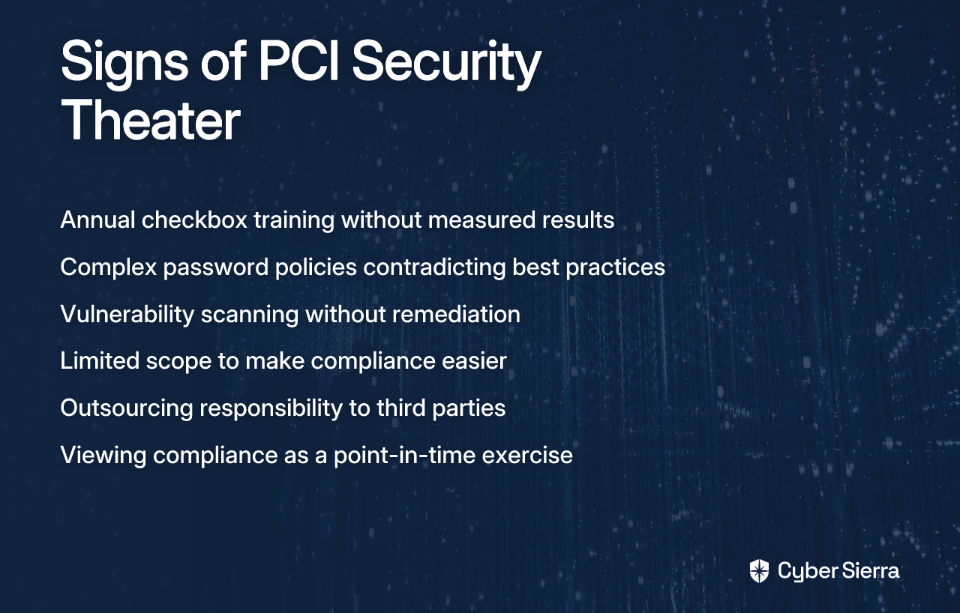
- Annual Checkbox Training: Requiring employees to click through generic security awareness modules once a year. They complete it just to make it go away, yet 88% of data breaches are still caused by human error.
- Overly Complex Password Policies: Mandating frequent password changes with complex requirements, which often leads to employees writing passwords down – defeating the original purpose. This contradicts NIST's current recommendations for longer, more memorable passphrases.
- Superficial Vulnerability Scanning: Running automated scans without meaningful remediation or contextual understanding of the risks identified.
Real PCI Compliance: Beyond the Checklist
Genuine PCI compliance isn't about satisfying 12 requirements for an annual assessment – it's about embracing the intent behind those requirements. It means building a continuous, risk-based security program that genuinely protects cardholder data.
The PCI Data Security Standard (PCI DSS) includes 12 key requirements, 78 base requirements, and over 400 test procedures. But checking these boxes alone doesn't ensure security.
Real compliance means these controls are living, breathing parts of your security operations – not just items on an annual checklist.
The High Cost of Performance: Pitfalls of PCI Security Theater
The Scoping Trap: "They want the connectivity. But don't want the scope."
One of the most common pitfalls is misunderstanding what systems should be in scope for PCI compliance. As one QSA noted in a Reddit discussion, many organizations are "conflating 'in scope' and 'CDE' where more and more systems are wrongly brought into scope though proven to be unable to connect with the CDE."
The reality is more straightforward: if a system can establish a connection to the Cardholder Data Environment (CDE), it's probably in scope. And if it can connect to something that can establish a connection, it's also in scope.
Security theater manifests when organizations arbitrarily limit their scope to make compliance easier, rather than accurately reflecting their actual environment. This leaves dangerous blind spots, as illustrated by a QSA who discovered that "the QSAC before us for sure just passed the client with flying colors, even though... they missed a huge scoping issue -- left out the VoIP and call recording scope."
Effective network segmentation is critical for properly defining and reducing scope, but it must be done with genuine security in mind – not just to make the compliance process easier.
The Third-Party Fallacy: Shifting Risk vs. Managing Risk
Another common form of security theater is assuming that using third-party service providers absolves you of responsibility for PCI compliance. As one Reddit user observed, some clients believe "shifting all associated risk to the third party was acceptable" for services like call recording solutions.
This misunderstanding can be costly. While you can outsource functions, you cannot outsource accountability. The PCI Security Standards Council holds merchants responsible for ensuring all third parties that access, process, store, or transmit cardholder data maintain proper security.
Real compliance involves thorough vendor management programs, including:
- Rigorous due diligence before engagement
- Clear contractual requirements for security
- Regular monitoring and assessment of third-party controls
- Verification that service providers maintain their own PCI compliance

The Annual Audit Blind Spot
Perhaps the most dangerous form of security theater is viewing PCI compliance as a point-in-time exercise, where the annual QSA assessment is the finish line rather than a checkpoint in an ongoing process.
In reality, PCI DSS requires continuous monitoring and testing. A security program focused on real protection embraces:
- Regular internal vulnerability scanning (beyond the quarterly requirement)
- Penetration testing that simulates real-world attacks
- Continuous monitoring of critical security controls
- Prompt remediation of identified issues
The Unethical Assessor Problem
An uncomfortable truth in the PCI compliance world is the existence of what one Reddit commenter called "unethical QSAs." With Level 1 merchant assessment contracts worth "$20-30k US per year," there can be financial pressure to cut corners.
Red flags include QSAs who:
- Issue reports with questionable document dating (one Reddit user reported seeing "an AOC that had a report date six months before the QSA signature, and that signature being an entire year previous to the entity signature date")
- Act as adversaries rather than collaborators
- Overlook significant issues that might jeopardize their contract renewal
As the Reddit community bluntly put it: "To all the unethical QSAs, we see you!"
From Checklist to Culture: Building a Framework for Real Security
Embrace PCI DSS v4.0: The Shift to Risk Management
PCI DSS version 4.0 represents a fundamental shift from a purely prescriptive approach to one that incorporates risk-based methodologies. This is a perfect opportunity to move beyond security theater toward real security.
Key changes include:
- Customized Approach: Organizations can design and implement custom controls as long as they support them with "a documented, targeted risk analysis" that proves the control meets the security objectives.
- Focus on Outcomes: v4.0 emphasizes security outcomes rather than prescriptive controls, giving organizations more flexibility to implement security that makes sense for their specific environment.
With the compliance deadline of March 31, 2025 approaching, now is the time to prepare for this more mature approach to security.
Implement Practical, High-Impact Controls
Instead of focusing solely on compliance requirements, prioritize controls that deliver genuine security value:
- Data Minimization: The best way to protect data is not to have it. Avoid storing sensitive data whenever possible, especially CVV codes after authorization.
- Advanced Encryption: PCI DSS v4.0 requires support for modern, secure protocols like TLS v1.2 or higher. Implement strong encryption not just to check a box but as a fundamental security layer.
- Real-Time Monitoring & Threat Detection: Move beyond periodic log reviews to implement continuous monitoring with technologies like Intrusion Detection Systems (IDS) and Security Information and Event Management (SIEM) solutions.
Adopt a Zero Trust Mindset
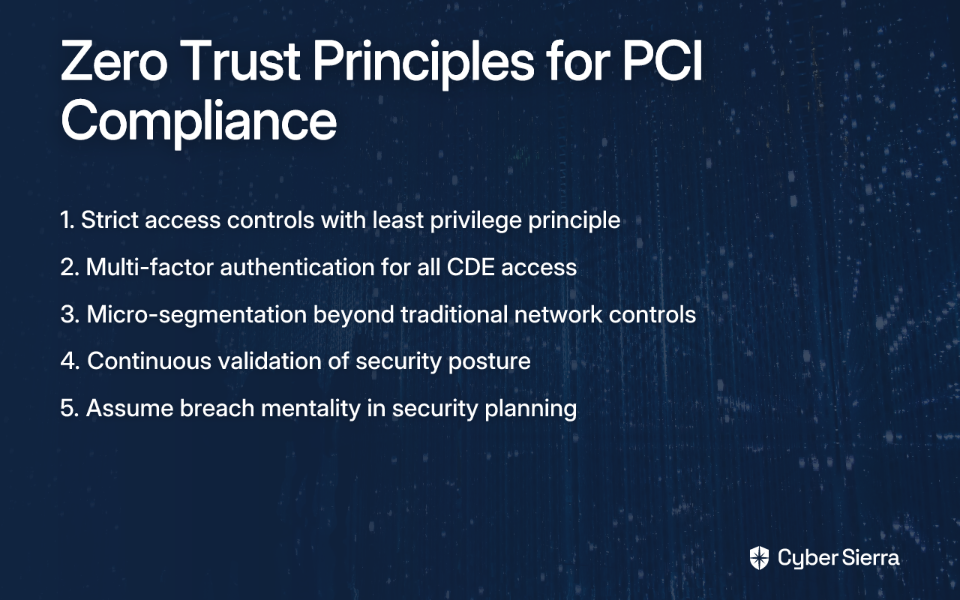
The Zero Trust security model perfectly aligns with the goals of PCI DSS by enforcing the principle of "never trust, always verify." This approach assumes no implicit trust based on network location or asset ownership.
Key Zero Trust principles for PCI compliance include:
- Strict Access Controls: Enforce the principle of least privilege for all users and systems accessing cardholder data.
- Multi-Factor Authentication (MFA): PCI DSS v4.0 mandates MFA for all access into the CDE, recognizing that passwords alone are insufficient.
- Micro-segmentation: Implement more granular network controls beyond traditional segmentation to further reduce the attack surface.
Compliance as a Consequence of Good Security
The fundamental shift organizations need to make is to stop treating compliance as the goal and instead focus on building robust security programs that make compliance a natural byproduct.
When you build a security program focused on genuinely protecting cardholder data based on risk-based principles, PCI compliance becomes less of a burden and more of a validation that you're doing the right things.
This approach offers several advantages:
- Reduced Risk: You're protected against threats, not just compliant with requirements.
- Lower Compliance Costs: When security is embedded in your operations, preparing for assessments requires less special effort.
- Competitive Advantage: Genuine security becomes a business differentiator in a world where data breaches can cost millions and damage customer trust.
The Path Forward: From Theater to Reality
As Bruce Schneier noted, "Security theater provides the feeling of security instead of the reality." For organizations serious about protecting cardholder data, it's time to remove the costumes, exit the stage, and implement security measures that genuinely work.
The new flexibility in PCI DSS v4.0 provides an ideal opportunity to build a defensible security posture that truly protects your customers and your brand. The choice is yours: Will your security program be a shield or just a show?
Ask yourself: Is your organization performing security theater, or are you genuinely protecting cardholder data? Your customers' sensitive information – and ultimately your business – depend on the answer.

Frequently Asked Questions
What is PCI security theater?
PCI security theater refers to implementing security measures that create the illusion of compliance and safety without genuinely protecting cardholder data. It's about "checking the box" on requirements, like having generic annual security training or running vulnerability scans without proper remediation. These actions satisfy an auditor but often fail to address the underlying risks, leaving an organization vulnerable despite having an Attestation of Compliance (AOC).
How is "real" PCI compliance different from just checking boxes?
Real PCI compliance is a continuous process of risk management integrated into daily operations, whereas a checkbox approach treats compliance as a once-a-year event to pass an audit. Genuine compliance means embracing the intent behind the 12 PCI DSS requirements. It involves continuous monitoring, regular testing that simulates real attacks, and building a security culture where protecting data is a priority every day, not just during assessment season.
Why is network scoping so important for PCI DSS?
Proper network scoping is critical because it defines which systems and networks are subject to PCI DSS controls. Incorrect scoping can leave parts of your environment that handle cardholder data unprotected and non-compliant. A common mistake is to arbitrarily limit the scope to make the audit easier, creating dangerous blind spots. Any system that can connect to the Cardholder Data Environment (CDE) is considered in scope.
Who is responsible for PCI compliance when using a third-party provider?
Your organization remains fully responsible and accountable for PCI compliance, even when using a third-party service provider to handle cardholder data. While you can outsource functions, you cannot outsource accountability. Merchants are required to perform thorough due diligence, have clear contractual security requirements, and continuously monitor their providers to ensure they also maintain PCI compliance.
What is the biggest change in PCI DSS v4.0?
The biggest change in PCI DSS v4.0 is the shift from a rigid, prescriptive approach to a more flexible, risk-based model that focuses on security outcomes. Version 4.0 introduces the "Customized Approach," allowing organizations to implement controls best suited for their environment, as long as they can justify them with a targeted risk analysis. This encourages building genuine security programs tailored to specific risks rather than following a universal checklist.
How can an organization move beyond a "checklist" mentality?
An organization can move beyond a checklist mentality by adopting a security-first culture, prioritizing high-impact controls, and implementing a Zero Trust security model. This involves practical steps like data minimization (not storing data you don't need), implementing strong encryption and multi-factor authentication (MFA), and using real-time monitoring. By making security a core business function, compliance becomes a natural byproduct rather than the primary goal.
Note: This article is not intended as legal advice. Organizations should consult with qualified security professionals and QSAs for specific guidance on PCI DSS compliance.
