Cut Down on CVE Alerts: The Role of Reachability Analysis



Join thousands of professionals and get the latest insight on Compliance & Cybersecurity.
You've just received another urgent notification from your vulnerability scanner. Another day, another critical CVE with a CVSS score of 9.8. Your team jumps into action, dropping everything to investigate and patch what appears to be a Remote Code Execution (RCE) vulnerability that could compromise your entire infrastructure.
Four hours later, you discover that while the vulnerable code exists in your codebase, it's in a dependency that your application never actually calls. There's no executable path to reach it. The "critical emergency" was never a real threat at all.
Sound familiar?
Your security team just wasted half a day chasing a ghost while actual exploitable vulnerabilities remained unaddressed. This isn't just frustrating—it's the norm for security teams drowning in alerts from scanning tools.
"Our team's drowning in CVEs from SCA and CSPM tools. Half of them are in packages we don't even use, or in code paths that never get called. We're wasting hours triaging stuff that doesn't actually pose a risk," laments one security professional on a recent Reddit thread.
The problem isn't that your vulnerability scanners are broken. It's that they're missing a crucial capability: reachability analysis.
What is Reachability Analysis? Moving Beyond the CVE Count
Reachability analysis is a critical technique in application security that evaluates whether a specific part of your application can actually invoke a vulnerable piece of code. Put simply, it's the difference between vulnerable code and an exploitable vulnerability.
Traditional vulnerability management approaches rely heavily on Common Vulnerability Scoring System (CVSS) scores to prioritize remediation efforts. But as many security professionals have discovered, "CVSS scores are basically useless because a 'critical' vuln that's not reachable is way less important than a 'medium' one that's actively being hit by traffic."
The core principle of reachability analysis is straightforward: If there is no executable path from an application's entry point to a vulnerable function in a library, that vulnerability poses no immediate threat to the application.
This approach transforms how we think about vulnerability management:
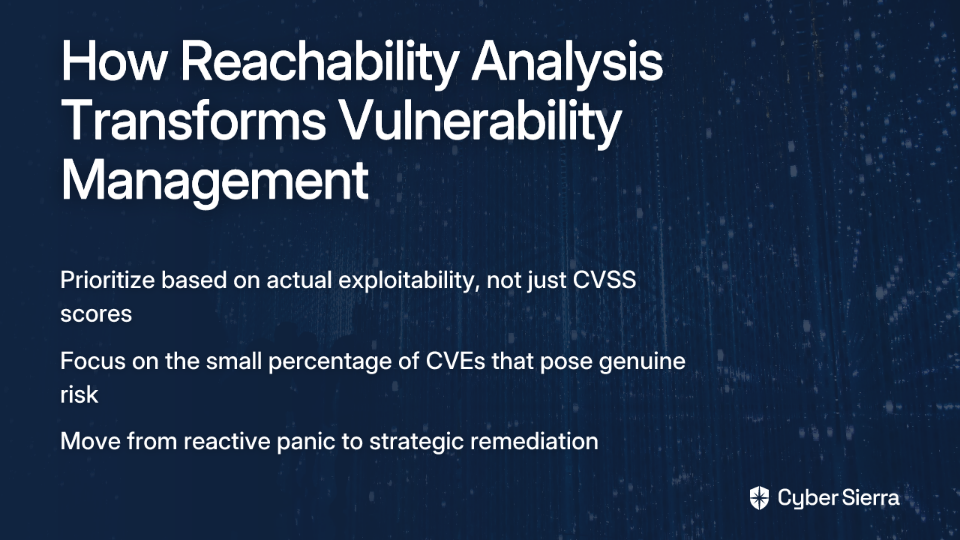
- Instead of handling vulnerabilities based solely on their CVSS severity, we prioritize based on actual exploitability
- Rather than drowning in an endless sea of CVEs, we focus on the small percentage that represent genuine risk
- Teams move from reactive panic to strategic remediation
As application complexity grows with microservices architectures and extensive third-party dependencies, reachability analysis becomes not just helpful but essential for effective security operations.
How Reachability Analysis Works: A Step-by-Step Process
Implementing reachability analysis isn't magic—it's a methodical process that combines several security analysis techniques. Here's how it works:
Step 1: Initial Vulnerability Identification (The Baseline)
The process begins with standard security scanning using tools for Static Application Security Testing (SAST) or Software Composition Analysis (SCA). These scans identify all known vulnerabilities in your codebase and its third-party dependencies, creating a baseline inventory of potential issues.
Tools like Tenable, Checkmarx, or Snyk typically generate this initial list of CVEs, often integrated into your CI/CD pipeline.
Step 2: Code Context and Data Flow Analysis (Mapping the Paths)
Once you have your list of potential vulnerabilities, reachability analysis maps which code segments are actually called at runtime:
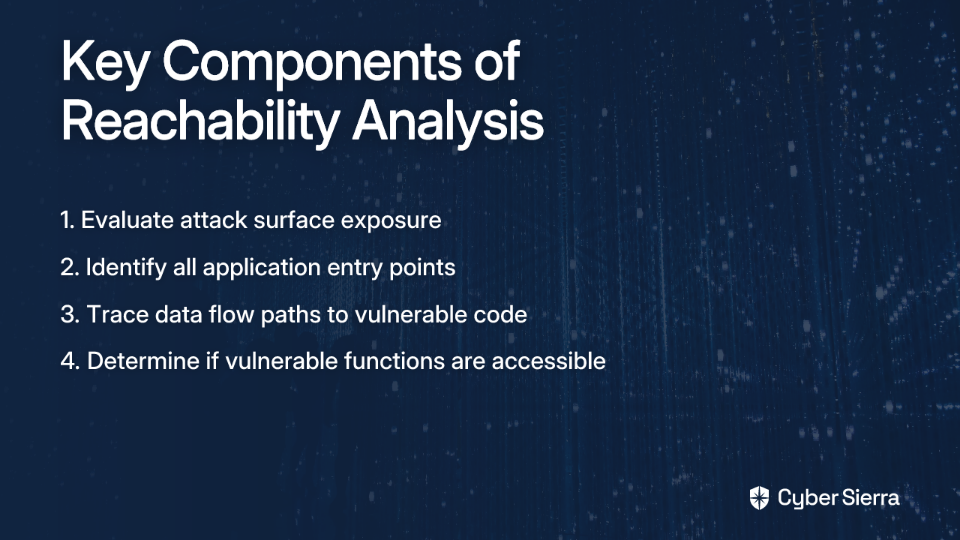
- Evaluation of Attack Surface: Identify which components are exposed to potential attackers
- Identify Entry Points: Pinpoint all avenues where data enters your application (user inputs, APIs, file uploads, etc.)
- Trace Data Paths: Perform data flow analysis to trace how information moves from entry points to potentially vulnerable code
This step determines if a theoretically vulnerable function is even accessible from the outside world.
Step 3: Execution and Exploit Path Analysis (Is it Live?)
Next, the analysis examines the application's control flow (e.g., if statements, loops, function calls) to determine the conditions under which the vulnerable code can be executed:
- Are there barriers that prevent exploitation, such as input validation or sanitization?
- Is the vulnerable code behind feature flags that disable it entirely?
- Does the vulnerable function require authentication or specific permissions to access?
Step 4: Reporting and Prioritization (Actionable Insights)
The final output isn't just another list of CVEs to be uploaded to ServiceNow tickets. Instead, it's a report that categorizes vulnerabilities into:
- Reachable: Vulnerabilities with a clear path to exploitation that should be prioritized
- Unreachable: Vulnerabilities that exist in your code but have no practical way to be exploited
This prioritized list gives developers clear, actionable feedback focused on genuine risks rather than theoretical problems.
Key Techniques and Types of Reachability Analysis
Different techniques offer varying levels of precision and coverage. Understanding these approaches helps you select the right tools for your environment.
Static vs. Dynamic Analysis
Static Reachability Analysis examines the codebase without executing it. It's excellent for shift-left security, catching issues early in development. However, it lacks runtime context and may miss dynamic behaviors or overestimate risk.
Dynamic Reachability Analysis evaluates the application while it is running using runtime monitoring and instrumentation. This provides highly accurate insights into actual runtime behavior and significantly reduces false positives. The tradeoff is potential performance overhead during testing.
Levels of Granularity
Different approaches to reachability analysis provide varying levels of detail:
- Function-Level Reachability: Determines if a specific vulnerable function within a third-party library is ever called by the application
- Dependency-Level Reachability: A simpler check to see if a vulnerable package is imported or included in the application's build at all
- Container Reachability: In containerized environments, analyzes whether a running application inside a container actually utilizes a vulnerable package included in the base image
- Internet Reachability: Prioritizes vulnerabilities in components that are directly or indirectly exposed to the internet, similar to how AWS Reachability Analyzer tests network connectivity paths
The Tangible Business and Security Benefits
The impact of implementing reachability analysis extends far beyond technical improvements:
Drastic Reduction in Noise and Wasted Effort
The headline statistic is staggering: reachability analysis can reduce alerts by up to 90-95%. Security practitioners report, "We've seen 60-70% of CVEs drop off once call paths and runtime usage are mapped."
Imagine what your team could accomplish if they could focus on the 10% of vulnerabilities that actually matter instead of drowning in alert fatigue from hundreds of irrelevant notifications.
Massive Cost and Time Efficiency
Automated reachability analysis can reduce the time spent on manual triage by 80-90%, translating to savings of up to 70% on labor costs associated with vulnerability management. For organizations spending hundreds of thousands on security analyst time, these savings are substantial.
Intelligent Prioritization Beyond CVSS
Reachability provides the context needed for true risk-based prioritization. When combined with other modern metrics like the Exploit Prediction Scoring System (EPSS), which estimates the likelihood of exploitation in the wild, you get a comprehensive risk assessment that far surpasses traditional CVSS-based approaches.
Fosters DevSecOps Collaboration
Instead of overwhelming developers with a huge list of low-context alerts, security teams can provide a short, high-confidence list of real issues. This builds trust between teams and speeds up remediation cycles, creating a more collaborative security culture.
Best Practices for Implementing Reachability Analysis
Ready to transform your vulnerability management approach? Here are key practices to ensure success:
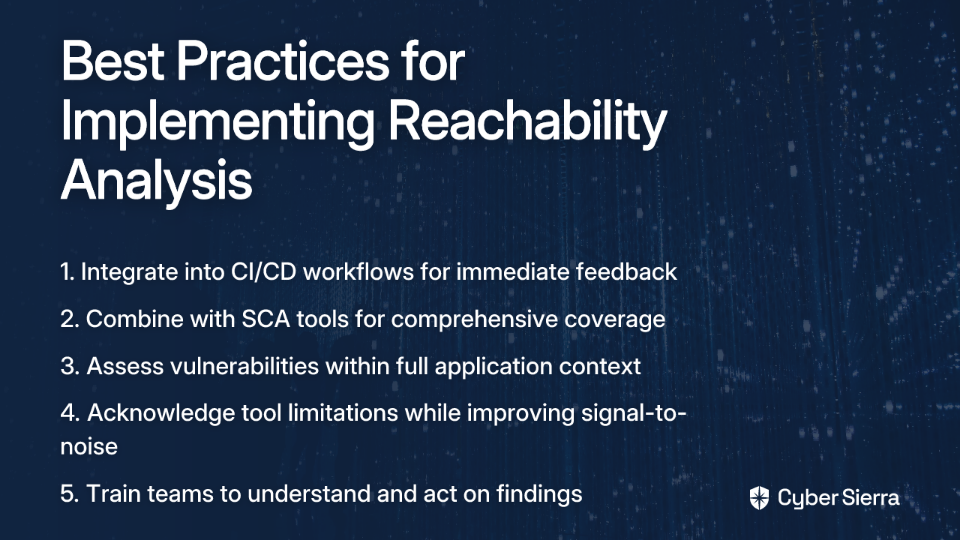
- Integrate into the Development Lifecycle: Don't treat reachability analysis as a separate, post-deployment step. Integrate it directly into CI/CD workflows to shift-left and provide developers with immediate feedback.
- Combine with Software Composition Analysis (SCA): SCA tools are excellent at identifying what dependencies you have and their known vulnerabilities. Reachability analysis is the layer on top that tells you if those vulnerabilities actually matter in your context.
- Understand the Context: Assess vulnerabilities within the complete application architecture, including user input flows and data paths. Context is everything when determining exploitability.
- Acknowledge Limitations: Be transparent about the limitations. No tool is perfect, and most use a single heuristic approach that can lead to some false positives or negatives. The goal isn't absolute certainty but a dramatic improvement in signal-to-noise ratio.
- Foster Team Training and Collaboration: Ensure development, security, and operations teams understand what reachability analysis shows and how to act on its findings.
Stop Chasing Ghosts, Start Fixing Risks
Traditional vulnerability management is drowning teams in a sea of low-context alerts, creating alert fatigue and obscuring real threats. We simply cannot continue treating every CVE as equally important when the vast majority pose no actual risk to our systems.
Reachability analysis provides the necessary context to filter out the noise, allowing teams to focus on the small percentage of vulnerabilities that are actually exploitable. It's time to evolve from simply identifying CVEs to understanding true risk.
By adopting reachability analysis, you can stop wasting time on theoretical problems and dedicate your resources to securing the attack paths that matter. In a world where exploitation is becoming more sophisticated and security teams more stretched, this isn't just a nice-to-have—it's essential for effective security operations.
Frequently Asked Questions (FAQ)
What is reachability analysis in application security?
Reachability analysis is a security technique that determines if a vulnerable piece of code within your application can actually be executed or "reached" by a potential attacker. It moves beyond simply identifying the presence of a known vulnerability (CVE) and instead maps the execution paths from an application's entry points (like an API or user input field) to the vulnerable code. If no path exists, the vulnerability is considered unreachable and poses no immediate risk.
How is reachability analysis different from prioritizing with CVSS scores?
Reachability analysis prioritizes vulnerabilities based on their actual exploitability in your specific application, whereas CVSS scores provide a generic severity rating that doesn't account for your application's context. A vulnerability with a "critical" 9.8 CVSS score might be located in a code library that your application never calls, making it an unreachable, low-risk issue. Conversely, a "medium" CVSS vulnerability that is reachable is a much higher priority. Reachability provides the context that CVSS lacks.
Why is a high-severity CVE not always a real threat?
A high-severity CVE is not always a real threat because the vulnerable code might not be accessible or executable within your application's environment. For a vulnerability to be a genuine threat, an attacker needs a viable path to exploit it. Many CVEs are found in large, multi-purpose libraries, but your application may only use a small, non-vulnerable part of that library. If there's no executable path from your code to the vulnerable function, the CVE represents a theoretical risk, not an actual one.
What are the main benefits of implementing reachability analysis?
The primary benefits of reachability analysis are a massive reduction in alert noise, improved prioritization of real risks, significant time and cost savings, and better collaboration between development and security teams. By filtering out unreachable vulnerabilities, teams can reduce alerts by up to 95%, allowing them to stop chasing false positives. This focus on genuine risks means faster remediation of what truly matters and a more efficient DevSecOps workflow.
Can reachability analysis replace my existing SAST or SCA tools?
No, reachability analysis does not replace SAST (Static Application Security Testing) or SCA (Software Composition Analysis) tools; it is a complementary technology that enhances them. SAST and SCA tools are essential for discovering potential vulnerabilities and creating an inventory of dependencies. Reachability analysis then adds a critical layer of contextual intelligence on top of that data to determine which of the vulnerabilities found are actually exploitable.
How can I get started with reachability analysis?
To get started, you should look for modern security tools that integrate reachability analysis directly into their scanning capabilities and embed them within your CI/CD pipeline. Begin by integrating a tool that combines SCA with reachability analysis into your development lifecycle for immediate feedback. Train your teams to understand the outputs so they can act on the prioritized, high-confidence results.