



10 Proven Cyber Risk Reduction Strategies for Enterprises in 2026


Join thousands of professionals and get the latest insight on Compliance & Cybersecurity.
Summary
- With the average data breach cost projected to hit $5.85 million by 2026, enterprises must move beyond performative security to achieve tangible risk reduction.
- Transition from periodic, manual audits to a proactive posture by implementing continuous control monitoring (CCM) and automating GRC processes.
- Key strategies include implementing robust third-party risk management (TPRM), leveraging threat intelligence, and building a "human firewall" through ongoing employee training.
- Unify these efforts with an integrated platform like Cyber Sierra, which automates compliance and risk management to build a truly resilient enterprise.
In today's rapidly evolving threat landscape, the financial impact of cyber breaches continues to escalate at an alarming rate. By 2026, the average cost of a data breach is projected to reach a staggering $5.85 million - a 10% year-over-year increase that should concern every enterprise security leader. This rising financial toll doesn't even account for the devastating impacts on brand reputation, customer trust, and operational continuity.
Simultaneously, the compliance landscape has become increasingly complex. Organizations must navigate a maze of frameworks like NIST, ISO 27001, GDPR, PCI-DSS, and more, each with its own requirements and controls. For many enterprises, compliance has become a full-time job that feels separate from actual security.
If you're struggling to build a cyber risk program that's more than just "on paper," you're not alone. Many cybersecurity professionals share this frustration - they want programs with "issues that actually get fixed — not just logged" and "dashboards that inform decisions, not just decorate reports." The gap between performative security and a genuine, effective cyber risk reduction strategy has never been wider.
This guide focuses on transforming your approach from periodic, manual assessments to a continuous, automated, and proactive cybersecurity posture that becomes "part of the normal conversation and doing business." Let's explore ten proven strategies that will help you achieve tangible outcomes in your cyber risk reduction efforts.
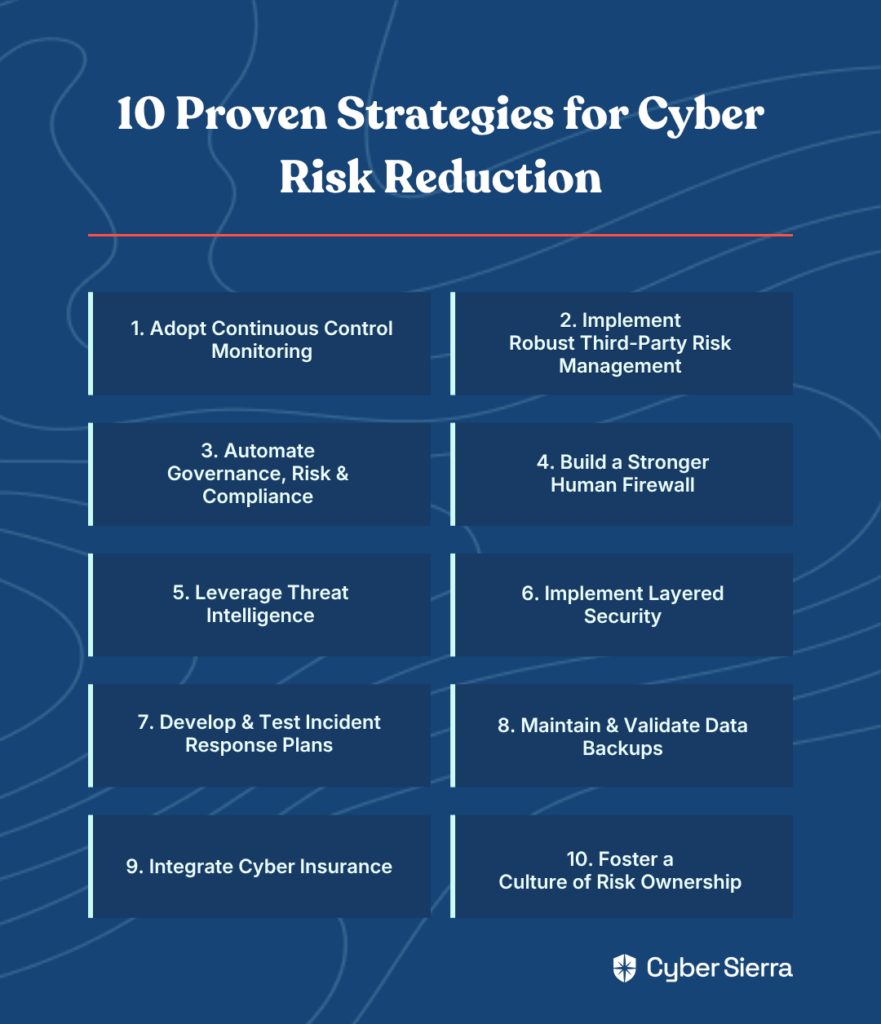
1. Adopt Continuous Control Monitoring (CCM)
Point-in-time assessments and annual audits are no longer sufficient in today's dynamic threat environment. Continuous Control Monitoring transforms security from a periodic checkbox exercise into a proactive, real-time discipline.
Implementation Steps:
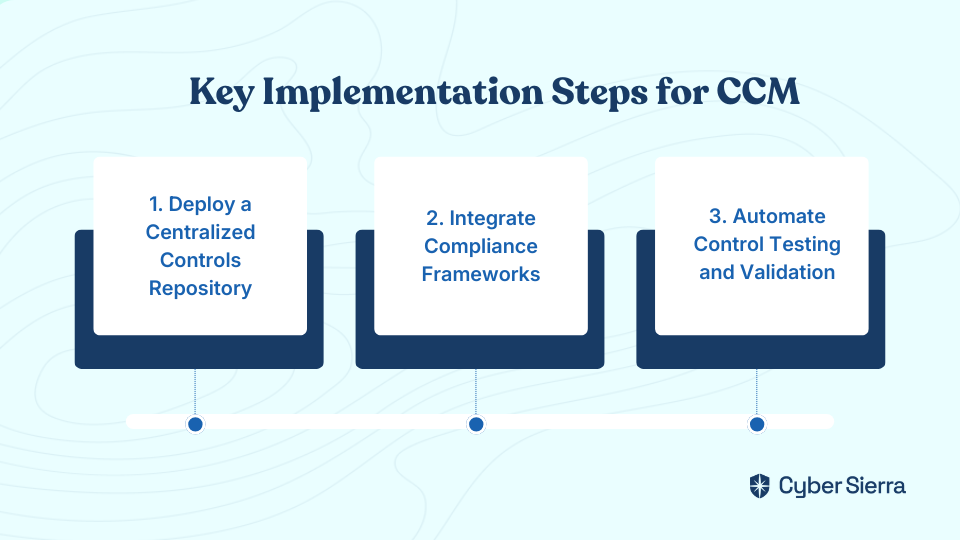
- Deploy a Centralized Controls Repository: Build a single source of truth for all security controls with near real-time updates. This eliminates manual evidence gathering for multiple frameworks.
- Integrate Compliance Frameworks: Map controls across multiple standards like NIST, ISO 27001, PCI DSS, and SOC 2 within a single platform.
- Automate Control Testing and Validation: Use automated tools to continuously test controls, detect exceptions, and generate alerts for anomalies in real-time.
Metrics for Success:
- Reduction in time and resources spent on manual audit preparation
- Decrease in control failures and compliance exceptions
- Improved real-time visibility score of your security posture
Cyber Sierra's Continuous Control Monitoring (CCM) platform provides this ongoing visibility, helping CISOs and compliance managers move from reactive to proactive risk management. The platform centralizes control repositories, provides actionable risk intelligence, and automates evidence collection across multiple compliance frameworks.
2. Implement a Robust Third-Party Risk Management (TPRM) Program
Your security is only as strong as your weakest vendor. A single breach in your supply chain can be catastrophic, making a structured TPRM program non-negotiable for effective cyber risk reduction.
Implementation Steps:
- Maintain an Accurate Third-Party Inventory: Keep a complete, up-to-date inventory of all vendors and classify them based on their criticality and access to sensitive data.
- Automate Vendor Assessments: Replace manual questionnaires with automated assessment workflows to streamline due diligence, onboarding, and periodic reviews.
- Combine Assessments with Continuous Monitoring: Use tools that provide near real-time, 24/7 visibility into a vendor's security posture, going beyond static, point-in-time assessments.
Metrics for Success:
- Reduced time-to-onboard for new vendors
- Decrease in security incidents originating from third parties
- Percentage of critical vendors under continuous monitoring
Solutions like Cyber Sierra's TPRM platform simplify this entire lifecycle, from onboarding to continuous monitoring, ensuring your supply chain doesn't become your biggest vulnerability.
3. Automate Governance, Risk & Compliance (GRC)
Managing multiple compliance requirements manually leads to "audit fatigue" and human error. Automating GRC processes streamlines data collection, risk assessments, and reporting, making your organization audit-ready at all times.
Implementation Steps:
- Centralize GRC Activities: Use a unified platform to manage policies, risks, controls, and audits across the organization.
- Automate Data Collection: Connect your GRC tool to your tech stack (cloud providers, identity providers, etc.) to automatically gather evidence for control validation.
- Generate Comprehensive Reports: Use automated reporting features to create detailed audit trails and dashboards for stakeholders, demonstrating compliance and risk posture clearly.
Metrics for Success:
- Reduction in audit preparation time and costs
- Faster turnaround time for risk assessments
- Improved consistency and accuracy in compliance reporting
Cyber Sierra's GRC module helps you manage multiple frameworks like SOC 2, ISO 27001, and HIPAA without the manual overhead, automating data collection and maintaining detailed audit trails.
4. Build a Stronger Human Firewall with Continuous Security Training
Human error remains a leading cause of security breaches. Empowering employees to be the first line of defense through ongoing training is one of the most cost-effective cyber risk reduction strategies.
Implementation Steps:
- Implement Interactive Training Modules: Go beyond annual slideshows. Use engaging, interactive modules covering topics like password hygiene, email safety, and identifying social engineering.
- Run Regular, Simulated Phishing Campaigns: Test employee awareness with realistic phishing simulations and provide immediate feedback and training to those who click.
- Track Security Quotient: Use a dashboard to get an overview of your employees' security awareness levels and identify areas needing improvement.
Metrics for Success:
- Reduction in click-rates on phishing simulations over time
- Decrease in security incidents attributed to human error
- Increase in employee-reported suspicious emails
With Cyber Sierra's Employee Security Training, you can foster a security-conscious culture through continuous learning and real-world simulations that strengthen your human firewall.
5. Leverage Threat Intelligence and Proactive Vulnerability Management
Don't wait for attackers to find your weaknesses. Proactively identify and remediate vulnerabilities across your attack surface by combining threat intelligence with a risk-based approach to patch management.
Implementation Steps:
- Adopt a Risk-Based Approach: Prioritize patching vulnerabilities based not just on CVSS scores, but on their exploitability and potential business impact.
- Conduct Continuous Scanning: Implement regular, automated vulnerability scanning for your network and cloud infrastructure to identify misconfigurations and exposures.
- Utilize Threat Intelligence Feeds: Subscribe to actionable threat intelligence to understand attacker TTPs (Tactics, Techniques, and Procedures) and hunt for threats proactively.
Metrics for Success:
- Reduction in the average time-to-remediate critical vulnerabilities
- Decrease in the overall organizational attack surface
- Improved security scorecard ratings
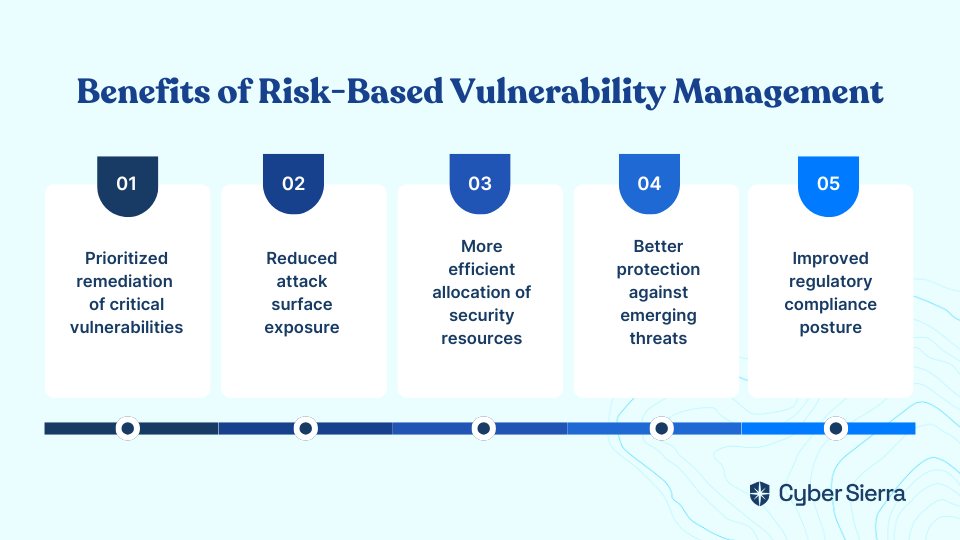
Cyber Sierra's Threat Intelligence platform offers an outside-in scanning approach to give you a comprehensive view of your posture and help prioritize remediation efforts.
6. Implement Layered Security (Defense-in-Depth)
There is no single silver-bullet solution for cyber risk reduction. A defense-in-depth strategy relies on multiple, overlapping security controls so that if one layer fails, another is there to stop an attack.
Implementation Steps:
- Combine Network and Endpoint Security: Use a mix of firewalls, network segmentation, and modern Endpoint Detection and Response (EDR) solutions.
- Enforce Strong Access Controls: Implement the principle of least privilege, ensuring users only have access to the data and systems necessary for their roles. Use Just-in-Time (JIT) access where possible.
- Mandate Multi-Factor Authentication (MFA): Enforce MFA across all critical systems, applications, and remote access points.
Metrics for Success:
- Reduction in successful lateral movement by attackers during security tests
- Number of critical assets protected by MFA
- Decrease in incidents related to compromised credentials
7. Develop and Regularly Test Your Incident Response (IR) Plan
It's not a matter of if a breach will occur, but when. A well-documented and frequently tested IR plan is crucial to minimizing the damage and ensuring a swift recovery.
Implementation Steps:
- Document a Formal IR Plan: Define roles, responsibilities, communication channels, and procedures for containment, eradication, and recovery.
- Conduct Tabletop Exercises: Regularly run simulation exercises with key stakeholders to test the plan's effectiveness and identify gaps without the pressure of a real incident.
- Perform Red Team Engagements: Hire ethical hackers to simulate a real-world attack to test your defenses and response capabilities under pressure.
Metrics for Success:
- Reduced Mean Time to Detect (MTTD) and Mean Time to Respond (MTTR) for incidents
- Improved performance and decision-making during tabletop exercises
- Faster resolution of incidents and reduced business impact
8. Maintain and Validate Data Backups
In the age of ransomware, reliable backups are your last line of defense. They are essential for business continuity and can be the deciding factor between a minor disruption and a catastrophic failure.
Implementation Steps:
- Follow the 3-2-1 Rule: Keep at least three copies of your data, on two different media types, with one copy stored off-site (and ideally offline/immutable).
- Encrypt Your Backups: Ensure all backups are encrypted, both in transit and at rest.
- Perform Regular Recovery Drills: Don't just back up data; regularly test your ability to restore it. A backup that can't be restored is useless.
Metrics for Success:
- Success rate of data recovery tests
- Recovery Time Objective (RTO) and Recovery Point Objective (RPO) are consistently met
- Percentage of critical systems included in the backup and recovery plan
9. Integrate Cyber Insurance as a Risk Transfer Mechanism
While not a replacement for strong security controls, cyber insurance is a critical tool for transferring residual financial risk. However, obtaining and maintaining coverage requires demonstrating robust cyber hygiene.
Implementation Steps:
- Assess Coverage Needs: Work with experts to right-size your policy based on your specific risk profile and regulatory requirements.
- Demonstrate Cyber Hygiene: Use your CCM and GRC data to automate the documentation required by insurers and prove your security posture, potentially leading to better premiums.
- Streamline the Application Process: Leverage platforms that can help you meet insurer requirements and facilitate collaboration on complex application forms.
Metrics for Success:
- Alignment of insurance coverage with the organization's identified financial risks
- Reduced time and effort spent on the insurance application and renewal process
- Improved ability to meet and demonstrate compliance with insurer requirements
Cyber Sierra's Cyber Insurance module helps bridge the gap between your security posture and insurer expectations, making it easier to obtain and maintain appropriate coverage.
10. Foster a Culture of Proactive Risk Ownership
A successful cyber risk reduction program is not owned solely by the CISO or the "second line" of defense; it must be embedded in the company culture. It requires executive buy-in and clear accountability where risk management is seen as everyone's responsibility.
Implementation Steps:
- Secure Executive Sponsorship: Align the risk program with business goals to get genuine support from leadership. When leaders ask for it, it becomes real.
- Establish Clear Risk Ownership: Define roles clearly. The business ("first line") owns the risk; the security team ("second line") provides oversight and expertise. This prevents the "why should anyone else get involved?" problem.
- Integrate Risk into Business Conversations: Make risk a standard part of project planning, product development, and strategic decision-making, not a separate, feared conversation.
Metrics for Success:
- Increased engagement from business units in risk assessment processes
- Risk management discussions are a regular agenda item in leadership meetings
- Faster, risk-informed decision-making across the organization
Build a Resilient Future: From Reactive Fixes to Proactive Defense
The cybersecurity landscape of 2026 demands more than just a defensive crouch. It requires a proactive, intelligent, and continuous approach to cyber risk reduction. The strategies outlined above are not just a checklist; they represent a fundamental shift from periodic, manual efforts to an integrated, automated security ecosystem.
By embracing concepts like Continuous Control Monitoring, automated GRC, and robust TPRM, you can transform your security program from a source of stress and audit fatigue into a true business enabler. Stop wrestling with siloed solutions and endless spreadsheets that only document problems without solving them.
See how Cyber Sierra's unified AI-enabled cybersecurity platform can help you implement these proven strategies, streamline compliance, and build a truly resilient enterprise prepared for the challenges of 2026 and beyond. With the right approach to cyber risk reduction, security can become "part of the normal conversation and doing business" rather than a dreaded checkbox exercise.
Frequently Asked Questions
What is the first step to improve my organization's cyber risk reduction strategy?
The most effective first step is to adopt Continuous Control Monitoring (CCM). This approach provides real-time visibility into your security posture, moving you away from outdated point-in-time assessments. CCM forms the foundation for understanding your actual risk, allowing you to identify and prioritize the most critical security gaps before implementing other strategies.
How does Continuous Control Monitoring (CCM) differ from traditional GRC?
Continuous Control Monitoring (CCM) is a proactive, technical process that automates the real-time testing of security controls, while traditional Governance, Risk, and Compliance (GRC) is a broader framework for managing policies, risk registers, and audits. Modern cybersecurity integrates CCM into GRC, feeding it live data to make risk management a dynamic, ongoing process rather than a static, administrative one.
Why is automating third-party risk management (TPRM) so important?
Automating Third-Party Risk Management (TPRM) is crucial because manual processes cannot keep up with the scale and dynamic nature of modern supply chain risks. Manual questionnaires provide only a static, point-in-time view that quickly becomes outdated. Automation enables continuous monitoring of vendor security postures, providing real-time alerts on new vulnerabilities and ensuring your organization isn't exposed by a weak link in its supply chain.
How can I justify the investment in a unified cybersecurity platform to my board?
Frame the investment as a strategic business enabler that delivers a clear return on investment (ROI) by reducing costs, improving efficiency, and protecting revenue. Highlight tangible outcomes such as a dramatic reduction in time and resources spent on manual audits; faster, data-driven decision-making; and a stronger security posture that can serve as a competitive differentiator to win new business.
What does it mean to build a "human firewall"?
Building a "human firewall" means transforming your employees from a potential security weakness into an active line of defense through continuous and engaging security awareness training. This goes beyond annual slideshows to include regular simulated phishing attacks, interactive learning modules, and empowering staff to confidently recognize and report potential threats, significantly reducing risks from social engineering.
Is cyber insurance a substitute for implementing robust security strategies?
No, cyber insurance is a complementary risk transfer mechanism, not a substitute for strong security controls. In fact, insurers increasingly require organizations to demonstrate a high level of cyber hygiene—including practices like CCM, MFA, and vulnerability management—before offering coverage. Strong defenses prevent breaches, while insurance helps manage the financial impact if a breach still occurs.
