



Regulatory Compliance for Fintech: A Complete Guide



Join thousands of professionals and get the latest insight on Compliance & Cybersecurity.
As the fintech industry continues to revolutionize financial services with a global valuation of approximately $340 billion, regulatory compliance has become the cornerstone of sustainable growth and market credibility. For founders, CISOs, and senior leadership teams in fintech companies, navigating the complex regulatory landscape is no longer optional—it's existential.
You've likely experienced the overwhelming flood of regulatory information that seemingly changes overnight. You've felt the frustration of trying to interpret how new regulations specifically apply to your innovative products. Perhaps you've even had the disheartening experience of completing a bank integration only to have the partnership dissolved due to regulatory concerns.
This comprehensive guide cuts through the noise to provide clarity on the regulatory frameworks that govern fintech operations in the United States and the Middle East, offering practical solutions to the compliance challenges that keep you up at night.
Understanding the Regulatory Landscape
The U.S. Regulatory Framework
If you're operating in the United States, you're navigating one of the most complex regulatory environments in the world. The U.S. approach to fintech regulation is notoriously fragmented, involving multiple federal agencies and state-level requirements:

- Office of the Comptroller of the Currency (OCC): Regulates national banks and federal savings associations
- Consumer Financial Protection Bureau (CFPB): Oversees consumer financial products and services
- Securities and Exchange Commission (SEC): Regulates securities markets and investment activities
- Federal Trade Commission (FTC): Enforces consumer protection and anti-competitive practices
- State Regulatory Authorities: Issue Money Transmitter Licenses (MTLs) and other state-specific requirements
This multi-layered approach creates significant challenges. As one fintech leader noted in a recent industry forum: "The real pain is interpreting how new regs apply to our specific products." This sentiment resonates with 93% of fintech companies that report struggling with compliance requirements, according to research by Empaxis.
The Middle East: Emerging Fintech Hub
The Middle East, particularly the United Arab Emirates (UAE), is rapidly establishing itself as a global fintech hub. This growth is driven by government initiatives designed to diversify economies beyond oil and attract international investment in technology sectors.
In the UAE, fintech companies typically choose between two main regulatory jurisdictions:
- Dubai International Financial Centre (DIFC): Offers prestige and established regulatory frameworks but comes with longer processing times and higher costs
- Abu Dhabi Global Market (ADGM): Generally preferred for startups focused on fundraising, as noted by industry participants: "If you're going to fund raise, go with ADGM."
Despite the region's forward-looking approach, digital banking adoption remains relatively low, with only 17% of Middle Eastern consumers currently engaging with digital banking services. This presents both a challenge and an opportunity for fintech companies targeting this market.
Common Compliance Challenges in Fintech
Interpreting Complex Regulations
For fintech leaders, the most significant challenge is often understanding how regulations apply to specific products and services. Traditional financial regulations weren't designed with innovative technologies in mind, creating gray areas that require careful navigation.
As one fintech executive shared in a Reddit discussion: "Biggest pain point is sorting what's relevant and what's not—too much info, not enough clarity." This challenge is exacerbated when launching products that cross multiple regulatory domains, such as payment processing services that must comply with banking regulations, data privacy laws, and consumer protection requirements simultaneously.
Fragmented Information Sources
The lack of a centralized source for regulatory updates creates significant inefficiencies. Most fintech companies still rely on outdated systems to track compliance changes:
"Most firms still track regulatory changes through email alerts, newsletters, or manual checks with regulators' websites, which gets messy fast," noted a compliance officer in a recent industry forum.
This fragmentation increases the risk of missing critical updates and creates inconsistencies in compliance approaches across the organization.
Integration with Traditional Financial Institutions
Forming partnerships with established banks is often essential for fintech growth, but these relationships come with their own compliance challenges. Traditional institutions may have concerns about the security and regulatory compliance of fintech partners.
One fintech founder described this challenge: "Spending time integrating with banks has to be complex and frustrating... I have had a bank sign a contract, commit to and complete integration and then pull out saying that new management has made a strategic decision not to work over Open APIs with 3rd parties."
This institutional inertia can significantly hamper growth plans and waste valuable resources, especially when banks become more cautious following industry fraud incidents.
Economic Uncertainty
The current economic climate adds another layer of complexity to compliance efforts. As interest rates fluctuate and market conditions remain unpredictable, both fintechs and their customers become more risk-averse:
"The high rate environment and sketchy small business environment. Less confidence and higher rates. Tough environment. People are anxious and hesitating," observed a B2B fintech leader.
This uncertainty makes it harder to justify investments in compliance infrastructure, despite its critical importance.
Key Regulations and Best Practices
Foundational Compliance Requirements
Regardless of your fintech's specific niche, certain regulatory requirements are universal:

1. Know Your Customer (KYC) and Anti-Money Laundering (AML)
These regulations require financial institutions to verify customer identities and monitor transactions for suspicious activities. Effective KYC/AML compliance involves:
- Implementing robust identity verification processes
- Maintaining comprehensive customer records
- Establishing transaction monitoring systems
- Reporting suspicious activities to relevant authorities
2. Data Privacy Regulations
Fintechs handle vast amounts of sensitive consumer data, making compliance with privacy regulations essential:
- General Data Protection Regulation (GDPR): Though European in origin, GDPR impacts any fintech serving European customers
- California Consumer Privacy Act (CCPA): Sets standards for businesses operating in California
- Other state-specific regulations: An increasing number of states are implementing their own data privacy frameworks
3. Consumer Protection Regulations
Various consumer protection laws apply to fintechs offering consumer financial products:
- Truth in Lending Act (TILA): Requires disclosure of loan terms and costs
- Equal Credit Opportunity Act (ECOA): Prohibits discrimination in lending
- Electronic Fund Transfer Act (EFTA): Governs electronic money transfers
- Telephone Consumer Protection Act (TCPA): Regulates telemarketing practices
Building an Effective Compliance Strategy
To navigate these regulatory requirements effectively, consider implementing these best practices:
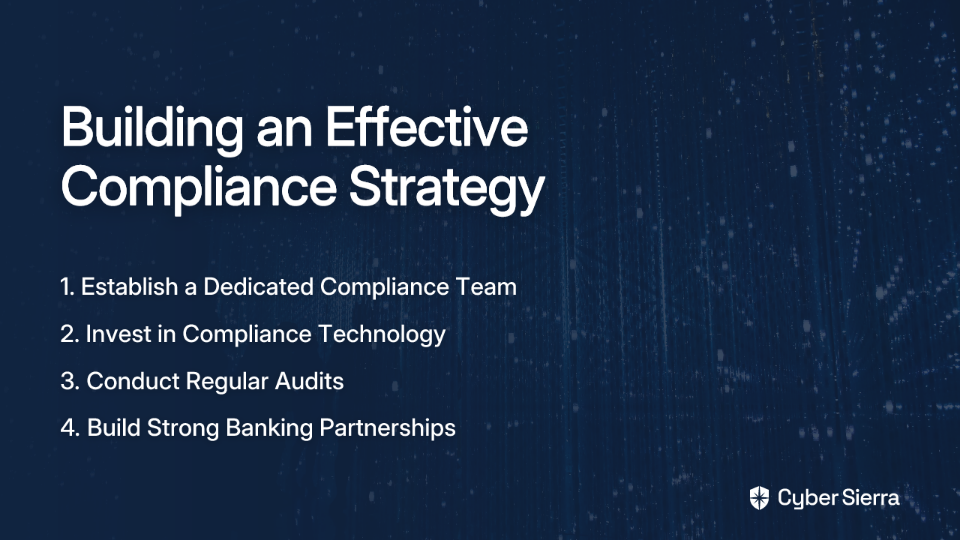
1. Establish a Dedicated Compliance Team
Even small fintechs need dedicated compliance personnel who understand both regulatory requirements and the company's products. This team should:
- Monitor regulatory changes
- Conduct regular risk assessments
- Develop and maintain compliance policies
- Train other team members on compliance requirements
2. Invest in Compliance Technology
Modern regulatory technology (RegTech) solutions can significantly reduce the burden of compliance management:
- Automated Monitoring Tools: Tools like Winnow provide searchable databases of state laws with regular updates on regulatory changes
- Compliance Management Systems: Platforms like Smartria and ComplySci help track compliance activities and deadlines
- Real-time Alert Systems: Customized alerts can provide tailored summaries of regulatory changes relevant to your business
As one compliance officer noted: "Real-time alerts with summaries would be a huge help, especially if they're tailored by region or business type."
3. Conduct Regular Audits
Regular compliance audits help identify gaps before they become regulatory issues:
- Schedule quarterly internal compliance reviews
- Consider annual third-party audits for objectivity
- Document all audit findings and remediation efforts
- Use audit results to improve compliance processes
4. Build Strong Banking Partnerships
Given the challenges of bank integration, a proactive approach to these relationships is essential:
- Demonstrate your compliance expertise early in discussions
- Be transparent about your security measures
- Understand the bank's regulatory concerns
- Establish clear communication channels for addressing compliance questions
Innovations in Regulatory Compliance
Regulatory Sandboxes
Regulatory bodies are increasingly creating "sandboxes" that allow fintech companies to test innovative products in a controlled environment with regulatory oversight but without full compliance burdens. These initiatives are particularly active in:
- United States: States like Arizona and Wyoming have established sandbox programs
- United Arab Emirates: Both DIFC and ADGM offer regulatory sandboxes
- Saudi Arabia: The Saudi Central Bank (SAMA) has implemented a sandbox for fintech testing
Global Financial Innovation Network (GFIN)
The GFIN is an international network of financial regulators committed to supporting financial innovation. It provides:
- Cross-border testing opportunities for innovative financial products
- Collaboration between regulators on emerging technologies
- Shared approaches to common regulatory challenges
Regional Focus: U.S. vs. UAE Regulatory Approaches
United States: Navigating Regulatory Fragmentation
The U.S. regulatory landscape presents unique challenges due to its fragmented nature.

Unlike many countries with a single financial regulator, the U.S. has multiple federal agencies with overlapping jurisdictions, plus state-level requirements.
This fragmentation creates several practical challenges:
- Multiple Licensing Requirements: Fintechs often need licenses from numerous states, each with different requirements and application processes. Money Transmitter Licenses (MTLs) are particularly burdensome, as they must be obtained state by state.
- Inconsistent Interpretations: Different regulators may interpret similar regulations differently, creating compliance uncertainty.
- Continuous Evolution: U.S. regulations are constantly changing, with new interpretations and guidance issued regularly. As technologies like AI and cryptocurrencies advance, regulators are racing to catch up.
- Enforcement-Driven Regulation: U.S. regulators often clarify expectations through enforcement actions rather than clear guidance. This approach forces fintechs to learn from others' mistakes.
To navigate this environment effectively, U.S.-focused fintechs should:
- Maintain Regulatory Relationships: Establish open lines of communication with relevant regulators
- Monitor Enforcement Actions: Stay informed about actions against similar companies
- Participate in Industry Groups: Join fintech associations that advocate for clearer regulations
- Consider a Regulatory Partner: Many fintechs partner with banks or established financial institutions to leverage their existing regulatory frameworks
UAE: An Emerging Fintech Hub
The UAE has positioned itself as a forward-thinking regulatory environment for fintech innovation, with Dubai and Abu Dhabi emerging as key centers.
The Open Finance Framework
In April 2024, the Central Bank of the UAE (CBUAE) gazetted the new Open Finance Regulation, marking a significant development for fintech companies operating in the region. This framework:
- Establishes mandatory participation requirements for licensed banks and insurance companies
- Creates new licensing categories for Open Finance Providers
- Sets standards for data sharing and customer consent
- Prohibits data scraping practices
The technical implementation includes:
- API Hub: A central infrastructure for secure data access
- Trust Framework: Standards for secure communication between parties
- Customer Consent Management: Protocols for obtaining and managing customer permissions
Choosing the Right Jurisdiction
Fintech companies establishing a presence in the UAE must choose between the two main financial free zones:
- Dubai International Financial Centre (DIFC)
- Advantages: Prestigious location, well-established regulatory framework
- Challenges: Longer processing times, higher costs
- Best for: Established fintechs looking for regional prestige and companies with significant capital
- Abu Dhabi Global Market (ADGM)
- Advantages: Preferred by investors for fundraising, generally more flexible
- Challenges: Less established than DIFC
- Best for: Early-stage startups focused on fundraising and growth
As one UAE-based fintech founder advised: "If you're going to fund raise, go with ADGM."
Practical Recommendations for Fintech Leaders
1. Stay Informed on Regulatory Changes
The volume of regulatory information is overwhelming, but targeted strategies can help you stay informed without drowning in details:
- Subscribe to regulatory updates specific to your business model and target markets
- Utilize tools that provide tailored summaries rather than unfiltered regulatory text
- Establish a regular cadence for reviewing regulatory developments with your team
- Consider using specialized services like Winnow to track changes that specifically affect your products
2. Build Compliance into Product Development
Rather than treating compliance as an afterthought, integrate it into your product development process:
- Include compliance team members in product planning sessions
- Conduct regulatory impact assessments during the design phase
- Create a compliance checklist for new features
- Document compliance considerations for future reference
3. Engage Local Legal Expertise
Particularly in regions like the UAE where regulatory frameworks are evolving rapidly, local legal expertise is invaluable:
- Retain counsel familiar with local regulatory nuances
- Establish relationships with regulators when possible
- Participate in local fintech communities for shared insights
- Consider regulatory consulting services for specific compliance projects
4. Balance Innovation and Compliance
The most successful fintechs find ways to innovate while maintaining regulatory compliance:
- Focus on areas where regulations provide clear guidance
- Use regulatory sandboxes to test innovative ideas
- Develop compliance-driven innovation that solves regulatory challenges
- Document your compliance rationale for innovative approaches
5. Prepare for Cross-Border Compliance
If your fintech has global ambitions, prepare for cross-border regulatory challenges:
- Map the regulatory requirements in each target market
- Identify common compliance elements that can be standardized
- Build flexibility into your compliance systems to accommodate regional variations
- Consider a phased expansion approach based on regulatory complexity
6. Invest in Security and Privacy
Security and privacy compliance are foundational for fintech credibility:
- Implement robust identity and access management systems
- Conduct regular security audits and penetration testing
- Develop clear data governance policies
- Train all team members on security and privacy best practices
As one fintech security professional noted: "The audit, compliance, and security aspects. Audit evidence is a big part of my job, as is general security work, patching, firewalls, bastion boxes, etc."
7. Create a Compliance Culture
Effective compliance requires organization-wide commitment:
- Clearly communicate compliance expectations to all team members
- Recognize and reward compliance-conscious behavior
- Incorporate compliance metrics into performance evaluations
- Provide regular training on relevant regulations
Conclusion: Turning Compliance into Competitive Advantage
Regulatory compliance in fintech is not merely about avoiding penalties—it's about building customer trust, creating sustainable business models, and enabling innovation that solves real problems within regulatory boundaries.
The fintech companies that thrive in the coming years will be those that view compliance not as a burden but as a strategic advantage. By understanding the regulatory landscape, implementing robust compliance processes, and leveraging technology to reduce compliance costs, these companies will earn the trust of customers, partners, and regulators alike.
Whether you're operating in the complex regulatory environment of the United States or the emerging fintech hub of the UAE, the principles remain the same: stay informed, be proactive, invest in compliance infrastructure, and build relationships with regulators.
By following the guidance in this comprehensive guide, fintech leaders can navigate the regulatory maze with confidence, allowing them to focus on what matters most—building innovative financial products that improve lives and transform industries.
Frequently Asked Questions
What are the primary regulatory challenges fintechs face?
Fintechs primarily struggle with interpreting complex and often outdated regulations for novel products, managing fragmented information sources for regulatory updates, and navigating difficult integrations with traditional financial institutions concerned about compliance. These challenges are compounded by economic uncertainty, which can make justifying compliance investments difficult despite their critical importance, and the sheer volume of information that needs to be processed to determine relevance.
How can fintechs effectively manage compliance in the US and UAE?
Fintechs can effectively manage compliance by establishing dedicated compliance teams, investing in RegTech solutions for automation and monitoring, conducting regular internal and external audits, and building strong, transparent partnerships with banking institutions. Additionally, staying informed on regulatory changes specific to their product and region, and integrating compliance into the product development lifecycle are crucial for both the US (with its fragmented system) and the UAE (with its evolving frameworks like Open Finance).
Why is investing in compliance technology (RegTech) crucial for fintechs?
Investing in RegTech is crucial because it automates and streamlines complex compliance processes, reduces the risk of human error, and helps fintechs stay updated with rapidly changing regulations across different jurisdictions. Tools like automated monitoring systems for regulatory changes, compliance management platforms for tracking activities, and real-time alert systems can significantly lessen the administrative burden, improve accuracy, and allow teams to focus on core business activities while maintaining robust compliance.
What are the key differences between fintech regulation in the US and the UAE?
The key difference lies in their structure and approach: U.S. fintech regulation is highly fragmented, involving multiple federal agencies (like OCC, CFPB, SEC, FTC) and state-level authorities, often leading to complex licensing requirements (e.g., state-by-state Money Transmitter Licenses) and inconsistent interpretations. In contrast, the UAE, particularly in financial free zones like DIFC and ADGM, offers a more centralized and often forward-looking regulatory environment, including recent initiatives like the Open Finance Regulation, aiming to foster innovation through clear frameworks and sandboxes while ensuring stability.
How can fintech startups build a strong compliance foundation from the beginning?
Fintech startups can build a strong compliance foundation by integrating compliance considerations into their product development process from day one ("compliance by design"), establishing a dedicated compliance function (even if initially small or outsourced), and investing early in scalable compliance technology (RegTech) to manage obligations efficiently. Seeking local legal expertise, especially when entering new or complex markets like the US or UAE, and fostering a company-wide culture where compliance is viewed as everyone's responsibility are also vital steps for long-term success and risk mitigation.
What are regulatory sandboxes and how do they benefit fintech innovation?
Regulatory sandboxes are controlled environments established by regulatory bodies that allow fintech companies to test innovative products, services, or business models for a limited time with real consumers, under regulatory supervision but without the immediate burden of full licensing or all compliance requirements. They benefit fintech innovation by enabling companies to experiment and gather data in a live market setting, significantly reducing the time and cost of bringing new solutions to market, while simultaneously allowing regulators to understand new technologies and adapt regulatory frameworks accordingly, fostering a more collaborative approach to innovation. Both the US (at state levels) and the UAE (DIFC, ADGM, SAMA) offer such programs.
Additional Resources
For fintech leaders looking to deepen their understanding of regulatory compliance, these resources provide valuable insights:
- Stripe: Overview of Compliance Fundamentals for Fintechs in the US
- DLA Piper: New Fintech Regulations in the UAE - Open Finance Regulation
- Global Legal Insights: Fintech Laws and Regulations in the USA
- Empaxis: Fintech Compliance Challenges and Strategies
By leveraging these resources and implementing the strategies outlined in this guide, fintech companies can navigate the regulatory landscape effectively, turning compliance challenges into opportunities for growth and differentiation.
