



Regulatory Compliance for SaaS Companies: A Complete Guide

Join thousands of professionals and get the latest insight on Compliance & Cybersecurity.
As a SaaS founder, CISO, or senior leader, you're likely all too familiar with this scenario: You're focused on building an innovative product and growing your customer base when suddenly a potential enterprise client asks, "Are you SOC 2 compliant?" or "How do you handle GDPR requirements?" Just like that, your product roadmap takes a backseat to compliance concerns.
You're not alone. Many SaaS leaders find themselves thinking, "It seems silly to waste time on compliance audits instead of building the product, but without it, you potentially limit your user base by a LOT." This tension between innovation and compliance is real, and the stakes are high - as one founder noted, "Many startups have lost major deals due to lack of compliance."
This comprehensive guide aims to demystify regulatory compliance for SaaS companies operating in both the U.S. and Middle Eastern regions like Dubai and the UAE. Instead of vague recommendations, we'll provide actionable insights to help you navigate this complex landscape efficiently.
Understanding the Regulatory Landscape
The SaaS compliance landscape is a complex web of domestic and international regulations that varies based on your industry, target market, and the type of data you handle. Let's break down the key regulations you need to be aware of:

Domestic Regulations (U.S.)
California Consumer Privacy Act (CCPA)
- Applies to businesses that collect personal information from California residents
- Requires transparency in how data is collected, used, and shared
- Gives consumers the right to opt-out of having their data sold
- Violations can result in fines ranging from $2,500 to $7,500 per violation
Health Insurance Portability and Accountability Act (HIPAA)
- Mandatory for SaaS companies handling protected health information (PHI)
- Establishes standards for protecting sensitive patient data
- Requires implementation of safeguards to ensure the confidentiality, integrity, and availability of PHI
- Non-compliance penalties can reach up to $50,000 per violation, with a maximum of $1.5 million per year
Many SaaS founders express frustration with HIPAA's complexity. As one Reddit user lamented, "I am having the hardest time finding a simple list of requirements of what being HIPAA compliant entails, like an actual simple checklist that you can follow." This sentiment is common - HIPAA regulations are intentionally broad to accommodate various healthcare scenarios, making straightforward compliance challenging.
Federal Trade Commission (FTC) Act
- Prohibits unfair or deceptive practices affecting commerce
- Increasingly focused on companies' data security and privacy practices
- Requires businesses to uphold their privacy promises and implement reasonable security measures
Service Organization Control 2 (SOC 2)
- While not a government regulation, SOC 2 is an auditing standard developed by the American Institute of CPAs (AICPA)
- Focuses on a service organization's controls related to security, availability, processing integrity, confidentiality, and privacy
- Many enterprise customers require SOC 2 compliance before considering a SaaS vendor
International Regulations
General Data Protection Regulation (GDPR)
- Applies to any organization processing personal data of EU residents, regardless of location
- Requires explicit consent for data collection and processing
- Grants individuals rights to access, correct, and delete their data
- Non-compliance can result in fines up to €20 million or 4% of global annual revenue, whichever is higher
The consequences of GDPR non-compliance are not theoretical. In 2023, Meta was fined €1.2 billion for transferring EU user data to servers in the United States without adequate safeguards - a stark reminder of the financial impact regulatory violations can have.
Personal Information Protection and Electronic Documents Act (PIPEDA)
- Canada's primary data privacy law
- Governs how private sector organizations collect, use, and disclose personal information
- Requires informed consent for data collection and reasonable security measures
Data Security Law (DSL) of China
- Regulates data processing activities and data security within China
- Implements a multi-level data classification system based on importance
- Restricts cross-border data transfers of important data
- Imposes severe penalties for non-compliance, including business suspension
ISO/IEC 27001
- International standard for information security management systems
- Provides a framework for establishing, implementing, operating, monitoring, and improving an ISMS
- Certification demonstrates commitment to information security best practices
Key Compliance Challenges for SaaS Companies
Data Privacy and Protection
SaaS companies face several significant data security risks:
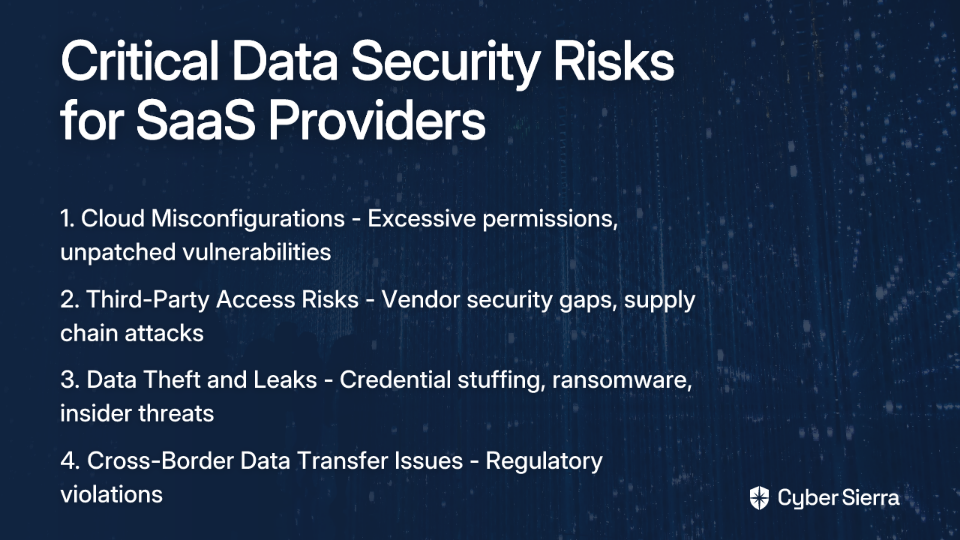
Cloud Misconfigurations Cloud environments, while powerful, are prone to misconfigurations that can lead to data breaches. Common issues include:
- Excessive permissions
- Unpatched vulnerabilities
- Insecure APIs
- Inadequate encryption
Third-Party Access Risks Most SaaS applications integrate with numerous third-party services, each representing a potential security vulnerability:
- Vendor access to sensitive data
- Insufficient vendor security practices
- Supply chain attacks
Data Theft and Leaks SaaS platforms are attractive targets for cybercriminals due to the concentration of valuable data:
- Credential stuffing attacks
- Ransomware
- Insider threats
Recommendations for Data Protection:
- Implement Zero Trust Architecture
- Verify every user and device attempting to access resources
- Apply least privilege principles to limit access
- Continuously validate security throughout the session
- Deploy Robust Authentication
- Implement multi-factor authentication (MFA)
- Use single sign-on (SSO) where appropriate
- Monitor for suspicious login attempts
- Encrypt Data at Rest and in Transit
- Use industry-standard encryption protocols (TLS 1.3, AES-256)
- Implement proper key management
- Consider field-level encryption for sensitive data
- Regular Security Assessments
- Conduct penetration testing at least annually
- Perform vulnerability scanning quarterly
- Use third-party security assessments to identify blind spots
Data Localization and Transfer
As global privacy regulations evolve, data localization and cross-border transfer restrictions have become increasingly complex:
Standard Contractual Clauses (SCCs)
- Essential for GDPR-compliant data transfers outside the EU
- Provide appropriate safeguards for international data transfers
- Must be incorporated into contracts with data processors and controllers
Data Localization Requirements
- Many jurisdictions require certain types of data to be stored within their borders
- Examples include Russia (requiring Russian citizens' data to be stored in Russia), China (certain categories of data), and India (financial data)
- Compliance often requires deploying infrastructure in specific regions
Recommendations for Data Transfer Compliance:
- Data Mapping
- Document all data flows within your organization
- Identify cross-border transfers
- Classify data according to sensitivity and applicable regulations
- Regional Infrastructure
- Deploy regional instances of your SaaS application where necessary
- Partner with cloud providers offering compliant regional data centers
- Implement data residency controls to prevent unauthorized transfers
- Transfer Mechanism Documentation
- Maintain records of all data transfer mechanisms
- Regularly review and update SCCs and other transfer agreements
- Implement technical measures to enforce transfer restrictions
Best Practices for Compliance Implementation
Establishing a Compliance Framework
The path to compliance begins with a structured approach:
1. Develop a Comprehensive Compliance Strategy
- Identify applicable regulations based on your business model, customer base, and data processing activities
- Create a compliance roadmap with clear milestones and responsibilities
- Allocate adequate resources (budget, personnel, tools)
2. Conduct Regular Compliance Audits
- Perform quarterly internal audits to assess compliance status
- Schedule annual third-party assessments for key frameworks (SOC 2, ISO 27001)
- Document findings and remediation plans
3. Implement Continuous Monitoring
- Deploy tools to monitor compliance on an ongoing basis
- Set up alerts for potential compliance issues
- Review monitoring results regularly
4. Document Everything
- Maintain detailed records of all compliance activities
- Document policies, procedures, and controls
- Keep evidence of compliance testing and remediation
Streamlining Compliance Efforts
Many SaaS leaders feel overwhelmed by compliance requirements, with one founder noting, "It would be nice to get a sample of the functionality I am looking for. This isn't possible on a lot of the products webpages." To address this common frustration, consider these approaches:
1. Compliance Automation
- Use compliance automation platforms like Vanta, Drata, or Secureframe to streamline evidence collection and monitoring
- Implement continuous compliance monitoring to reduce manual effort
- Automate policy distribution and acknowledgment
2. Integrated Security and Compliance
- Align security controls with compliance requirements
- Implement controls that satisfy multiple compliance frameworks
- Use a unified control framework (like NIST CSF) as a foundation
3. Outsourcing and Expert Guidance
- Consider outsourcing compliance tasks to specialized firms
- Engage compliance consultants for complex frameworks
- Leverage managed security service providers (MSSPs) for ongoing compliance maintenance
As one experienced founder advised, "Outsource it to firms who specialize in it. You get through it faster and easier."
Cybersecurity Measures for Compliance
Robust cybersecurity is the foundation of regulatory compliance for SaaS companies. Here are essential measures to implement:
Incident Response Planning
1. Develop a Comprehensive Incident Response Plan (IRP)
- Define roles and responsibilities for incident handling
- Establish clear procedures for identifying, containing, and remediating security incidents
- Include communication templates for internal and external stakeholders
- Ensure compliance with breach notification requirements across jurisdictions
2. Regular Testing and Updates
- Conduct tabletop exercises to test the IRP's effectiveness
- Update the plan based on lessons learned from exercises and actual incidents
- Ensure the plan addresses evolving threats and regulatory requirements
Security Monitoring and Detection
1. Implement Security Information and Event Management (SIEM)
- Centralize security logs from all systems and applications
- Set up alerts for suspicious activities and potential security incidents
- Establish 24/7 monitoring capabilities, either in-house or through a managed security service
2. Threat Intelligence Integration
- Subscribe to threat intelligence feeds relevant to your industry
- Incorporate intelligence into detection rules and monitoring systems
- Regularly update security controls based on emerging threats
Vulnerability Management
1. Regular Vulnerability Assessments
- Conduct quarterly vulnerability scans of all systems and applications
- Prioritize remediation based on risk level and potential impact
- Track vulnerability remediation metrics and trends
2. Penetration Testing
- Perform annual penetration tests to identify exploitable vulnerabilities
- Include both application and infrastructure testing
- Address findings based on risk priority
Region-Specific Compliance: United States
Industry-Specific Regulations
Beyond the general regulations mentioned earlier, U.S.-based SaaS companies may need to comply with industry-specific frameworks:
Financial Services
- Gramm-Leach-Bliley Act (GLBA): Requires financial institutions to explain their information-sharing practices and protect sensitive data
- Sarbanes-Oxley Act (SOX): Mandates strict financial disclosure and fraud prevention controls
- Payment Card Industry Data Security Standard (PCI DSS): Required for processing credit card transactions
Healthcare
- HIPAA: As mentioned earlier, crucial for any SaaS handling protected health information
- 21st Century Cures Act: Promotes interoperability and prohibits information blocking
- FDA regulations: Apply to SaaS that qualifies as a medical device
Education
- Family Educational Rights and Privacy Act (FERPA): Protects the privacy of student education records
- Children's Online Privacy Protection Act (COPPA): Applies to services collecting information from children under 13
State-Level Regulations
The U.S. has a growing patchwork of state privacy laws that SaaS companies must navigate:
California
- California Consumer Privacy Act (CCPA): Already discussed above
- California Privacy Rights Act (CPRA): Expands CCPA with additional consumer rights and obligations for businesses
Virginia
- Consumer Data Protection Act (CDPA): Grants consumers rights to access, correct, and delete personal data
Colorado, Connecticut, and Utah
- All have enacted comprehensive privacy laws with varying requirements
- Common elements include consumer rights, data minimization principles, and transparency requirements
Region-Specific Compliance: Middle East (UAE and Dubai)
The Middle East, particularly the UAE and Dubai, has been developing its regulatory framework for data protection and cybersecurity. SaaS companies targeting this region face unique compliance challenges:
UAE Federal Data Protection Law
In 2021, the UAE introduced Federal Decree-Law No. 45/2021 on Personal Data Protection, which:
- Establishes rights for data subjects
- Requires a legal basis for processing personal data
- Mandates data protection impact assessments for high-risk processing
- Restricts cross-border data transfers to countries with adequate protection
Dubai International Financial Centre (DIFC) Data Protection Law
For SaaS companies operating in or targeting clients in the DIFC:
- Compliance with DIFC Data Protection Law No. 5 of 2020 is mandatory
- The law is broadly aligned with GDPR principles
- Requires appointment of a Data Protection Officer in certain cases
- Mandates data breach notification within 72 hours
DESC Certification
The Dubai Electronic Security Center (DESC) has established a certification framework for cloud service providers operating in Dubai:
- Compliance Requirements:
- Implementation of specific security controls
- Regular security assessments
- Adherence to UAE data protection laws
- Localization of certain data types
- Benefits of DESC Certification:
- Enhanced credibility with government and private sector clients
- Demonstration of compliance with local security standards
- Competitive advantage in the UAE market
- Facilitation of business growth in the region
As noted in an Oracle blog post about their DESC certification, this certification "allows organizations to further benefit from increased innovation, enhanced security, advanced functionality, and the opportunity to leverage emerging technologies."
Abu Dhabi Global Market (ADGM) Data Protection Regulations
SaaS providers serving clients in the ADGM financial free zone must comply with:
- ADGM Data Protection Regulations 2021
- Requirements similar to GDPR, including Data Protection Impact Assessments
- Mandatory breach notification requirements
- Restrictions on international data transfers
Building a Sustainable Compliance Program
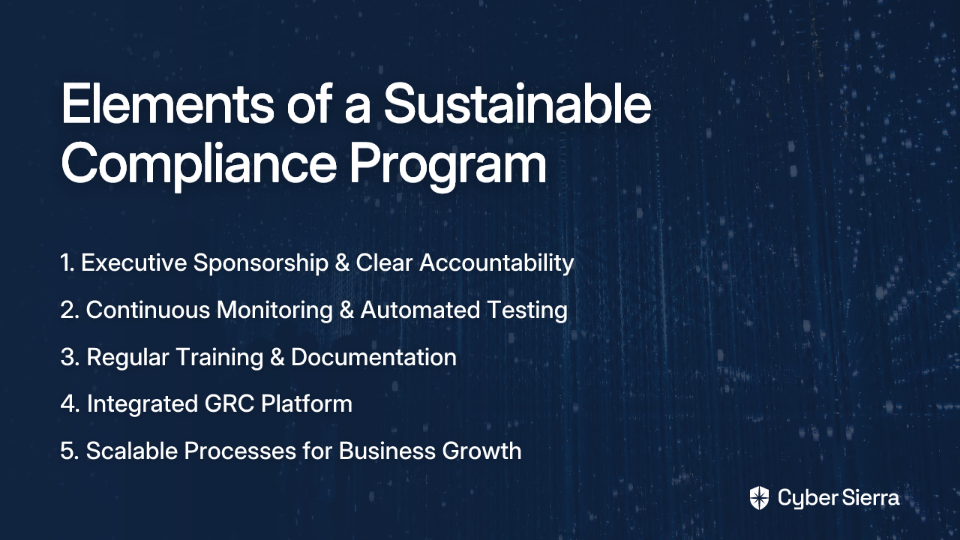
Compliance is not a one-time project but an ongoing program that requires continuous attention. Here's how to build a sustainable approach:
1. Cultivate a Compliance Culture
- Executive Sponsorship: Ensure leadership demonstrates commitment to compliance
- Regular Training: Conduct role-specific compliance training for all employees
- Clear Accountability: Assign compliance responsibilities across the organization
- Incentives: Recognize and reward compliance-focused behaviors
2. Leverage Technology
- GRC Platforms: Implement Governance, Risk, and Compliance platforms to centralize compliance activities
- Continuous Monitoring Tools: Deploy tools that provide real-time visibility into compliance status
- Documentation Automation: Use document management systems to maintain compliance records
- Automated Testing: Implement automated testing of security and compliance controls
3. Plan for Growth
- Scalable Processes: Design compliance processes that can scale with your business
- Forward-Looking Assessments: Regularly evaluate upcoming regulations that may affect your business
- Geographic Expansion Planning: Incorporate compliance requirements into market entry strategies
- Acquisition Integration: Develop a framework for assessing and integrating compliance programs during acquisitions
Conclusion: Turning Compliance into a Competitive Advantage
While regulatory compliance can seem like a burden that takes resources away from product development, forward-thinking SaaS companies are leveraging compliance as a competitive advantage. As one CISO noted, "Take ownership of the losses, celebrate those that make the wins. If something goes wrong, it's my fault for not getting the right resources, people, training, or whatever in place."
By implementing a robust compliance program, you can:
- Build Trust: Demonstrate to customers that you take data protection seriously
- Access New Markets: Meet regulatory requirements for entering regulated industries or regions
- Streamline Due Diligence: Accelerate sales cycles by having compliance documentation ready
- Improve Security Posture: Leverage compliance requirements to enhance your security program
- Reduce Risk: Minimize the likelihood of costly data breaches and regulatory penalties
Remember that compliance is not just about checking boxes or passing audits. It's about building a foundation of trust with your customers, partners, and regulators. By approaching compliance strategically and integrating it into your business operations, you can transform what many see as a necessary evil into a valuable business enabler.
For SaaS companies navigating the complex world of regulatory compliance, the key is to start early, leverage expertise when needed, and build compliance into your organization's DNA. With the right approach, you can meet regulatory requirements while continuing to innovate and grow your business.
