



Risk Management in Cybersecurity: What It Is and How to Get Started



Join thousands of professionals and get the latest insight on Compliance & Cybersecurity.
You've just been appointed as the new CISO. Your inbox is overflowing with vulnerability reports, compliance deadlines loom on the horizon, and the board wants a "quick overview" of your security posture by next week. Meanwhile, your team is struggling to prioritize a growing backlog of security tasks while vendors bombard you with solutions promising to solve all your problems.
Sound familiar?
In today's cybersecurity landscape, the challenge isn't just identifying threats—it's knowing which ones actually matter to your business and deserve your limited resources. This is where effective risk management becomes not just a compliance checkbox but a strategic necessity.
What Is Risk Management in Cybersecurity?
Risk management is the systematic process of identifying, assessing, and responding to risks that could impact an organization's ability to achieve its objectives. In the cybersecurity context, it involves understanding potential threats to your digital assets and taking measured steps to protect them.
According to a recent IBM report, the average cost of a data breach reached a staggering $4.45 million in 2023, with healthcare organizations facing the highest costs at $10.10 million per breach. For hospitality companies, the average was $2.9 million—figures that underscore the financial imperative of proper risk management.
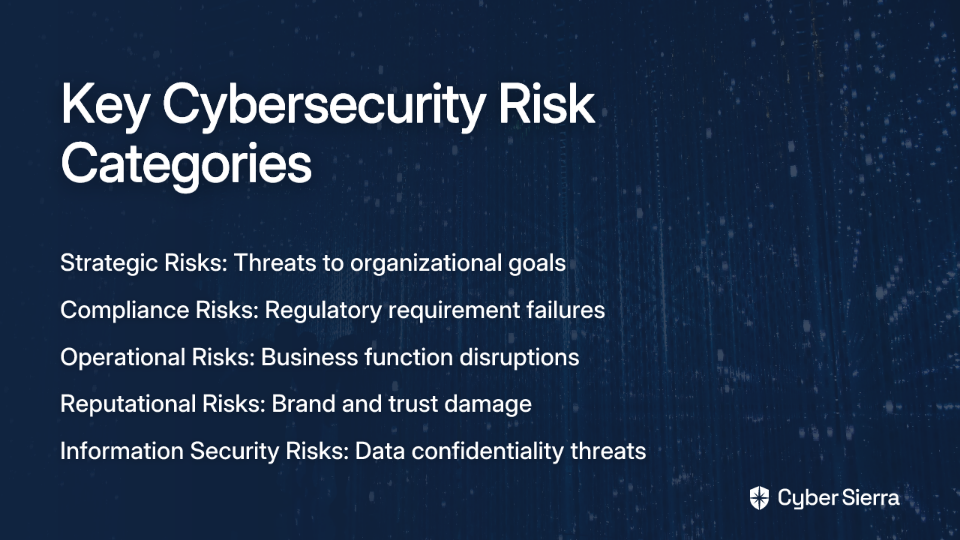
A comprehensive cybersecurity risk management approach typically addresses several risk categories:
- Strategic Risks: Threats to your organizational goals and objectives (e.g., market shifts, leadership changes)
- Compliance Risks: Exposure resulting from failure to meet regulatory requirements like GDPR, HIPAA, or PCI DSS
- Operational Risks: Issues that could disrupt day-to-day business functions
- Reputational Risks: Potential damage to brand image and customer trust
- Information Security Risks: Direct threats to data confidentiality, integrity, and availability
"Everything has risk - no matter how trivial or small," notes one cybersecurity professional on Reddit. This reality means risk management isn't optional—it's essential for any organization that relies on technology.
Why Traditional Approaches Often Fail
Despite its importance, many organizations struggle with risk management. A common sentiment among security professionals is frustration over perceived ineffectiveness: "Been doing various types of risk assessment for over 10 years in 3 companies and don't get its importance. Except for box ticking during audits, I don't find it useful in anyway."
This disconnect often stems from several common pitfalls:
- Risk assessments without action: Identifying risks without implementing mitigation strategies creates documentation without protection.
- Disconnection from business objectives: When security teams operate in isolation from business goals, risk management becomes a theoretical exercise.
- Over-reliance on tools: Purchasing security solutions without a clear understanding of your specific risk landscape leads to gaps in coverage and wasted resources.
- Inconsistent methodologies: Ad-hoc approaches to risk assessment create inconsistent results and make tracking progress difficult.
As one security professional bluntly stated, "If you're not following through by managing those risks, I don't know what to tell you." This highlights perhaps the biggest failure in risk management: the lack of concrete action following assessment.
The Six-Step Risk Management Process
Effective cybersecurity risk management follows a structured approach that connects assessment to action. Here's a practical framework:
1. Risk Identification
This initial phase involves systematically discovering and documenting potential risks to your organization. Effective techniques include:
- Asset inventory and classification: You can't protect what you don't know exists. Maintain comprehensive records of all hardware, software, data, and other assets.
- Threat intelligence gathering: Stay informed about emerging threats targeting your industry.
- Stakeholder interviews: Engage with department heads to understand business-critical systems and processes.
- Historical incident analysis: Review past security incidents for patterns and insights.
- Vulnerability scanning: Regularly scan your infrastructure to identify technical weaknesses.
One useful approach is the Mozilla Rapid Risk Assessment methodology, which helps teams quickly identify key risks in new projects or systems.
2. Risk Assessment
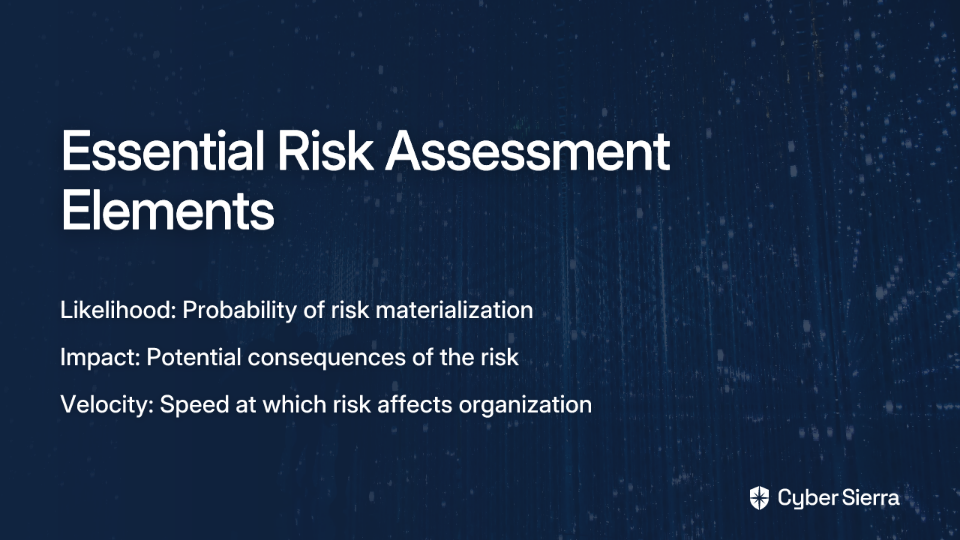
Once risks are identified, evaluate them based on:
- Likelihood: The probability of the risk materializing
- Impact: The potential consequences if the risk occurs
- Velocity: How quickly the risk might affect your organization
This assessment should result in a prioritized list of risks. As one professional notes, "You need to make a decision when doing something, this will inherit risk... the risk assessment tells you what may occur as a result."
Common frameworks for structuring this assessment include NIST Risk Management Framework, ISO 31000, and FAIR (Factor Analysis of Information Risk).
3. Control Implementation
Based on your risk assessment, develop and implement controls to address the prioritized risks. These controls generally fall into three categories:
- Preventive controls: Measures designed to stop incidents before they occur (e.g., firewalls, access controls)
- Detective controls: Systems that identify when an incident is in progress (e.g., intrusion detection, log monitoring)
- Corrective controls: Mechanisms that minimize damage after an incident (e.g., backup systems, incident response plans)

When implementing controls, align with established frameworks like NIST Cybersecurity Framework, ISO 27001, or CIS Controls to ensure comprehensive coverage.
4. Resource Allocation
Effective risk management requires appropriate resources, including:
- Budget: Financial resources for tools, services, and personnel
- Personnel: Skilled staff to implement and maintain security controls
- Technology: Solutions that support risk management activities
- Time: Dedicated hours for planning, implementation, and review
This step often requires securing executive buy-in by clearly communicating how resource investments correlate to risk reduction and business protection.
5. Risk Treatment
With controls and resources in place, execute your risk treatment strategy. Options include:
- Risk acceptance: Acknowledging and accepting certain risks when the cost of mitigation exceeds potential impact
- Risk avoidance: Eliminating activities that create unacceptable risk
- Risk transfer: Sharing risk through insurance or third-party services
- Risk mitigation: Implementing controls to reduce likelihood or impact
"A risk assessment should be followed by a continuity plan that details what actions are taken if the risk is realized," emphasizes a cybersecurity professional, highlighting the importance of having concrete action plans.
6. Monitoring and Reporting
Risk management is not a one-time activity but an ongoing process requiring:
- Regular reassessment: Periodically review and update your risk register
- Control effectiveness evaluation: Test controls to ensure they're working as intended
- Continuous improvement: Refine your approach based on changing threats and business needs
- Executive reporting: Provide clear, actionable risk information to leadership
Building an Effective Risk Management Program
Beyond the six-step process, successful risk management programs share several key elements:
Leadership Commitment
Executive support is critical for effective risk management. CISOs should:
- Speak the language of business: Frame security risks in terms of business impact
- Quantify risks when possible: Use data to illustrate the financial implications of security events
- Connect security to strategic goals: Show how risk management enables business objectives
As one CISO notes, "If you can find a way to sell security as more than a cost center, then that's another focal point." This perspective helps overcome the perception that GRC functions are merely "a cost sink and bottleneck" rather than business enablers.
Clear Documentation
Maintain comprehensive documentation including:
- Risk register: A centralized inventory of identified risks, their assessments, and treatment plans
- Security policies: Formal statements of expectations for security behavior
- Procedures: Step-by-step instructions for implementing security controls
- Control mapping: Documentation showing how implemented controls address specific risks and compliance requirements
Employee Engagement
Security is everyone's responsibility. Build a security-conscious culture by:
- Providing regular training: Ensure all employees understand their role in risk management
- Creating awareness campaigns: Keep security top-of-mind through ongoing communication
- Recognizing security champions: Identify and support individuals who promote security practices
- Soliciting feedback: Encourage staff to report security concerns and suggest improvements
As recommended by experienced security leaders, "My team has a min of 3 hours a week of dedicated training time." This investment in continuous learning ensures teams stay current with evolving threats and mitigation strategies.
Practical Threat Modeling
Threat modeling helps identify and address risks in specific systems or processes. While some formal methods can be time-consuming, several approaches balance thoroughness with practicality:
- STRIDE: A Microsoft-developed methodology that examines six threat categories (Spoofing, Tampering, Repudiation, Information disclosure, Denial of service, Elevation of privilege)
- Data Flow Diagrams (DFDs): Visual representations that help identify where security controls are needed
- AWS Threat Composer: A tool that simplifies threat modeling for AWS environments
"I've been pretty impressed with Threat Composer from AWS and the threat modelling they built into the AWS Toolkit for VSCode," notes one security professional, highlighting the value of user-friendly tools.
Third-Party Risk Management
Modern organizations rely heavily on vendors and partners, creating additional risk surfaces that must be managed:
- Vendor assessment: Evaluate the security posture of potential partners before engagement
- Contractual requirements: Include specific security obligations in vendor agreements
- Ongoing monitoring: Regularly review third-party security practices and performance
- Incident response coordination: Ensure vendors have appropriate breach notification procedures
Practical First Steps for New Risk Management Programs
If you're just getting started with formalizing your risk management approach, consider these initial steps:
1. Establish Your Risk Framework
Select an established framework to guide your efforts. Options include:
- NIST Risk Management Framework (RMF): A comprehensive approach developed by the National Institute of Standards and Technology
- ISO 31000: An international standard providing principles and guidelines for effective risk management
- FAIR (Factor Analysis of Information Risk): A methodology focused on quantifying risk in financial terms
2. Conduct a Baseline Risk Assessment
Start with a high-level assessment of your current security posture:
- Identify your most critical assets and systems
- Document existing security controls
- Analyze gaps between current state and framework requirements
- Prioritize areas for immediate attention
3. Develop Your Risk Register
Create a structured document to track identified risks, including:
- Risk description and category
- Likelihood and impact assessments
- Current controls and their effectiveness
- Planned mitigation actions and timelines
- Risk owner responsible for monitoring and treatment
4. Implement Continuous Monitoring
Establish mechanisms to maintain ongoing awareness of your risk landscape:
- Deploy security monitoring tools
- Schedule regular control assessments
- Create dashboards for key risk indicators
- Establish routine reporting to stakeholders
5. Build Response Capabilities
Develop plans for when risks materialize despite preventive measures:
- Create incident response procedures
- Define roles and responsibilities during security events
- Establish communication protocols
- Conduct regular tabletop exercises to test preparedness
How Technology Can Enhance Risk Management
While technology alone can't solve risk management challenges, the right tools can significantly improve efficiency and effectiveness. Modern platforms can help:
- Automate data collection: Gather information about assets, vulnerabilities, and threats automatically
- Centralize risk information: Maintain a single source of truth for risk data
- Streamline assessments: Standardize evaluation processes across the organization
- Enhance visibility: Provide real-time dashboards and reporting
- Track remediation: Monitor progress on risk treatment activities
Cyber Sierra's platform, for example, addresses these needs through several integrated modules that work together to simplify risk management:
- The Continuous Control Monitoring (CCM) module provides ongoing visibility into security controls, helping organizations move away from point-in-time assessments to real-time awareness.
- For managing vendor risks, the Third-Party Risk Management (TPRM) module automates assessments and provides continuous monitoring of third-party security compliance.
- The Governance, Risk & Compliance (GRC) module helps organizations navigate complex regulatory requirements by automating data collection and maintaining audit trails.
However, remember that technology should support—not replace—the human expertise and judgment essential to effective risk management.
Common Pitfalls to Avoid
Even well-intentioned risk management programs can falter. Watch out for these common mistakes:
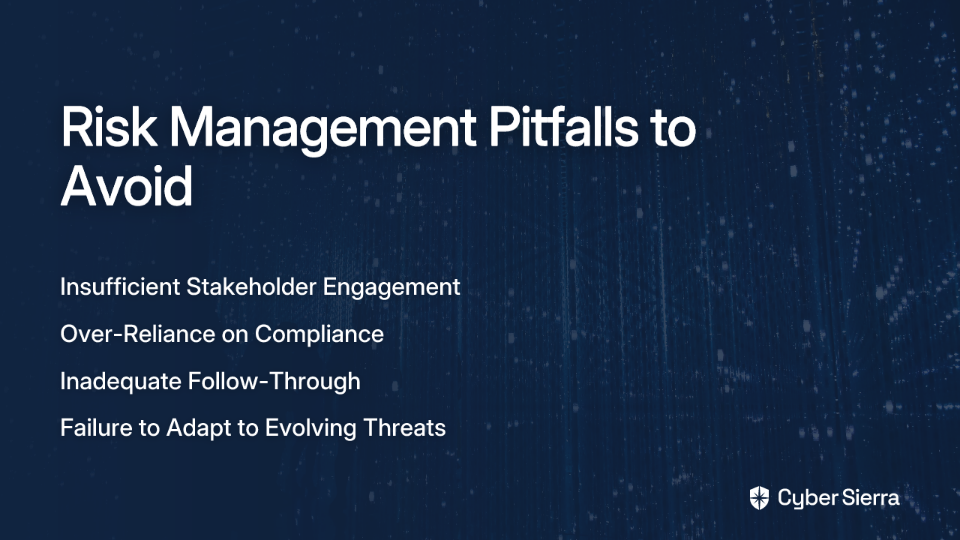
Insufficient Stakeholder Engagement
Risk management can't operate in isolation. Without broad organizational buy-in, you'll face:
- Resistance to implementing controls
- Incomplete risk identification
- Resource constraints
- Limited executive support
Remedy this by involving stakeholders from across the organization in risk identification and assessment activities.
Over-Reliance on Compliance
While regulatory compliance is important, it shouldn't be the primary driver of your risk management program:
- Compliance frameworks represent minimum standards, not comprehensive security
- Checkbox approaches prioritize documentation over effectiveness
- Compliance requirements may lag behind emerging threats
Instead, focus on the specific risks facing your organization and use compliance as one component of a broader strategy.
Inadequate Follow-Through
The most common criticism of risk management is the lack of action following assessment: "What are we going to do about it?" echoes throughout security teams.
Ensure your program includes:
- Clear ownership for risk treatment activities
- Specific, time-bound action plans
- Regular progress reviews
- Accountability mechanisms
Failure to Adapt
The threat landscape evolves constantly, requiring risk management programs to evolve as well:
- Regularly reassess risks and controls
- Stay informed about emerging threats
- Update your approach based on lessons learned
- Incorporate new technologies and methodologies as appropriate
Conclusion: From Compliance Checkbox to Strategic Asset
Effective risk management transforms cybersecurity from a reactive, compliance-driven function to a strategic business enabler. By systematically identifying, assessing, and addressing risks, CISOs can:
- Allocate limited resources to the highest-priority threats
- Provide executives with clear visibility into security posture
- Demonstrate the business value of security investments
- Build organizational resilience against evolving threats
As one security professional aptly noted, proper risk management "can actually help the company generate revenue while preventing additional cost vectors like fines, lawsuits, etc and lowering risks." This perspective highlights the true value proposition of effective risk management—it's not just about preventing bad things, but about enabling the organization to pursue opportunities with confidence.
The journey toward mature risk management is continuous, but even small steps can yield significant benefits. Start with a clear framework, focus on your most critical risks, ensure follow-through on mitigation activities, and continuously refine your approach.

Remember that while tools and technologies can enhance your capabilities, the most important components are the people and processes that bring risk management to life. By fostering a culture where security is everyone's responsibility and risk-informed decision-making is the norm, you'll build an organization that's not just secure, but resilient in the face of an uncertain future.
Frequently Asked Questions (FAQ)
What is cybersecurity risk management?
Cybersecurity risk management is the systematic process of identifying, assessing, and responding to risks that could impact an organization's digital assets and ability to achieve its objectives. It involves understanding potential threats to your information systems, data, and technology infrastructure and taking measured steps to protect them, thereby ensuring business continuity and protecting sensitive information.
Why is cybersecurity risk management important for businesses?
Cybersecurity risk management is crucial for businesses because it helps protect against financial losses, reputational damage, and operational disruptions caused by cyber threats. For instance, the average cost of a data breach reached $4.45 million in 2023. Effective risk management allows organizations to prioritize threats, allocate resources efficiently, meet compliance requirements, and build resilience, ultimately enabling them to operate securely and pursue strategic goals with confidence.
What are the main steps in the cybersecurity risk management process?
The main steps in the cybersecurity risk management process typically include:
- Risk Identification: Discovering and documenting potential risks.
- Risk Assessment: Evaluating risks based on likelihood, impact, and velocity.
- Control Implementation: Developing and deploying security controls (preventive, detective, corrective).
- Resource Allocation: Assigning budget, personnel, and technology.
- Risk Treatment: Deciding how to respond to risks (accept, avoid, transfer, mitigate).
- Monitoring and Reporting: Continuously reviewing risks, controls, and reporting to leadership. This cyclical process ensures that risk management remains an ongoing and adaptive activity.
What are common mistakes to avoid in cybersecurity risk management?
Common mistakes to avoid in cybersecurity risk management include insufficient stakeholder engagement, over-reliance on compliance as the sole driver, inadequate follow-through on risk treatment plans, and failing to adapt the program to the evolving threat landscape. Addressing these pitfalls involves fostering broad organizational buy-in, focusing on specific organizational risks beyond mere compliance, ensuring clear ownership and action plans for mitigation, and regularly updating the risk management approach.
How can technology help with cybersecurity risk management?
Technology can significantly enhance cybersecurity risk management by automating data collection, centralizing risk information, streamlining assessments, improving visibility through dashboards, and tracking remediation efforts. Platforms like Cyber Sierra's GRC, CCM, and TPRM modules can automate compliance, provide real-time control monitoring, and manage vendor risks. However, technology should support, not replace, human expertise and judgment.
What is the first step to take when starting a new risk management program?
The first step to take when starting a new risk management program is to establish your risk framework by selecting an established guide like NIST RMF, ISO 31000, or FAIR. This framework will provide the structure and principles for your subsequent activities, such as conducting a baseline risk assessment, identifying critical assets, documenting existing controls, and prioritizing areas for immediate attention.
Additional Resources
For those looking to deepen their risk management expertise:
- NIST Risk Management Framework - Comprehensive guidance on implementing risk-based security
- CISA's Risk Management Toolkit - Resources for enhancing risk awareness and promoting systems-level thinking
- ISO 31000 Framework - International standards for risk management principles and implementation
- FAIR Institute - Resources for quantitative risk analysis
- OWASP Risk Assessment Framework - Open-source tools for application security risk assessment
This article was published by Cyber Sierra, an AI-enabled cybersecurity platform that helps organizations automate and simplify security compliance through continuous control monitoring, third-party risk management, and integrated GRC capabilities. Learn more at cybersierra.co.
