



Risk Management vs Compliance - What's the Difference?



Join thousands of professionals and get the latest insight on Compliance & Cybersecurity.
You've been tasked with implementing a new governance framework at your organization. As you research, you keep seeing "risk management" and "compliance" mentioned as separate functions, yet they both seem to deal with organizational risks and controls. The job boards list them as distinct roles with different requirements, adding to your confusion.
"Why are these separate departments when they both deal with risk?" you wonder. "And how do I know which one my organization needs to prioritize?"
This confusion is common among professionals across industries. The overlap between risk management and compliance can blur their distinct purposes, leaving many uncertain about how to effectively implement either function.
What is Risk Management?
Risk management is the systematic process of identifying, assessing, and mitigating potential threats to an organization's capital, earnings, and operations. It's forward-looking and proactive, focused on what could happen and how to prepare for it.
Think of risk management as your organization's strategic radar system, constantly scanning the horizon for potential storms and helping you navigate around them before they hit.
The Risk Management Process
Effective risk management follows a structured approach:

- Identification: Recognizing potential risks from both internal and external sources
- Analysis: Evaluating the likelihood and potential impact of each risk
- Planning: Developing strategies to address identified risks
- Mitigation: Implementing controls and measures to reduce exposure
- Monitoring: Continuously reviewing and adjusting the risk management strategy
As one risk manager on Reddit explains, "A risk assessment should be followed by a continuity plan that details what actions are taken if the risk is realized." This highlights the forward-thinking nature of risk management.
Types of Risks Managed
Risk management addresses a broad spectrum of potential threats:
- Strategic risks: Threats to business objectives and competitive position
- Operational risks: Disruptions to day-to-day business activities
- Financial risks: Threats to financial stability and asset values
- Compliance risks: Potential violations of laws and regulations
- Reputational risks: Threats to public perception and brand value
The Value of Risk Management
Effective risk management delivers several key benefits:
- Protection of assets and reputation: By identifying potential threats before they materialize
- Enhanced decision-making: Through a clearer understanding of risk implications
- Improved operational efficiency: By reducing unexpected disruptions
- Competitive advantage: Through calculated risk-taking that enables innovation
Consider Netflix's strategic pivot from DVD rentals to streaming. This was a calculated risk that transformed not just the company but an entire industry. According to Statista, the video streaming market is now projected to reach $139.60 billion in 2024, largely due to companies willing to take managed risks in digital transformation.
What is Compliance?
Compliance refers to the act of adhering to laws, regulations, standards, and internal policies that govern an organization's operations. Unlike risk management's proactive nature, compliance is primarily reactive, responding to established requirements.
If risk management is your radar system, compliance is your navigational rulebook—ensuring you follow established waterways and avoid restricted zones as you sail.
As one professional puts it, "Compliance is generally like 30% technical, and much more about business process." This highlights that compliance is not just about implementing technical controls but about ensuring that organizational processes align with regulatory requirements.
Key Components of Compliance Programs
An effective compliance program typically includes:
- Policies and procedures: Documented guidelines that align with laws and regulations
- Training and awareness: Education for employees about compliance requirements
- Monitoring and auditing: Regular checks to ensure ongoing compliance
- Reporting mechanisms: Systems for identifying and addressing potential violations
- Enforcement and discipline: Consequences for non-compliance
Common Regulatory Frameworks
Organizations typically must comply with multiple regulatory frameworks, depending on their industry and location:
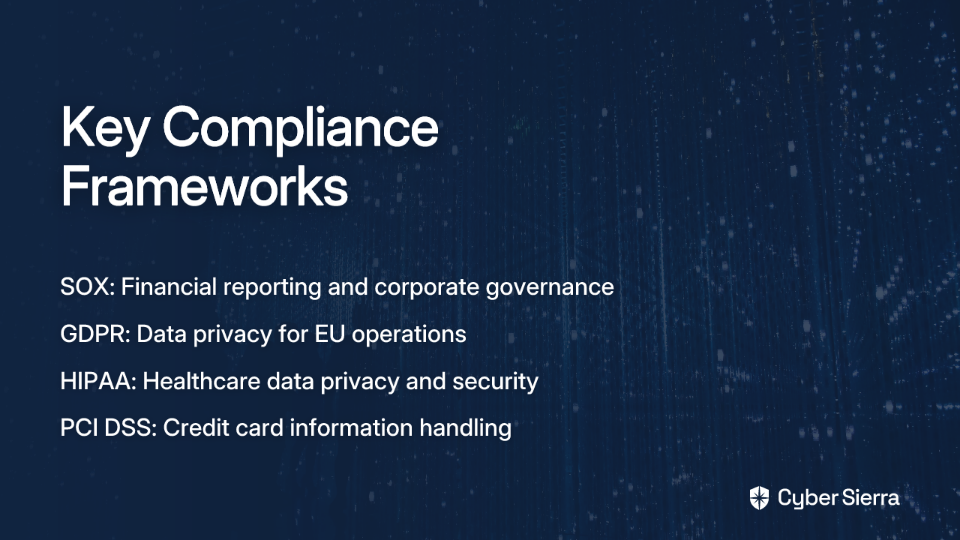
- Sarbanes-Oxley Act (SOX): Financial reporting and corporate governance requirements
- General Data Protection Regulation (GDPR): Data privacy requirements for organizations operating in the EU
- Health Insurance Portability and Accountability Act (HIPAA): Healthcare data privacy and security standards
- Payment Card Industry Data Security Standard (PCI DSS): Requirements for organizations that handle credit card information
The Value of Compliance
While sometimes viewed as a burden, compliance delivers significant benefits:
- Legal protection: Avoiding fines, penalties, and legal action
- Reputational integrity: Maintaining stakeholder trust
- Operational stability: Preventing disruptions from regulatory intervention
- Ethical culture: Fostering an environment of integrity
However, as one cybersecurity professional cautions, "Being compliant to an external standard doesn't make you secure." This underscores that compliance is meeting a minimum standard, not necessarily achieving optimal protection.
Key Differences Between Risk Management and Compliance
Understanding the fundamental differences between risk management and compliance helps clarify their distinct yet complementary roles:
1. Focus and Approach
Risk Management:
- Proactive identification of potential threats
- Forward-looking assessment of what might happen
- Strategic decision-making about risk tolerance
- Continuous adaptation to changing risk landscapes
Compliance:
- Reactive adherence to established rules
- Current-state evaluation of what is happening
- Tactical implementation of required controls
- Periodic assessment based on regulatory cycles
2. Scope and Coverage
Risk Management:
- Addresses all types of risks (strategic, operational, financial, etc.)
- Tailored to the organization's specific risk profile
- Prioritizes risks based on impact and likelihood
- May go beyond regulatory requirements
Compliance:
- Focuses specifically on regulatory and legal requirements
- Standardized based on industry and regulatory frameworks
- Treats all compliance requirements as mandatory
- Limited to established rules and regulations
3. Organizational Positioning
Risk Management:
- Often integrated with strategic planning
- May report to the CEO or board level
- Cross-functional collaboration across departments
- Influences business decision-making
Compliance:
- Typically operates within legal or regulatory affairs
- Usually reports to legal counsel or dedicated compliance officer
- Focused interaction with regulatory bodies
- Ensures business decisions meet regulatory requirements
Common Misconceptions and Challenges
Organizations often struggle with several misconceptions that hamper effective implementation of both risk management and compliance:
Misconception 1: Compliance Equals Security
"Compliance is not security" is a common refrain among cybersecurity professionals. As one Reddit user noted, "I've seen more people agree with this statement than not, even those that are in this field."
Meeting compliance requirements provides a baseline level of protection, but true security requires a comprehensive risk management approach that goes beyond regulatory minimums. Compliance tells you what you must do; risk management helps you determine what you should do.
Misconception 2: Risk Management is Just Paperwork
Some professionals struggle to see the value of risk assessments. One risk manager with over 10 years of experience confessed, "Been doing various types of risk assessment for over 10 years in 3 companies and don't get its importance."
This perception often stems from organizations treating risk management as a documentation exercise rather than an integral part of decision-making. When risk assessments are conducted but their recommendations ignored, the process becomes performative rather than protective.
As one frustrated professional noted, "If anything happens they can say 'Look we did a risk assessment and made recommendations' then if the business ignores the recommendation and you get popped it's not my fault!'"
Misconception 3: Compliance is a One-Time Project
Many organizations approach compliance as a checklist to complete rather than an ongoing process. This misunderstanding leads to periodic scrambles to meet audit requirements rather than embedding compliance into daily operations.
"Compliance is not just a checklist; it's a mindset and culture shift needed in organizations," explained one GDPR professional. This cultural dimension is often overlooked in compliance programs.
Integrating Risk Management and Compliance
The most effective organizations don't treat risk management and compliance as isolated functions but integrate them into a cohesive governance framework. This integration, often called Governance, Risk, and Compliance (GRC), provides several advantages:
Benefits of Integration
- Elimination of redundant efforts: Coordinated risk and compliance activities reduce duplication
- Comprehensive risk coverage: Ensures regulatory compliance while addressing broader risks
- Consistent approach: Harmonized methodologies and terminology across functions
- Strategic alignment: Links risk and compliance activities to business objectives
- Enhanced resource allocation: Prioritizes efforts based on both regulatory requirements and risk exposure
Best Practices for Integration

- Establish a unified governance structure: Create clear reporting lines and responsibilities
- Adopt integrated technology solutions: Implement GRC platforms that support both functions
- Develop a common risk language: Ensure consistent terminology across the organization
- Align assessment methodologies: Coordinate risk and compliance assessment approaches
- Foster a risk-aware culture: Promote awareness of both risk and compliance responsibilities
Frequently Asked Questions
What is the main difference between risk management and compliance?
The main difference lies in their focus and approach: risk management is proactive and strategic, focusing on identifying and mitigating potential future threats across the organization, while compliance is reactive and tactical, centered on adhering to existing laws, regulations, and standards. Risk management asks "what could happen?" whereas compliance asks "are we following the rules now?"
Why is risk management considered proactive while compliance is reactive?
Risk management is considered proactive because it involves looking ahead to anticipate potential problems and opportunities, and then developing strategies to manage them before they materialize. It's about shaping the future. Compliance, on the other hand, is reactive because it responds to established external rules and internal policies, ensuring the organization meets current obligations and standards.
Does being compliant mean an organization is secure?
No, being compliant does not automatically mean an organization is secure. Compliance typically sets a minimum baseline of requirements. True security often requires a more comprehensive, tailored approach driven by risk management, which addresses threats specific to the organization that may go beyond regulatory mandates. Compliance is a part of security, but not the entirety of it.
What are the key benefits of integrating risk management and compliance?
Integrating risk management and compliance, often under a GRC framework, offers several benefits, including eliminating redundant efforts, providing comprehensive risk coverage, ensuring a consistent approach to governance, strategically aligning these functions with business objectives, and optimizing resource allocation. This holistic view helps organizations operate more efficiently and effectively.
How do risk management and compliance contribute to an organization's overall governance?
Both risk management and compliance are crucial components of an organization's overall governance structure. Risk management contributes by informing strategic decisions and ensuring the organization is prepared for potential uncertainties, thereby protecting its assets and objectives. Compliance contributes by ensuring the organization operates ethically and within legal boundaries, maintaining its license to operate and stakeholder trust. Together, they support informed decision-making and responsible operations.
When should an organization prioritize risk management over compliance, or vice-versa?
Neither should be chronically prioritized over the other as both are essential; however, their immediate focus can shift. Organizations must always meet compliance obligations to avoid legal penalties. Beyond that, risk management should drive strategic decisions, identifying where to invest resources for optimal protection and opportunity, which may exceed compliance minimums. In stable environments with well-defined regulations, compliance might seem more prominent day-to-day, but risk management underpins long-term resilience and strategic success.
Conclusion
While risk management and compliance serve different purposes, they are complementary functions that work best when integrated. Risk management provides the forward-looking strategic approach to identifying and mitigating potential threats, while compliance ensures adherence to mandatory regulatory requirements.
The most successful organizations recognize that neither function alone is sufficient. As one Reddit user aptly summarized the relationship: "Risk management is about making informed decisions about what could go wrong and how to handle it. Compliance is about ensuring you're following the rules that have been established."
By understanding the distinct roles of each function and implementing them in a coordinated manner, organizations can both protect their assets and meet their regulatory obligations. The key is moving beyond viewing either function as mere paperwork exercises and instead embedding them into the organization's decision-making processes and culture.

Whether you're implementing these functions for the first time or looking to enhance existing programs, start by clarifying their distinct purposes while exploring opportunities for integration. This balanced approach will help your organization navigate both the known waters of regulatory requirements and the uncharted territories of emerging risks.
Remember that "getting your head around the difference between the letter of the law and the practical implications of it" takes time and effort, but the investment pays dividends in organizational resilience and sustainable growth.
