



Understanding Sarbanes-Oxley Title II: Auditor Independence


Join thousands of professionals and get the latest insight on Compliance & Cybersecurity.
You've been tasked with ensuring your firm's compliance with auditor independence requirements, but you're struggling to navigate the complex web of rules and regulations. Perhaps you're wondering if preparing financial statements for an audit client constitutes a self-review threat, or you're unsure how personal relationships might impact your independence status. These concerns are common among accounting professionals, and for good reason – auditor independence is the cornerstone of financial reporting integrity.
The Sarbanes-Oxley Act of 2002 (SOX) revolutionized corporate governance and financial reporting standards in the United States, with Title II specifically addressing auditor independence. This landmark legislation emerged in response to major accounting scandals like Enron and WorldCom that shook investor confidence to its core.
The Foundation of Auditor Independence
Title II of the Sarbanes-Oxley Act establishes stringent standards to ensure external auditors remain independent from their audit clients. This independence is crucial for reducing conflicts of interest that could compromise an audit's integrity and objectivity.
The Public Company Accounting Oversight Board (PCAOB), created under SOX, plays a vital role in enforcing these standards. As a nonprofit corporation established by Congress, the PCAOB essentially "audits the auditors," ensuring they adhere to SOX standards and protecting investors through improved audit oversight.
But why does auditor independence matter so much? It's not just a procedural rule—it's the bedrock of public trust in financial markets. When auditors maintain their independence, financial statements gain credibility, and investors are better protected from fraudulent reporting.
Breaking Down SOX Title II: Key Provisions
Let's examine the critical sections of Title II that define auditor independence requirements:

Section 201: Services Outside the Scope of Practice of Auditors
This section directly addresses one of the most common concerns among accounting professionals: the self-review threat. It explicitly prohibits registered public accounting firms from providing certain non-audit services to the same clients they audit.
The prohibited services include:
- Bookkeeping or other services related to accounting records or financial statements
- Financial information systems design and implementation
- Appraisal or valuation services, fairness opinions, or contribution-in-kind reports
- Actuarial services
- Internal audit outsourcing services
- Management functions or human resources
- Broker or dealer, investment adviser, or investment banking services
- Legal services and expert services unrelated to the audit
Services not specifically prohibited may be provided, but only with pre-approval from the client's audit committee, which brings us to the next important provision.
Section 202: Pre-Approval Requirements
All audit and permissible non-audit services must be pre-approved by the issuer's audit committee. This empowers the audit committee to act as a gatekeeper, ensuring that any additional services do not compromise the auditor's objectivity.
There is a de minimis exception for non-audit services that constitute less than 5% of total fees paid to the auditor, but in practice, most firms rarely rely on this exception and seek explicit approval for all services.
Section 203: Audit Partner Rotation
To prevent overly familiar relationships between auditors and clients, SOX mandates rotation of key audit personnel:
- The lead and concurring (reviewing) audit partners must rotate off the audit after five consecutive years
- Following rotation, these partners must observe a "cooling-off" period of five years before returning to that client's audit
- Other significant audit partners must rotate after seven consecutive years with a two-year cooling-off period
This rotation requirement helps maintain a fresh perspective and reduces the risk of compromised independence due to long-standing relationships.
Section 204: Auditor Reports to Audit Committees
Communication is key to maintaining independence. Under this section, registered public accounting firms must report to the audit committee on:
- All critical accounting policies and practices to be used
- Alternative treatments of financial information within Generally Accepted Accounting Principles (GAAP) that have been discussed with management
- Other material written communications between the auditor and management
Section 206: Conflicts of Interest
This section addresses the "revolving door" concern by prohibiting an accounting firm from auditing a public company if one of the company's key executives (CEO, CFO, Controller, etc.) was employed by the audit firm and worked on the company's audit during the one-year period preceding the current audit.
Real-World Impact: SOX at 20 Years
Two decades after its implementation, SOX has significantly transformed the accounting landscape:
- Increased Audit Quality and Scrutiny: The PCAOB's oversight has led to a significant focus on audit quality. However, violations still occur. The PCAOB noted a sharp increase in independence-related violations during its 2023 audit inspection cycle, with comment forms on independence issues rising from 7% in 2021 to 14% in 2023.
- Restored Investor Confidence: A Center for Audit Quality survey showed investor confidence in independent auditors rose from 67% to 83% between 2011 and 2019, while confidence in independent audit committees similarly increased from 63% to 81%.
- Improved Financial Reporting: After SOX implementation, financial restatements initially spiked by 66% in 2005-2006 as companies adjusted to stricter standards. The subsequent decline in restatements indicated that SOX led to more reliable reporting practices.
Navigating Common Independence Scenarios
Let's address some common scenarios that cause confusion about auditor independence under SOX Title II:
The "Self-Review Threat" - Preparing Financials for an Audit Client
A common question is: "If I prepare financial statements for an audit client, doesn't that create a self-review threat that impairs independence?"
The answer lies in understanding the distinction between preparation and decision-making. Preparing financial statements from a client-provided trial balance (TB) is considered a non-attest service and does not inherently impair independence as long as the auditor does not make any managerial decisions. The client's management must:
- Take responsibility for the financial statements
- Approve all significant judgments
- Understand the basis for any accounting treatments
As one CPA noted, "A CPA preparing financial statements from information given to them is a SSAR service. He/she does not need to be independent to prepare, however a CPA is not independent when he/she is making managerial decisions on the client's behalf."
Personal Conflicts of Interest - Relationships and Financial Holdings
Another area of concern involves personal relationships with client personnel. If you're wondering, "What if my significant other is a senior person in the client structure?" - the answer is straightforward: independence is about both fact and appearance.
Even if you believe you can remain objective, the appearance of a conflict of interest can be just as damaging. In such situations, your firm would likely prohibit you from working on that audit engagement. The best practice is to formally notify your manager and the firm's independence office immediately to get the situation on record.
Internal vs. External Auditors' Roles in SOX
There's often confusion about the respective roles of internal and external auditors under SOX. Here's the distinction:
- Internal Auditors work for the company and help management design, implement, and test Internal Controls for Financial Reporting (ICFR) throughout the year.
- External Auditors work for the accounting firm and provide an independent opinion on both the financial statements and the effectiveness of the company's internal controls.
Best Practices for Ensuring Auditor Independence
To avoid independence violations, firms should adopt these PCAOB-recommended practices:
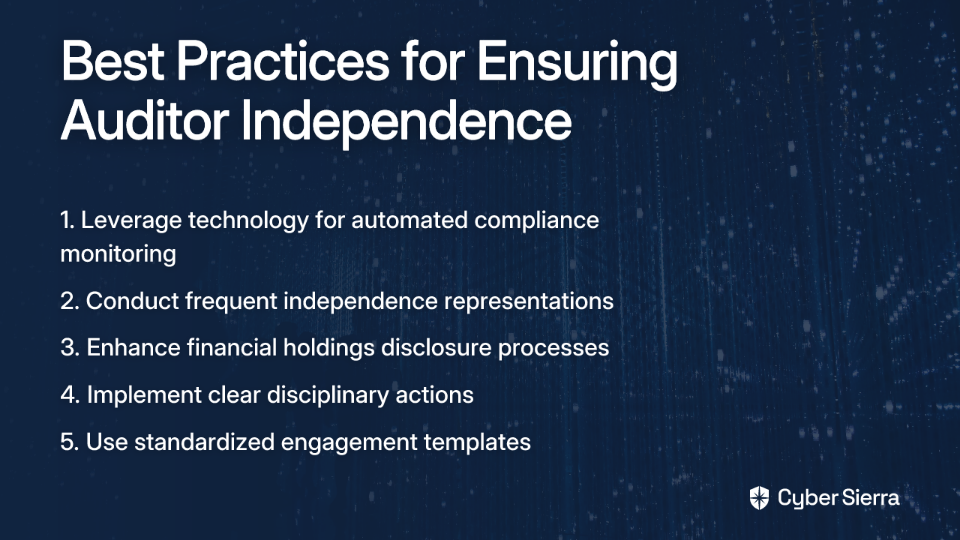
- Leverage Technology: Use automated systems to cross-check employee financial holdings against restricted entity lists to detect personal independence violations early.
- Conduct Frequent Representations: Move from annual to quarterly compliance confirmations to keep independence top-of-mind.
- Enhance Disclosure Processes: Mandate training on proper disclosure of financial holdings and verify reported information against account statements.
- Implement Clear Disciplinary Actions: Establish and enforce sanctions for non-compliance to signal the seriousness of independence policies.
- Use Standardized Templates: Employ global templates for audit engagement letters to prevent prohibited clauses like indemnification.
The Cornerstone of Trust
SOX Title II fundamentally reshaped the accounting profession by codifying the principles of auditor independence. Its rules on prohibited services, partner rotation, and audit committee oversight are not just regulatory hurdles—they are essential safeguards for our financial markets.
For auditors, firms, and corporate boards, understanding and rigorously applying the principles of auditor independence under sarbanes oxley 2 is paramount. It is the foundation upon which investor confidence and the integrity of our capital markets are built. True independence is non-negotiable.
Frequently Asked Questions
What is the main purpose of SOX Title II?
The main purpose of Title II of the Sarbanes-Oxley Act (SOX) is to establish and enforce strict auditor independence standards. This is done to eliminate conflicts of interest, enhance the credibility of financial audits, and restore investor confidence in public financial reporting. The rules outlined in Title II are designed to ensure that external auditors remain objective and skeptical when examining a client's financial statements.
Can an auditor prepare financial statements for a client they audit?
Yes, an auditor can prepare financial statements for an audit client, but only under specific conditions. This service is permissible as long as the auditor does not make any managerial decisions on the client's behalf. The client's management must take full responsibility for the financial statements, approve all significant judgments, and understand the accounting treatments used. This prevents a "self-review threat," where the auditor would essentially be auditing their own work.
How often must audit partners be rotated under SOX?
SOX requires mandatory rotation of key audit partners to maintain a fresh perspective. The lead and concurring (reviewing) audit partners must rotate off an audit after five consecutive years and then observe a five-year "cooling-off" period. Other significant audit partners have a seven-year rotation limit, followed by a two-year cooling-off period.
What are some non-audit services auditors are forbidden from providing to clients?
SOX Title II, Section 201, explicitly prohibits auditors from providing several non-audit services to their audit clients to avoid conflicts of interest. These forbidden services include bookkeeping, financial information systems design, appraisal or valuation services, actuarial services, internal audit outsourcing, management or human resources functions, and legal services unrelated to the audit.
What happens if an auditor has a personal conflict of interest with a client?
If an auditor has a personal conflict of interest, such as a close family member in a key financial role at the client company, their independence is considered impaired. Both the fact and the appearance of a conflict are critical. The auditor must immediately disclose the situation to their firm's independence office. Typically, the firm will remove the auditor from that specific engagement to maintain integrity and objectivity.
Why is auditor independence so important?
Auditor independence is critically important because it is the bedrock of trust in financial markets. When auditors are truly independent, their opinion on financial statements is more credible and reliable. This protects investors from misleading or fraudulent financial reporting, promotes confidence in capital markets, and ensures the integrity of the entire financial ecosystem.
