



How to Choose a Security Compliance Platform (A CISO Buyer Guide)

Join thousands of professionals and get the latest insight on Compliance & Cybersecurity.
Summary
- Manual evidence gathering for compliance audits is a major pain point, consuming hundreds of engineering hours and creating a "compliance treadmill."
- To choose the right platform, evaluate it across five key dimensions: framework breadth, automation depth, continuous monitoring, integrated TPRM, and Total Cost of Compliance (TCC).
- Look for automated evidence collection (which can reduce workloads by 30-40%), continuous control monitoring to prevent compliance drift, and integrated vendor risk management.
- A unified platform like Cyber Sierra automates these processes, transforming compliance from a periodic scramble into a continuous, strategic function.
You've sat through the audit kick-off call. You've sent the "hey, can you grab a screenshot of that config with a timestamp?" Slack message — for the hundredth time. You've watched your engineers, who should be patching production systems, spend their afternoon on calls with your GRC team trying to explain what an S3 bucket policy is.
Sound familiar? You're not alone.
That's the compliance treadmill. And the market is flooded with vendors claiming they can get you off it.
Some can. Many can't. And choosing wrong doesn't just waste your budget — it creates a new category of technical debt, a tool that your team has to configure, maintain, and babysit while still doing compliance work manually.
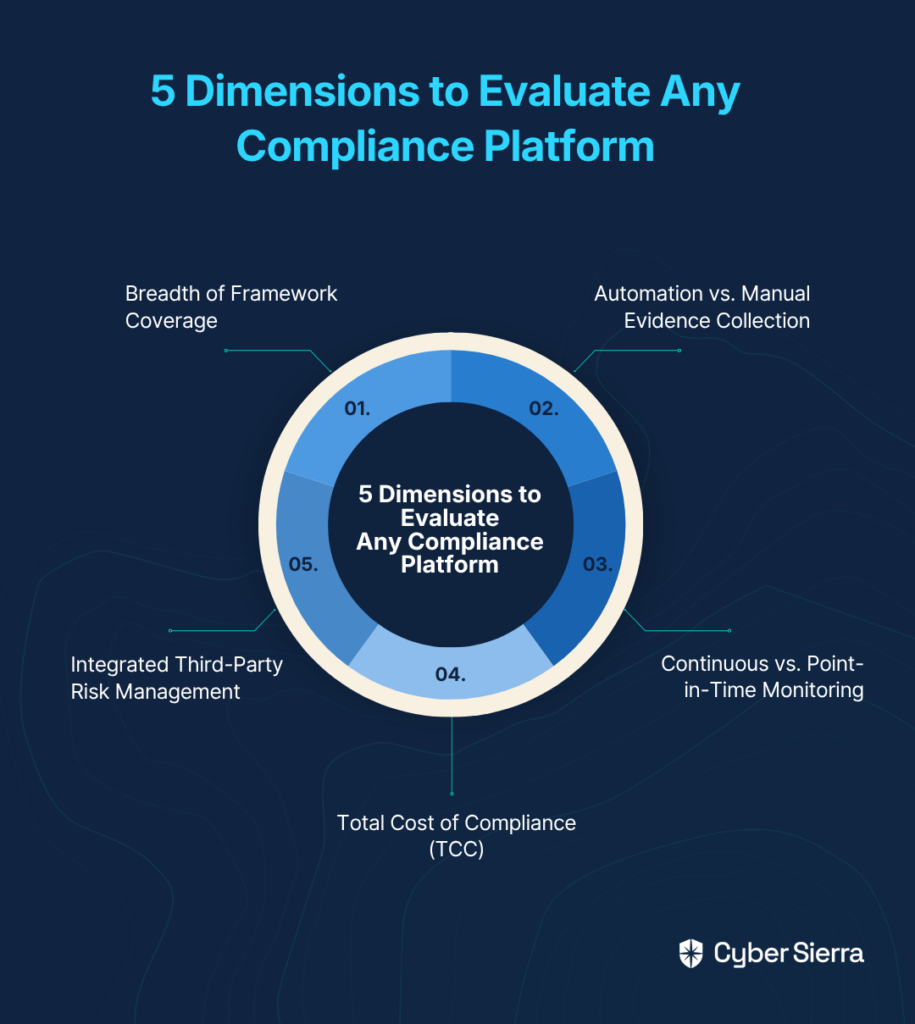
This guide gives you a structured, five-dimensional framework to evaluate any security compliance platform like a CISO — not a feature-checker. By the end, you'll know exactly what to ask vendors, what trade-offs to watch for, and how to build the business case for a platform that acts as a genuine force multiplier.
The 5 Dimensions That Separate Great Compliance Platforms from Expensive Spreadsheets
Dimension 1: Breadth of Framework Coverage
Your business doesn't operate under a single regulation. A typical compliance portfolio might include:
- SOC 2 for US enterprise customers
- ISO 27001 for European contracts
- HIPAA for health data
- PCI DSS for payment processing
- NIST for the federal space
And that's before any customer-specific security questionnaires land in your inbox.
A platform that only handles one framework is a silo waiting to happen. You'll end up paying for one tool to manage SOC 2, another for ISO 27001, and still going back to spreadsheets for everything else.
What to look for:
- Pre-built control libraries for SOC 2, ISO 27001, NIST CSF, PCI DSS, HIPAA, and GDPR out of the box
- Cross-framework control mapping — the "collect once, apply many" principle. One piece of evidence should satisfy controls in multiple frameworks simultaneously, not require re-collection
- Custom framework support to accommodate internal policies and unique risk requirements
Questions to ask vendors:
- "If I get a new PCI DSS requirement next quarter, how long does it take to add it to the platform?"
- "Show me how a single piece of evidence maps to overlapping controls across SOC 2 and ISO 27001."
Cyber Sierra's GRC platform is built around this multi-framework reality — managing SOC 2, ISO 27001, GDPR, HIPAA, PCI DSS, and custom controls from a single, centralized policy repository so your team isn't rebuilding the wheel for every new audit.
Dimension 2: Automation vs. Manual Evidence Collection
This is where most platforms either earn their seat at the table or reveal themselves as glorified GRC spreadsheets.
Manual evidence collection is the single biggest cost center in audit prep. It's not just the time it takes — it's the coordination cost. Think about what it takes to get a timestamped screenshot of an AWS IAM configuration from an engineer who is simultaneously managing a P1 incident. Now multiply that across 200 controls.
The right platform eliminates this entirely through deep, API-driven integrations.
What to look for:
- Native integrations with your cloud providers (AWS, Azure, GCP), identity providers (Okta, Azure AD), code repositories (GitHub, GitLab), and endpoint management tools
- Automated evidence pulling that continuously syncs control data without human intervention
- Audit-ready evidence packages that can be shared directly with auditors, reducing the back-and-forth communication bottleneck
The practitioners who've made the switch are clear on the ROI: "Does it shorten the audit period? Maybe not. Does it lighten your load? 100%. I would estimate for a small to midsize business, it probably reduces the load by a factor of 30-40%."
A 30-40% reduction in compliance workload is not a marginal improvement — it's the difference between your team being reactive and strategic.
Questions to ask vendors:
- "Which specific integrations do you support, and how deep does the evidence collection go?"
- "What happens when a new tool is added to our stack — how long until it's pulling evidence?"
Dimension 3: Continuous vs. Point-in-Time Monitoring
Here's the uncomfortable truth about most compliance programs: they're built around a snapshot. Your team scrambles for six weeks before the audit, everything looks good on audit day, and then the environment quietly drifts out of compliance for the next ten months until the cycle repeats.
That drift is where breaches live.
CISA has long emphasized ongoing assessments as foundational to security programs — not because regulators demand it, but because the threat landscape doesn't pause between your audits.
Continuous Controls Monitoring (CCM) is the capability that closes this gap. Instead of periodic checks, CCM provides near real-time visibility into your security controls, automatically detecting when something drifts out of its compliant state — a public S3 bucket, a disabled MFA requirement, an expired certificate — and alerting your team before it becomes an auditor's finding or an attacker's entry point.
The key benefits of CCM, as highlighted by industry research, include:
- Efficiency: Reduces manual processes, freeing time for strategic security initiatives
- Cost Reduction: Lowers costs associated with compliance failures and reactive remediation
- Improved Decision-Making: Provides data-backed insights for leadership reporting
- Proactive Risk Management: Identifies vulnerabilities before they are exploited
Cyber Sierra's CCM module is built specifically around this principle — providing near real-time updates to a central controls repository, automating control testing and validation, and detecting anomalies the moment they occur.
Questions to ask vendors:
- "What is your monitoring frequency — real-time, daily, or weekly?"
- "Show me what an alert looks like when a control drifts out of compliance."
- "How does your platform distinguish between a configuration change that's approved versus one that's a risk?"
Dimension 4: Integrated Third-Party Risk Management (TPRM)
Your attack surface doesn't end at your perimeter. It ends at your vendors' perimeters — and their vendors' perimeters.
According to a Gartner survey, 45% of organizations experienced a third-party-related business interruption in the last two years. A compliance program is incomplete if it doesn't account for the risk sitting in the vendor ecosystem.
The problem with most TPRM programs? The process itself is broken. Many platforms rely on the SIG questionnaire — a comprehensive but notoriously exhaustive framework where, as one compliance practitioner noted, "many questions means that your Third Parties have many questions to answer and you have many answers to evaluate." The result is analysis paralysis, months-long backlogs, and questionnaire responses that are outdated by the time they're reviewed.
What to look for:
- Built-in TPRM, not a bolt-on: A unified module that shares data with your GRC and CCM capabilities eliminates the context-switching and data silos that plague separate point solutions
- Automated vendor assessments: The platform should auto-generate and track assessments, not just store PDFs
- Continuous vendor monitoring: Real-time visibility into vendor security posture, not a questionnaire you send once a year and forget
- AI-enabled risk scoring: Modern platforms leverage AI to analyze vendor data for anomalies and generate dynamic risk assessments — moving the needle from reactive evaluation to proactive intelligence.
Cyber Sierra's TPRM module addresses this directly — automating vendor assessments, prioritizing vendor inventory by risk level, and providing 24/7 visibility into vendor security compliance rather than relying on point-in-time questionnaires that age out immediately.
Dimension 5: Total Cost of Compliance (TCC) — Not Just TCO
The sticker price conversation is a trap. A platform with a higher annual fee that eliminates hundreds of hours of manual audit prep is dramatically cheaper than a low-cost tool that still requires significant manual work.
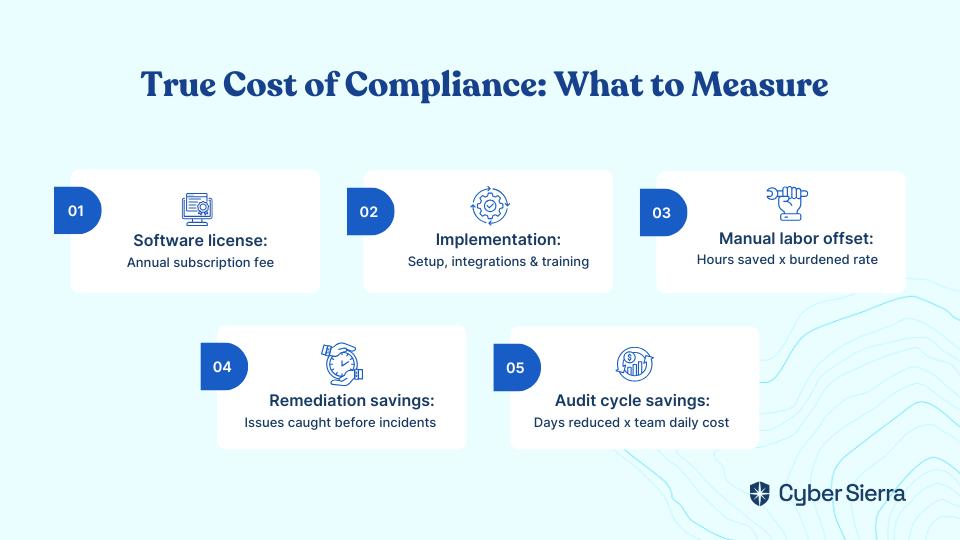
True cost modeling should include:
| Cost Category | What to Measure |
|---|---|
| Software license | Annual subscription fee |
| Implementation | Setup time, integrations, training |
| Manual labor offset | Hours saved × burdened hourly rate |
| Remediation cost reduction | Issues caught by CCM before becoming incidents |
| Audit cycle time savings | Days reduced × team daily cost |
Consider: 200 hours of engineering and compliance time saved at a burdened rate of $100/hour equals a $20,000 value — often exceeding the annual license cost entirely. Companies using automated tools consistently report saving hundreds of hours on audit prep, translating into cost reductions that dwarf the subscription fee.
The hidden cost of cheap or manual tools also includes the risk of compliance failures, fines, and the reputational damage of a breach that CCM could have caught. Build that into your model.
Comparison Matrix: Unified Platform vs. Siloed / Manual Approach
| Buying Dimension | Unified Platform (e.g., Cyber Sierra) | Siloed Tools & Spreadsheets |
|---|---|---|
| Framework Coverage | Multi-framework out of the box (SOC 2, ISO 27001, NIST, HIPAA, PCI DSS, GDPR) with cross-mapping | Single-framework or manual mapping; evidence re-collected per audit |
| Evidence Collection | Fully automated via API integrations; collect once, apply to many controls | Manual screenshots, spreadsheets, long engineering calls, high error rate |
| Control Monitoring | Continuous (CCM): 24/7 real-time alerts for configuration drift | Point-in-time: periodic checks before audits; gaps missed year-round |
| TPRM | Integrated module with automated assessments and continuous vendor monitoring | Separate tool or spreadsheets; point-in-time questionnaires that go stale |
| AI-Enabled Intelligence | Risk scoring, anomaly detection, and prioritized remediation across GRC and TPRM | Minimal or none; manual analysis required to identify and triage risks |
| Total Cost of Compliance | Higher upfront, lower TCC due to audit prep savings and proactive risk management | Lower sticker price, significantly higher TCC from hidden labor and remediation costs |
The pattern is clear: siloed tools fail on multiple dimensions simultaneously, not just one. And the compounding effect — manual evidence + point-in-time monitoring + separate TPRM tool + no AI — is the compliance treadmill in its worst form.
How Cyber Sierra Delivers on All Five Dimensions
Cyber Sierra is built as a unified, AI-enabled security compliance platform designed specifically to address each of these dimensions — not as separate products stitched together, but as an integrated suite sharing a single data layer.
- Continuous Control Monitoring (CCM) automates evidence gathering and provides near real-time visibility into control effectiveness — turning audit readiness from a frantic project into a continuous state.
- GRC manages multiple compliance frameworks from a single pane of glass, with automated data collection, policy management, and audit trail generation across SOC 2, ISO 27001, HIPAA, PCI DSS, GDPR, and more.
- TPRM moves vendor risk from a static annual questionnaire exercise to a dynamically monitored program with automated assessments, risk-based prioritization, and 24/7 vendor posture visibility.
- AI-enabled intelligence runs across all modules, surfacing anomalies, prioritizing remediation, and reducing the manual analytical burden on your team.
The result is a direct attack on the Total Cost of Compliance — fewer manual hours, faster audit cycles, fewer surprises, and a security posture that's defensible every day of the year, not just in the two weeks before an auditor shows up.
Make Your Next Audit Your Last Hard One
The compliance treadmill isn't just a metaphor; it's hundreds of engineering hours lost to manual evidence collection and last-minute fire drills. The right platform gets you off it by automating evidence gathering across your entire tech stack and using continuous monitoring to keep you compliant year-round—not just for a point-in-time audit.
This shifts the conversation from sticker price to Total Cost of Compliance (TCC), where the value of reclaimed engineering time far outweighs the software license.
Your next step today? Calculate the hours your team spent on the last audit cycle. That number is the foundation of your business case for a better way.
When you’re ready to see how automation can reclaim those hours, book a personalized demo. We’ll show you how a unified platform turns compliance from a cost center into a force multiplier that actually improves your security posture.
Frequently Asked Questions
What is a security compliance platform?
A security compliance platform is software that centralizes and automates tasks required to meet regulatory standards like SOC 2 or ISO 27001. It automates evidence collection, continuously monitors security controls, and manages policies to make audits faster and reduce manual work for your team.
Why is automated evidence collection so important?
Automated evidence collection is important because it eliminates the single biggest time-sink in audit preparation. By using API integrations to pull data directly from cloud services and tools, it frees engineers from manual screenshot gathering, reduces human error, and ensures evidence is always current.
How does continuous controls monitoring (CCM) improve security?
Continuous Controls Monitoring (CCM) improves security by providing 24/7 real-time visibility into your controls. It automatically detects and alerts you to any configuration drift, such as a disabled MFA setting, allowing you to fix issues before they become audit findings or security breaches.
What should I look for in a compliance platform's framework coverage?
Look for a platform that offers broad, pre-built support for key frameworks like SOC 2, ISO 27001, PCI DSS, and HIPAA. It must also feature cross-framework mapping, so one piece of evidence can satisfy multiple controls, and allow for custom frameworks to fit your internal policies.
How is the Total Cost of Compliance (TCC) different from the software price?
The Total Cost of Compliance (TCC) measures the full investment, not just the license fee. It includes the cost of the software plus the value of manual labor it saves. A platform that automates heavily can have a lower TCC than a cheaper tool that still requires hundreds of staff hours.
Why should third-party risk management (TPRM) be integrated?
Integrating TPRM is critical because your security posture depends on your vendors. A unified platform connects vendor risk data with your internal controls, providing a complete risk picture and replacing outdated, point-in-time questionnaires with continuous, automated vendor monitoring.
