



How to Reduce Security Operations Costs by 60% with Automation

Join thousands of professionals and get the latest insight on Compliance & Cybersecurity.
Summary
- Security operations costs are spiraling due to a global talent shortage and excessive manual labor, but strategic automation can slash these costs by up to 60%.
- The biggest budget drains are manual compliance tasks, inefficient vendor risk management, and alert fatigue, which slow down teams and increase risk.
- Focus automation efforts on high-impact areas like Governance, Risk, and Compliance (GRC), Third-Party Risk Management (TPRM), and Continuous Control Monitoring (CCM) to see the greatest returns.
- Integrated platforms like Cyber Sierra automate these critical functions, transforming security from a cost center into a proactive, strategic advantage.
You've set up a robust security operations center. You've invested in top-tier talent, implemented cutting-edge tools, and diligently followed best practices. Yet your security budget continues to balloon while your team drowns in alerts, manual tasks, and compliance paperwork.
In an era where cyber threats are multiplying exponentially but security budgets are under intense scrutiny, security leaders face what feels like an impossible dilemma: how do you strengthen your security posture while simultaneously reducing operational costs?
The Unwinnable Battle: Balancing Rising Threats and Shrinking Budgets
If you're struggling to justify your security operations costs, you're not alone. According to discussions across professional forums, organizations are increasingly "facing challenges in finding cost reduction options within their cybersecurity budgets" while simultaneously harboring "doubts regarding the value added by SOC services."
This tension is exacerbated by a critical reality: there's a global shortage of 3.9 million cybersecurity professionals, creating a perfect storm of higher salary demands, increased recruitment costs, and constant retention challenges. This shortage isn't just a hiring inconvenience—it's directly inflating your operational expenses.
But what if there was a way to break this cycle? What if automation could be the key to not just marginal savings, but a transformative 60% reduction in security operations costs?
Why Your Security Operations Budget is Spiraling
Before diving into solutions, it's crucial to understand exactly what's draining your security budget:
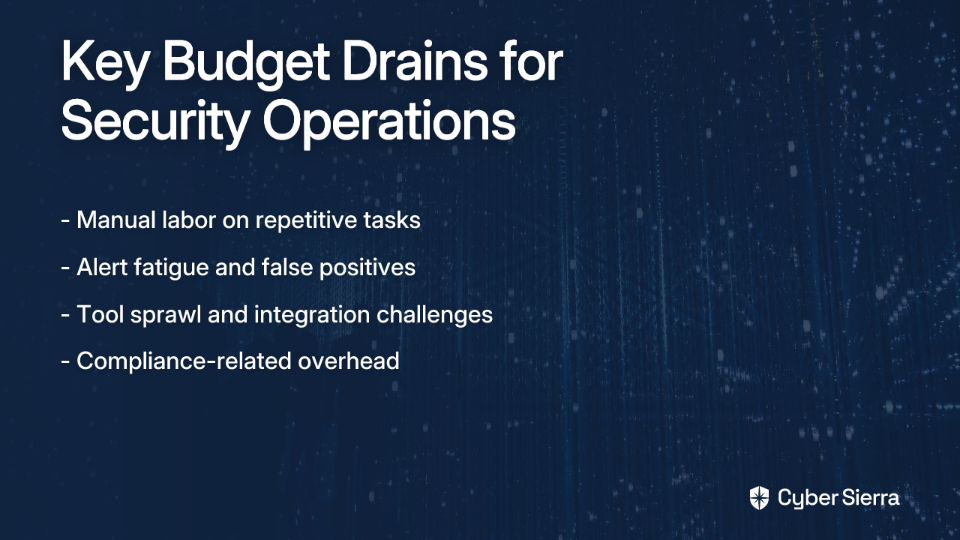
The Manual Labor Tax
The most expensive component of security operations isn't your technology—it's the human hours spent on repetitive, low-value tasks. Security teams report "time management concerns driving the need for automation" as they struggle with:
- Manual log analysis and correlation
- Repetitive compliance documentation
- Time-consuming vulnerability management
- Labor-intensive vendor risk assessments
The High Cost of Alert Fatigue
Without automation, security analysts become overwhelmed by the sheer volume of alerts—many of which are false positives. This leads to:
- Decreased analyst effectiveness and morale
- Higher turnover rates among skilled professionals
- Critical alerts potentially being missed
- Slower response times to genuine threats
Research shows that automation can achieve a 90% reduction in false positives, freeing up analysts to focus on what matters. This isn't just about efficiency—it directly impacts retention and job satisfaction, with studies showing a 25-35% increase in job satisfaction for analysts in highly automated environments.
Tool Sprawl & Integration Nightmares
Many security operations centers suffer from a proliferation of disconnected tools:
- SIEM systems that don't integrate with case management
- Endpoint protection platforms isolated from network monitoring
- GRC tools disconnected from vulnerability scanners
- Third-party risk management systems operating in silos
This lack of integration creates massive operational overhead as teams manually correlate data across systems.
The Automation Blueprint: 4 High-Impact Areas to Slash Costs
Let's move beyond theory to practical implementation. Here are the four most impactful areas where automation can dramatically reduce your security operations costs:
1. Governance, Risk, and Compliance (GRC) Automation
The Pain: Manual evidence gathering for audits is incredibly labor-intensive. Many organizations struggle with managing multiple compliance frameworks simultaneously, leading to what industry professionals call "compliance fatigue." The scope of this challenge is massive—the global GRC market was valued at USD 32.2 billion in 2021 and is growing at a 14.5% CAGR through 2030.
The Solution: Automating GRC processes can transform compliance from a periodic scramble into a continuous, efficient process:
- Establish Clear Objectives: Define your goals and involve stakeholders from legal, IT, and compliance departments.
- Assess Current Processes: Identify bottlenecks and map existing workflows to understand where automation will have the greatest impact.
- Select the Right Tools: Choose technology that fits your current and future compliance needs across multiple frameworks.
- Implement with Change Management: Provide training and establish data quality controls to ensure successful adoption.
Platforms like Cyber Sierra's GRC module are designed to execute this blueprint, automating data collection, risk assessments, and control monitoring to make enterprises audit-ready in a fraction of the time.
2. Third-Party Risk Management (TPRM) Automation
The Pain: Security professionals frequently report "slow vendor onboarding times" and "complexity of TPRM tools leading to inefficiency." Traditional vendor assessment relies on point-in-time questionnaires that quickly become outdated and require enormous manual effort to maintain.
The Solution: Automating vendor risk assessments can reduce onboarding time from weeks to hours:
- Automated vendor questionnaire distribution and tracking
- Continuous monitoring of vendor security postures
- Automated risk scoring and prioritization
- Real-time alerts for changes in vendor security status
For example, Cyber Sierra's TPRM platform automates the entire vendor lifecycle, from initial assessment through continuous monitoring, ensuring your supply chain doesn't become your biggest vulnerability.
3. Incident Response & Threat Hunting (SOAR)
The Pain: Security teams waste precious time on manual triage, investigation, and response processes. Each minute spent manually investigating an alert increases both operational costs and potential breach impacts.
The Solution: Security Orchestration, Automation and Response (SOAR) technologies integrate security tools and automate incident response playbooks:
- Automated alert triage and enrichment
- Playbook-based response to common incident types
- Automated evidence gathering and documentation
- Streamlined escalation processes
The impact is substantial:
- Investigation time reduced by up to 5 minutes per alert
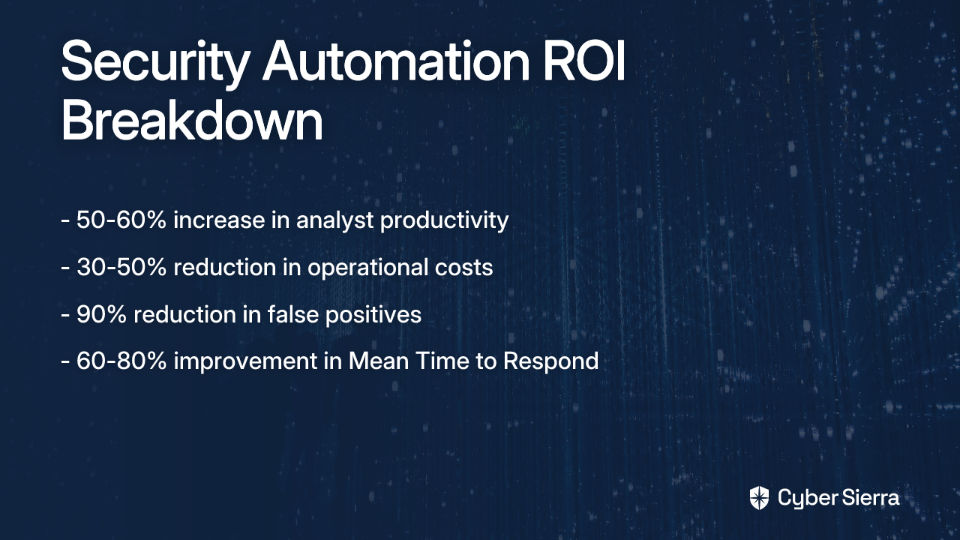
- Mean Time to Respond (MTTR) improved by 60-80%
- Operational costs cut by 30-50%
4. Continuous Control Monitoring (CCM)
The Pain: Traditional security control validation happens through periodic, manual checks that leave organizations vulnerable between assessments and drain valuable security resources.
The Solution: Shift from periodic audits to continuous, automated control validation:
- Automated testing and validation of security controls
- Real-time detection of control failures or misconfigurations
- Centralized visibility into control effectiveness
- Automated evidence collection for compliance purposes
Continuous Control Monitoring transforms compliance from a point-in-time exercise into a continuous, automated process, dramatically reducing the manual effort required while improving your security posture.
The ROI of Automation: Deconstructing the 60% Savings
Let's break down exactly how automation translates into that promised 60% cost reduction:
Fewer Hands, More Brains
Automation doesn't mean replacing your security team—it means elevating them from mundane tasks to high-value work:
- With a 50-60% increase in analyst productivity, your existing team can handle a higher volume of work
- Analysts can pivot from alert triage to proactive threat hunting
- Junior analysts can take on more responsibilities with automated guidance
- Senior resources can focus on strategic initiatives rather than routine operations
Slashing Incident Costs
Faster response directly equals lower costs:
- Reduced dwell time for attackers in your environment
- Fewer incidents escalating to major breaches
- Lower remediation costs through earlier containment
- Reduced risk of regulatory penalties and legal fees
Direct Operational Savings
The numbers speak for themselves:
- 30-50% reduction in operational costs through basic automation
- Up to 60% savings with comprehensive automation strategies
- 90% reduction in false positives, dramatically reducing wasted effort
Optimizing Your Security Stack
An integrated automation approach can also help rationalize your security tool investments:
- Consolidate overlapping tools and functions
- Reduce licensing costs through platform approaches
- Decrease integration and maintenance overhead
- Improve return on existing security investments
Navigating the Pitfalls: Common Challenges in Security Automation
Automation isn't a magic bullet, and security professionals rightfully express a "desire for personal oversight and concerns about fully automated systems". To implement automation successfully, you'll need to navigate these common challenges:
Integration Complexity
Many organizations struggle with "difficulty automating processes, particularly with Microsoft security products" and other legacy systems. The solution:
- Start with platforms designed for integration
- Prioritize open APIs and pre-built connectors
- Consider unified platforms that reduce integration points
Misconfiguration Risks
Poorly implemented automation can create new security risks:
- Begin with "human-in-the-loop" automation where critical actions require approval
- Implement thorough testing of automated workflows
- Start with low-risk use cases before automating critical functions
Change Management Challenges
Automation requires shifts in processes and team responsibilities:
- Involve security analysts in automation design from the start
- Provide clear training on new workflows and technologies
- Communicate the value automation brings to individual roles
Transforming Security from a Cost Center to a Strategic Enabler
Automation isn't just about cost-cutting—it's about fundamentally transforming how security functions within your organization:
- From reactive firefighting to proactive risk management
- From compliance burden to continuous assurance
- From constant resource requests to demonstrable efficiency
- From technical overhead to business enablement
The first step is to assess your own operations. Where is your team spending the most time on manual, repetitive work? Which tasks cause the most frustration and burnout? Answering these questions is the start of your automation journey.
Integrated platforms like Cyber Sierra provide the tools to automate GRC, vendor risk, and control monitoring, helping you transform security operations from a reactive cost center into a proactive, strategic advantage.
By embracing automation strategically, you can achieve that elusive goal: strengthening your security posture while simultaneously reducing costs by up to 60%.

Frequently Asked Questions
How can I reduce my security operations costs?
You can significantly reduce security operations costs by implementing automation in key areas. Automation tackles the biggest budget drains, such as manual labor on repetitive tasks, managing high volumes of false positive alerts, and the overhead from a lack of tool integration. By automating processes, you can achieve up to a 60% reduction in operational expenses.
What are the best areas to start with for security automation?
For the highest impact, start by automating Governance, Risk, and Compliance (GRC), Third-Party Risk Management (TPRM), and incident response (SOAR). These areas are typically labor-intensive and ripe for efficiency gains. Automating GRC reduces audit preparation time, TPRM automation speeds up vendor onboarding, and SOAR dramatically cuts down incident response times.
Will security automation make my security analysts redundant?
No, security automation is designed to augment, not replace, your security team. It elevates analysts by freeing them from mundane, repetitive tasks like manual log analysis and false positive triage. This allows them to focus on higher-value activities such as proactive threat hunting, strategic analysis, and managing complex incidents, leading to a 50-60% increase in productivity and higher job satisfaction.
What is the real ROI of security automation?
The return on investment (ROI) for security automation is substantial and multifaceted. Financially, it can reduce operational costs by 30-60%. Operationally, it leads to a 90% reduction in false positives and improves Mean Time to Respond (MTTR) by 60-80%. Strategically, it increases analyst productivity and retention, transforming your security team from a reactive cost center into a strategic business enabler.
Why is tool integration so important for successful automation?
Tool integration is crucial because disconnected security tools (a problem known as "tool sprawl") create massive operational overhead and data silos. Successful automation, especially through SOAR platforms, relies on seamless communication between your SIEM, endpoint protection, GRC tools, and other systems. An integrated approach ensures that automated workflows can execute end-to-end without manual intervention, maximizing efficiency and effectiveness.
How does automating GRC and compliance save money?
Automating Governance, Risk, and Compliance (GRC) saves money by drastically reducing the manual labor required for audits and continuous monitoring. Instead of periodic, time-consuming evidence gathering, automation provides continuous control validation and real-time data collection. This minimizes the human hours spent on compliance tasks, reduces "compliance fatigue," and ensures the organization is perpetually audit-ready, cutting down on both direct labor costs and the indirect costs of non-compliance.
Ready to explore how automation can transform your security operations? Contact Cyber Sierra for a personalized assessment of your automation opportunities.
