



Top 10 Security Orchestration Platforms with Built-in GRC

Join thousands of professionals and get the latest insight on Compliance & Cybersecurity.
Summary
- Standalone SOAR tools often fail by automating inefficient processes; integrating them with Governance, Risk, and Compliance (GRC) provides essential business context.
- Combining SOAR with GRC enables risk-informed prioritization, ensuring security teams focus on threats that pose the greatest business risk, not just the loudest alerts.
- Before adopting a platform, organizations must evaluate internal processes, assess security maturity, and prioritize key integrations to ensure success.
- A platform with native SOAR and GRC capabilities, like Cybersierra's GRC suite, helps transform security operations into a strategic business enabler.
You've implemented a SOAR (Security Orchestration, Automation, and Response) solution, but your team is still drowning in alerts. The automation is faster, but the number of alerts keeps growing. Your analysts are spending more time managing integrations than actually responding to threats. And when auditors come knocking, you're still scrambling to prove compliance.
Sound familiar?
The hard truth is that traditional SOAR tools often create as many problems as they solve. As one security analyst on Reddit put it: "The SOAR masking the problem, so it never felt like there was an actual difference in analyst workload, but now there were people whose job it was to manage the integration. And that job never quite finished."
The next evolution for mature security programs isn't just SOAR—it's SOAR integrated with Governance, Risk, and Compliance (GRC). This powerful combination bridges the gap between technical security alerts and business-level risk management, transforming your security operations from reactive firefighting to strategic risk mitigation.
Beyond Automation: Why Integrated GRC is a Game-Changer for SOAR
Traditional SOAR platforms excel at automating repetitive security tasks, but they often lack the business context that GRC provides. As another security professional bluntly stated, "Automating a bad process doesn't make it a better process."
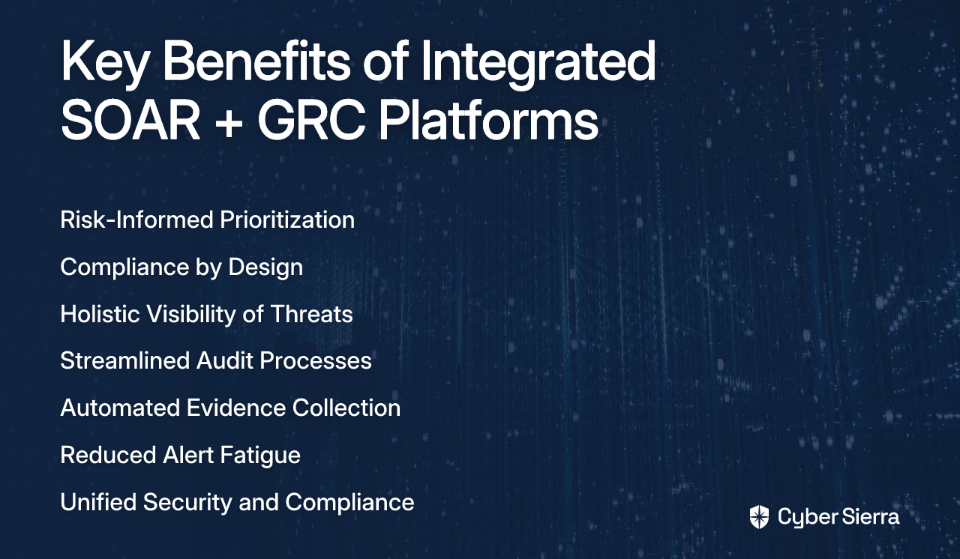
When you integrate GRC functionality with SOAR, you gain several critical advantages:
Risk-Informed Prioritization: Your automated actions are no longer based solely on technical severity but are prioritized according to business risk. This means resources are allocated to threats that matter most to your organization.
Compliance by Design: Workflows and playbooks can be built with compliance frameworks (NIST, ISO 27001, PCI DSS) in mind, ensuring automated responses don't inadvertently violate regulatory requirements.
Holistic Visibility: You connect technical incidents to vendor risks (TPRM), internal controls (CCM), and audit evidence, creating a single source of truth. This is especially important considering that 36% of companies still rely on spreadsheets for third-party management, and only 29% track vendors throughout the relationship lifecycle.
Let's look at the top 10 platforms that successfully merge these critical capabilities:
The Top 10 Security Orchestration Platforms with GRC Functionality
1. Cybersierra
Overview: Cybersierra provides an AI-enabled cybersecurity platform designed from the ground up to simplify and automate security compliance for enterprises. Unlike bolt-on solutions, it natively integrates SOAR capabilities with comprehensive GRC functionality.
Key SOAR + GRC Features:
- Governance, Risk & Compliance (GRC): Automates data collection, risk assessments, and reporting across multiple frameworks (SOC2, ISO 27001, HIPAA, PCI DSS), streamlining audits and reducing compliance fatigue.
- Continuous Control Monitoring (CCM): Provides near real-time visibility into security controls, building a central repository that detects exceptions and anomalies instantly.
- Third-Party Risk Management (TPRM): Automates vendor assessments and provides 24/7 visibility into vendor security compliance, addressing the critical gap that only 29% of firms track third parties throughout their relationship lifecycle.
Pros: Native GRC integration, AI-driven automation, user-friendly for compliance-focused teams Cons: Newer player compared to some legacy vendors
2. Swimlane (Turbine)
Overview: A low-code security automation platform focused on high integration capability and scalability for enterprises and MSSPs.
Key SOAR + GRC Features: While primarily a SOAR, its extensive integration capabilities allow it to pull in data from dedicated GRC tools. The platform centralizes data for consistent SOC workflows.
Pros: AI-enabled, low-code automation; claims 50% reduction in Mean Time to Detection and Remediation Cons: GRC features are through integration rather than native, higher licensing costs for advanced features
3. Fortinet (FortiSOAR)
Overview: A security orchestration solution deeply integrated with Fortinet's Security Fabric, providing a cohesive management experience.
Key SOAR + GRC Features: Offers incident and compliance management modules with robust reporting capabilities. Its playbooks can enforce internal policies and track actions for audit purposes.
Pros: Deep integration with Fortinet products; AI-driven recommendations Cons: Can be complex to integrate with third-party tools outside the Fortinet ecosystem
4. Palo Alto Networks (Cortex XSOAR)
Overview: A market-leading platform (formerly Demisto) combining security orchestration, case management, and threat intelligence.
Key SOAR + GRC Features: Features extensive playbook creation capabilities that can be customized for compliance use cases. Its case management functionality serves as an audit trail for all incident response actions.
Pros: Unified case management; strong threat intelligence capabilities Cons: High cost and initial setup complexity can be a barrier for smaller teams
5. IBM Security QRadar SOAR
Overview: A robust platform (formerly Resilient) providing dynamic playbooks and strong incident response management.
Key SOAR + GRC Features: Excels at tracking incident response steps against established procedures, aiding in compliance demonstration. Integrates with various security tools for a centralized view.
Pros: Strong compliance automation; excellent alert correlation Cons: Can have complexity issues with legacy integrations
6. ServiceNow Security Operations
Overview: Integrates security incident response directly into the broader ServiceNow ITSM environment.
Key SOAR + GRC Features: Its core strength is leveraging the native ServiceNow GRC module. Security incidents can be automatically mapped to business risks, controls, and policies within the same platform.
Pros: Unbeatable ITSM and GRC integration for existing ServiceNow users Cons: Requires extensive configuration and is deeply tied to the ServiceNow ecosystem
7. Google Security Operations
Overview: A cloud-native solution (part of Google Chronicle) designed for organizations operating at scale in the cloud.
Key SOAR + GRC Features: Leverages Google's AI and analytics for threat detection and response automation. Integrations with cloud services allow compliance and configuration checks to be part of automated workflows.
Pros: AI-powered analytics; strong support for cloud environments Cons: Best suited for organizations heavily invested in Google Cloud
8. Microsoft Sentinel
Overview: A cloud-native SIEM and SOAR solution for the Microsoft Azure ecosystem.
Key SOAR + GRC Features: Tightly integrated with Microsoft Defender and Azure Policy, allowing security playbooks to enforce compliance configurations and respond to policy violations automatically.
Pros: Fast incident response; seamless integration with Microsoft products Cons: Most effective within a Microsoft-centric infrastructure
9. Splunk SOAR
Overview: A highly customizable platform (formerly Phantom) allowing security teams to automate complex workflows across dozens of tools.
Key SOAR + GRC Features: Its flexibility enables teams to build custom playbooks for GRC tasks, such as evidence gathering for audits or running automated compliance checks.
Pros: Extensive integration library; highly customizable workflows Cons: High licensing costs can be prohibitive for smaller organizations
10. Tines
Overview: A no-code automation platform designed to allow security teams to automate any workflow without needing developers.
Key SOAR + GRC Features: While not a dedicated GRC tool, its ease of use allows compliance managers to build simple automation stories for tasks like user access reviews or evidence collection from other systems.
Pros: Extremely user-friendly no-code interface; flexible and fast to deploy Cons: Lacks the built-in GRC modules of more comprehensive platforms
How to Choose the Right Platform and Avoid Common Pitfalls
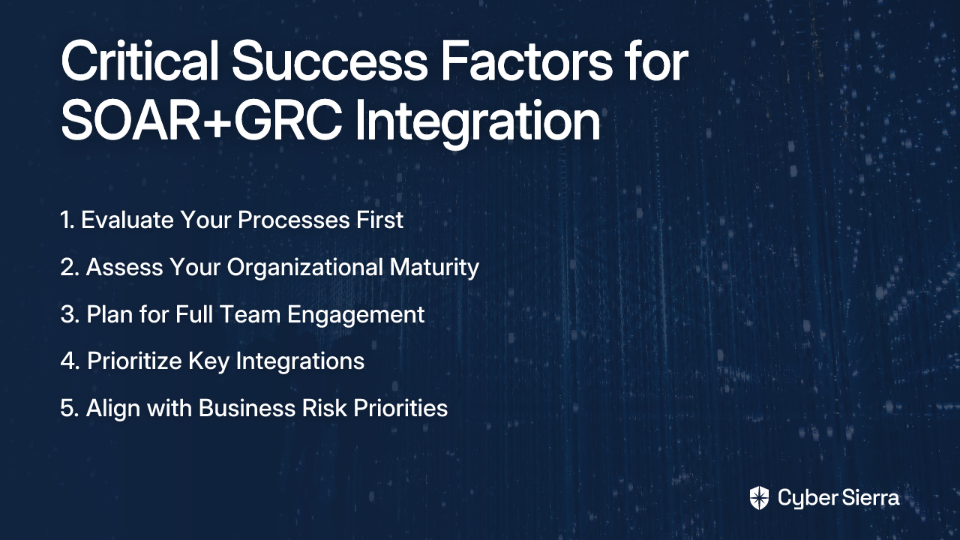
After reviewing countless user experiences and implementation stories, four critical success factors emerged for organizations integrating SOAR and GRC:
1. Evaluate Your Processes First
Before you buy any tool, map your existing incident response and compliance processes. As one security leader noted, "Automating a bad process doesn't make it a better process." Identify bottlenecks and define what success looks like before you automate.
2. Assess Your Organizational Maturity
A critical insight from security practitioners: "The maturity of the security org was key influence factor." A small, understaffed team will struggle with a complex tool requiring dedicated engineers. Be realistic about your resources. Platforms with guided onboarding and native integrations can lower the barrier to entry.
3. Plan for Full Team Engagement
As one Reddit user observed, "If you only have 1 or 2 members engaged in the platform then there is no point to using it." SOAR is a program that requires buy-in from the entire SOC and collaboration with compliance teams. Success relies on continuous training and active use.
4. Prioritize Key Integrations
Avoid the pitfall where "the already high learning curve of SOAR projects was made worse" by complex initial projects. List your critical security tools (SIEM, EDR, threat intel feeds, ticketing systems) and prioritize platforms with robust, out-of-the-box integrations for them.
Conclusion
The convergence of SOAR and GRC is no longer a luxury but a necessity for building a resilient security program. These integrated platforms help security teams move faster, make smarter risk-based decisions, and clearly demonstrate their value to the business through automated compliance and reporting.
By selecting the right platform that aligns with your organizational maturity and security needs, you can transform your security operations from a technical cost center to a strategic business enabler. The key is not just automation for automation's sake, but intelligent orchestration that's informed by business risk and compliance requirements.
As threats continue to evolve and regulatory landscapes become more complex, the organizations that successfully integrate these capabilities will be best positioned to protect their assets while maintaining compliance in an increasingly challenging environment.
Frequently Asked Questions
What is an integrated SOAR and GRC platform?
An integrated SOAR and GRC platform is a security solution that combines the automated threat response capabilities of Security Orchestration, Automation, and Response (SOAR) with the business context and compliance management of Governance, Risk, and Compliance (GRC). This allows security teams to prioritize responses based on business risk, ensure automated actions align with compliance frameworks, and maintain a holistic view of their security posture.
Why is integrating GRC with a SOAR solution important?
Integrating GRC with a SOAR solution is important because it connects technical security actions with business-level risk, ensuring that automation efforts are focused on the most critical threats to the organization. Without GRC context, SOAR can lead to automating inefficient processes or overwhelming analysts. The integration provides risk-informed prioritization and embeds compliance requirements directly into security workflows.
How does a SOAR platform with GRC help with audits and compliance?
A SOAR platform with GRC capabilities helps with audits by automating evidence collection, enforcing compliant workflows, and providing a centralized, auditable trail of all incident response actions. Playbooks can be designed around specific frameworks like PCI DSS or HIPAA, ensuring that the response to an incident is not only automated but also documented in a way that demonstrates adherence to regulatory requirements.
What should I look for when choosing a SOAR platform with GRC features?
When choosing a platform, you should evaluate your organization's internal process maturity, the platform's integration capabilities with your existing tools, and how it aligns with your business risk priorities. It's crucial to assess your current processes before automating them. A complex tool can overwhelm a small team, so be realistic about your resources and prioritize platforms with robust, out-of-the-box integrations for your critical security stack.
What is the difference between a native vs. integrated GRC solution for SOAR?
A native SOAR+GRC platform is built from the ground up with both functions fully intertwined, offering a seamless user experience. An integrated solution involves connecting a dedicated SOAR tool to a separate GRC tool via APIs. Native platforms often simplify data correlation and reporting, while integrated solutions provide flexibility if you already have a preferred tool for one function, though they may require more effort to manage the connection.
