



Security Triage: Which Cyber Initiatives to Cut (And Which to Keep)


Join thousands of professionals and get the latest insight on Compliance & Cybersecurity.
You've just been handed another budget cut while your threat landscape continues to expand. Your team is already stretched thin, alerts are piling up, and executives expect perfect security despite slashing resources. Sound familiar?
Welcome to the unwinnable war of modern cybersecurity—where you're expected to defend everything with increasingly limited means.
The hard truth: some things are naturally going to slip through the cracks. It's not a failure of your abilities; it's the reality of our profession. But there's a crucial difference between things falling through cracks randomly and making calculated decisions about what risks your organization will accept.
The Triage Mindset: From "Doing Everything" to "Doing What Matters"
Security professionals have borrowed the concept of "triage" from emergency medicine—the systematic prioritization of patients based on injury severity and survival likelihood. In cybersecurity, we need to extend this concept beyond incident response to our entire security program.
Consider these sobering statistics:
- Up to 62% of security alerts are ignored due to alert fatigue
- The average time to exploit a new vulnerability has dropped to just five days in 2024
- Most organizations can only address a fraction of their known vulnerabilities
The foundation of security triage lies in risk-based security, expressed by the fundamental equation:
Risk = Likelihood × Impact
This simple formula will guide our framework for making defensible decisions about which initiatives to fund and which to defer.
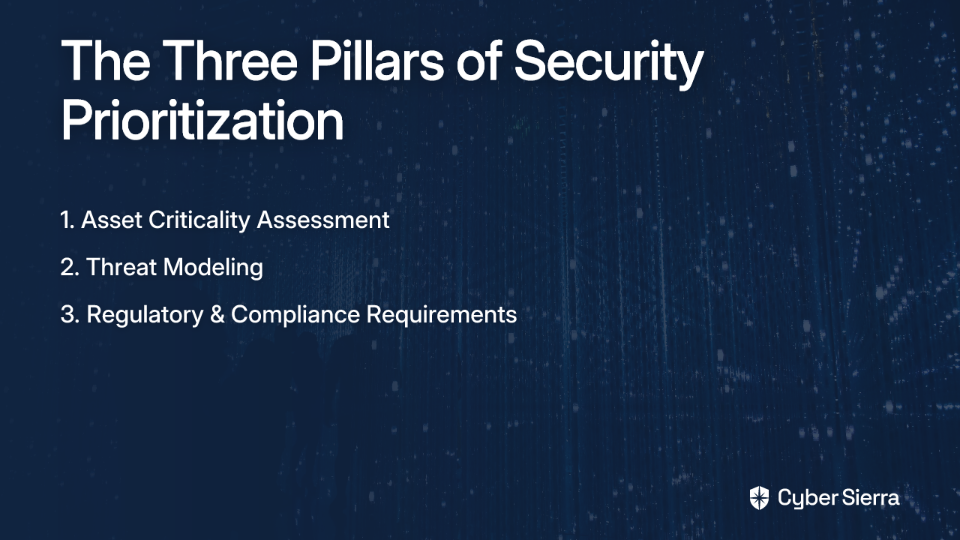
A Framework for Triage: The Three Pillars of Prioritization
Effective security triage requires understanding three critical inputs that form the foundation of your decision-making process:
Pillar 1: Asset Criticality Assessment ("What am I protecting?")
Begin by inventorying and classifying your "crown jewels"—the systems, data, and processes most vital to your operations. This addresses the common pain point where "execs store docs in all kinds of places like their own Dropbox" by helping you focus protection efforts on what truly matters.
Action steps:
- Create an asset inventory with business impact ratings
- Identify dependencies between systems
- Categorize assets by criticality (Critical, High, Medium, Low)
Pillar 2: Threat Modeling ("What am I protecting it from?")
Not all threats are equally likely or relevant to your organization. Threat modeling helps you focus on the most probable attack vectors targeting your critical assets.
Action steps:
- Leverage threat intelligence like CISA's Known Exploited Vulnerabilities (KEV) catalog
- Assess which threat actors are most likely to target your industry
- Review your IDP/IPS logs to identify actual attack patterns
Pillar 3: Regulatory & Compliance Requirements ("What are my non-negotiables?")
While compliance isn't security, it creates a baseline of mandatory controls that cannot be cut. Understanding your obligations under frameworks like GDPR, PCI DSS, or NIST helps establish your security floor.
Action steps:
- Inventory all applicable regulatory requirements
- Work with your cyber insurance provider to understand their requirements
- Identify the minimum viable security posture needed for compliance
The Decision Matrix: Your Tool for Objective Prioritization
To move beyond gut feelings and make data-driven decisions, you need a systematic approach to evaluating security initiatives. A decision matrix provides this structure by weighing multiple factors to produce an objective priority score.
Here's how to create and use your security decision matrix:
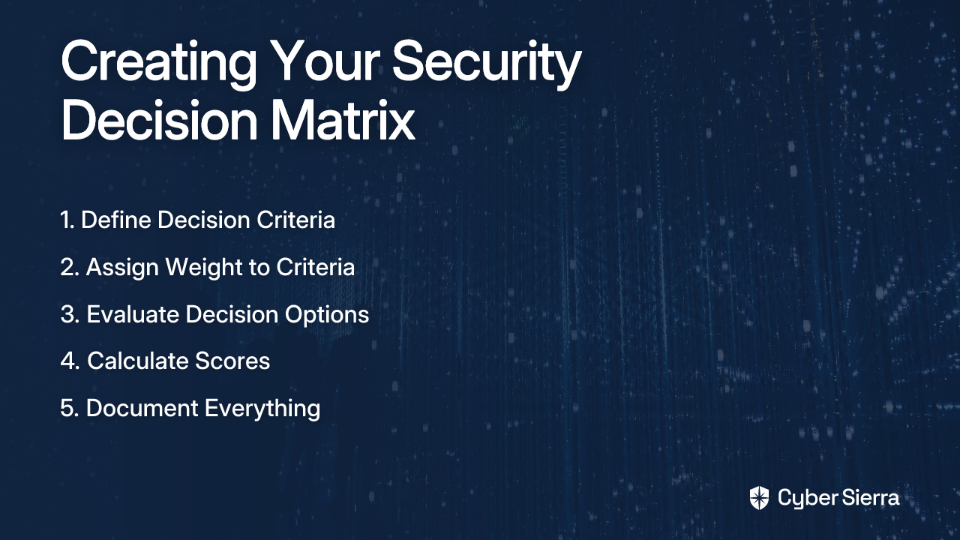
- Define Decision Criteria: Identify what matters for the decision. Common criteria include:
- Business Impact (if the risk materializes)
- Threat Likelihood
- Implementation Cost
- Resource Requirements (FTEs)
- Compliance Alignment
- Time to Implement
- Assign Weight to Criteria: Score the importance of each criterion on a scale of 1-5. For example:
- Compliance might be a 5 (critical)
- User convenience might be a 2 (important but not decisive)
- Evaluate Decision Options: Rate each security initiative against each criterion on a scale of 1-10.
- Calculate Scores: For each initiative, multiply its score for a criterion by that criterion's weight, then sum the results for a final priority score.
- Document Everything: The highest scores indicate your top priorities, but crucially, document the entire matrix and your rationale in your risk register.
Triage in Action: Applying the Decision Matrix to Common Initiatives
Let's look at how this framework applies to real-world security dilemmas:
Example 1: Prioritizing OWASP Top 10 Fixes
When facing multiple application vulnerabilities from the OWASP Top 10, use your decision matrix to determine which to address first:
| Criteria (Weight) | Fix A01-Broken Access Control on App X | Fix A03-Injection on App Y |
|---|---|---|
| Asset Criticality (5) | Customer Data App (9) × 5 = 45 | Internal Tool (5) × 5 = 25 |
| Exploitability (4) | On CISA KEV (8) × 4 = 32 | Medium (6) × 4 = 24 |
| Potential Impact (4) | Data Breach (9) × 4 = 36 | Limited Access (5) × 4 = 20 |
| Remediation Complexity (3) | Complex (3) × 3 = 9 | Simple (8) × 3 = 24 |
| TOTAL SCORE | 122 | 93 |
In this scenario, fixing the Broken Access Control vulnerability should be prioritized despite being more complex to remediate.
Example 2: Scoping an MFA Implementation
When resources are limited, you may need to choose between comprehensive or targeted MFA deployment:
| Criteria (Weight) | MFA for All Employees | MFA for Privileged Accounts Only |
|---|---|---|
| Risk Reduction (5) | High (9) × 5 = 45 | Medium (7) × 5 = 35 |
| Compliance Mandate (4) | Exceeds Requirements (8) × 4 = 32 | Meets Requirements (6) × 4 = 24 |
| Implementation Cost (3) | High (3) × 3 = 9 | Low (8) × 3 = 24 |
| Business Friction (3) | High (2) × 3 = 6 | Low (8) × 3 = 24 |
| TOTAL SCORE | 92 | 107 |
The targeted approach scores higher because it balances risk reduction with practical resource constraints and minimizes business disruption—a critical consideration for any security initiative.
Example 3: SIEM vs. EDR Investment
When choosing between enhancing your SIEM or investing in a new EDR solution:
| Criteria (Weight) | Upgrade Existing SIEM | Deploy New EDR Solution |
|---|---|---|
| Threat Detection (5) | Medium (6) × 5 = 30 | High (9) × 5 = 45 |
| Analyst Overhead (4) | High (3) × 4 = 12 | Medium (6) × 4 = 24 |
| Integration Complexity (3) | Low (8) × 3 = 24 | Medium (5) × 3 = 15 |
| Cost (4) | Medium (6) × 4 = 24 | High (4) × 4 = 16 |
| TOTAL SCORE | 90 | 100 |
In this case, the EDR solution emerges as the priority despite higher costs, primarily due to its superior threat detection capabilities—highlighting how this framework helps you make nuanced trade-offs.
Communicating Your Decisions: From Technical Risks to Business Trade-Offs
Even the most rigorous prioritization process will fail if you can't effectively communicate your decisions to stakeholders. Security professionals must translate technical concerns into business language.
Speak the Language of Business with Outcome-Driven Metrics
Transform your technical requests into measurable business protections:
Instead of: "We need $200k for a new vulnerability scanner."
Try: "Our current patching cadence is 90 days. For $200k, we can implement tooling to achieve a 30-day patching cadence, reducing our window of exposure to critical threats by 66%."
This approach ties security investments directly to business KPIs that executives understand and value.
The Risk Register: Your Professional Shield
The risk register is your crucial "CYA" tool—a formal log of identified risks, their potential impact, the planned response (mitigate, accept, transfer, avoid), the risk owner, and current status.
For any security initiative you're forced to deprioritize, document the associated risk in the register and have it formally accepted by executive management. This fulfills the recommendation to "implement a risk acceptance form that executive management signs off on."
A well-maintained risk register serves multiple purposes:
- Creates transparency about security trade-offs
- Establishes accountability for accepted risks
- Provides a historical record of decision-making
- Protects you professionally when "things slip through the cracks"
The Inevitable Reality: Managing What Slips Through the Cracks
The hardest part of security triage isn't the technical assessment—it's accepting that you can't do everything. As one professional noted, "some things are naturally going to slip through the cracks, it's human nature."
The key difference: A documented, de-prioritized risk isn't a "crack" you missed; it's a calculated business decision. Your triage framework and signed risk register transform what might look like security negligence into structured risk management.
This approach also informs your incident response strategy. The risks you've chosen to accept are precisely the ones you need robust detection and response plans for. Your SIEM and EDR solutions should be configured to provide maximum visibility into these accepted risk areas.
From Firefighter to Strategist
In our resource-constrained reality, effective cybersecurity isn't about eliminating all risk—it's about managing it intelligently. By implementing a structured triage approach:
- Assess your critical assets, threats, and obligations using the three pillars framework
- Prioritize objectively using a decision matrix based on risk = likelihood × impact
- Communicate decisions using business-focused metrics and outcomes
- Document everything in your risk register with executive sign-off
This methodology transforms your role from a perpetually stressed firefighter to a strategic business partner. You'll protect your organization while also managing your professional risk and sanity in an environment where demand always exceeds supply.
Remember: Security triage isn't about being perfect—it's about being deliberate. In a world where we can't do everything, we must focus relentlessly on doing what matters most.
By leveraging frameworks like NIST and CIS, implementing DevSecOps principles, and adopting SRE approaches to security automation, you can create a resilient security posture even with limited resources. The goal isn't to implement every possible security control but to establish a defensible framework for deciding which controls provide the most protection for your investment.
Whether you're working with enterprise-grade tools like Microsoft E5 security suite or building with FOSS alternatives, the principles of security triage remain the same: understand your assets, assess your threats, document your decisions, and focus your limited resources where they'll have the greatest impact.
Frequently Asked Questions
What is security triage in cybersecurity?
Security triage in cybersecurity is the process of prioritizing security tasks, vulnerabilities, and initiatives based on their risk level, which is determined by factors like asset criticality, threat likelihood, and potential business impact. It's a strategic shift from trying to address every single alert to focusing limited resources on the threats that pose the greatest danger to the organization's most vital assets. This approach helps security teams manage alert fatigue and make defensible, data-driven decisions.
Why is a risk-based approach to security important?
A risk-based approach is important because it allows organizations to allocate their limited security resources—time, budget, and personnel—to the areas that pose the most significant threat to the business. Instead of treating all vulnerabilities equally, this approach uses the formula Risk = Likelihood × Impact to focus on what matters most. It transforms security from a technical cost center into a strategic function that protects business value.
How can I start building a security triage process?
You can start building a security triage process by focusing on three foundational pillars: identifying and classifying your critical assets, modeling the most relevant threats to your organization, and understanding your mandatory compliance requirements. Begin by creating an asset inventory to know what you're protecting. Then, use threat intelligence to understand your adversaries. Finally, map out your regulatory obligations. These three inputs provide the context to start making informed prioritization decisions.
What is a security decision matrix and what should it include?
A security decision matrix is a tool used to objectively score and prioritize security initiatives based on a set of weighted criteria. Key criteria often include the business impact if a risk materializes, the likelihood of a threat, implementation cost and complexity, and alignment with compliance mandates. By assigning a weight to each criterion and scoring each initiative against them, you can generate a numerical score that provides a clear, data-driven basis for prioritization.
How does a risk register protect security professionals?
A risk register protects security professionals by creating a formal, documented record of all identified risks and the executive-level decisions made about them. When an initiative is de-prioritized due to resource constraints, the associated risk is logged in the register with a rationale and an executive sign-off accepting that risk. This transforms a potential "oversight" into a documented, calculated business decision, providing professional accountability and a defensible record of your team's strategic choices.
Does security triage mean we stop trying to fix everything?
Yes, security triage intentionally moves away from the impossible goal of fixing everything and instead focuses on systematically addressing the most critical risks first. It's not about ignoring problems, but about making conscious, defensible decisions on what to prioritize when you can't do it all. The risks that are de-prioritized are formally accepted and often become key areas for enhanced monitoring and incident response planning.
