SOC vs SOX Compliance: Essential Guide



Join thousands of professionals and get the latest insight on Compliance & Cybersecurity.
You've just been tasked with ensuring your company's compliance program is up to date. As you dive into research, you're immediately bombarded with acronyms: SOC, SOX, GDPR, HIPAA, PCI DSS... the list seems endless. While all these frameworks matter, SOC and SOX frequently cause the most confusion due to their similar-sounding names but vastly different purposes.
Even more concerning, your company might be treating these compliance frameworks as mere checkboxes rather than integral parts of your security and governance strategy. This dangerous mindset can leave your organization technically "compliant" yet still vulnerable to significant breaches and financial risks.
Understanding SOX: The Legal Mandate for Financial Integrity

The Sarbanes-Oxley Act (SOX) emerged from the ashes of major corporate scandals that rocked the business world in the early 2000s. When energy giant Enron and telecommunications company WorldCom collapsed due to massive accounting fraud, public trust in corporate America plummeted. In response, Congress passed SOX in 2002 to restore investor confidence and protect the public from fraudulent financial reporting.
Who Must Comply with SOX?
SOX compliance is not optional for:
- All U.S. publicly traded companies
- Their boards, management, and public accounting firms
- Foreign companies with securities listed on U.S. exchanges
- Private companies preparing for an Initial Public Offering (IPO)
Core Requirements of SOX
At its heart, SOX aims to ensure financial transparency and executive accountability. The most significant sections include:
Section 302 - Corporate Responsibility for Financial Reports
This section requires CEOs and CFOs to personally certify the accuracy of their company's financial reports filed with the Securities and Exchange Commission (SEC). They must attest that:
- They've reviewed the reports
- The reports contain no untrue statements or material omissions
- The financial information fairly represents the company's financial condition
Section 404 - Management Assessment of Internal Controls
Perhaps the most demanding and costly aspect of SOX, Section 404 requires:
- Management to establish, document, and maintain internal controls over financial reporting
- An annual assessment of these controls' effectiveness
- An independent external auditor to verify and report on management's assessment
The Public Company Accounting Oversight Board (PCAOB), established by SOX, oversees these audit processes to ensure they meet professional standards.
The High Cost of Non-Compliance
SOX violations carry severe consequences:
- Personal liability for executives
- Fines up to $1 million for certifying inaccurate reports
- Criminal penalties including up to $20 million in fines and 20 years imprisonment for willfully altering or destroying financial records
- "Clawback" provisions where executives must return bonuses if financial restatements occur
Beyond legal penalties, SOX compliance is expensive. According to IBM, organizations often spend over $1 million annually on SOX compliance efforts, with costs increasing based on company size and complexity.
Demystifying SOC: The Market-Driven Standard for Service Trust
Unlike SOX, System and Organization Controls (SOC) reports aren't mandated by law. Rather, they're voluntary attestation standards governed by the American Institute of Certified Public Accountants (AICPA).
SOC reports emerged as service organizations (like SaaS providers, data centers, and cloud services) needed a way to prove to their clients that they had effective controls for protecting data and ensuring reliable service.
Different Types of SOC Reports
Understanding the differences between SOC report types is crucial for determining which one(s) your organization needs:
SOC 1: Focus on Financial Controls
SOC 1 reports specifically address a service organization's internal controls that could impact their clients' financial reporting. They're designed for service providers whose operations might affect the accuracy of their customers' financial statements.
For example, if your company provides payroll processing services, your clients' auditors will want assurance that your systems correctly calculate and report payroll expenses.
SOC 2: Focus on Security, Availability, Processing Integrity, Confidentiality, and Privacy
SOC 2 reports have become the gold standard for technology and cloud service providers. They evaluate controls based on the AICPA's Trust Services Criteria (TSC):

- Security (mandatory): The system is protected against unauthorized access
- Availability (optional): The system is available for operation as committed
- Processing Integrity (optional): System processing is complete, accurate, timely, and authorized
- Confidentiality (optional): Information designated as confidential is protected
- Privacy (optional): Personal information is collected, used, retained, and disclosed in conformity with privacy commitments
SOC 3: The Public-Facing Summary
A SOC 3 report is essentially a simplified version of SOC 2 that removes sensitive details, making it suitable for public distribution. It serves as a seal of approval that organizations can share on their websites to build trust without revealing the specifics of their security controls.
Type 1 vs. Type 2: The Crucial Distinction
Both SOC 1 and SOC 2 reports come in two varieties:
- Type 1: A point-in-time assessment that evaluates whether controls are suitably designed as of a specific date
- Type 2: A more rigorous evaluation that tests the operating effectiveness of controls over a period (typically 6-12 months)
Type 2 reports carry significantly more weight with clients and auditors because they demonstrate sustained compliance rather than a one-time effort.
SOC vs. SOX: A Head-to-Head Comparison
Despite their similar acronyms, SOX and SOC serve fundamentally different purposes:
| Feature | SOX (Sarbanes-Oxley Act) | SOC (System and Organization Controls) |
|---|---|---|
| Nature | Mandatory Federal Law enforced by the SEC | Voluntary, Market-Driven Standard governed by the AICPA |
| Applicability | U.S. Public Companies and their leadership | Service Organizations (e.g., SaaS, cloud providers) |
| Primary Goal | Protect investors by ensuring accurate financial reporting and preventing corporate fraud | Build trust by demonstrating effective internal controls related to financial reporting (SOC 1) or security and operations (SOC 2) |
| Audience | The SEC, investors, and the public | Service organization's clients, business partners, and their auditors |
| Penalties | Severe legal penalties including heavy fines and imprisonment | No direct legal penalties, but potential loss of business and customer trust |
The Critical Intersection: How SOC 1 Supports SOX Compliance
Here's where these frameworks intersect: When a public company (subject to SOX) outsources functions that impact its financial statements—for example, using a cloud-based payroll provider—it still remains responsible for ensuring proper controls.
To satisfy SOX requirements, the public company needs assurance about its service provider's controls. This is where SOC 1 reports become crucial. The service provider obtains a SOC 1 report, which the public company then uses as evidence to support its own SOX compliance efforts.
From Checklist to Culture: Making Compliance Truly Effective
"Compliance is not security," as many cybersecurity professionals point out in forums like Reddit's cybersecurity community. Organizations often treat frameworks like SOX and SOC as mere checkboxes rather than foundations for robust security and governance.
This mindset creates a dangerous reality where "organizations are often compliant yet still vulnerable to significant breaches." As one security professional notes, "Increased investment in security tools is not correlating with reduced data breaches," highlighting that compliance alone doesn't guarantee protection.
Actionable Strategies for Meaningful Compliance
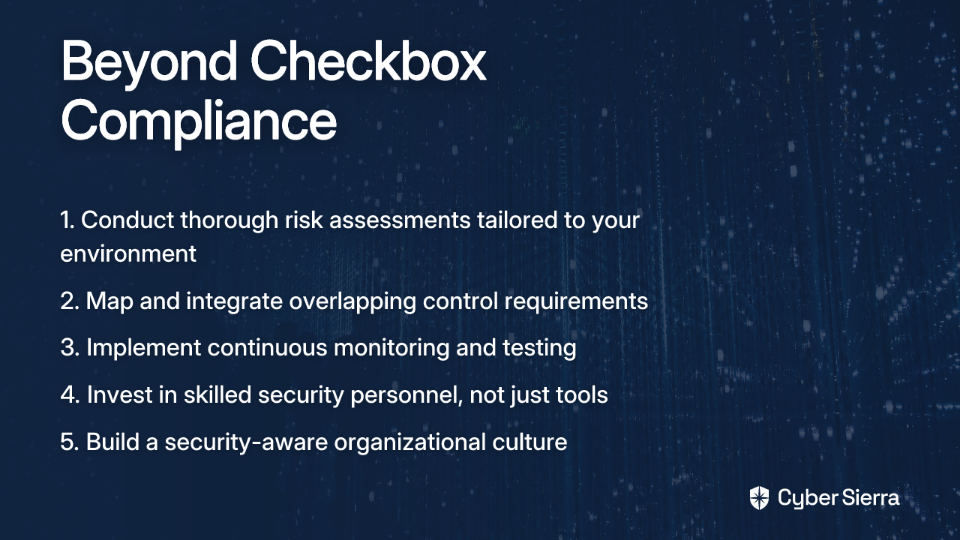
To move beyond the checkbox mentality:
- Adopt a Risk-Based Approach: Generic frameworks often overlook an organization's unique threat landscape. Conduct a thorough risk assessment to tailor controls to your specific environment.
- Integrate and Streamline Controls: If your organization deals with multiple frameworks, map overlapping requirements between SOX, SOC, and others to reduce redundancy and improve efficiency.
- Embrace Continuous Auditing: Compliance is not a one-time project. Implement processes for continuous monitoring and testing of controls. As one security expert recommends, "be constantly re-evaluating your environment and finding vulnerabilities."
- Invest in People, Not Just Tools: Small and medium-sized businesses often struggle because "they cannot afford any fancy tooling." However, the real gap is often in skilled personnel. As one practitioner notes, "You need people who actively work with security, configuring systems, write detection logic... and none of that comes from compliance."
Conclusion: Choosing the Right Path for Governance and Trust
Understanding the distinction between SOX and SOC is essential for navigating your compliance journey. SOX represents a non-negotiable legal requirement for public companies focused on financial integrity, while SOC offers a voluntary, trust-building mechanism for service organizations to prove their operational and security diligence.
The true value of these frameworks emerges when organizations move beyond viewing compliance as a burden and instead integrate it into their broader risk management and security culture. By doing so, you not only satisfy auditors but build a more resilient and trustworthy business that can withstand the evolving challenges of today's digital landscape.
Remember that compliance itself is just the beginning—the foundation upon which to build effective governance, security, and trust.
Frequently Asked Questions
What is the main difference between SOC and SOX?
The primary difference is that SOX is a mandatory U.S. federal law for public companies, while SOC is a voluntary, market-driven standard for service organizations. SOX aims to protect investors by ensuring accurate financial reporting and carries severe legal penalties for non-compliance. SOC reports, governed by the AICPA, are designed to help service organizations build trust with clients by demonstrating effective internal controls over financial reporting (SOC 1) or security and operations (SOC 2).
Who needs to comply with SOX?
SOX compliance is mandatory for all U.S. publicly traded companies, their management and boards, and the public accounting firms that audit them. It also applies to foreign companies that list securities on U.S. exchanges and private companies that are in the process of preparing for an Initial Public Offering (IPO). The goal is to enforce executive accountability and protect investors from corporate fraud.
What is a SOC 2 report and why is it important?
A SOC 2 report is a voluntary compliance standard that evaluates a service organization's controls based on the AICPA's five Trust Services Criteria: Security, Availability, Confidentiality, Processing Integrity, and Privacy. It has become the gold standard for technology companies, cloud providers, and SaaS vendors because it provides independent assurance to clients that the service provider has robust systems in place to protect their data and ensure service reliability.
How does a SOC 1 report help with SOX compliance?
A SOC 1 report is a crucial tool for SOX compliance. When a public company (which must comply with SOX) outsources a service that impacts its financial statements (like payroll processing), it needs to verify that the service provider has proper controls. The provider's SOC 1 report offers this verification, which the public company can then use as evidence to support its own SOX audit and demonstrate its internal controls over financial reporting are effective.
Which is better: a SOC 2 Type 1 or Type 2 report?
A SOC 2 Type 2 report is generally considered better and provides significantly more assurance to clients. A Type 1 report only assesses if an organization's controls are designed properly at a single point in time. In contrast, a Type 2 report tests the operating effectiveness of those same controls over a period of time (typically 6-12 months), proving that the security practices are consistently maintained.
If my company is SOC 2 compliant, does that mean we are secure?
Not necessarily. While achieving SOC 2 compliance is a strong indicator of a mature security program, it should be viewed as a baseline, not the ultimate goal. Compliance frameworks verify that specific controls are in place, but true security requires a continuous, risk-based approach. This means going beyond the "checkbox" audit to actively manage your unique threat landscape, invest in skilled personnel, and foster a security-aware culture.