Startup Data Classification for DLP Success



Join thousands of professionals and get the latest insight on Compliance & Cybersecurity.
You've set up your startup, built an impressive product, and are starting to handle significant amounts of data. Now, your CTO or CISO is pushing to implement a Data Loss Prevention (DLP) solution to protect that valuable information. The problem? Your data is "impossible to track," scattered across various cloud services, with "little if any permissions on it." Sound familiar?
As one frustrated tech leader put it on Reddit, "My senior management thinks it is [easy to implement DLP]," but the reality is far more complex when you've never classified your data before. What you're facing isn't just a technical challenge—it's a foundational gap in your security strategy.
What is Data Classification (And Why Should Your Startup Care?)
Data classification is the process of organizing your information into relevant categories based on sensitivity, business value, and compliance requirements. Think of it as creating a digital hierarchy for your data assets, with clear labels that determine how they should be handled, shared, and protected.
Why is this critical for your DLP strategy? Because you can't protect what you don't understand. A DLP solution without proper classification is like a security guard with no instructions on what to protect—it either lets everything through or blocks everything indiscriminately.
This fundamental connection between classification and DLP delivers several essential benefits for startups:
- Improved Data Security: By identifying your "crown jewels"—intellectual property, customer PII, financial records—you can focus your limited security resources on what truly matters.
- Regulatory Compliance: With laws like GDPR, CCPA, HIPAA, and PCI DSS affecting even early-stage startups, knowing exactly where your regulated data resides makes compliance manageable rather than overwhelming.
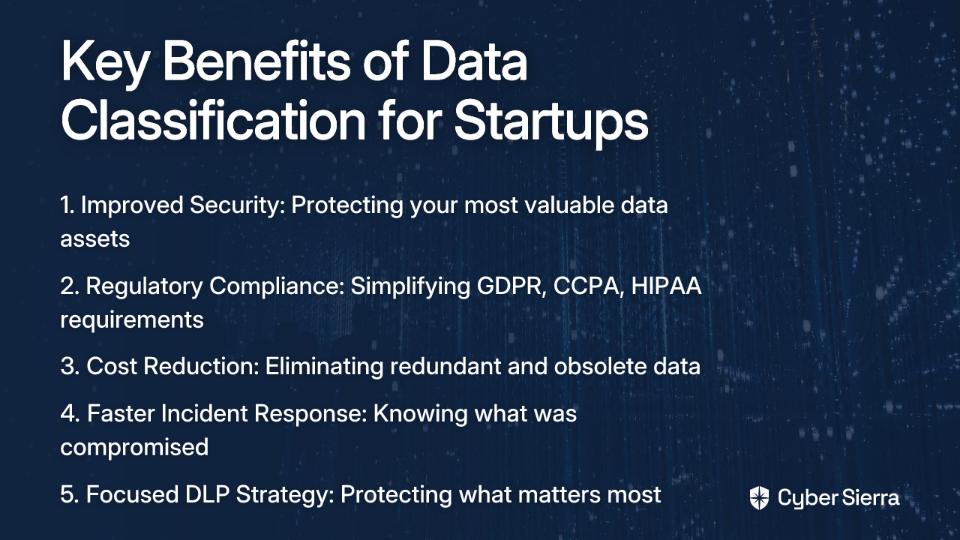
- Reduced Costs: Proper classification helps identify redundant, obsolete, and trivial (ROT) data, reducing unnecessary storage and backup costs—a crucial consideration for budget-conscious startups.
- Efficient Incident Response: If a breach occurs, knowing immediately what data was potentially compromised allows for faster, more targeted remediation.
Before Lines of Code: Getting the People and Policy Right
As one cybersecurity professional wisely observed, "I see everyone jumping to technical solutions but this is not how you should start." Data classification is fundamentally a data governance challenge before it's an IT issue.
Step Zero: Get Stakeholder Buy-In
The biggest hurdle isn't technical—it's "getting buy-in from senior management." To overcome this:
- Don't frame data classification as a security cost center. Frame it as risk management.
- Ask leadership the pointed question: "What will data spillage actually cost you?" Quantify the potential impact in terms of regulatory fines, reputation damage, and competitive disadvantage.
- Involve key stakeholders from various departments (legal, HR, operations, finance) from the very beginning. This creates shared ownership and provides the business context needed for effective classification.
The Cornerstone: Your Information Classification Policy
This is the single most important starting point. As recommended by experienced practitioners, your policy must be "endorsed and signed off by the board" and should clearly define:
- Classification Levels: Start simple with 3-4 tiers (e.g., Public, Internal, Confidential, Restricted)
- Data Handling Rules: Specify what you can and can't do with each level (sharing restrictions, encryption requirements)
- Roles and Responsibilities: Assign a data owner or data steward for key data sets (e.g., the head of HR owns employee data)
- Consequences: Outline what happens when policy isn't followed

A Practical 4-Step Framework for Classifying Your Data
Now that you understand the importance of classification and have laid the groundwork with stakeholders, let's move to a practical framework for implementation.
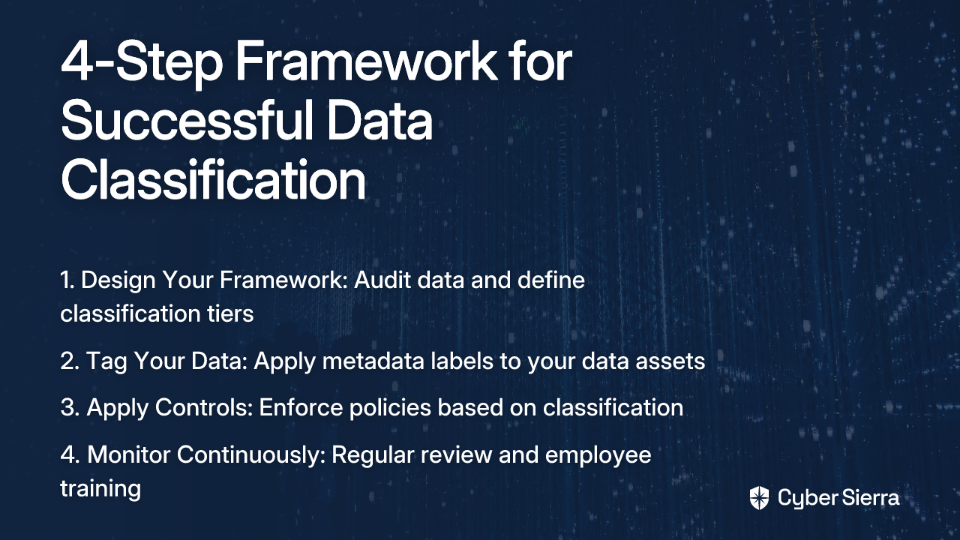
Step 1: Design Your Data Classification Framework
Before classifying anything, you need to know what you have and how to categorize it:
- Conduct a Data Audit: Identify your data assets, where they live, and whether they are structured data (in databases) or unstructured data (in documents, emails).
- Define Your Classification Tiers: For most startups, a simple three-tier model works well:
- Public: Information intended for public consumption (marketing materials, public website content)
- Internal: Data for company use only, where unauthorized disclosure would cause minimal harm (internal memos, operational documents)
- Confidential: Sensitive data requiring strict controls (financial records, employee PII, source code, business strategy)
- Define Protection Controls: For each tier, specify the required security controls. For example, Confidential data must be encrypted and access restricted via RBAC (Role-Based Access Control).
As AWS recommends for cloud-native startups, this could mean using separate AWS accounts per sensitivity level or implementing strict IAM policies for different data classifications.
Step 2: Tag Your Data
Tagging is the process of applying metadata labels to your data assets according to your classification framework. You have several approaches:
- User-based Classification: Employees manually apply tags. This requires training but leverages their business context.
- Content-based Classification: Automated tools inspect file contents for sensitive patterns like credit card numbers or social security numbers.
- Context-based Classification: Uses metadata like creation date, storage location, or creator's role as indicators of sensitivity.
For startups with limited resources, start with manual classification of your most critical data repositories. As you grow, consider tools like Microsoft Purview for Microsoft 365 environments or AWS Macie for AWS users, which use machine learning to automate the process.
Step 3: Apply Controls and Manage Your Data Lifecycle
Once your data is tagged, it's time to make those classifications actionable:
- Enforce Policies: Use your tags to automate security. For example, create DLP rules that block any document tagged as Confidential from being sent to external email addresses.
- Redact Sensitive Data: When possible, don't just protect sensitive data—remove it where it's not needed. Use tools to automatically find and redact PII from documents or datasets.
- Tackle the "Mountain of Old Data": This is a major pain point for many organizations. Establish a formal data lifecycle management policy with clear retention procedures. As one cybersecurity professional bluntly put it: "Anything over three years old should get torched unless the document owner provides a decent business justification for its existence."
Step 4: Monitor, Review, and Train Continuously
Data classification is not a one-time project—it's an ongoing program:
- Monitor for Compliance: Use tools to continuously check that your policies are being enforced. Cloud users can leverage services like AWS Config to automatically verify that sensitive data repositories maintain proper encryption and access controls.
- Validate and Review: Regularly audit your classification outcomes. Is data being tagged correctly? Are your policies still aligned with business needs?
- Train Your Team: User awareness is crucial. Conduct regular training sessions on the data classification policy and proper data handling. As noted by Securiti.ai, this training is essential for fostering a security-conscious culture.
From Classification Chaos to Confident Data Protection
Implementing data classification might feel like a "herculean task" when you're starting from scratch, but remember that perfect is the enemy of good. For startups, the key is to:
- Start with a clear, board-approved Information Classification policy
- Focus first on your most sensitive and valuable data
- Begin with manual classification if needed, then gradually introduce automation
- Make data classification part of your company culture from day one
By taking these practical first steps, you'll build the essential foundation for an effective DLP strategy. More importantly, you'll foster a data-aware culture that scales with your startup's growth, preventing the accumulation of unmanaged, unclassified data that plagues more established companies.
Remember: A successful DLP strategy isn't about having the most sophisticated technical solution—it's about having a clear understanding of what data matters most to your business and ensuring it's properly identified, classified, and protected. Start with classification, and the rest will follow.
Frequently Asked Questions
What is the very first step to implementing data classification?
The very first step is not technical; it's creating an Information Classification Policy and securing buy-in from senior management. Before any data is tagged or tools are purchased, your organization must agree on what constitutes sensitive data, define clear classification levels (e.g., Public, Internal, Confidential), and assign ownership, ensuring the policy is endorsed by leadership.
How does data classification directly improve a Data Loss Prevention (DLP) solution?
Data classification directly improves a DLP solution by providing the necessary context to make intelligent decisions. An effective DLP tool relies on classification tags to understand which data is sensitive and requires protection. Without classification, a DLP system is essentially blind, leading to either missed threats (false negatives) or blocking legitimate business activities (false positives).
What is the best way for a startup to handle a massive amount of old, unclassified data?
The best way is to prioritize and not attempt to classify everything at once. Start by identifying your most critical data assets—your "crown jewels"—such as intellectual property, customer PII, and financial records. For the rest, establish a data retention policy to systematically and defensibly delete redundant, obsolete, and trivial (ROT) data that no longer has business value.
What are the most common data classification levels for a startup?
Most startups can begin with a simple and effective three-tier classification model:
- Public: Information cleared for public release (e.g., marketing content).
- Internal: Data for company-wide use where unauthorized access would cause minimal harm (e.g., internal memos).
- Confidential/Restricted: Highly sensitive data that requires strict access controls and could cause significant damage if disclosed (e.g., source code, financial data, customer PII).
What tools can help with data classification?
While policy and process come first, several tools can automate classification once your framework is established. For cloud-native startups, common choices include AWS Macie for data in AWS and Microsoft Purview for Microsoft 365 environments. These tools use machine learning to identify and tag sensitive information, but they are most effective when guided by a well-defined classification policy.
Who is ultimately responsible for classifying data in a company?
Data classification is a shared responsibility, but it is typically led by designated "data owners" or "data stewards." While senior leadership is responsible for endorsing the policy and providing resources, data owners—usually department heads or senior managers—are responsible for the data within their domain (e.g., the Head of HR owns employee data). All employees are responsible for handling data according to the established policy.