



How to Unify Control Mapping Across ISO 27001, SOC 2, and GDPR

Join thousands of professionals and get the latest insight on Compliance & Cybersecurity.
You've set up your ISO 27001 documentation, compiled everything for SOC 2, and now GDPR compliance is on the horizon. As you look at your sprawling spreadsheets and control documents, a sinking feeling sets in: "I'm documenting everything twice in separate sheets."
If this sounds familiar, you're not alone. Many compliance professionals find themselves drowning in duplicative work, with studies showing that most organizations end up re-documenting the same 60-70% of controls multiple times across different frameworks. One compliance manager reported needing "to supply something like 300 requests for submissions—100 exclusively for SOC 2, 100 exclusively for ISO, and 100 common to both."
This article will show you how to break free from this cycle of redundancy by unifying your control mapping across ISO 27001, SOC 2, and GDPR—saving you time, reducing audit fatigue, and strengthening your overall security posture.
The High Cost of Siloed Compliance: Why You're "Documenting Everything Twice"
The modern regulatory landscape is overwhelming. Financial services firms alone face an average of 234 regulatory alerts per day, making manual tracking virtually impossible. When you treat each compliance framework as a separate project, you're essentially signing up for:
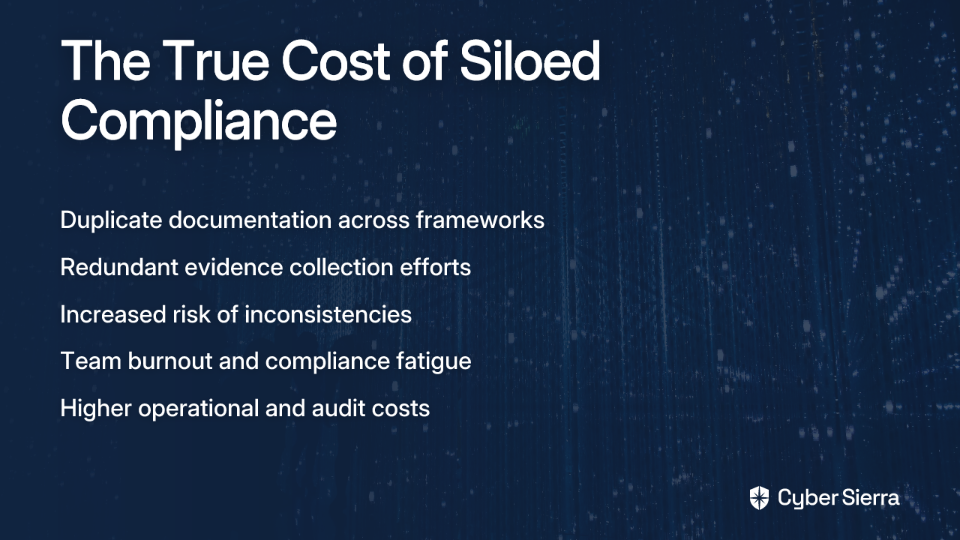
- Duplicate Documentation: Creating and maintaining multiple versions of essentially the same controls
- Evidence Collection Overload: Gathering the same evidence multiple times for different audits
- Increased Risk of Inconsistencies: When controls are managed separately, discrepancies inevitably emerge
- Compliance Fatigue: Teams become overwhelmed by repetitive tasks, leading to errors and burnout
- Higher Costs: Both in terms of human resources and audit fees
As one compliance manager noted on Reddit: "SOC 2 and ISO 27001 have significant overlap, and running them as totally separate projects almost always leads to wasted effort."
The traditional approach of managing compliance in siloed spreadsheets simply doesn't scale. It's error-prone, time-consuming, and provides no real-time visibility into your organization's actual security posture.
Finding the Common Ground: Key Overlaps Between ISO 27001, SOC 2, and GDPR
Before diving into the unification process, let's understand what we're working with:
Brief Overview of Each Framework
- ISO 27001: An internationally recognized standard that provides a framework for establishing, implementing, maintaining, and continually improving an Information Security Management System (ISMS). It focuses on ensuring the confidentiality, integrity, and availability of information through a risk-based approach.
- SOC 2: Developed by the American Institute of CPAs (AICPA), SOC 2 centers around five Trust Services Criteria (TSC): security, availability, processing integrity, confidentiality, and privacy. It's primarily designed for service organizations that store customer data in the cloud.
- GDPR: The General Data Protection Regulation is an EU law that regulates how personal data of EU residents can be collected, processed, and stored. It emphasizes individual privacy rights and imposes strict requirements on data controllers and processors.
Key Areas of Overlap
Despite their different origins and specific focuses, these frameworks share significant common ground:
- Risk Management: All three frameworks require systematic approaches to identifying, assessing, and mitigating risks.
- Access Control: Each standard mandates controls over who can access information and what they can do with it.
- Data Protection: While GDPR is most explicit about data protection, all three frameworks include controls to safeguard sensitive information.
- Incident Response: Each requires organizations to have plans for detecting, responding to, and recovering from security incidents.
- Continuous Improvement: All three frameworks emphasize the need for ongoing monitoring and enhancement of security controls.
According to a comparative analysis by Brain, these frameworks share fundamental principles despite their different terminologies and specific requirements. This overlap creates the perfect opportunity for a unified approach.
A Practical Guide to Unifying Your Control Framework
Now let's move from theory to practice with a step-by-step approach to unifying your control framework across ISO 27001, SOC 2, and GDPR.
Step 1: Choose Your Foundation (The ISO 27001 Advantage)
Start by selecting a foundational framework upon which to build your unified control structure. ISO 27001 is often the ideal choice because:
- It provides a comprehensive, structured approach to information security
- Its risk-based methodology aligns well with both SOC 2 and GDPR
- The Statement of Applicability (SOA) offers a natural framework for mapping controls
- Its international recognition makes it a solid foundation for global compliance efforts
As noted by Ampcus Cyber, "ISO 27001 offers a powerful, foundational approach to establishing unified security governance." By establishing ISO 27001 as your base, you create a structured ISMS that can be extended to meet the requirements of other frameworks.
Step 2: Assess and Map: Create a Unified Control Matrix
This is where the real work of unification happens. Your goal is to create a single matrix that maps controls across all three frameworks:
- Start with a comprehensive inventory of all controls required by ISO 27001, SOC 2, and GDPR.
- Identify overlaps and equivalencies between controls. For example, ISO 27001's access control requirements (A.9) align closely with SOC 2's Common Criteria (CC6.1, CC6.2) and GDPR's data access provisions (Articles 25, 32).
- Create your unified control matrix listing:
- The control ID and description
- The corresponding requirements in each framework (ISO clause, SOC 2 criteria, GDPR article)
- The evidence required to demonstrate compliance
- The control owner and testing frequency
For accurate mapping, leverage authoritative resources:
These official mapping documents are invaluable for ensuring your matrix is properly aligned with the standards' requirements.
Step 3: Implement and Centralize: Build Your Single Source of Truth
With your mapping complete, the next step is implementation:
- Apply the "Stricter Requirement" Rule: When requirements conflict across frameworks, always default to the stricter standard. As one compliance expert advises, "If ISO requires quarterly IAM reviews and SOC 2 only asks for annual, just do quarterly." This ensures you're compliant with both without duplicating efforts.
- Centralize Documentation: Establish a single repository for all compliance documentation. This becomes your "single source of truth" for all frameworks.
- Implement Evidence Tagging: This is crucial for reusing evidence across frameworks. When you collect evidence (like vulnerability scan results or access reviews), tag it with all applicable control IDs from your unified matrix. This allows you to collect once but use the evidence for multiple audits.
- Harmonize Policies: Draft policies that reference multiple framework requirements simultaneously. For example, your access control policy should explicitly address ISO 27001's Annex A.9 controls, SOC 2's CC6 criteria, and GDPR's Article 32 requirements.
Step 4: Automate and Monitor: Moving Beyond Manual Spreadsheets
A unified control framework is powerful, but managing it manually is still burdensome. Modern compliance demands automation:
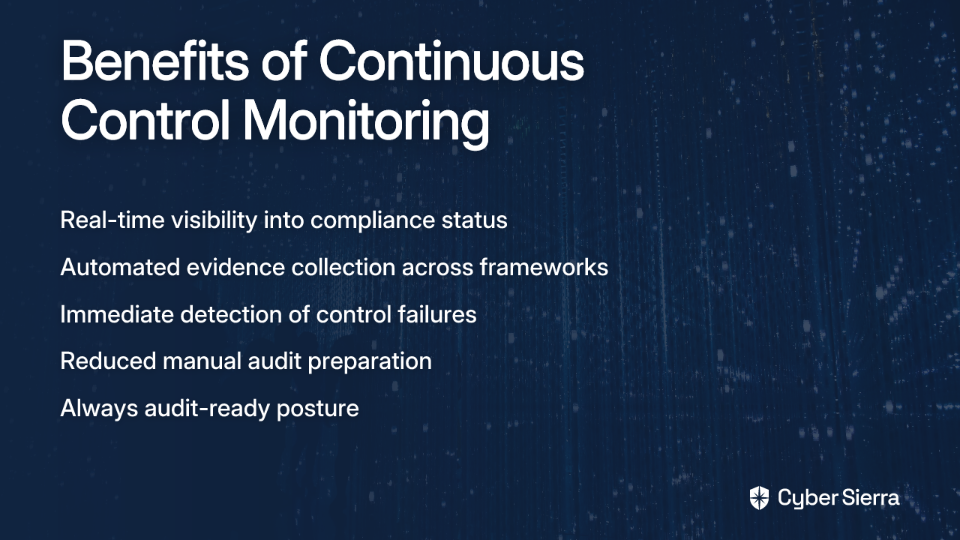
- Implement Continuous Control Monitoring: Move from periodic, manual checks to automated, continuous monitoring of your controls. This provides real-time visibility into your compliance posture.
- Automate Evidence Collection: Use tools that automatically gather and store evidence of control effectiveness (like system configurations, access logs, or vulnerability scan results).
- Leverage GRC Platforms: Consider specialized Governance, Risk, and Compliance (GRC) platforms designed to manage unified frameworks.
Platforms like Cyber Sierra offer specialized capabilities that directly address the challenges of unified compliance. Their Governance, Risk & Compliance (GRC) module allows you to manage multiple frameworks simultaneously from a single dashboard, automating data collection and maintaining detailed audit trails.
Additionally, Cyber Sierra's Continuous Control Monitoring (CCM) feature transforms the compliance process by automatically testing controls and gathering evidence in near real-time. This effectively eliminates the manual, periodic scramble for audits and provides a live view of your security posture.
The Strategic Benefits of a Unified Compliance Program
Unifying your control framework isn't just about reducing administrative burden—it delivers substantial strategic advantages:
1. Streamlined Compliance & Reduced Audit Fatigue
A unified approach significantly decreases the time spent preparing for and responding to audits. Rather than scrambling to collect evidence for each separate framework, your organization maintains a continuous state of audit readiness with centralized evidence that serves multiple purposes.
2. Cost Efficiency
The financial benefits are substantial. According to compliance experts, a unified approach can reduce audit and compliance costs by up to 30-40% through:
- Fewer duplicate controls to implement and maintain
- Reduced audit preparation time
- Lower consulting fees
- More efficient use of staff resources
3. Stronger Security Posture
When compliance is unified, security becomes more consistent and effective across the organization. Rather than focusing on checking boxes for individual frameworks, your team can concentrate on building robust security practices that satisfy all requirements simultaneously.
4. Market Trust and Competitive Advantage
Holding multiple certifications (ISO 27001, SOC 2) and demonstrating GDPR compliance instills confidence in customers, partners, and stakeholders. With a unified framework, you can achieve and maintain these certifications more efficiently, turning compliance into a competitive advantage.
5. Future-Proofing Your Program
A flexible, unified system makes it easier to adapt to new regulations and emerging threats without starting from scratch. As new requirements emerge, they can be mapped to your existing control framework, minimizing disruption and additional work.
Conclusion: From Silos to Strategy
Managing compliance for ISO 27001, SOC 2, and GDPR doesn't have to be the repetitive, soul-crushing task that many organizations experience. By shifting from siloed projects to an integrated strategy, you can transform compliance from a costly obligation into a streamlined strategic advantage.
The key takeaways:
- Recognize the overlap: Approximately 60-70% of controls are common across these frameworks.
- Build on a strong foundation: Use ISO 27001 as your base and map other requirements to this structure.
- Create a unified control matrix: Document once, map to multiple frameworks, and collect evidence efficiently.
- Automate where possible: Move beyond spreadsheets to continuous monitoring and automated evidence collection.
- Apply the "stricter requirement" rule: When frameworks conflict, default to the more stringent standard.
By following these principles, you'll not only reduce the administrative burden of compliance but also strengthen your overall security posture and create a more resilient organization. The days of "documenting everything twice" can finally be behind you.
Frequently Asked Questions
What is a unified control framework?
A unified control framework is a centralized system where a single set of security controls is mapped to the requirements of multiple compliance standards, such as ISO 27001, SOC 2, and GDPR. This approach eliminates the need to maintain separate documentation for each framework. Instead of "documenting everything twice," you create one control, gather evidence for it once, and then use that single effort to demonstrate compliance across several standards by leveraging the significant overlap between them.
Why is ISO 27001 recommended as the foundation for unified compliance?
ISO 27001 is recommended as the foundation because it provides a comprehensive and internationally recognized Information Security Management System (ISMS) that is risk-based and highly structured. Its organized nature, particularly the Statement of Applicability (SOA), creates a natural and logical framework for mapping controls from other standards like SOC 2 and GDPR. Its global acceptance also makes it a solid base for companies operating internationally.
How do you handle conflicting requirements between different compliance frameworks?
When requirements conflict between frameworks, the best practice is to always implement the stricter or more stringent control. For example, if one framework requires quarterly access reviews while another only requires annual reviews, you should perform quarterly reviews. This "stricter requirement" rule ensures that you satisfy the requirements of all frameworks simultaneously without creating redundant processes.
What is the first step to unifying compliance frameworks like ISO 27001 and SOC 2?
The first step is to create a unified control matrix by conducting a comprehensive assessment and mapping exercise. This involves inventorying all controls required by each framework you adhere to (e.g., ISO 27001, SOC 2, GDPR). You then identify and map the overlapping requirements into a single spreadsheet or GRC tool. This matrix becomes your central reference for managing controls, evidence, and audit activities.
How much overlap is there between ISO 27001, SOC 2, and GDPR?
There is a significant overlap, with studies and compliance experts estimating that 60-70% of the controls and security principles are common across ISO 27001, SOC 2, and GDPR. Key areas of commonality include risk management, access control, incident response, and data protection. This substantial overlap is what makes a unified compliance approach so effective, as it allows organizations to address the majority of requirements with a single set of controls.
What are the main benefits of unifying compliance controls?
The main benefits of unifying compliance controls include significant cost savings, reduced audit fatigue, a stronger overall security posture, and increased operational efficiency. By eliminating redundant documentation and evidence collection, you can reduce compliance costs by up to 40%. It also streamlines audit preparation, frees up your team from repetitive tasks, and fosters a more consistent and robust security environment across the entire organization.
Is your organization struggling with managing multiple compliance frameworks? How have you approached unifying your control environment? Share your experiences in the comments below.
