



How to Use GenAI for Automated Policy Documentation Updates


Join thousands of professionals and get the latest insight on Compliance & Cybersecurity.
Summary
- Manual policy documentation is unsustainable, with over 11,900 regulatory updates in a single week creating significant compliance risks for businesses.
- Generative AI can automate the creation and updating of compliance documents, handling up to 80% of the workload from drafting policies to summarizing regulatory changes.
- To effectively use GenAI, organizations should train models on trusted internal data, use specific prompts for accuracy, and always include a human expert for final review.
- For full effectiveness, GenAI should be integrated into a compliance ecosystem; Cybersierra's GRC platform connects AI-generated policies to live controls and audit trails.
You've set up yet another meeting to update the company's security policies. The agenda? Manually sifting through new PCI DSS requirements, then painstakingly updating dozens of documents scattered across shared drives. It's a tedious process that pulls you away from strategic work—and you can't help thinking: "There must be a better way to document as I go."
Sound familiar? Many IT and compliance professionals dream of a system that can automatically create and update the documentation needed to keep pace with evolving regulations. With over 11,906 new regulatory documents added in just 7 days and 50 final rules becoming effective in the next week according to Compliance.ai, manual tracking has become nearly impossible.
The good news? Generative AI (GenAI) is transforming how organizations handle policy documentation—moving from reactive, manual processes to proactive, automated systems that can draft, update, and maintain critical compliance documents.
In this article, you'll learn how to implement GenAI for policy documentation, understand its benefits and limitations, and discover how integrated platforms can enhance its effectiveness for compliance management.
The Breaking Point: Why Manual Policy Management Fails in the Modern Enterprise
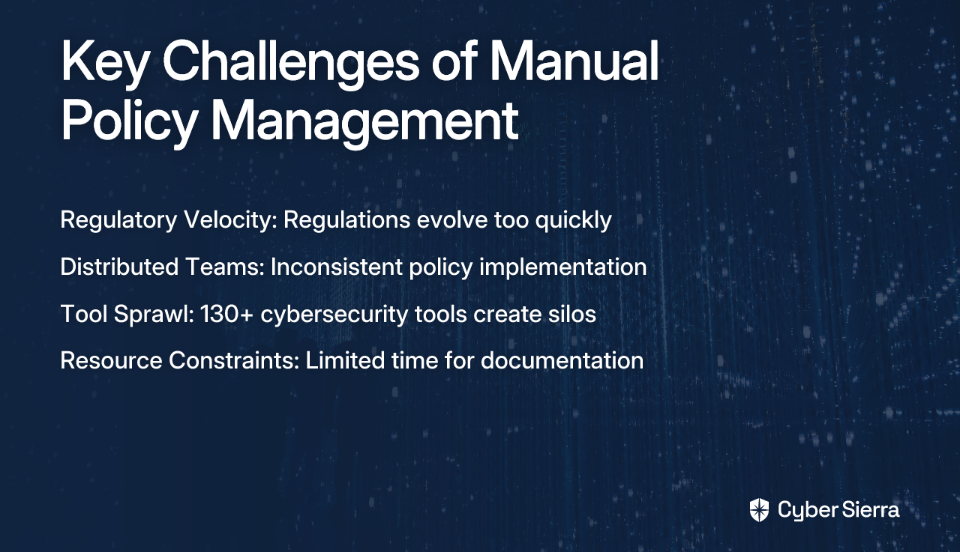
Traditional policy management approaches are collapsing under the weight of modern compliance demands. Here's why:
Regulatory Velocity: Regulations evolve faster than ever. The SEC issued penalties totaling $37,812,859 in the last 30 days, highlighting the cost of non-compliance.
Distributed Teams: Remote and global workforces create inconsistent policy implementation across departments, making centralized documentation challenging.
Tool Sprawl: The average enterprise uses 130+ cybersecurity tools, creating siloed policy management without a unified view.
Resource Constraints: According to a Reddit discussion on documentation tools, many organizations struggle with "little to no documentation" due to limited resources.
The consequences are severe. In September 2024 alone, organizations were fined over €4 billion for non-compliance with data processing principles. Manual policy management isn't just inefficient—it's becoming an existential risk.
What is Generative AI and How Can It Revolutionize Documentation?
Generative AI refers to artificial intelligence systems that can create original content—text, images, code—based on the patterns they've learned from vast datasets. As IBM explains, these systems "interpret and generate human-understandable content based on their training."
For policy documentation, GenAI isn't about replacing human judgment but amplifying it. Here's how it transforms the documentation process:
Automated Template Creation: GenAI can scan existing policies and automatically identify variables (like "Company Name") and conditional logic, turning static documents into dynamic templates.
First Draft Generation: Instead of starting with a blank page, provide a simple prompt outlining your objective and relevant framework, and GenAI will generate a comprehensive first draft.
Regulatory Intelligence: GenAI can ingest and summarize complex regulatory updates, highlighting specific impacts on your existing policies.
Clause Redrafting: When regulations change, GenAI can suggest alternative clauses that maintain compliance while preserving your organization's tone and approach.
Policy-to-Code Generation: For technical policies, tools like OpsMx's Rules Genie can take plain language policy definitions and automatically generate enforcement scripts in languages like Rego for the Open Policy Agent.
A Practical Guide: Implementing GenAI for Automated Policy Updates
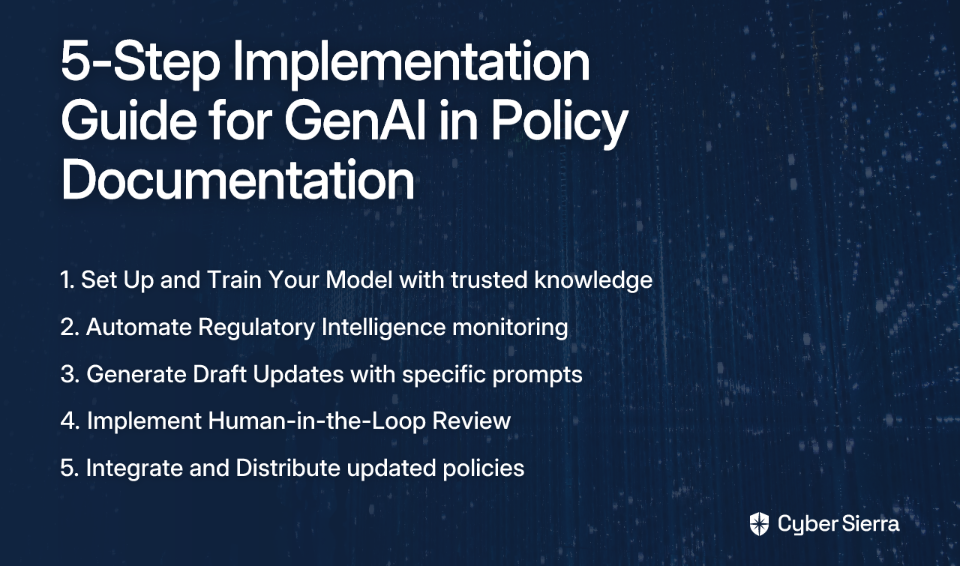
Let's break down how to implement GenAI for policy documentation in five actionable steps:
Step 1: Set Up and Train Your Model
While you can use general-purpose AI tools like ChatGPT, for policy documentation you'll want to create guardrails to prevent "hallucinations" (inaccurate outputs).
Actionable Tip: Feed your AI system a trusted knowledge base including:
- Your existing policy library
- Relevant frameworks (NIST, ISO 27001, PCI DSS)
- Historical audit findings
- Industry-specific regulations
This ensures outputs are grounded in your organization's reality and compliance requirements.
Step 2: Automate Regulatory Intelligence
Set up an automated monitoring system to track regulatory sources like the U.S. Code of Federal Regulations. An AI tool can then:
- Ingest regulatory updates
- Summarize key changes
- Flag which internal policies are potentially impacted
- Prioritize updates based on implementation deadlines
This transforms regulatory tracking from a manual chore to an automated, proactive process.
Step 3: Generate Draft Updates with Specific Prompts
The quality of your GenAI outputs depends heavily on your prompts. As one IT professional noted in a discussion about documentation tools, "Try throwing some stuff into ChatGPT with some very specific prompts - you might be surprised on the output..."
Example Prompt:
Based on the summarized changes to PCI DSS v4.0 regarding multi-factor authentication, review our current 'Access Control Policy' (document ID: POL-SEC-004) and draft updated sections 3.1 and 3.2 to meet the new requirements. Ensure the language is clear for a non-technical audience.
The specificity of this prompt—referencing exact document IDs and sections—dramatically improves the relevance and accuracy of the AI's response.
Step 4: The Human-in-the-Loop Review
This critical step addresses a fundamental truth from documentation professionals: "you can't escape the need for someone to pull it together and make it comprehensible."
The Subject Matter Expert (SME)'s role is not to write from scratch but to:
- Validate the AI's output for accuracy
- Add organizational context and nuance
- Ensure the policy meets specific business needs
- Apply professional judgment to edge cases
GenAI accelerates the first 80% of the work, allowing human experts to focus on the high-value validation and refinement that machines can't replicate.
Step 5: Integrate and Distribute
Once approved, the policy needs to be integrated into your GRC system and distributed to stakeholders. GenAI can help here too:
- Generate a 3-bullet summary of policy changes for an all-company email
- Create five quiz questions for the annual employee compliance training
- Produce department-specific guidance based on the master policy
- Update related documentation that references the changed policy
This ensures your updated policies aren't just stored but actually implemented and understood across the organization.

The Payoff and the Pitfalls: Benefits and Challenges of GenAI
Benefits
Greater Efficiency: According to IBM's research on GenAI, organizations can automate and accelerate content generation, freeing up employees for higher-value strategic tasks.
Enhanced Accuracy: AI-generated scripts and text minimize ambiguity and misinterpretation common in manual writing, ensuring policies are precise and implementable.
Improved Consistency: Ensure uniform policy enforcement and language across all documentation, eliminating the "policy drift" that occurs when different departments create their own variations.
Audit Readiness: When auditors arrive, you can demonstrate not just current policies but the systematic process used to maintain them, including regulatory change tracking and update history.
Challenges & Mitigation (Based on insights from IBM)
Challenge: Inaccurate Outputs (Hallucinations) Mitigation: Implement strong "guardrails" by ensuring the model draws only from trusted, verified sources you provide. Always have a human SME review critical outputs.
Challenge: Bias Mitigation: Ensure your training data (your existing policies and documents) is reviewed for inherent biases. Continuously evaluate outputs with a diverse team of reviewers.
Challenge: Inconsistency Mitigation: Master prompt engineering. Develop a library of standardized, detailed prompts for common tasks to ensure reliable and consistent outputs.
From Standalone AI to a Full Compliance Ecosystem
While tools like ChatGPT are a great starting point, true automation requires integration. A standalone AI tool can't connect a regulatory change to a specific internal control, track its implementation, or provide evidence for auditors.
This is where specialized platforms come in. An AI-enabled GRC platform provides the necessary ecosystem for GenAI to thrive by connecting the dots between policies, controls, assets, and evidence.
For example, Cybersierra's integrated platform enhances the effectiveness of GenAI for policy documentation in several ways:
Continuous Control Monitoring (CCM): Instead of waiting for an audit, Cybersierra's CCM provides near real-time data on control effectiveness. GenAI can analyze this data stream and proactively suggest policy updates. For example, if the CCM tool detects persistent cloud misconfigurations, GenAI could draft a more stringent policy for cloud deployments.
Governance, Risk & Compliance (GRC): Cybersierra's GRC module serves as the single source of truth for your policies. When GenAI drafts a new policy, the platform can automatically map it to multiple frameworks (like SOC 2, ISO 27001, HIPAA), link it to relevant controls, and maintain a detailed audit trail for when auditors come knocking.
Automating the Full Lifecycle: The integration provides the end-to-end workflow: monitoring for changes, using GenAI to draft updates, routing them for human approval, and then tracking their implementation and effectiveness via CCM.
This approach addresses a key pain point identified in user research: "I need to up my documentation game and it'd be easier for me to do if it would just map out the process I do as I do it." An integrated platform doesn't just help you write policies—it maps them to your actual operations, creating a living system rather than static documents.
Conclusion: From Documentation Burden to Compliance Advantage
GenAI is transforming policy documentation from a static, manual chore into a dynamic, automated process. The key insights to take away:
- Manual policy management is unsustainable in today's regulatory environment, creating significant compliance and business risks.
- GenAI can automate 60-80% of policy documentation work, from monitoring regulatory changes to drafting updates to creating training materials.
- Human expertise remains essential for validation, context, and judgment—GenAI is a powerful assistant, not a replacement for SMEs.
- Integration is critical for moving beyond standalone AI experiments to a systematic, auditable compliance program.
Stop chasing documentation and start automating it. The competitive advantage belongs to organizations that can maintain compliance without diverting resources from innovation and growth.
Frequently Asked Questions
What is GenAI for policy documentation?
Generative AI for policy documentation is the use of artificial intelligence to automatically create, update, and manage compliance documents like security policies and procedures. It transforms the process by generating first drafts from simple prompts, summarizing complex regulatory changes, redrafting specific clauses to meet new requirements, and even translating policies into executable code. Instead of replacing human experts, it acts as a powerful assistant to accelerate their work.
How does GenAI automate policy updates?
GenAI automates policy updates by continuously monitoring regulatory sources for changes, identifying impacted internal policies, and automatically generating draft updates for human review. The process involves setting up an AI model with your trusted knowledge base (existing policies, frameworks like NIST or ISO 27001), which then ingests and summarizes new regulations. Using specific prompts, you can instruct the AI to redraft specific sections of a policy, which are then validated by a Subject Matter Expert before being distributed.
Why is human review still necessary for AI-generated policies?
Human review is essential to validate the accuracy of AI-generated content, add critical organizational context, and apply professional judgment to nuances and edge cases that an AI cannot understand. While GenAI can handle about 80% of the drafting work, it lacks true comprehension of your business's specific needs, risk appetite, and operational realities. A human-in-the-loop process ensures that policies are not only compliant but also practical, comprehensible, and aligned with your company's strategic goals.
What are the main risks of using GenAI for compliance documents?
The main risks of using GenAI for compliance are generating inaccurate information (hallucinations), perpetuating hidden biases from training data, and producing inconsistent outputs. These risks can be mitigated effectively. Hallucinations are minimized by training the AI on a curated, trusted knowledge base and implementing strong "guardrails." Bias is addressed by carefully reviewing training data and having diverse teams review outputs. Inconsistency is solved by developing and using a library of standardized, detailed prompts for common documentation tasks.
What is the difference between using ChatGPT and an integrated GRC platform for policy management?
A standalone tool like ChatGPT can draft text, but an integrated Governance, Risk, and Compliance (GRC) platform connects that text to your entire compliance ecosystem. An AI-enabled GRC platform provides the end-to-end workflow. It not only helps draft a policy but also maps it to multiple compliance frameworks (e.g., SOC 2, HIPAA), links it to specific internal controls, tracks its implementation through continuous monitoring, and maintains a complete audit trail. This creates a living, auditable system rather than just a collection of static documents.

While GenAI tools are democratizing access to automation capabilities, specialized platforms like Cybersierra provide the framework and guardrails needed for enterprise-grade policy management. See how an integrated GRC platform can provide the foundation for your GenAI-powered compliance strategy and make you audit-ready, faster.
The future of policy documentation isn't just automated—it's intelligent, integrated, and proactive. And it starts with GenAI.
