



The Future of Cyber GRC in the Age of AI


Join thousands of professionals and get the latest insight on Compliance & Cybersecurity.
You've invested years building a career in Cybersecurity Governance, Risk, and Compliance (GRC). Now, every time you open LinkedIn, another headline screams about AI automating your job away. As one frustrated GRC professional put it, "If an AI can already automate 75% of the work involved in vulnerability identification, how long before it replaces cybersecurity professionals entirely?"
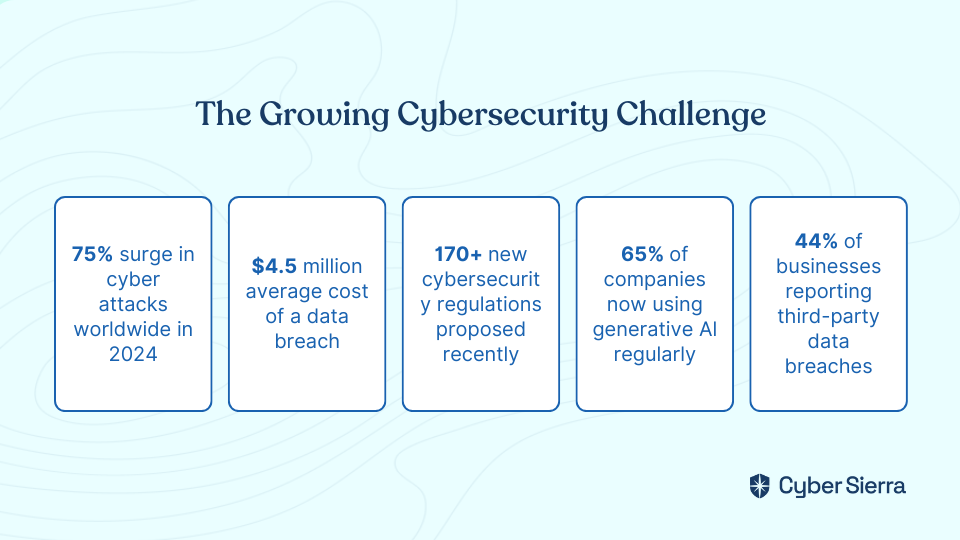
Meanwhile, you're drowning in spreadsheets, battling office politics, and feeling the weight of an ever-expanding regulatory landscape. With cyberattacks surging by 75% globally in 2024, the average cost of a data breach hitting $4.5 million, and over 170 new cybersecurity regulations proposed in the last two years, the pressure is mounting.
But here's the truth: AI isn't coming to replace you—it's arriving just in time to transform your role into something far more strategic and valuable.
The Traditional GRC Landscape: A Foundation Under Pressure
Cybersecurity GRC integrates governance, risk management, and compliance into a cohesive framework to manage complex cyber threats and align security with business goals. But today, this foundation is cracking under immense pressure.
Operational Silos
James Wade, CISO at MCS, summarizes a common frustration: "We had different business units...each doing their own thing." This siloed approach, as one practitioner bluntly stated, can "kill their efficiency and effectiveness," making coordinated risk management nearly impossible.
The Grind of Manual Work
GRC professionals spend countless hours on "excel forms" and rely heavily on "tribal knowledge" due to poor documentation. As one Reddit user explained: "not everything is documented and mostly tribal knowledge so in my first year it was getting documentation down." This manual, reactive approach is both inefficient and error-prone.
Navigating Corporate Politics
Perhaps the most draining aspect is the political maneuvering required. "There is an obscene amount of politics that happens before they agree to fix/improve something," laments one GRC professional. This creates a significant barrier between identifying risks and actually mitigating them.
Regulatory Overload
The expanding regulatory landscape—including the US SEC's cybersecurity rules, the EU's Cyber Resilience Act, and the Digital Operational Resilience Act (DORA)—has created a compliance burden that traditional approaches simply cannot sustain.
The AI Revolution: Transforming GRC from Reactive to Proactive
With 65% of companies now using generative AI regularly, its impact on GRC is undeniable. AI is not just another tool—it's the catalyst for evolving GRC practices from reactive compliance exercises to proactive risk management.
Enhanced Risk Management
AI-driven tools are moving organizations from constantly putting out fires to preventing them before they start:
- Machine learning can analyze patterns to predict cybersecurity vulnerabilities and insider threats before they're exploited
- Cyber Risk Quantification (CRQ) uses AI to translate technical cyber risk into financial terms the board can understand, as detailed by Kovrr
Streamlined Compliance
The days of manually sifting through regulatory updates are ending:
- Natural Language Processing (NLP) can scan and interpret new regulations, flagging relevant changes and simplifying compliance efforts
- As Deana Robinson from Sonoco Products noted, GRC automation provides "real-time regulatory alerts and structured compliance workflows," drastically reducing response times
Improved Operational Efficiency
AI automates the most tedious aspects of GRC work, freeing professionals to focus on what matters:
- Repetitive tasks like data collection, control testing, and report generation can be automated
- AI-powered GRC dashboards provide actionable insights that bridge the gap between technical risk and business priorities
Parrish Gunnels, CISO at Sunflower Bank, uses such tools to categorize risks into clear buckets for effective board-level prioritization, making the entire process more efficient and impactful.
Practical Applications: The AI-Powered GRC Toolkit in Action
These aren't theoretical benefits—AI is already transforming GRC practices today:
Automated Risk Assessments
AI analyzes vast datasets in real-time to continuously evaluate risk posture, replacing point-in-time assessments with dynamic monitoring that reflects the actual risk landscape.
Third-Party Risk Management (TPRM)
With 44% of businesses reporting third-party data breaches, AI is crucial for continuously monitoring vendor risks and compliance. AI-powered TPRM platforms can automatically flag vendor security issues and compliance gaps before they impact your organization.
Audit Automation
AI streamlines the audit process by automatically gathering evidence and analyzing controls against frameworks like ISO, NIST 800-53, and SOX. This reduces the "evidence gathering" burden that frustrates so many GRC professionals.
Incident Response
AI-powered Security Information and Event Management (SIEM) tools use anomaly detection to identify and respond to security incidents faster than humanly possible, reducing both detection and response times.
Navigating the New Risks: The Dual-Edged Sword of AI
While AI offers tremendous benefits, it also introduces new challenges. As one cybersecurity professional warned, "attackers can use AI just as well."
The Governance of AI Itself
Creating effective governance for AI systems is complex, particularly around bias/fairness checks and LLM guardrails. Yet as one practitioner noted, "AI shouldn't be governed in isolation." Creating a parallel GRC ecosystem for AI leads to "more overhead and confusion." Instead, AI governance must be integrated into existing frameworks.
Data Integrity is Non-Negotiable
AI's effectiveness depends entirely on the quality of its training data. As Deana Robinson emphasized: "AI can only be as effective as the data it processes." Organizations must establish robust data governance practices to ensure AI solutions deliver reliable insights.
The "Black Box" Problem
AI models can be opaque, making it difficult to explain their reasoning. This lack of transparency poses significant challenges for Audit and regulatory accountability, particularly when decisions need to be justified to external stakeholders.
Best Practices for AI-Powered GRC: A Roadmap for the Future
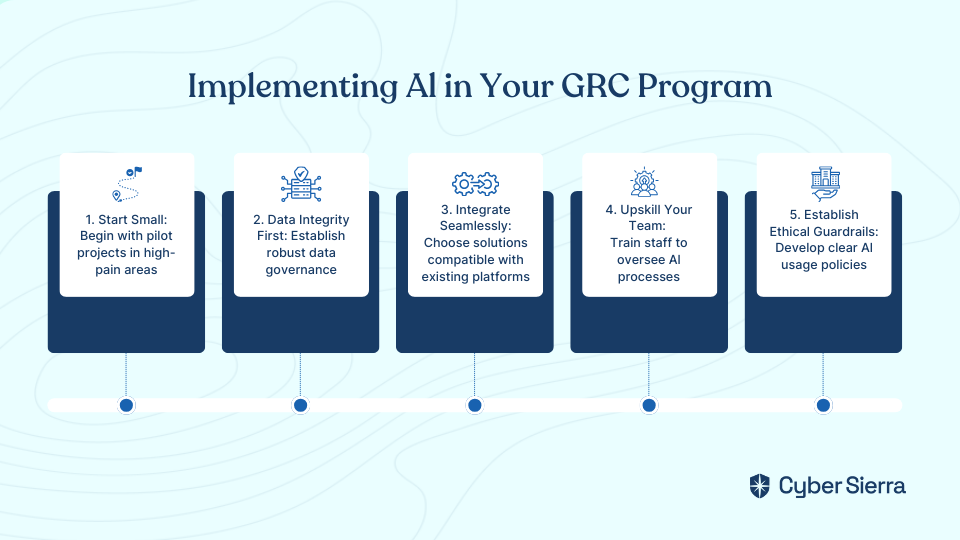
For organizations looking to harness AI's potential in GRC, follow these key steps:
- Start Small: Implement pilot projects targeting specific, high-pain areas to demonstrate quick wins and build momentum
- Data Integrity First: Establish robust data governance practices—clean, well-managed data is the prerequisite for reliable AI insights
- Integrate Seamlessly: Choose AI solutions that integrate with existing GRC platforms, such as the Diligent One Platform, to avoid creating new information silos
- Upskill Your Team: Invest in training to help your team transition from manual task execution to strategic oversight of AI-driven processes
- Establish Ethical Guardrails: Develop clear policies governing AI usage to ensure fairness, transparency, and accountability
The Future is Human-Centric, AI-Augmented
Despite the anxieties around AI replacing GRC roles, the future isn't about elimination—it's about elevation. While AI excels at processing data and automating tasks, it cannot replicate uniquely human skills that are essential to effective GRC:
Strategic Context
As one cybersecurity professional noted, "AI does not have the ability to understand context." Humans remain essential for interpreting AI outputs and applying them to the unique business environment. AI can analyze patterns, but humans provide the judgment to determine what those patterns mean for your specific organization.
Relationship Building
Perhaps most importantly, "the G in GRC requires a LOT of building relationships and buy in at executive leadership levels. This cannot be done by an AI." Navigating politics and building consensus remains a core human skill that no algorithm can replicate.
Ethical Judgment and Accountability
Humans must define the ethical boundaries for AI and remain ultimately accountable for GRC outcomes, especially in the face of events like the SEC charging companies for misleading cyber disclosures.
The future of Cyber GRC belongs to professionals who embrace AI as a co-pilot. By delegating the repetitive work to machines, they can focus on strategic leadership, complex problem-solving, and building a resilient, risk-aware culture. The role of the CISO and GRC professional will become more strategic, more influential, and ultimately, more valuable than ever before.
Rather than asking if AI will replace your GRC job, perhaps the better question is: How will you leverage AI to transform your role from "boring as shit" spreadsheet management to strategic risk leadership that drives real organizational value?
Frequently Asked Questions
Will AI replace jobs in Cybersecurity GRC?
No, AI is not expected to replace jobs in Cybersecurity GRC; instead, it is set to elevate the role of GRC professionals by automating repetitive tasks and enabling a more strategic focus. AI handles data-heavy, manual work like control testing, evidence gathering, and report generation. This frees up GRC experts to concentrate on uniquely human skills such as strategic planning, interpreting AI insights within the business context, building relationships with leadership, and making complex ethical judgments. The future is human-centric and AI-augmented, not human-replaced.
How is AI transforming GRC from reactive to proactive?
AI transforms GRC from a reactive, compliance-focused function to a proactive, risk-management-oriented one by using predictive analytics and real-time data processing. Instead of just responding to incidents and audit findings, AI-powered tools can analyze vast datasets to predict potential vulnerabilities and insider threats before they are exploited. AI also enables Cyber Risk Quantification (CRQ), which translates technical risks into financial terms, allowing organizations to prioritize threats and prevent them before they escalate.
What are the biggest challenges when implementing AI in GRC?
The biggest challenges of implementing AI in GRC are governing the AI systems themselves, ensuring high-quality data integrity, and addressing the "black box" problem where AI decision-making lacks transparency. Organizations must create governance frameworks for AI to manage bias and ensure fairness, without creating a confusing parallel GRC system. Since AI's effectiveness depends entirely on the data it's trained on, robust data governance is critical. Finally, the opaque nature of some AI models can pose problems for audits and regulatory accountability, requiring new approaches to ensure transparency.
How can GRC professionals prepare for an AI-driven future?
GRC professionals can prepare for an AI-driven future by focusing on upskilling in strategic areas and learning how to effectively manage and oversee AI-powered tools. The key is to shift from manual task execution to strategic oversight. Professionals should invest in training to understand AI capabilities, data governance principles, and how to interpret AI-generated insights. Developing skills in relationship-building, executive communication, and ethical judgment will become even more critical, as these are areas where human expertise remains irreplaceable.
What is the first step to integrating AI into GRC?
The best first step to integrating AI into your GRC program is to start small with a pilot project that targets a specific, high-pain area. Instead of attempting a massive overhaul, identify a recurring, time-consuming task like third-party risk monitoring or compliance evidence gathering. Implementing an AI solution for this single problem can demonstrate quick wins, build momentum within the organization, and provide valuable lessons for broader adoption. Always ensure the chosen AI solution can integrate with your existing GRC platforms to avoid creating new data silos.
Why is human judgment still essential for GRC with AI?
Human judgment remains essential because AI lacks the ability to understand business context, navigate organizational politics, or make nuanced ethical decisions. An AI can identify a security risk, but a human GRC professional is needed to interpret that risk's significance for the specific organization, communicate it to leadership, and build the consensus needed to address it. Skills like strategic thinking, relationship building, and ultimate accountability cannot be automated, making humans the indispensable leaders of any AI-augmented GRC framework.
