Third-Party Risk Management in 2026: Strategy & Tech to Reduce Vendor Risk


Join thousands of professionals and get the latest insight on Compliance & Cybersecurity.
Summary
- With 29% of data breaches originating from third-party vendors, traditional risk management methods that rely on static, self-reported questionnaires are no longer sufficient.
- The critical evolution in TPRM is the shift from point-in-time assessments to continuous monitoring, which provides an ongoing, real-time view of a vendor's security posture.
- A future-proof TPRM program requires a complete lifecycle approach—from vendor inventory to secure offboarding—and will increasingly rely on AI to automate risk identification.
- Platforms like Cyber Sierra's TPRM module automate continuous monitoring to provide objective validation of vendor security, moving beyond unreliable, point-in-time data.
You just received an alert: one of your critical SaaS vendors has experienced a major data breach. Your team scrambles to assess the impact, but it's too late—sensitive customer data has been exposed, and your company's name is about to appear in headlines alongside the breach notification.
This scenario is more common than you might think. According to SecurityScorecard, 29% of all data breaches originate from third-party vendors, making your supply chain one of your most vulnerable attack vectors.
"You can't trust the third party didn't just lie," laments one security professional on Reddit, echoing a sentiment shared by many TPRM specialists. With vendors self-reporting their security posture and compliance status, how can you be sure you're not just checking boxes while real risks remain hidden?
Why Yesterday's TPRM Won't Work in 2026
As we look toward 2026, traditional approaches to Third-Party Risk Management are becoming increasingly obsolete for several critical reasons:
The Expanding Attack Surface: Every Vendor is a New Door
The modern digital ecosystem demands deeper integrations and greater data sharing between your organization and third parties. Each connection represents a potential entry point for threats. When one vendor might connect to hundreds of fourth and fifth parties, the risk compounds exponentially.
The Regulatory Gauntlet: New Laws, Harsher Penalties
Compliance is no longer optional. Regulations like GDPR, CCPA, and the EU's Digital Operational Resilience Act (DORA) are imposing stricter requirements and heavier penalties for failures in third-party oversight. By 2026, these regulations will only become more demanding, with potential fines reaching up to 4% of global annual revenue for serious violations.
The Four Horsemen of Vendor Risk: Beyond Just Cybersecurity
TPRM isn't just about preventing breaches—it encompasses four critical risk categories:
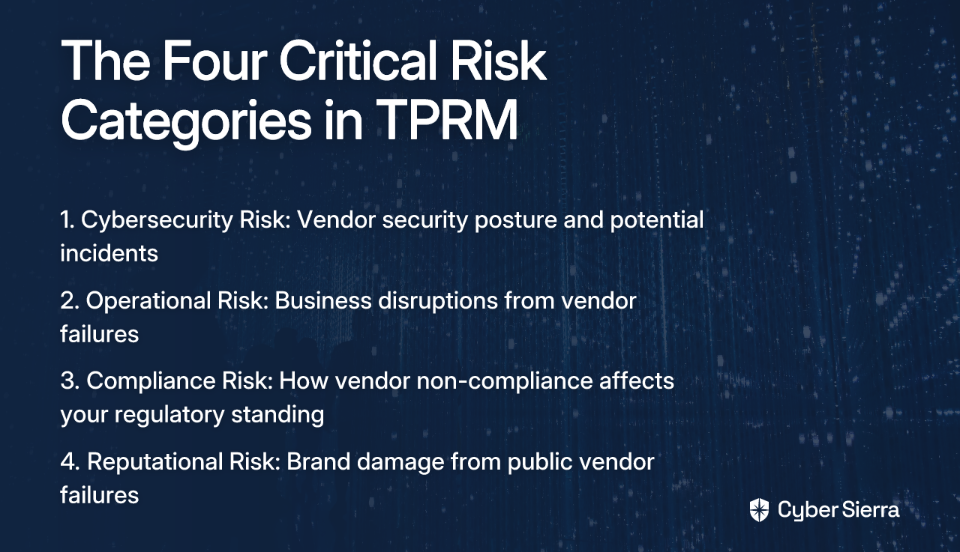
- Cybersecurity Risk: The most obvious concern, relating to a vendor's security posture and potential for incidents.
- Operational Risk: Disruptions to your business operations due to vendor failures, as demonstrated by the recent CDK Global ransomware attack that impacted thousands of car dealerships nationwide.
- Compliance Risk: How a vendor's non-compliance can directly impact your own regulatory standing.
- Reputational Risk: The damage to your brand when a vendor failure becomes public, often resulting in customer loss and diminished trust.
The Modern TPRM Lifecycle: A Step-by-Step Framework
To address these evolving challenges, organizations need a comprehensive TPRM framework that goes beyond traditional approaches. Here's what a future-proof TPRM program will look like by 2026:
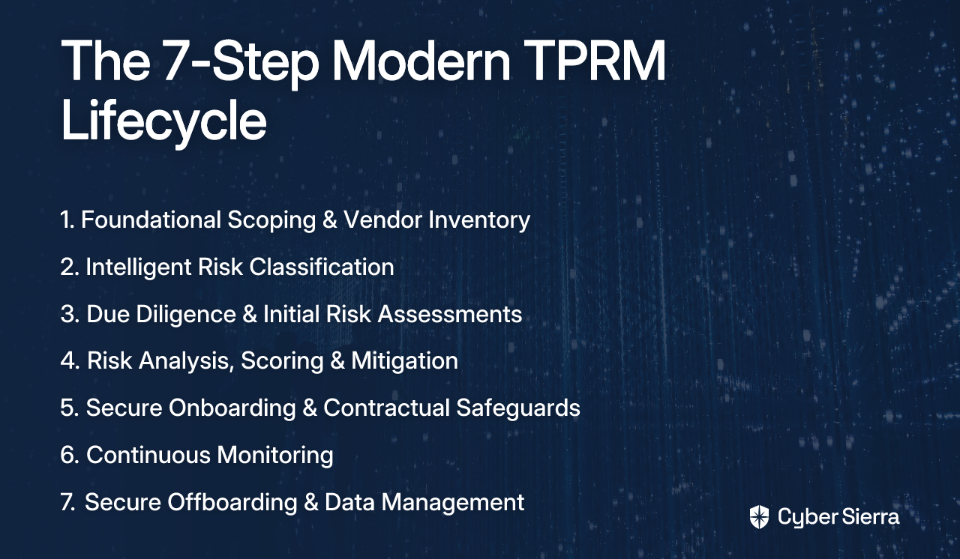
Step 1: Foundational Scoping and Vendor Inventory
You can't protect what you don't know you have. Create a centralized, complete inventory of all vendors, including upstream suppliers and downstream partners. This visibility is the foundation of effective risk management.
Step 2: Intelligent Risk Classification (Not All Vendors Are Equal)
Categorize vendors based on criticality and level of access to sensitive data. High-risk vendors will require deeper assessments and continuous monitoring, while low-risk vendors can follow a more streamlined process. This targeted approach helps manage resource constraints while focusing on your greatest areas of vulnerability.
Step 3: Due Diligence and Initial Risk Assessments
Use standardized Risk Assessment Questionnaires to gather initial insights, but recognize their limitations. These assessments are self-reported and represent only a point-in-time snapshot of a vendor's security posture.
"The best I feel that can be done is to achieve due diligence," notes one Reddit user, highlighting the limitations of traditional questionnaire-based assessments. By 2026, these will be just the starting point, not the entire program.
Step 4: Risk Analysis, Scoring, and Mitigation
Review assessment responses, assign risk scores, and identify security gaps. Most importantly, high-risk issues must be remediated before onboarding. This proactive approach prevents introducing known vulnerabilities into your ecosystem.
Step 5: Secure Onboarding and Contractual Safeguards
Embed security requirements, right-to-audit clauses, and incident notification timelines into contracts. These legal protections establish clear expectations and recourse if vendors fail to maintain adequate security practices.
Step 6: The Game Changer - Continuous Monitoring
This is where TPRM in 2026 will differ most dramatically from today's approaches. Implement continuous security monitoring to track vendor security postures throughout their lifecycle. This shift from "trust but verify" to "continuously validate" addresses the fundamental problem of relying on self-reported data.
Step 7: Secure Offboarding and Data Management
When a relationship ends, follow a formal process to revoke all access, ensure data is returned or destroyed securely, and fulfill data privacy regulations. This often-overlooked step prevents "ghost" vendors from retaining access to your systems and data.
Beyond the Questionnaire: The Power of Continuous Monitoring
The most critical evolution in TPRM by 2026 will be the widespread adoption of continuous monitoring technologies. The difference is fundamental: assessments are point-in-time snapshots; monitoring is an ongoing, real-time video feed of a vendor's security posture.
This approach delivers several crucial benefits:
- Reduces Risk of Data Breaches: Identifies vulnerabilities before they can be exploited
- Minimizes Regulatory Fines: Provides ongoing proof of vendor oversight
- Strengthens Incident Response: Enables quicker detection of third-party threats
- Encourages Vendor Accountability: Data-driven security ratings motivate vendors to improve their posture
Modern continuous monitoring will work through:
- Automated Risk Scanning: Continuously evaluating a vendor's external attack surface for vulnerabilities
- Live Intelligence Feeds: Collecting real-time threat data from various sources
- Breach Detection and Dark Web Monitoring: Identifying if vendor credentials or data have been exposed
- AI-Driven Risk Scoring: Assigning dynamic security ratings to vendors for easy comparison and prioritization
Platforms like Cyber Sierra's TPRM module are built on this principle. They move beyond static spreadsheets by providing near real-time, 24/7 visibility into vendor security compliance. This automation directly solves the challenge of trusting self-reported questionnaires by providing objective, external validation of a vendor's security posture.
Future-Forward: Key Technologies and Strategies for 2026
AI and Automation: The New TPRM Co-Pilot
By 2026, AI will revolutionize how organizations approach TPRM. According to Aravo, AI will automate risk assessments by identifying risk conditions, improving decision-making, and dramatically reducing manual effort. This directly addresses the need for more "effective tools" that many security professionals are seeking.
Imagine an AI assistant that can automatically flag concerning patterns in vendor behavior, predict potential security incidents based on external signals, and recommend tailored mitigation strategies—all without requiring manual reviews of lengthy questionnaires.
Integrated Risk Management: Breaking Down Departmental Silos
Effective TPRM requires collaboration between procurement, IT, compliance, and legal teams. By 2026, leading organizations will have implemented centralized platforms providing 360° unified visibility into all third-party relationships.
This integrated approach is a core tenet of modern GRC platforms. For example, Cyber Sierra unifies TPRM with Continuous Control Monitoring (CCM) and Governance, Risk & Compliance (GRC). This allows organizations to not only assess a vendor's external posture but also continuously monitor how that vendor impacts their own internal controls and compliance with frameworks like SOC 2 or ISO 27001.
Addressing the "Mom-and-Pop" Vendor Challenge: A Pragmatic Approach
One persistent challenge in TPRM is dealing with smaller vendors for whom formal certifications like SOC 2 are cost-prohibitive. As one Reddit user noted, "You need to do business with a mom and pop setup that cannot obtain certification."
By 2026, mature TPRM programs will take a more nuanced approach:
- Use your risk classification framework: If the vendor is low-risk (limited data access, non-critical function), you may "accept the risk" with appropriate documentation.
- Implement compensating internal controls: When vendor controls are inadequate, implement additional internal safeguards to mitigate the risk.
- Focus on specific security measures: Rather than requiring full certifications, focus on the security measures that matter most for the specific service (e.g., encryption, MFA, secure development practices).
From Reactive Checkbox to Strategic Advantage
As we look toward 2026, TPRM is evolving from a compliance-driven, manual, and periodic activity to a strategic, automated, and continuous security function. Organizations that embrace this evolution will not only avoid breaches but build resilient and trustworthy digital supply chains.
The future of TPRM isn't about collecting more questionnaires—it's about gaining real-time visibility, leveraging AI-powered insights, and creating an integrated approach to vendor risk that spans the entire organization.
Are you still relying on spreadsheets and annual questionnaires? It's time to embrace the strategies and technologies that will define third-party security for 2026 and beyond.
Frequently Asked Questions
What is Third-Party Risk Management (TPRM)?
Third-Party Risk Management (TPRM) is the process of identifying, assessing, and mitigating risks associated with using external vendors, suppliers, and service providers. It involves a complete lifecycle approach to ensure third parties don't introduce unacceptable security, operational, compliance, or reputational risks to your organization.
Why are traditional TPRM methods becoming obsolete?
Traditional TPRM methods, which rely on point-in-time questionnaires, are becoming obsolete because they fail to address the dynamic and expanding nature of modern digital supply chains. They can't keep up with the expanding attack surface, stricter regulations, and the fact that self-reported data can be quickly outdated or inaccurate.
What is the difference between risk assessments and continuous monitoring?
The key difference is that risk assessments are static, point-in-time snapshots of a vendor's security posture, while continuous monitoring provides an ongoing, real-time view. An assessment shows a vendor's status on a specific day, whereas monitoring acts like a live video feed, constantly scanning for new vulnerabilities and changes in their security rating.
How should organizations handle small vendors who lack formal security certifications?
Organizations should adopt a risk-based approach for small vendors. This involves classifying the vendor based on their access to sensitive data and criticality. For low-risk vendors, you might formally accept the risk. For higher-risk vendors, you can implement compensating internal controls and focus on verifying specific security measures (like encryption and MFA) rather than requiring a full certification.
What are the key steps in a modern TPRM lifecycle?
A modern TPRM lifecycle consists of seven key steps: foundational scoping and vendor inventory, intelligent risk classification, due diligence and initial risk assessments, risk analysis and mitigation, secure onboarding and contractual safeguards, continuous monitoring, and secure offboarding and data management. This framework ensures risk is managed at every stage of the vendor relationship.
How will AI change TPRM by 2026?
By 2026, AI will act as a co-pilot for TPRM teams by automating risk identification, improving decision-making, and significantly reducing manual workloads. AI-powered platforms can automatically analyze vendor data, predict potential incidents based on threat intelligence, and recommend specific mitigation strategies, making TPRM more predictive and efficient.