
Top 10 Compliance Gaps That Lead to Failed Audits (And How to Fix Them)


Join thousands of professionals and get the latest insight on Compliance & Cybersecurity.
Summary
- Most audit failures stem from predictable gaps like poor documentation, lack of continuous monitoring, and inadequate vendor risk management.
- To succeed, organizations must shift from reactive, annual checks to a proactive, continuous compliance posture.
- Implementing a unified GRC platform helps automate evidence collection, monitor controls in real-time, and maintain an "always audit-ready" status.
Your boss just told you that you failed a compliance audit, and now you're scrambling to figure out what to do next. The sinking feeling in your stomach is all too familiar for many security and compliance professionals. The truth is, failed audits are rarely a surprise—they're the result of common, predictable gaps that plague many organizations.
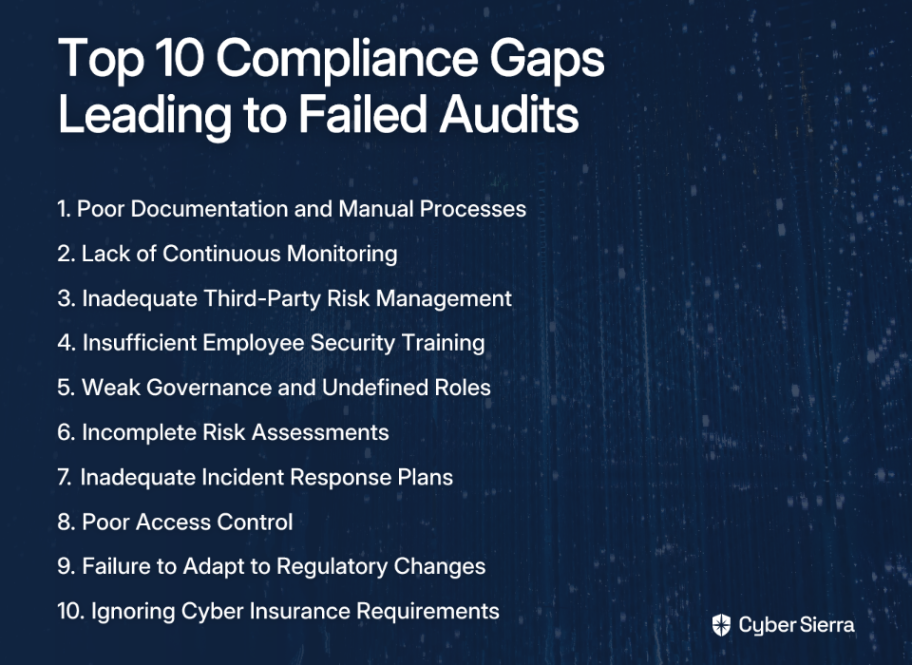
The good news? By understanding these gaps and implementing the right fixes, you can transform compliance from a source of stress into a strategic advantage. Let's dive into the top 10 compliance gaps that lead to failed audits and the practical steps to fix them.
1. Poor Documentation and Manual Processes
The Gap: If you're still relying on spreadsheets, manual evidence collection, and inconsistent documentation, you're setting yourself up for failure. Missing, outdated, or poorly organized records make it impossible to produce evidence on demand during an audit.
Why it Leads to Audit Failure: As noted by F5, poor documentation is a primary failure point because it serves as the primary proof of compliance. Without a clear audit trail, auditors assume the control is not in place or not operating effectively.
How to Fix It:
- Establish a centralized repository for all compliance documentation
- Implement standardized templates for policies, procedures, and risk assessments
- Automate evidence collection from cloud environments and security tools
- Define clear roles and responsibilities for documentation ownership
The Automated Solution: Implementing a GRC automation platform like Cyber Sierra's GRC module can eliminate manual chaos by automating data collection, maintaining detailed audit trails, and managing policies across multiple frameworks such as SOC2, ISO 27001, GDPR, and HIPAA.
2. Lack of Continuous Monitoring
The Gap: Many organizations treat compliance as a once-a-year event, checking security controls only during audit periods. This approach leaves you blind to configuration drifts, new vulnerabilities, and control failures that occur between audits.
Why it Leads to Audit Failure: Auditors increasingly look for evidence of continuous compliance, not just point-in-time snapshots. Without ongoing monitoring, you can't prove that controls have been operating effectively throughout the entire audit period.
How to Fix It:
- Implement tools that continuously check systems against defined controls
- Develop dashboards to track key compliance metrics in real-time
- Configure alerts for compliance violations and control failures
- Schedule regular internal assessments between formal audits
3. Inadequate Third-Party Risk Management (TPRM)
The Gap: Onboarding vendors without proper due diligence, using outdated questionnaires, and failing to monitor their security posture post-onboarding is a recipe for disaster. Remember: your organization's security is only as strong as your weakest vendor.
Why it Leads to Audit Failure: Regulators and auditors are laser-focused on supply chain risk. According to ProcessUnity, common TPRM issues include "improper vendor classification, lengthy onboarding cycles, and inadequate ongoing assessments"—all of which raise red flags during audits.
How to Fix It:
- Establish a formal TPRM program with standardized processes
- Classify vendors based on data access and criticality
- Implement continuous monitoring of vendor security posture
- Centralize contract management with security requirements
The Automated Solution: Cyber Sierra's TPRM module automates the entire vendor lifecycle, from onboarding and risk-based assessments to continuous monitoring, addressing the challenge of managing hundreds of vendor relationships.
4. Insufficient Employee Security Training
The Gap: Many organizations treat security awareness training as a "check-the-box" activity. Training is infrequent, unengaging, and fails to address the latest social engineering tactics.
Why it Leads to Audit Failure: Most compliance frameworks explicitly require evidence of security awareness training. As one Reddit user pointed out, those "paying the bills should see that training is necessary early on" in the compliance journey.
How to Fix It:
- Implement ongoing training instead of annual sessions
- Run regular phishing simulations to test awareness
- Maintain a dashboard of training metrics and completion rates
- Tailor training to different roles and departments
5. Weak Governance and Undefined Roles
The Gap: Lack of clear ownership for compliance and security controls. When responsibilities are not clearly defined, controls get missed and risks go unmanaged.
Why it Leads to Audit Failure: When auditors ask "Who is responsible for this control?" and get vague answers, it's a major finding. This points to insufficient management oversight and undefined roles, which are critical for ensuring controls operate as intended.
How to Fix It:
- Appoint a CISO or equivalent senior leader responsible for cybersecurity
- Develop a RACI matrix (Responsible, Accountable, Consulted, Informed) for key controls
- Schedule regular management reviews of compliance status
- Document the governance structure in policies and procedures

The Automated Solution: A unified GRC platform helps enforce governance by assigning control owners, tracking remediation tasks, and generating reports for management reviews.
6. Incomplete Risk and Vulnerability Assessments
The Gap: Performing infrequent or incomplete risk assessments that fail to cover all assets is a common gap. This includes not maintaining a comprehensive IT asset inventory and not conducting regular vulnerability scans.
Why it Leads to Audit Failure: Most compliance frameworks are built on risk management principles. An auditor will ask to see your risk assessment methodology, asset inventory, and evidence of vulnerability management. Failure here undermines the entire compliance program.
How to Fix It:
- Maintain a comprehensive IT asset inventory
- Implement regular vulnerability scanning of networks and cloud infrastructure
- Conduct annual penetration tests to identify hidden vulnerabilities
- Establish a formal patch management program with clear timelines
"Organizations without a clear picture of their assets and vulnerabilities can't effectively protect them," notes security experts at Executech. "Regular scanning is essential for maintaining a strong security posture."
7. Inadequate Incident Response (IR) and Business Continuity (BC) Plans
The Gap: Having outdated, untested, or non-existent IR or BC plans is surprisingly common. When a security incident occurs, teams are unprepared, leading to chaotic responses, extended downtime, and potential data loss.
Why it Leads to Audit Failure: Auditors will ask for your IR and BC plans and, more importantly, for evidence that you've tested them. A plan that exists only on paper is considered a failed control, potentially leading to downtime costs of up to $5,600 per minute according to some estimates.
How to Fix It:
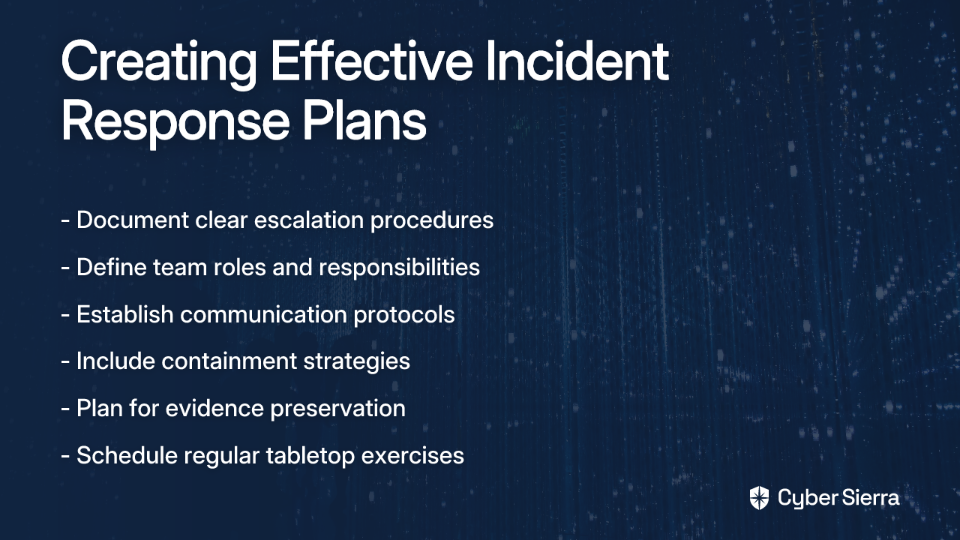
- Develop formal, documented IR and BC plans
- Conduct regular tabletop exercises to test your plans
- Test backup and recovery procedures periodically
- Review and update plans at least annually
8. Poor Access Control and User Provisioning
The Gap: Failing to enforce the principle of least privilege is a critical gap. When employees have excessive access to systems and data, and processes for managing user accounts are manual and inconsistent, security risks multiply.
Why it Leads to Audit Failure: Access control is a fundamental security principle. Finding former employees with active accounts or current employees with excessive permissions is an immediate and critical audit finding.
How to Fix It:
- Implement Role-Based Access Control (RBAC)
- Enforce Multi-Factor Authentication (MFA) for all critical systems
- Automate user provisioning/de-provisioning with HR integration
- Conduct quarterly access reviews with manager certification
The Automated Solution: Through Continuous Control Monitoring, solutions like Cyber Sierra can monitor for overly permissive IAM roles and alert on changes to critical user groups, helping to enforce least privilege continuously.
9. Failure to Adapt to Regulatory Changes
The Gap: The regulatory landscape (GDPR, CCPA, etc.) is constantly evolving. Organizations that fail to track these changes and update their policies accordingly fall out of compliance without realizing it.
Why it Leads to Audit Failure: Ignorance of new regulations is not a valid defense in an audit. Auditors expect organizations to have a formal process for monitoring regulatory changes and incorporating them into their compliance program.
How to Fix It:
- Designate a person or team to track regulatory changes
- Subscribe to compliance news services and updates
- Conduct gap analyses when new regulations emerge
- Update policies and procedures promptly
10. Ignoring Cyber Insurance Requirements
The Gap: As cyber insurance becomes a business necessity, many organizations fail to realize their policy has strict security requirements. Not meeting these requirements can potentially void coverage when it's needed most.
Why it Leads to Audit Failure: While not a traditional compliance audit, insurer questionnaires function similarly. Failing to meet their requirements can lead to denied coverage or significantly higher premiums.
How to Fix It:
- Review your policy to understand specific security requirements
- Use automated documentation to demonstrate compliance
- Leverage your compliance evidence to negotiate better premiums
The Automated Solution: Cyber Sierra's Cyber Insurance module helps organizations understand coverage needs, implement required controls, and automate documentation collection for insurers.
Moving From Audit Panic to Continuous Compliance
The path to a failed audit is paved with these common and avoidable gaps. The solution isn't more last-minute scrambling—it's a fundamental shift from a reactive, manual approach to one that is proactive, automated, and continuous.
Being "always audit-ready" isn't about perfection; it's about having a mature, technology-enabled program that provides constant visibility into your security and compliance posture. It means replacing the traditional audit fire drill with a state of continuous compliance.
By addressing these gaps with the right combination of people, processes, and technology, you can not only pass your next audit but also make your organization more secure in the process. After all, true compliance isn't about checking boxes—it's about building a resilient security program that protects your business every day.
Ready to stop the audit panic cycle? Explore how Cyber Sierra's unified GRC platform can help you close these gaps through continuous monitoring, automation, and intelligent compliance management.
Frequently Asked Questions
What are the most common reasons for failing a compliance audit?
The most common reasons for a failed compliance audit are poor documentation, a lack of continuous monitoring, and inadequate third-party risk management. These issues typically stem from relying on manual, point-in-time processes instead of adopting a proactive, automated, and continuous approach to compliance management.
Why is continuous monitoring crucial for passing audits?
Continuous monitoring is crucial because it provides ongoing, real-time evidence that security controls are consistently operating as intended. Auditors no longer accept point-in-time snapshots; they require proof that your systems have remained compliant throughout the entire audit period, which continuous monitoring effectively demonstrates by detecting configuration drifts and vulnerabilities as they happen.
How can automation help improve our compliance posture?
Automation improves compliance posture by replacing manual, error-prone tasks with efficient, consistent processes. It can automatically collect evidence from your tech stack, continuously monitor controls against frameworks like SOC 2 or ISO 27001, streamline vendor risk assessments, and assign and track remediation tasks, significantly reducing the risk of human error and saving valuable time.
What is the first step to take after a failed compliance audit?
The first step after a failed audit is to conduct a detailed root cause analysis to understand precisely why each control failed. Once you've identified the gaps, create a formal remediation plan that assigns clear ownership, sets realistic timelines, and defines the evidence needed to prove the issue has been resolved.
How can we establish strong compliance governance?
To establish strong compliance governance, you must define and document clear roles and responsibilities for security and compliance. This can be achieved by appointing a senior leader (like a CISO) to oversee the program, using a RACI (Responsible, Accountable, Consulted, Informed) matrix for key controls, and holding regular management reviews to track progress and enforce accountability.
What is Third-Party Risk Management (TPRM) and why does it matter for audits?
Third-Party Risk Management (TPRM) is the process of identifying, assessing, and mitigating risks associated with your vendors and suppliers. It matters for audits because regulators and frameworks hold you accountable for the security of your entire supply chain. Failing to demonstrate a robust TPRM program with proper due diligence and ongoing vendor monitoring is a major red flag for auditors.