



Top 5 GRC Applications in 2025

Join thousands of professionals and get the latest insight on Compliance & Cybersecurity.
You've set up a complex spreadsheet to track all your compliance activities, manually collecting evidence for audits, and constantly worrying about whether you're prepared for the next regulatory change. Yet despite all this effort, you still face the annual scramble before major audits and the nagging feeling that you're just "checking boxes" instead of truly managing risk.
For organizations starting their GRC journey from scratch, the landscape can be overwhelming—but it also presents a clean slate to build a modern, efficient program. Even for established companies, the pressure to consolidate disparate tools into a unified approach has never been greater.
The regulatory landscape continues to grow more complex, cyber threats are evolving rapidly, and supply chains introduce new risks daily. An effective Governance, Risk, and Compliance (GRC) strategy, powered by the right technology, is no longer optional—it's essential for survival and growth.
This article explores the top 5 GRC applications for 2025 that can help you automate processes, gain real-time visibility, and build a resilient security posture. We'll examine their key features, ideal use cases, and how to choose the best fit for your organization.
What is GRC and Why Does it Matter in 2025?
Governance, Risk, and Compliance (GRC) is a structured approach to align IT with business objectives while effectively managing risks and meeting compliance requirements.
- Governance: The set of policies, rules, and frameworks an organization uses to achieve its goals. This includes resource management, ethical conduct, and transparent information sharing—critical for companies that "do not have any proper policies, standards, guidelines, and procedures in place."
- Risk Management: The process of identifying, assessing, and remediating potential risks—whether financial, strategic, or security-related. This includes maintaining a comprehensive risk register and regularly reviewing security posture.
- Compliance: The act of adhering to laws, regulations, standards (like PCI compliance, ISO 27001, HIPAA), and internal policies.
The 2025 Imperative
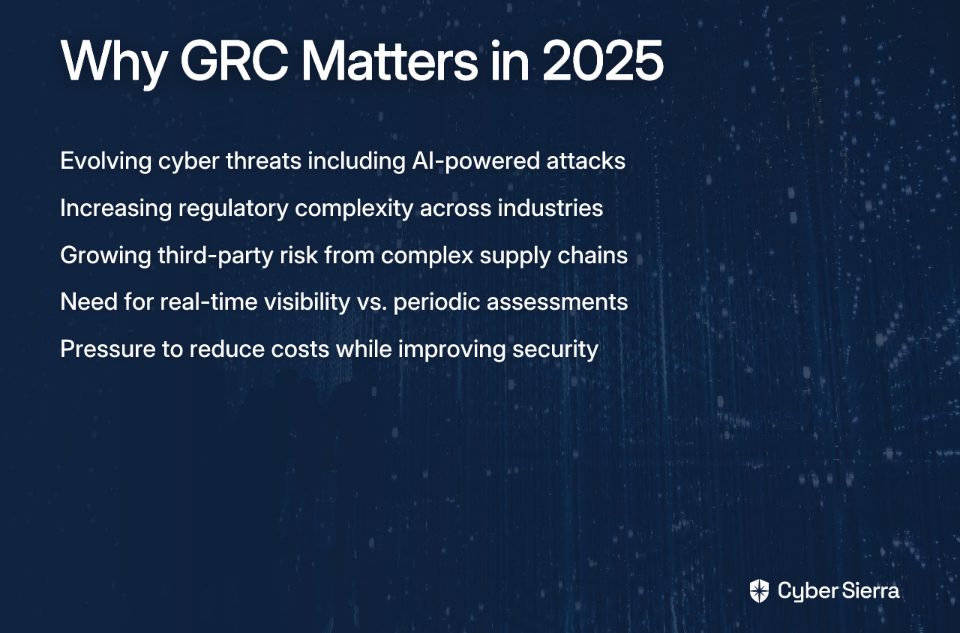
GRC has become increasingly critical for several reasons:
- Evolving Threats: The rise of sophisticated cyber-attacks and new technologies like generative AI introduce novel risks. As one security professional noted, "If autonomous AI agents are making decisions… how do we ensure they're not exploited?"
- Regulatory Pressure: Data privacy laws (like GDPR) and industry mandates are multiplying, demanding a more structured approach to compliance.
- Integrated Approach: Siloed approaches lead to inefficiencies and blind spots. An integrated GRC strategy provides a unified view, enhancing decision-making and reducing costs, according to AuditBoard.
Key GRC Trends Shaping the 2025 Landscape
The GRC landscape is evolving rapidly, driven by several key trends:
AI-Driven Risk Assessment & Automation
GRC platforms are increasingly leveraging AI to predict risks more accurately and automate repetitive tasks. Advanced analytics provide intelligent insights for better decision-making, with MetricStream reporting that AI-powered GRC tools can reduce manual effort in evidence collection by up to 50%.
This automation addresses a key pain point expressed by many professionals: "Right now, we track all this in an Excel spreadsheet. Looking for a tool that can help manage our policies, vendor management, risk management, etc."
Continuous Control Monitoring (CCM)
The market is moving away from periodic, point-in-time checks towards real-time monitoring. Organizations need to "continuously track and assess our IT infrastructure, data, and security protocols" to proactively fix gaps before they become critical issues or audit findings.
This trend directly addresses the need to "do this about a year to 8 months before major audits to avoid the scramble," by making compliance an ongoing process rather than a periodic event.
Integrated Platforms & Centralized Dashboards
Users want a single source of truth. Modern tools offer centralized dashboards that provide a 360-degree view of the organization's risk profile, moving beyond solutions that feel like "smoke and mirrors to get you a check mark" by providing transparent, data-driven insights.
Focus on Third-Party Risk Management (TPRM)
With increasingly complex supply chains, managing vendor risk is a top priority. GRC tools are incorporating robust TPRM modules to automate vendor assessments and continuous monitoring, replacing cumbersome spreadsheets with dynamic, risk-based approaches.
Top 5 GRC Applications in 2025
Based on comprehensive research and market analysis, here are the top GRC applications to watch in 2025:
1. MetricStream
Overview: A comprehensive, enterprise-grade GRC platform known for its deep integration of risk, compliance, audit, and cybersecurity functions.
Key Features:
- Centralized Platform: Manages Risk, Compliance, Policy, and Audit in one place
- AI Capabilities (AiSPIRE): Provides intelligent insights for predictive risk management
- Continuous Control Monitoring: Automates compliance checks and risk mitigation
- ESG Compliance: Strong capabilities for managing Environmental, Social, and Governance frameworks
Best For: Large enterprises in highly regulated industries needing a powerful, all-in-one solution.
Learn more about MetricStream GRC Solutions
2. ServiceNow
Overview: A versatile platform that excels at integrating GRC into daily IT and business workflows, making risk management a part of operations.
Key Features:
- Workflow Automation: Utilizes no-code playbooks to simplify complex processes
- Incident Response Focus: Seamlessly connects risk management with incident response
- Real-time Monitoring: Continuously tracks compliance and control performance
- Integration Ecosystem: Leverages existing ServiceNow investments for a unified approach
Best For: Organizations already invested in the ServiceNow ecosystem looking to extend its capabilities into GRC.
Learn more about ServiceNow GRC
3. AuditBoard
Overview: A user-friendly platform focused on simplifying audit, risk, and compliance management for internal teams.
Key Features:
- Intuitive Interface: Designed for ease of use and collaboration between audit, risk, and compliance teams
- Centralized Collaboration Tools: Enhances communication and visibility on internal controls
- Automated Workflows: Reduces manual effort in audit and compliance tasks
- Pre-built Frameworks: Comes with templates for common compliance frameworks
Best For: Audit and compliance teams seeking a collaborative, easy-to-navigate platform to streamline their processes.
Explore AuditBoard's approach to GRC
4. Archer
Overview: A long-standing leader in the GRC space, known for its proactive approach to risk management and robust feature set.
Key Features:
- Intuitive Dashboards: Simplifies data interpretation for better decision-making
- Third-Party Risk Management: Streamlines vendor assessments and risk profiling
- Flexible Assessment Module: Supports deep integration with other business systems
- Scalable Architecture: Handles complex enterprise requirements effectively
Best For: Organizations needing mature and flexible risk management capabilities, especially for TPRM.
5. LogicGate (Risk Cloud®)
Overview: A highly flexible and customizable GRC platform that empowers organizations to build risk and compliance applications tailored to their specific needs.
Key Features:
- No-Code Platform: Uses a drag-and-drop interface to build automated workflows
- Advanced Analytics: Provides actionable insights from risk and compliance data
- Automated Compliance Processes: Significantly reduces manual effort
- Customization Capabilities: Adapts to unique organizational requirements
Best For: Companies that require a high degree of customization to match their unique risk profiles and processes.
A Modern, Integrated Alternative: Cyber Sierra
While the tools above are established leaders, a new generation of platforms is emerging to address modern GRC challenges with greater agility and automation. Cyber Sierra is an AI-enabled platform designed to simplify and automate security compliance for today's enterprises.
Addressing Key Pain Points:
Overcoming "Compliance Fatigue": Cyber Sierra's GRC module automates data collection and reporting across multiple frameworks (SOC2, ISO 27001, GDPR, HIPAA, PCI DSS). This tackles the frustration of paying for each framework separately and simplifies audit readiness.
From Periodic to Proactive: The Continuous Control Monitoring (CCM) module provides near real-time visibility into your security posture, moving beyond simple checklists to offer actionable risk intelligence.
Tackling Supply Chain Risk: The Third-Party Risk Management (TPRM) module automates vendor assessments and monitoring, replacing cumbersome spreadsheets with a dynamic, risk-based approach.
What sets Cyber Sierra apart is its integration of GRC, CCM, TPRM, Threat Intelligence, and even Cyber Insurance readiness into a single, unified platform, providing a holistic view of an organization's security and compliance posture.
How to Choose the Right GRC Tool for Your Business
With so many options available, selecting the right GRC application requires careful consideration of your organization's specific needs:

Assess Core Functionality
Does the tool address your primary needs (e.g., internal audit, TPRM, compliance framework management)? Ensure it provides depth and isn't just "smoke and mirrors" to get you a compliance check mark.
Ask yourself:
- What are your most pressing GRC challenges?
- Which compliance frameworks do you need to support (ISO 27001, PCI compliance, SOC2, etc.)?
- Is your focus on risk management, compliance, or both?
Check Integration Capabilities
The tool must integrate with your existing systems (ERP, CRM, security tools) for a unified data flow. According to the Digital Project Manager, integration capabilities can make or break a GRC implementation.
Consider:
- Does the tool offer pre-built connectors for your critical systems?
- How easily can data flow between your existing tools and the GRC platform?
- Will you need custom integrations, and if so, what's the level of effort required?
Evaluate Configurability vs. Simplicity
Do you need a highly customizable platform like LogicGate, or a more user-friendly, out-of-the-box solution like AuditBoard? For startups, platforms like Drata, Vanta, and Secureframe are often recommended for their streamlined approach.
As one industry professional noted, "Drata, Vanta, and Secureframe are probably the biggest players in the startup space." These tools offer quicker implementation but may have less customization potential.
Demand a User-Friendly Experience
A tool is only effective if people use it. Prioritize platforms with intuitive interfaces and clear dashboards that encourage user engagement. MetricStream emphasizes that user adoption is critical for GRC success.
Look for:
- Clean, intuitive dashboards
- Minimal training requirements
- Mobile accessibility for on-the-go risk management
Consider Total Cost of Ownership
Look beyond the license fee. Ask about costs for additional frameworks, implementation support, and training. One common frustration is that some vendors "will make you pay for each framework, for example you'd have to pay for ISO 27001 v2013 and ISO 27001 v2022 just to see gaps."
Questions to ask:
- Are compliance frameworks bundled or priced separately?
- What are the implementation and training costs?
- Are there additional fees for adding users or modules?
- What's the typical ROI timeframe for similar organizations?
Match to Your Organization's Maturity
A startup with "zero tooling when it comes to GRC" has different needs than an established enterprise with mature processes. Choose a solution that can grow with you but doesn't overwhelm your current capabilities.
For organizations just establishing their GRC program, consider tools that provide policy templates and implementation guidance to help build the foundation of "proper policies, standards, guidelines, and procedures."
Conclusion
In 2025, navigating governance, risk, and compliance requires more than spreadsheets and checklists. The right GRC application automates manual work, provides real-time insights, and builds a foundation of operational resilience.
Whether you choose an established leader like MetricStream or ServiceNow, or explore newer integrated platforms like Cyber Sierra, the key is selecting a solution that aligns with your organization's size, maturity, and strategic goals. By doing so, you can transform GRC from a burdensome obligation into a strategic advantage that protects your business while enabling growth.
The future of GRC is intelligent, integrated, and continuous. By embracing these principles in your technology selection, you'll be well-positioned to navigate the complex risk landscape of 2025 and beyond.
Frequently Asked Questions
What is GRC software and why is it important?
GRC software is a tool that helps organizations manage governance, risk, and compliance activities from a single, unified platform. It is important because it automates manual processes, provides a centralized view of risk, and ensures adherence to regulations, which is critical in today's complex threat and regulatory landscape. By centralizing these functions, businesses can move beyond inefficient spreadsheets, enhance decision-making, and build a more resilient security posture.
How do I choose the right GRC tool for my business?
To choose the right GRC tool, you should assess your organization's specific needs, size, and maturity level. Key steps include evaluating the tool's core functionality (like audit management or TPRM), checking its integration capabilities with your existing systems, deciding between a customizable or a simple out-of-the-box solution, and considering the total cost of ownership beyond just the license fee.
What are the key features to look for in a modern GRC platform?
A modern GRC platform should offer features that align with current industry trends. Look for AI-driven risk assessment for predictive insights, Continuous Control Monitoring (CCM) for real-time visibility into your security posture, integrated modules for a holistic view (e.g., TPRM, compliance), and centralized dashboards for clear, actionable reporting.
Why are spreadsheets not enough for GRC management?
Spreadsheets are not enough for modern GRC management because they are manual, error-prone, and lack real-time visibility. They create silos of information, make collaboration difficult, and cannot scale to handle the complexity of evolving regulations and cyber threats. GRC platforms automate data collection, provide continuous monitoring, and offer a single source of truth that spreadsheets simply cannot match.
When should a startup start thinking about GRC tools?
A startup should start thinking about GRC tools as soon as it begins handling sensitive customer data or needs to comply with industry regulations like SOC 2 or HIPAA. Early adoption of a streamlined GRC tool can establish a strong compliance foundation from the start, prevent costly future remediation, and build trust with customers and investors.
How does AI improve GRC processes?
AI improves GRC processes by automating repetitive tasks, enhancing risk detection, and providing predictive insights. For example, AI can analyze vast amounts of data to identify potential threats, automate evidence collection for audits, and forecast risk trends, allowing teams to move from a reactive to a proactive risk management stance. This reduces manual effort and improves the accuracy of risk assessments.
