



Top GRC Platforms for Enterprise Compliance in 2025


Join thousands of professionals and get the latest insight on Compliance & Cybersecurity.
You've spent the night before an audit frantically gathering screenshots and exporting logs from a dozen systems. Your inbox overflows with vendor security questionnaires as news breaks about a major supplier's data breach. Meanwhile, your board is demanding evidence that compliance controls are working continuously—not just during the annual audit scramble.
Sound familiar? You're not alone.
"A poorly defined process can make any GRC tool ineffective," notes one cybersecurity professional in a recent Reddit discussion. Another points out that "inadequate knowledge about needs can lead to poor choices in GRC platform selection."
In 2025, enterprise compliance is no longer about checkbox exercises or point-in-time assessments. According to AWS, Governance, Risk, and Compliance (GRC) is a structured approach to align IT with business goals, manage enterprise risk, and meet regulatory requirements. Modern GRC platforms have evolved into sophisticated ecosystems that provide continuous monitoring, automation, and integrated risk management capabilities.
This guide will help you navigate the increasingly complex GRC landscape to find the platform that best suits your organization's unique needs.
Why Modern GRC Platforms Are Business-Critical in 2025
The compliance landscape has fundamentally shifted. According to AWS, three key factors are driving the critical need for robust GRC solutions:
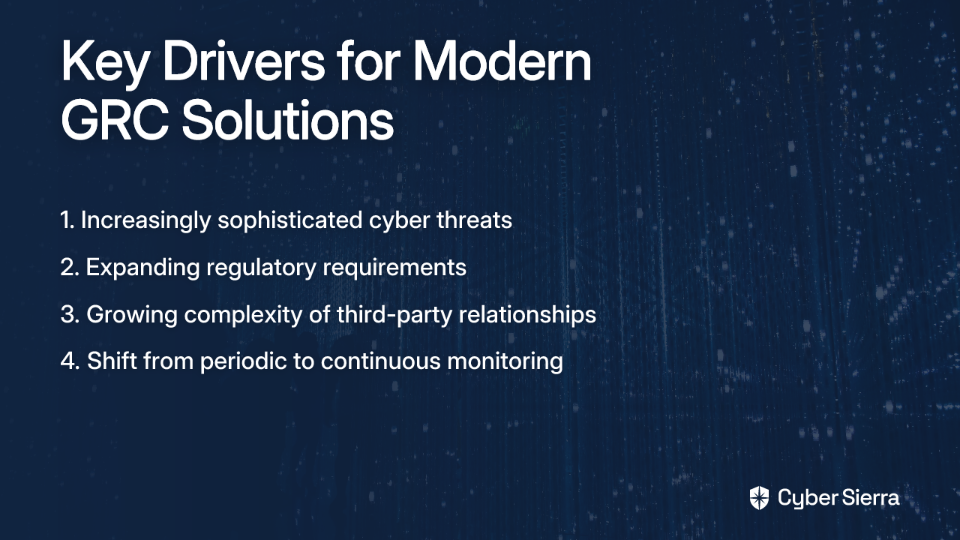
- Increasingly sophisticated cyber threats require enhanced data protection
- Expanding regulatory requirements across jurisdictions (GDPR, CCPA, industry standards like PCI DSS and HIPAA)
- Growing complexity of third-party business relationships introducing supply chain risks
Perhaps the most significant evolution has been the shift from periodic, point-in-time compliance to continuous monitoring. Continuous Control Monitoring (CCM) has emerged as a foundational concept—defined as "a technology-driven approach to consistently monitor compliance, risk management, and security controls."
This shift delivers substantial benefits:
- Increased compliance efficiency through automated evidence gathering
- Cost reduction by identifying control gaps early
- Enhanced decision-making with real-time risk overview
- Reduced breach risk through proactive vulnerability identification
As compliance requirements multiply and cyber risks escalate, manual spreadsheet-based approaches simply can't keep pace. Modern enterprises need intelligent platforms that transform compliance from a periodic burden into a continuous, value-adding business function.
Key Capabilities of Top-Tier GRC Platforms in 2025

When evaluating GRC platforms for enterprise compliance, these are the non-negotiable capabilities to demand:
1. Automation & Continuous Control Monitoring
The days of "audit season dread" should be behind us. Look for platforms that connect directly to your tech stack—cloud providers, identity management systems, endpoint security—to automatically test controls and collect evidence.
According to Vanta, implementing effective CCM requires:
- Identifying key processes and controls
- Defining clear control objectives and performance benchmarks
- Setting up automated tests that run at high frequency
- Establishing monitoring systems with alerts and Key Risk Indicators (KRIs)
Cyber Sierra's Continuous Control Monitoring (CCM) module exemplifies this approach, creating a central controls repository with near real-time updates across frameworks like NIST, ISO 27001, and PCI DSS.
2. Integrated Third-Party Risk Management
Supply chain risk has become a primary attack vector. Leading platforms now include robust Third-Party Risk Management (TPRM) capabilities that go far beyond static questionnaires.
Key TPRM features identified by UpGuard include:
- Automated questionnaire distribution and analysis
- Continuous external scanning and security ratings
- Complete workflows from detection through remediation tracking
Cyber Sierra's TPRM platform addresses this need by providing continuous vendor monitoring and automated assessments to identify supply chain risks before they become incidents.
3. Unified Framework & Policy Management
With enterprises often needing to comply with multiple regulatory frameworks simultaneously, a unified control library is essential. Look for platforms that map a single control to multiple frameworks—creating a "test once, comply many" approach that dramatically improves efficiency.
The platform should also serve as a central repository for policy management, including version control and attestation tracking.
4. Usability, Customization, and Integrations
Reddit users consistently highlight that "overly complex processes can frustrate users" and "dependence on developers for GRC tools creates bottlenecks." The most effective platforms now offer:
- No-code/low-code workflow builders
- Customizable dashboards tailored to different stakeholders
- Robust APIs for integration with existing security tools
- Intuitive user interfaces that encourage adoption
As one Reddit user wisely advised: "Make sure you really know what you want before buying any of them."
Top GRC Platforms for 2025
For Large, Complex Enterprises
MetricStream Recognized as a leader by both Gartner and Forrester, MetricStream offers an integrated approach to risk, compliance, audit, and cybersecurity. Its AI capabilities (AiSPIRE) and strong ESG management features set it apart. According to MetricStream's own analysis, the platform excels in providing enterprise-wide visibility and advanced analytics.
ServiceNow GRC Organizations already embedded in the ServiceNow ecosystem will find its GRC module particularly powerful. Its strengths include seamless integration of incident response into GRC workflows and no-code playbooks. This platform shines in environments where IT service management and security operations need to work in lockstep with compliance.
Archer A longtime player in the space, Archer is known for deep customization capabilities and an integrated risk management focus. However, be aware of potential challenges with complex setup requirements and a less intuitive UI, as noted by both MetricStream and Drata.
For Mid-Market & High-Growth Companies
Drata A leader in compliance automation, Drata excels at automated evidence collection across 20+ frameworks including SOC 2, ISO 27001, and HIPAA. According to Drata's analysis, the platform scales effectively from startup to enterprise, making it ideal for high-growth organizations.
LogicGate Praised for its flexibility and user-friendly drag-and-drop workflow builder, LogicGate offers advanced analytics for creating tailored risk management programs. Its intuitive interface addresses the pain point that "the effectiveness of GRC tools is often related to their usability and customization options."
AuditBoard Offering intuitive functionality specifically designed to streamline audit and compliance management, AuditBoard provides a strong collaborative workspace for sharing documents and managing processes. This directly addresses the challenge of "users often juggling multiple GRC platforms, leading to confusion and inefficiency."
Platforms with Specialized Focus
For organizations prioritizing vendor risk management, specialized TPRM platforms like UpGuard, SecurityScorecard, and BitSight provide deep insights into third-party security postures through external security ratings and continuous monitoring.
The Unified Security Approach
The most forward-thinking organizations are breaking down silos between GRC, security operations, and threat intelligence. This integrated approach recognizes that compliance status should be informed by real-time threats and control effectiveness.
Cyber Sierra exemplifies this next-generation approach with its comprehensive cybersecurity platform that combines:
- Governance, Risk & Compliance (GRC) for automating data collection across frameworks
- Continuous Control Monitoring (CCM) for real-time proof that controls are working
- Third-Party Risk Management (TPRM) for supply chain security
- Threat Intelligence for proactive attack surface monitoring
- Additional modules for Employee Security Training and Cyber Insurance
This integrated approach directly addresses the need for a unified security posture view while managing risk effectively within budget constraints.
How to Choose the Right GRC Platform

When selecting a GRC platform, consider these key factors identified by Drata:
- Urgency: What's driving your GRC initiative? An upcoming audit, customer requirement, or strategic initiative?
- Compliance Program Maturity: Are you starting from scratch or optimizing an existing program?
- Internal Support & Resources: Do you have dedicated personnel for implementation?
- Integration Requirements: Which systems must your GRC platform connect with?
- Value Timeline: How quickly do you need to demonstrate ROI?
For successful implementation, AWS recommends:
- Defining clear goals before selection
- Assessing existing procedures to understand your starting point
- Securing engagement from top management for necessary resources and support
Always request demos and consider pilot programs before making a final decision.
From Compliance Burden to Strategic Advantage
The GRC platform of 2025 is not a static database but a dynamic, automated engine for risk management. The shift toward continuous monitoring, integrated platforms, and data-driven decision-making transforms compliance from a costly burden into a strategic advantage.
Organizations ready to move beyond siloed tools and embrace a unified, proactive security posture should explore integrated platforms that align with their specific needs and maturity level. With the right solution, you can build trust with customers, partners, and regulators while protecting your organization from evolving threats.
The spreadsheet compliance era is over. The age of intelligent, continuous, integrated GRC has arrived.
Frequently Asked Questions
What is a GRC platform?
A GRC (Governance, Risk, and Compliance) platform is a centralized software solution that helps organizations align their IT operations with business goals, manage enterprise-wide risks, and comply with legal and regulatory requirements. These platforms move beyond simple checklists, offering a structured approach to integrate and manage these three critical business functions in a unified way.
Why is continuous control monitoring essential for modern GRC?
Continuous Control Monitoring (CCM) is essential because it transforms compliance from a periodic, point-in-time exercise into an automated, ongoing process. This technology-driven approach provides real-time visibility into whether security controls are working effectively, which helps organizations reduce breach risk, increase compliance efficiency, and make better-informed decisions based on current data rather than outdated audit reports.
What are the key features of a top-tier GRC platform in 2025?
A top-tier GRC platform in 2025 must include several key capabilities: automation and continuous control monitoring to automatically gather evidence, integrated third-party risk management (TPRM) to secure the supply chain, unified framework management to map controls across multiple regulations, and a user-friendly interface with robust integrations to ensure broad adoption and seamless operation.
How do I choose the right GRC platform for my organization?
To choose the right GRC platform, you should evaluate your organization's specific needs by considering several key factors: the urgency driving the initiative (like an upcoming audit), the maturity of your current compliance program, the internal resources available for implementation, and the essential integrations required with your existing tech stack. Always request demos and define clear goals before making a final selection.
How do GRC platforms help manage supply chain risk?
Modern GRC platforms help manage supply chain risk through integrated Third-Party Risk Management (TPRM) modules. These features automate the process of sending and analyzing vendor security questionnaires, provide continuous external security scanning of your suppliers, and offer complete workflows to track risks from detection through to remediation, securing your business from vulnerabilities within your supply chain.
