



9 Best GRC Tools for Enterprise Security Teams in 2026

Join thousands of professionals and get the latest insight on Compliance & Cybersecurity.
There's a meaningful difference between a purpose-built GRC tool and a compliance spreadsheet dressed up with color-coded tabs. A spreadsheet tracks. A GRC tool manages — it centralizes policies, automates control testing, maps your posture across multiple frameworks, and gives you a living, breathing view of your risk at any moment. The moment your organization is juggling ISO 27001, SOC 2, NIST CSF, and a vendor questionnaire backlog, the spreadsheet isn't just inconvenient — it's a liability.
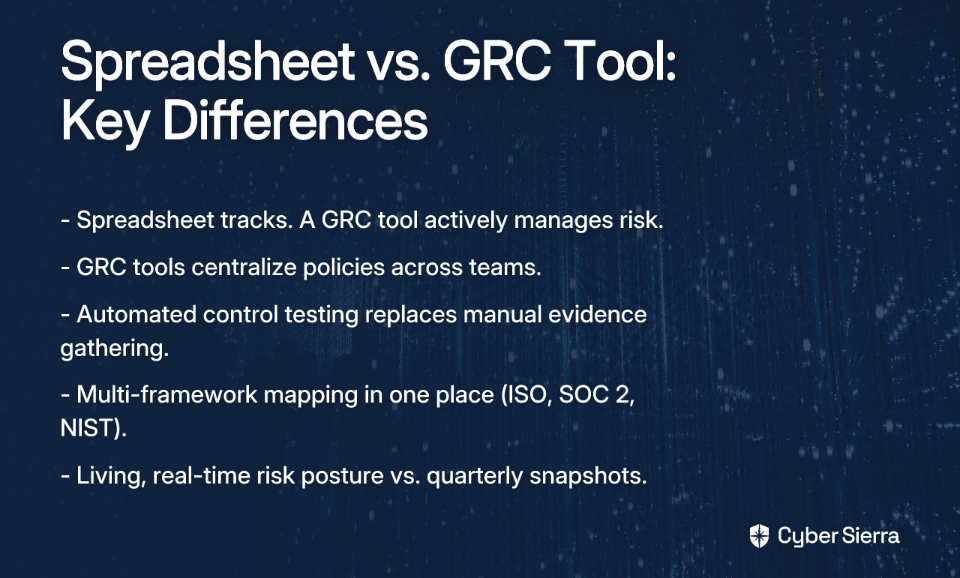
For many enterprise security teams, the pain of manual GRC is real. It shows up as audit fatigue from endless evidence collection, fragmented controls when multiple teams with different requirements create chaos, and a persistent lack of real-time posture visibility that leaves CISOs flying blind between quarterly reviews.
Meanwhile, the GRC tooling market itself can be frustrating to navigate. Some platforms feel designed to simply get a check mark, while popular enterprise solutions carry a reputation for high costs and complexity that borders on folklore.
The good news? The era of AI-enabled GRC has arrived. Modern platforms now offer Continuous Control Monitoring, automated risk quantification, and cross-framework compliance management that transforms GRC from a reactive audit scramble into a proactive, strategic advantage. According to the ACFE's 2024 Report to the Nations, organizations that use continuous monitoring instead of periodic reviews can reduce fraud losses by 40–60% — a number that makes the ROI case for modern GRC tools practically self-evident.
Here are the 9 best GRC tools for enterprise security teams in 2026, structured by use-case strength so you can find the right fit — not just the most popular badge.
The 9 Best GRC Tools for Enterprise Teams in 2026
1. Cyber Sierra — Best AI-Enabled GRC Tool for Enterprises
Ideal Company Size: Medium to large enterprises in regulated industries (BFSI, HealthTech, Tech, Manufacturing, Retail)
Cyber Sierra is an integrated, AI-driven GRC platform built to replace the periodic, manual model of compliance with something closer to a continuous security nervous system. Rather than bolting together separate tools for risk, compliance, and vendor management, Cyber Sierra unifies them under a single platform — eliminating the fragmentation that plagues most enterprise security programs.
Key Features:
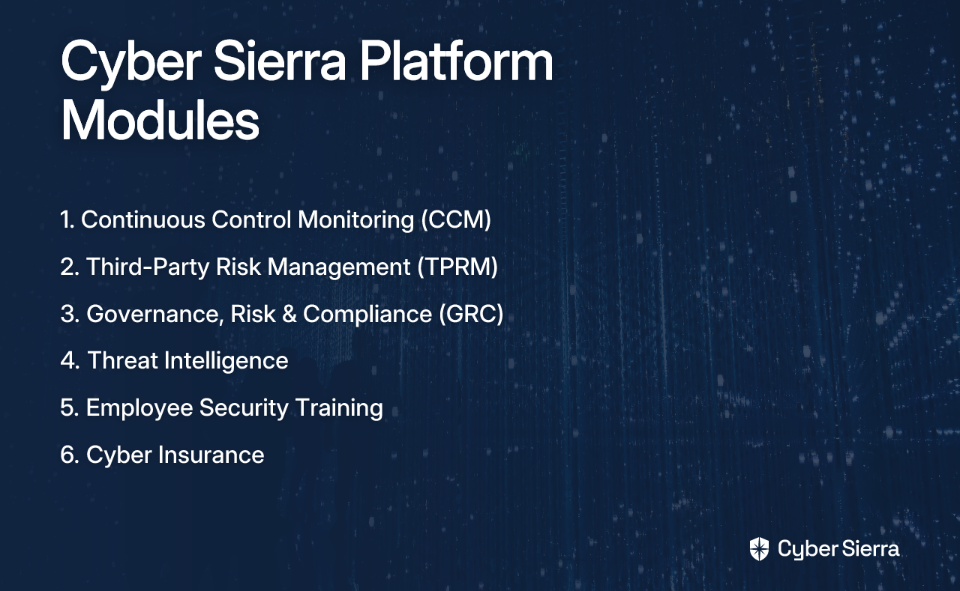
- Continuous Control Monitoring (CCM). Provides near real-time visibility into control effectiveness across frameworks including NIST, ISO 27001, PCI DSS, and GDPR. Automates control testing, centralizes the controls repository, and flags exceptions the moment they emerge — not at your next audit cycle.
- Third-Party Risk Management (TPRM). Automates vendor assessments, prioritizes vendor inventory by risk level, and provides 24/7 visibility into third-party security posture. If your team is drowning in SIG questionnaires, this module replaces the manual chase with automated workflows.
- Governance, Risk & Compliance (GRC). Handles multi-framework compliance (SOC 2, ISO 27001, HIPAA, GDPR, PCI DSS) with automated data collection, risk assessments, and audit-ready reporting. Detailed audit trails mean you're not scrambling when auditors knock.
- Threat Intelligence. Outside-in vulnerability scanning across network and cloud infrastructure, with a security scorecard to help prioritize remediation before threats are exploited.
- Employee Security Training. Simulated phishing campaigns and interactive modules to close the human-vector gap.
- Cyber Insurance. Helps organizations right-size coverage, demonstrate cyber hygiene to underwriters, and streamline the application process.
Watch Out For: Cyber Sierra is a comprehensive platform — organizations will get the most value when internal processes are mature enough to act on the AI-generated insights, rather than treating it as a box-checking exercise.
2. MetricStream — Best for Unified Enterprise GRC
Ideal Company Size: Large, global enterprises with mature GRC programs
MetricStream is one of the most established names in the GRC space, offering a deeply integrated platform that connects risk, compliance, audit, and cyber risk functions into a single holistic view. Its AI-driven analytics support risk quantification and regulatory change management at scale.
Key Features:
- Integrated risk, compliance, audit, and IT risk management modules
- AI-powered analytics for real-time risk intelligence and continuous control monitoring
- Deep regulatory coverage across global frameworks
- Customizable dashboards and reporting
Watch Out For: The platform's depth is also its challenge — implementations tend to be resource-intensive, with a steep learning curve that may require dedicated internal resources or external consultants.
3. ServiceNow GRC — Best for IT-Centric Risk & Compliance
Ideal Company Size: Mid-to-large enterprises already invested in the ServiceNow ecosystem
ServiceNow GRC earns its place by doing what no standalone GRC tool can: natively connecting compliance and risk processes to your IT operations, service desk, and security incident response workflows. As one practitioner noted, "If you have ServiceNow as a ticketing tool, ServiceNow GRC Module is a good option."
Key Features:
- Native integration with ITSM, SIR, and vendor risk management
- No-code playbooks to automate GRC workflows
- Real-time visibility tied directly to underlying IT assets
Watch Out For: If you're not already a ServiceNow shop, the cost and setup complexity can push this into "laughably expensive" territory quickly — a sentiment echoed frequently in practitioner communities.
4. AuditBoard — Best for Internal Audit & SOX Compliance
Ideal Company Size: Mid-to-large enterprises with mature internal audit functions
AuditBoard is the go-to GRC tool for organizations where internal audit and SOX compliance are the primary drivers. Its clean, intuitive interface stands out in a market full of clunky enterprise software, making it a favorite among audit teams that need collaboration without the chaos.
Key Features:
- Streamlined workflows for evidence collection, testing, and issue resolution
- Centralized audit trail and documentation management
- Strong team collaboration features across audit, risk, and compliance stakeholders
Watch Out For: AuditBoard excels in the audit lane, but if you need robust TPRM, enterprise risk quantification, or multi-framework compliance automation, you may find yourself stitching it together with other tools.
5. Archer (formerly RSA Archer) — Best for Integrated Risk Management
Ideal Company Size: Large enterprises with dedicated GRC teams and implementation resources
Archer is a veteran of the enterprise GRC space, offering powerful risk taxonomy, highly configurable use cases, and strong reporting capabilities across IT, third-party, and operational risk domains.
Key Features:
- Flexible risk taxonomy and configurable assessment workflows
- Customizable dashboards and incident management
- Broad coverage of enterprise and operational risk scenarios
Watch Out For: Its reputation precedes it — "I have heard nothing but horrific things about Archer," one practitioner noted bluntly in a community thread. Archer is genuinely powerful, but implementation is notoriously complex and resource-heavy. Budget accordingly.
6. LogicGate — Best for Agile Risk & Compliance Workflows
Ideal Company Size: Mid-market organizations needing a flexible, customizable GRC solution
LogicGate takes a different approach than heavyweight enterprise platforms. Its no-code, drag-and-drop interface lets teams build and automate their own GRC workflows without needing a developer, making it a strong choice for organizations that need flexibility without the overhead.
Key Features:
- No-code configuration for custom risk and compliance applications
- Advanced analytics and reporting dashboards
- Adaptable workflows for policy management, risk assessments, and compliance tracking
Watch Out For: The flexibility that makes LogicGate appealing for mid-market teams can become a limitation at enterprise scale, where deeply embedded GRC requirements may outgrow its customization ceiling.
7. OneTrust — Best for Privacy Management & Data Governance
Ideal Company Size: Organizations where GDPR, CCPA, and data governance are primary GRC concerns
OneTrust is the market leader in privacy and trust intelligence, with a commanding feature set for data discovery, regulatory change management, and consent management. It covers GRC, ethics, and ESG under one roof.
Key Features:
- Automated data discovery and mapping for privacy frameworks
- Smart assessments and regulatory change tracking
- Modules spanning GRC, ethics management, and ESG compliance
Watch Out For: Pricing is a persistent complaint — OneTrust is "starting to creep into ServiceNow cost territory, i.e., laughably expensive," as buyers have noted. Its core GRC automation also lags behind more specialized, AI-first platforms.
8. RiskLens — Best for Quantifying Cyber Risk in Financial Terms
Ideal Company Size: Large enterprises with mature risk programs adopting quantitative analysis
RiskLens occupies a unique niche: it translates cybersecurity risk into financial impact using the FAIR™ (Factor Analysis of Information Risk) methodology. If your CISO needs to make the board care about a misconfiguration, RiskLens gives you the dollar figure to make them listen.
Key Features:
- FAIR model-based cyber risk quantification
- Financial impact modeling for risk scenarios
- Prioritization of security investments by potential loss reduction
Watch Out For: RiskLens is a specialist, not a generalist. It requires meaningful investment in scenario tailoring and staff training on FAIR methodology, and it works best as a complement to a broader GRC platform rather than a standalone solution.
9. LogicManager — Best for User-Friendly Enterprise Risk Management
Ideal Company Size: Mid-sized organizations needing a practical ERM solution with strong support
LogicManager focuses on making risk management genuinely usable. Pre-built templates, a taxonomy-based approach to standardizing risk assessments, and a reputation for hands-on customer advisory services make it a strong entry point for organizations building their GRC programs without a large internal team.
Key Features:
- Pre-built risk templates and taxonomy-based assessment standardization
- Automated report generation and risk visualization dashboards
- Strong vendor support and advisory services baked into the offering
Watch Out For: LogicManager's ease of use is its defining strength, but that simplicity comes at the cost of the advanced AI-driven automation and deep customization available in larger platforms.
GRC Tools Decision Matrix: At a Glance
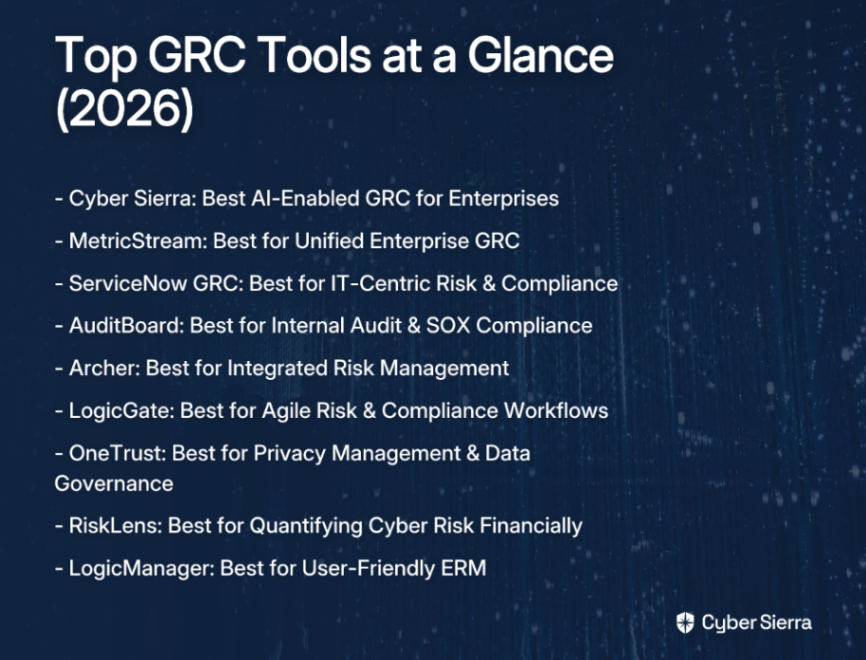
| Tool | Best For | AI Capabilities | Ideal Org Size | Watch Out For |
|---|---|---|---|---|
| Cyber Sierra | AI-Enabled GRC for Enterprises | Continuous monitoring, automated evidence collection, predictive risk intelligence | Medium to Large | Requires internal process maturity to act on AI insights |
| MetricStream | Unified Enterprise GRC | Advanced risk analytics, continuous monitoring | Large & Global | Resource-intensive implementation and steep learning curve |
| ServiceNow GRC | IT-Centric Risk & Compliance | Workflow automation and process intelligence | Mid-to-Large | High cost and complexity outside the ServiceNow ecosystem |
| AuditBoard | Internal Audit & SOX Compliance | Audit workflow and evidence automation | Mid-to-Large | Limited scope beyond audit and SOX use cases |
| Archer | Integrated Risk Management | Rules-based automation, basic analytics | Large | Notoriously complex implementation; not for the faint of heart |
| LogicGate | Agile Risk & Compliance Workflows | Basic analytics and task automation | Mid-Market | May not scale for the most complex enterprise requirements |
| OneTrust | Privacy Management & Data Governance | Smart privacy assessments and regulatory tracking | All Sizes | Expensive; GRC features may lag behind AI-first competitors |
| RiskLens | Quantifying Cyber Risk Financially | FAIR-based quantitative risk modeling | Large | Highly specialized; needs pairing with a broader GRC tool |
| LogicManager | User-Friendly ERM | Basic report and task automation | Mid-Sized | Lacks advanced AI and deep customization of larger platforms |
From Compliance Chaos to Strategic Clarity
Navigating the GRC market is complex, but the path forward is clear. Ditching spreadsheets isn’t just about convenience; it’s about trading audit fatigue and fragmented controls for real-time risk visibility. The right tool transforms compliance from a reactive, manual scramble into a strategic, automated function.
Remember these key takeaways:
- Match the tool to your pain. The best platform is the one built for your primary use case, whether that's internal audit (AuditBoard), IT-centric risk (ServiceNow), or unified, AI-driven compliance (Cyber Sierra).
- Embrace continuous monitoring. The single biggest shift you can make is moving from periodic reviews to automated, continuous control monitoring. It's the difference between seeing a snapshot of risk and having a live video feed.
Your next step? Before you book a single demo, take 30 minutes to identify the top five controls across your frameworks that generate the most manual evidence collection. This simple audit of your audit process will immediately highlight where automation can deliver the biggest wins.
When you’re ready to see how a modern GRC platform can eliminate that manual work and provide a single source of truth for your entire risk posture, book a personalized demo.
Frequently Asked Questions
What is a GRC tool and why is it better than a spreadsheet?
A GRC tool is software that centralizes governance, risk, and compliance management. Unlike spreadsheets, it automates control testing, maps your posture across multiple frameworks, and provides a real-time view of risk, turning compliance from a manual task into a strategic function.
Why is AI important in modern GRC platforms?
AI is crucial for modern GRC because it enables continuous control monitoring (CCM) and automates evidence collection. This replaces periodic, manual audits with real-time risk visibility, reduces audit fatigue, and helps teams proactively identify and remediate compliance gaps.
How does a GRC tool help with multi-framework compliance?
A GRC tool simplifies multi-framework compliance by mapping controls to multiple standards (e.g., ISO 27001, SOC 2, NIST) from a single repository. This "test once, apply many" approach eliminates redundant work, ensures consistency, and streamlines audits across different regulations.
What is Continuous Control Monitoring (CCM)?
Continuous Control Monitoring (CCM) is an automated process that continuously tests and validates the effectiveness of your security controls. It provides near real-time alerts on control failures, allowing you to fix issues as they happen instead of discovering them during an audit.
How do I choose the right GRC tool for my enterprise?
To choose the right GRC tool, assess your organization's maturity, primary use case (e.g., audit, IT risk, privacy), and required frameworks. Prioritize platforms that offer AI-driven automation, continuous monitoring, and can scale with your needs. Always evaluate the total cost of ownership.
What is the typical cost of an enterprise GRC tool?
The cost of enterprise GRC tools varies widely based on modules, company size, and complexity. Solutions can range from tens of thousands to hundreds of thousands of dollars annually. Legacy platforms like ServiceNow and OneTrust are often cited as being on the higher end of the spectrum.
