



10 Most Dangerous Ransomware-as-a-Service Operations in 2026 and How to Defend Against Each



Join thousands of professionals and get the latest insight on Compliance & Cybersecurity.
Summary
- Ransomware attacks surged by 47% in 2025, with attackers shifting to human-operated tactics like social engineering and insider recruitment as ransom payments decline.
- Top RaaS groups exploit a range of vulnerabilities, from unpatched external systems and stolen credentials to sophisticated supply chain attacks and zero-day exploits.
- A robust defense strategy requires strengthening identity protocols, continuous vulnerability scanning, rigorous third-party risk management, and building a strong "human firewall" through employee training.
- A unified security program is crucial to combat these diverse threats. Cybersierra provides an integrated platform that combines Continuous Control Monitoring, Threat Intelligence, and Employee Security Training to fortify your defenses.
The Evolving Face of Digital Extortion
The recent high-profile ransomware attacks on major organizations have left many security professionals anxious about their own defenses. As one IT manager confessed, "The recent ransomware attacks on Garmin and Canon have got me worried." This concern is well-founded – the threat landscape is not just persisting but evolving at an alarming rate.
Ransomware-as-a-Service (RaaS) has democratized cybercrime to an unprecedented degree. As one security researcher observed, "anyone who has bit of knowledge of internet can use this service to make quick money." This business model has dramatically lowered the barrier to entry, allowing technically unskilled criminals to deploy sophisticated attacks with minimal effort.
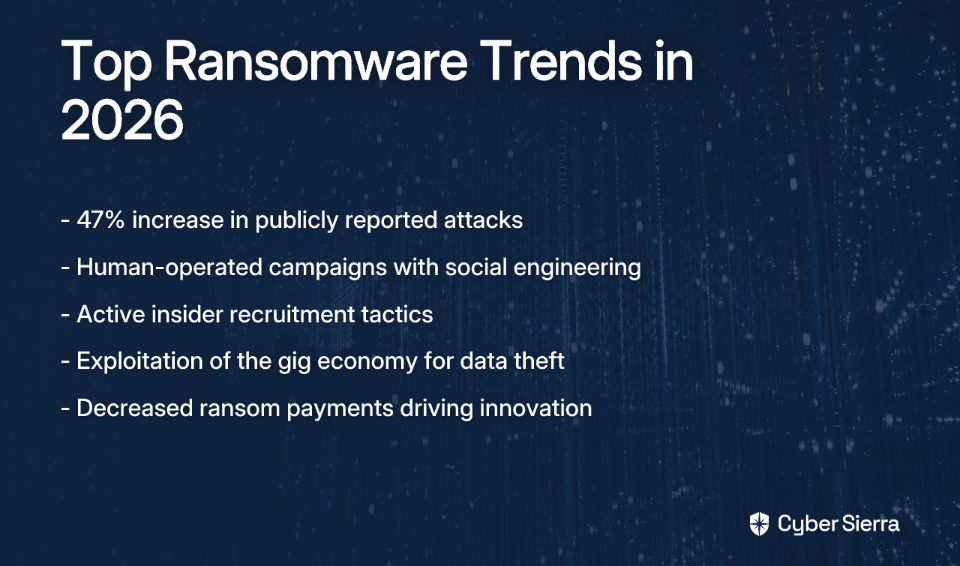
The statistics paint a concerning picture for 2026. According to Recorded Future's research, 2025 saw a staggering 47% increase in publicly reported ransomware attacks, jumping from 4,900 to 7,200 incidents. Paradoxically, despite this surge in attack volume, total ransom payments have actually decreased. This economic pressure is forcing RaaS operators and their affiliates to adopt increasingly aggressive and innovative tactics beyond simple encryption.
What makes modern ransomware particularly dangerous is its human element. As one analyst aptly put it, "Ransomware is human operated, so it needs to be humanized." Today's attacks aren't just automated scripts; they're carefully orchestrated campaigns involving sophisticated social engineering, active recruitment of insiders, and even exploitation of the gig economy for physical data theft.
In this article, we'll break down the 10 most dangerous RaaS operations predicted for 2026, detailing their tactics, techniques, and procedures (TTPs), and providing specific defensive measures for each. Most importantly, we'll show you how to build a comprehensive protection strategy that addresses these evolving threats.
The 2026 RaaS Hit List: Top 10 Operations to Watch
1. Scattered Lapsus$ Hunters
Profile: A highly coordinated ecosystem that has redefined large-scale ransomware operations by focusing on psychological manipulation over technical exploits.
Primary TTPs:
- Social Engineering: Their primary vector. They are masters of pretexting and manipulation.
- Vishing: Using voice calls to trick employees (often help desk staff) into resetting Multi-Factor Authentication (MFA) and granting access via OAuth authorizations.
- Public Pressure: Leverages Telegram channels to name and shame executives, increasing pressure to pay the ransom. Source
Target Profile: Large enterprises with extensive employee bases and complex IT support structures.
Defense Blueprint:
- Strengthen identity and access management (IAM) protocols, especially for MFA resets.
- Implement strict verification procedures for all help desk requests involving privileged access.
- Develop communication protocols for responding to public extortion attempts.
How Cyber Sierra Fortifies Your Defense: The primary threat here is the human element. Cyber Sierra's Employee Security Training directly counters this by building a resilient "human firewall." The platform uses interactive training, quizzes, and simulated counter-phishing campaigns to educate employees on identifying and resisting sophisticated social engineering tactics like vishing.
2. Qilin (Agenda) Ransomware
Profile: A mature and steadily expanding RaaS platform that surpassed 1,000 victims.
Primary TTPs:
- Credential Theft: Gains initial access primarily through stolen credentials purchased on the dark web.
- Supply Chain Attacks: Infiltrates networks by compromising trusted third-party vendors, especially Managed Service Providers (MSPs).
- Legal Intimidation: Uniquely integrates legal pressure into negotiations, threatening victims with regulatory fines (e.g., GDPR, HIPAA) to coerce payment. Source
Target Profile: Manufacturing and healthcare sectors, where operational disruption and regulatory compliance are critical concerns.
Defense Blueprint:
- Enforce strong password policies and mandatory MFA across all services.
- Implement a robust vendor risk management program to vet and continuously monitor the security posture of all third parties.
How Cyber Sierra Fortifies Your Defense: Qilin's reliance on supply chain attacks makes Cyber Sierra's Third-Party Risk Management (TPRM) essential. The platform automates vendor assessments, provides near real-time visibility into vendor compliance, and helps prioritize risks, ensuring your partners don't become your biggest vulnerability.
3. Akira Ransomware
Profile: Known for its methodical operations and focus on targets with a very low tolerance for downtime.
Primary TTPs:
- Exposed Perimeter Systems: Exploits unpatched vulnerabilities and misconfigurations in internet-facing devices like VPNs and remote desktop services.
- Double Extortion: Systematically exfiltrates sensitive data before encryption to maximize leverage during negotiations.
Target Profile: Healthcare systems, educational institutions, and small municipal governments.
Defense Blueprint:
- Maintain a complete inventory of all internet-facing assets.
- Implement a rigorous patch management and vulnerability scanning program.
- As one user noted, attackers can spend significant time "learning and documenting networks," so continuous monitoring is key.
How Cyber Sierra Fortifies Your Defense: Akira thrives on finding gaps in your external attack surface. Cyber Sierra's Threat Intelligence module provides proactive defense by conducting continuous network and cloud vulnerability scanning from an "outside-in" perspective. It delivers a comprehensive security scorecard, helping you identify and prioritize remediation for the very weaknesses Akira exploits.
4. Cl0p Ransomware
Profile: A notorious group specializing in large-scale supply-chain extortion through zero-day exploitation.
Primary TTPs:
- Zero-Day Exploitation: Known for high-impact campaigns targeting vulnerabilities in widely used enterprise software (e.g., Oracle EBS, MOVEit).
- Data Theft Focus: Prioritizes data exfiltration over disruptive encryption, often demanding a ransom just to prevent the public release of stolen data. Source
Target Profile: Large corporations across all sectors that rely on specific enterprise software solutions.
Defense Blueprint:
- Develop a rapid-response plan for zero-day vulnerabilities.
- Implement network segmentation to contain breaches and prevent lateral movement.
- Use Data Loss Prevention (DLP) tools to monitor and block unauthorized data exfiltration.
How Cyber Sierra Fortifies Your Defense: Defending against zero-days requires robust internal controls. Cyber Sierra's Continuous Control Monitoring (CCM) provides real-time visibility into the effectiveness of controls like network segmentation and access policies. It automates control testing, detects anomalies, and ensures your defenses are working as designed, even when a new threat emerges.
5. DragonForce Ransomware
Profile: Operates as a decentralized cartel, allowing affiliates to use its tools under their own brand names.
Primary TTPs:
- BYOVD (Bring Your Own Vulnerable Driver): A sophisticated technique that uses legitimate, signed (but vulnerable) drivers to bypass security software and gain kernel-level access, effectively disabling endpoint defenses. Source
Target Profile: Technologically mature organizations with advanced security stacks that require sophisticated evasion techniques to bypass.
Defense Blueprint:
- Deploy Endpoint Detection and Response (EDR) solutions with kernel-level monitoring.
- Implement strict application control and driver installation policies.
How Cyber Sierra Fortifies Your Defense: While Cyber Sierra doesn't replace EDR, its GRC (Governance, Risk & Compliance) module is critical for establishing and enforcing the policies needed to combat advanced threats. It helps you manage policy lifecycles, track exceptions, and maintain a detailed audit trail, ensuring that security configurations designed to block threats like BYOVD are consistently applied and monitored.

6. Play Ransomware
Profile: A consistently active group with over 350 victims in 2025, now transitioning to a full RaaS structure.
Primary TTPs:
- Trusted-Access Abuse: Exploits valid accounts, especially those with privileged access, to move laterally and deploy ransomware.
Target Profile: A wide range of industries, with a focus on organizations that have complex IT environments and numerous user accounts.
Defense Blueprint:
- Enforce the Principle of Least Privilege rigorously. No user or service account should have more access than necessary.
- Closely monitor activity from privileged accounts for anomalous behavior. As one security professional lamented, "A single compromised user should not lead to the network's downfall, but it often does."
How Cyber Sierra Fortifies Your Defense: Play's focus on abusing legitimate access highlights the need for strong governance. Cyber Sierra's GRC platform helps formalize access control policies, while the CCM module continuously monitors their implementation. This combination ensures that your least privilege policies are not just documents, but actively enforced controls.
7. SafePay Ransomware
Profile: A highly active double-extortion group that avoids targeting entities within Commonwealth of Independent States (CIS) countries.
Primary TTPs:
- Combined Data Theft and Encryption: A classic double-extortion model where victims are pressured both by operational disruption and the threat of a data leak.
Target Profile: Financial services and technology companies outside the CIS region.
Defense Blueprint:
- Follow the 3-2-1 backup rule: three copies of your data, on two different media types, with one copy stored off-site and offline.
- Develop and regularly test your BCP (Business Continuity Plan) and incident response plan.
How Cyber Sierra Fortifies Your Defense: A solid defense against double-extortion requires demonstrable proof of cyber hygiene for incident response and insurance purposes. Cyber Sierra's Cyber Insurance module helps you align your security posture with insurer requirements. It automates the collection of documentation and evidence from other modules (like CCM and GRC) to streamline the application process and help you secure better coverage.
8. INC Ransom
Profile: Targets corporate networks with high financial capacity, indicating thorough pre-attack reconnaissance.
Primary TTPs:
- Spear-Phishing: Highly targeted phishing campaigns aimed at specific individuals or departments to gain an initial foothold.
- Enterprise Vulnerability Exploitation: Leverages known but unpatched vulnerabilities in common enterprise software.
Target Profile: Large enterprises in finance, legal, and consulting sectors.
Defense Blueprint:
- Implement a multi-layered defense against phishing, including email filtering, browser isolation, and continuous employee training.
- Maintain a prioritized vulnerability management program.
How Cyber Sierra Fortifies Your Defense: INC uses a two-pronged attack that requires a two-pronged defense. Cyber Sierra provides an integrated solution: Employee Security Training to defend against spear-phishing and Threat Intelligence to continuously scan for and prioritize the enterprise vulnerabilities they exploit.
9. Lynx Ransomware
Profile: Believed to be a rebrand or offshoot of INC Ransom, employing a very similar operational model.
Primary TTPs:
- Consistent Double Extortion: Reliably executes data exfiltration before encryption across all its campaigns.
Target Profile: Technology and business services sectors.
Defense Blueprint:
- Assume a breach will occur and focus on detection and response.
- Utilize intrusion detection systems and monitor network traffic for signs of data exfiltration.
- Have a well-documented and rehearsed incident response plan.
How Cyber Sierra Fortifies Your Defense: An effective incident response requires clear documentation and process. Cyber Sierra's GRC module provides a centralized platform to manage your incident response plans, document actions taken during an event, and maintain a clear audit trail for post-incident analysis and regulatory reporting.
10. RansomHub
Profile: A newer player that saw explosive growth with over 230 victims before abruptly going silent amid rumors of an exit scam.
Primary TTPs:
- Classic RaaS Model: Relied on effective affiliate recruitment with attractive profit-sharing models.
Target Profile: Diverse, reflecting the varied interests of its recruited affiliates.
Defense Blueprint:
- Stay informed about the constantly shifting threat landscape. Groups can appear and disappear quickly.
- Focus on foundational security hygiene rather than chasing specific threat actor names.
- Note the prediction from Recorded Future that 2026 will see non-Russian actors outnumbering Russian ones for the first time, signaling global expansion and diversification.
How Cyber Sierra Fortifies Your Defense: The volatility of groups like RansomHub shows why you need a proactive, not reactive, security strategy. Cyber Sierra's Threat Intelligence provides continuous insights into the evolving attack surface and emerging TTPs, helping you build a resilient security program that can withstand threats from any group, new or old.
Building a Unified Defense Against the Ransomware Onslaught
The RaaS landscape of 2026 is defined by its human focus, tactical innovation, and decentralized nature. Defending against these threats requires moving away from siloed tools and toward an integrated, continuous, and intelligent security program. A piecemeal approach is no longer sufficient when attackers are leveraging everything from insider threats to sophisticated social engineering.
A comprehensive defense strategy must be built on core principles:
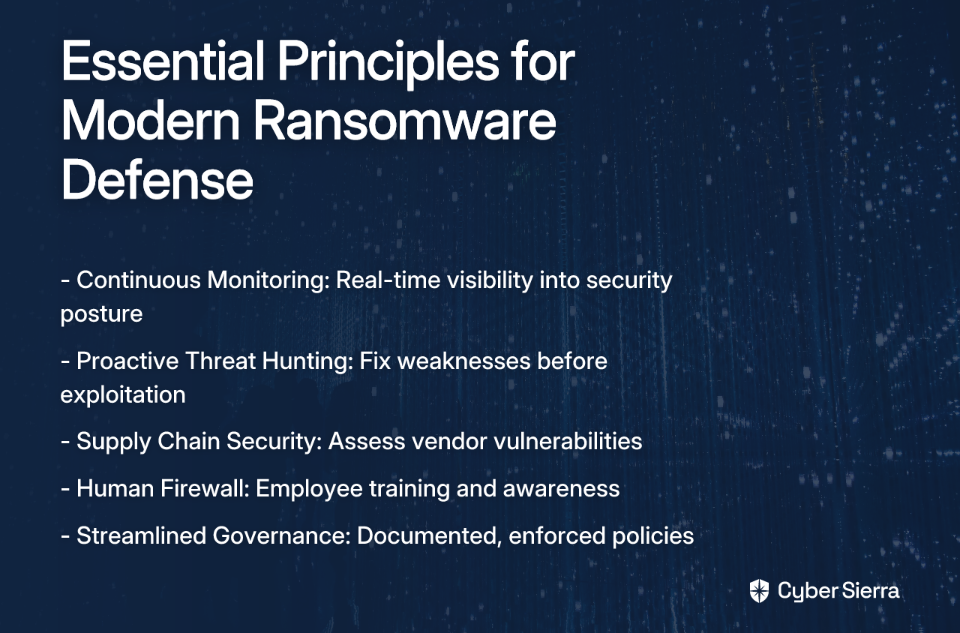
- Continuous Monitoring: Don't rely on periodic checks. You need real-time visibility into your security posture.
- Proactive Threat Hunting: Identify and fix weaknesses before they are exploited.
- Supply Chain Security: Your security is only as strong as your weakest vendor.
- A Strong Human Firewall: Your employees must be an active part of your defense.
- Streamlined Governance: Your policies must be documented, enforced, and audit-ready.
This is where Cyber Sierra's AI-enabled platform provides a unified solution. Instead of juggling multiple vendors, you can:
- Gain Real-Time Visibility with Continuous Control Monitoring (CCM) to ensure your defenses are always working.
- Identify Vulnerabilities Proactively with Threat Intelligence that scans your entire attack surface.
- Secure Your Supply Chain with automated Third-Party Risk Management (TPRM).
- Empower Your People through engaging Employee Security Training.
- Unify Your Program with a centralized GRC platform that makes you audit-ready, always.
As ransomware operations become more sophisticated, your defense strategy must evolve in parallel. The RaaS landscape changes rapidly—what worked yesterday may not work tomorrow. By implementing a comprehensive, integrated approach to cybersecurity that addresses the unique TTPs of today's most dangerous ransomware groups, you can significantly reduce your risk exposure.
Frequently Asked Questions
What is Ransomware-as-a-Service (RaaS) and why is it so popular?
Ransomware-as-a-Service (RaaS) is a business model where ransomware developers lease their malicious software to affiliates who then carry out the attacks. This model has become incredibly popular because it lowers the technical barrier to entry, allowing less skilled criminals to launch sophisticated attacks by simply paying a subscription or a share of the profits. This has led to a significant increase in the volume and variety of ransomware incidents.
What are the most common tactics used by top ransomware groups in 2026?
The most common tactics include sophisticated social engineering (like vishing), exploiting unpatched vulnerabilities in internet-facing systems, and abusing stolen credentials. Many groups also focus on supply chain attacks by targeting third-party vendors to gain access to their primary targets. Data exfiltration before encryption, known as double extortion, is now a standard procedure.
Why is the human element a critical vulnerability in ransomware attacks?
The human element is a critical vulnerability because modern ransomware is often human-operated, not just automated. Attackers exploit human psychology through social engineering, tricking employees into granting access or resetting security credentials. They also actively recruit insiders and leverage public pressure on executives, making a resilient and well-trained workforce (a "human firewall") an essential layer of defense.
What is "double extortion" in the context of ransomware?
Double extortion is a tactic where attackers both encrypt a victim's data and exfiltrate a copy of it before demanding a ransom. This puts double pressure on the victim: they must pay to get a decryption key to restore their systems and also to prevent the attackers from leaking their sensitive data publicly. This increases the likelihood of payment even if the victim has reliable backups.
How can organizations effectively defend against these evolving ransomware threats?
Effective defense requires a comprehensive, integrated strategy that goes beyond traditional tools. Key pillars include continuous monitoring of security controls, proactive threat intelligence to identify vulnerabilities, robust third-party risk management, and continuous employee security training. A unified approach that combines these elements into a single governance, risk, and compliance (GRC) framework is crucial for staying ahead of attackers.
