



Top 5 Solutions for Continuous Compliance Across AWS, Azure, and GCP in 2025

Join thousands of professionals and get the latest insight on Compliance & Cybersecurity.
You've set up a meticulously planned audit preparation schedule for your multi-cloud environment, but three weeks before your annual SOC 2 audit, you're drowning in a mountain of CSV exports, screenshots, and frantic emails to engineering. Sound familiar?
"If you're pulling evidence manually, it turns into a mountain of CSV exports, screenshots, and back-and-forth with engineering," laments one IT manager on Reddit. Another adds, "Pulling evidence from AWS and Azure can definitely get messy since it is scattered across so many consoles."
This scattered approach to compliance is no longer sustainable in 2025's complex multi-cloud reality. As organizations leverage AWS, Azure, and GCP simultaneously, maintaining continuous compliance across multiple frameworks (SOC 2, ISO 27001, PCI DSS, etc.) has become exponentially more challenging.
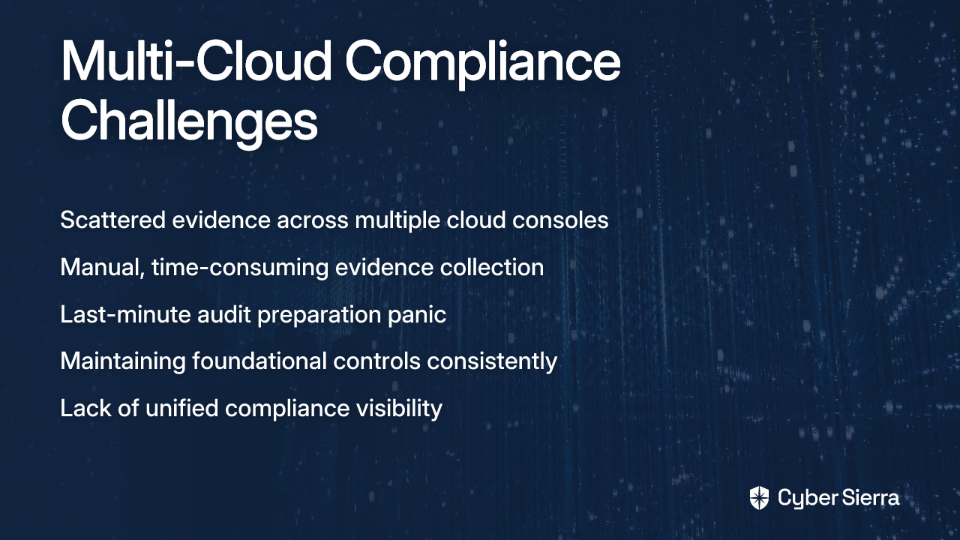
Why is Multi-Cloud Continuous Compliance So Challenging?
Before diving into solutions, let's acknowledge why multi-cloud compliance has become such a headache:
Scattered Evidence
With infrastructure and data distributed across multiple cloud providers, evidence gathering becomes a treasure hunt across dozens of different consoles and interfaces. As one security professional notes, "data is scattered across so many consoles," making it nearly impossible to maintain a unified compliance view.
Manual Overload
The traditional approach of manually collecting evidence for audit cycles is breaking under the weight of cloud complexity. Security teams report spending weeks "pulling CSV exports, screenshots, and back-and-forth with engineering" just to prepare for a single audit.
Audit Fatigue & Scramble
The constant pressure and last-minute "scramble" to prepare for audits creates a reactive compliance culture. One CISO advises, "You need to do this about 8 months before major audits to avoid the scramble," but few organizations successfully escape the audit panic cycle.
Foundational Controls vs. Tooling
While automated tools are invaluable, they're not magic bullets. As one practitioner cautions, "you still need things like MFA, backups, logging, and policies set up correctly or you will run into gaps during the audit." Tools must be built on a foundation of solid security practices.
The Top 5 Solutions for Continuous Compliance in 2025
The good news is that the industry has responded with powerful solutions designed specifically for continuous compliance across multi-cloud environments. Here are the top five solutions that stand out in 2025:
1. Native Cloud Tools: AWS Security Hub & Microsoft Defender for Cloud
Overview: Native tools from cloud providers offer a starting point for compliance monitoring within their respective ecosystems.
Key Features:
- AWS Security Hub: Centralizes security findings from AWS services and integrates with third-party tools to provide a comprehensive view of your AWS compliance status.
- Microsoft Defender for Cloud: Offers unified security management and advanced threat protection across Azure workloads, with built-in compliance dashboards.
- Both provide compliance checks against major frameworks like PCI DSS, NIST, and ISO 27001.
Best For: Organizations primarily operating within a single cloud provider or those looking for a cost-effective foundation for their compliance journey.
As one Reddit user advises, "Some teams start with the native compliance dashboards in AWS/Azure and then add a tool like Vanta, Drata, or similar to automate evidence collection and monitoring." This layered approach allows organizations to leverage the deep integration of native tools while addressing their limitations.
Limitations: While powerful within their ecosystems, native tools often struggle with providing a unified view across multiple cloud providers, leading many organizations to supplement them with third-party solutions.
2. Orca Security
Overview: Orca Security offers an agentless Cloud Security Posture Management (CSPM) and Cloud Workload Protection Platform (CWPP) that provides deep visibility across your entire cloud estate from a single platform.
Key Features:
- Agentless Architecture: Achieves 100% coverage across your entire cloud estate without requiring agents, simplifying deployment and eliminating performance overhead.
- Multi-Cloud Support: Provides a unified management dashboard across AWS, Azure, Google Cloud, and Kubernetes environments.
- Comprehensive Framework Coverage: Supports over 150+ frameworks and CIS benchmarks, including SOC 2, ISO 27001, PCI DSS, HIPAA, and more.
- Automated Remediation: Integrates with tools like Jira and Slack to automatically address compliance alerts and guide remediation efforts.
Best For: Organizations requiring comprehensive, agentless visibility and threat detection across multiple cloud providers without the operational overhead of agent deployment.
3. Lacework
Overview: Lacework stands out as an AI-driven, multi-cloud security platform focused on real-time threat detection, configuration monitoring, and compliance insights.
Key Features:
- AI-Driven Analytics: Uses machine learning to baseline normal activity and detect anomalies, significantly reducing alert fatigue and false positives.
- Multi-Cloud Visibility: Offers a unified view for enhanced security audits across AWS, Azure, and GCP environments.
- Continuous Monitoring: Provides real-time threat detection and compliance insights, moving beyond periodic scans to true continuous assurance.
- Polygraph® Technology: Creates a visual map of your cloud environment, helping to understand relationships between entities and detect suspicious behaviors.
Best For: Security teams that want to leverage AI and behavioral analytics for proactive threat detection alongside compliance monitoring, particularly in dynamic environments with frequent changes.
4. RegScale
Overview: RegScale is a platform focused on AI-driven automation for GRC and Continuous Controls Monitoring (CCM), designed to drastically reduce the manual effort and time required for audits and certifications.
Key Features:
- AI-Powered GRC: Utilizes artificial intelligence to streamline governance, risk, and compliance processes, making it easier to maintain compliance with constantly changing regulations.
- Impressive Efficiency Metrics: Organizations using RegScale report 60% faster audit preparation and 94% less effort needed for SOC 2 Type 2 compliance.
- Compliance-as-Code: Integrates with DevSecOps workflows by embedding compliance checks into CI/CD pipelines, automating evidence collection from the source.
- Unified Framework Management: Simplifies managing multiple standards like NIST, PCI DSS, and SOC 2 in one place, with built-in mapping between frameworks.
Best For: Regulated industries and government contractors needing to accelerate certification processes (like FedRAMP) and deeply integrate compliance into their development lifecycle.
5. Cyber Sierra
Overview: Cyber Sierra offers an AI-enabled cybersecurity platform designed to unify and automate GRC, continuous monitoring, vendor risk, and more. It addresses the critical pain point of needing "consolidation" of tools to create a single source of truth.
Key Features:
- Unified Platform Approach: Solves the problem of scattered data by integrating multiple security functions into one dashboard. As one IT director noted on Reddit, the key value is "having one place that continuously ingests role, membership, privilege, and MFA data across tenants and can produce auditor-ready reports."
- Continuous Control Monitoring (CCM): The core of Cyber Sierra's compliance offering builds a central controls repository with near real-time updates, automates control testing and validation, and detects exceptions and anomalies as they occur.
- Automated GRC Module: Automates data collection, risk assessments, control monitoring, and reporting across multiple frameworks like SOC2, ISO 27001, and HIPAA, which is critical for multi-cloud environments.
- Holistic Security Approach: Extends beyond compliance with integrated modules for Third-Party Risk Management (TPRM) and Threat Intelligence, recognizing that strong compliance is a byproduct of good security.
Best For: Organizations looking for a comprehensive, all-in-one platform to automate and unify their entire security and compliance program, from internal controls to vendor risk, and move beyond point solutions to a single source of truth.
How to Choose the Right Solution for Your Needs
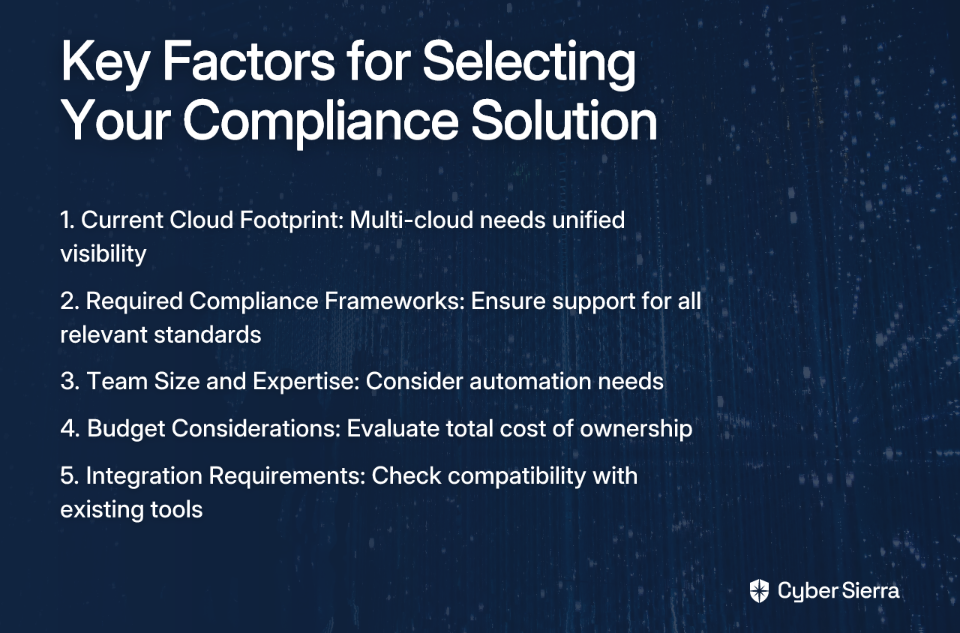
When evaluating these solutions for your organization, consider these key factors:
- Current Cloud Footprint: If you're primarily in one cloud, native tools may be sufficient. For multi-cloud environments, solutions like Orca, Lacework, or Cyber Sierra offer better unified visibility.
- Required Compliance Frameworks: Ensure the solution supports all frameworks relevant to your industry (SOC 2, ISO 27001, PCI DSS, HIPAA, etc.)
- Team Size and Expertise: Smaller teams may benefit from more automated, all-in-one platforms that require less specialized knowledge.
- Budget Considerations: Native tools offer cost advantages but may require supplemental solutions. Consider the total cost of ownership, including implementation and maintenance.
- Integration Requirements: Evaluate how well the solution integrates with your existing security stack and workflows.
Conclusion: The Future of Compliance is Continuous
The shift from point-in-time compliance to continuous, automated monitoring is no longer optional—it's essential for organizations operating across AWS, Azure, and GCP. As one security professional summarized, "The key value is consolidation. Having one place that continuously ingests... data across tenants and can produce auditor-ready reports is a huge time-saver."
By implementing solutions that enable continuous compliance, organizations can transform from the reactive "audit scramble" to a proactive posture where they're perpetually audit-ready. This not only reduces stress and manual effort but also enhances overall security posture and operational efficiency.
Whether you start with native cloud tools and build up, or adopt a comprehensive platform like Cyber Sierra, the important step is moving away from manual, scattered approaches toward automated, continuous compliance monitoring across your entire multi-cloud environment.
Your future self—no longer drowning in CSV exports three weeks before an audit—will thank you.
Frequently Asked Questions
What is multi-cloud continuous compliance?
Multi-cloud continuous compliance is the ongoing process of automatically monitoring and validating that an organization's systems, data, and controls consistently meet regulatory standards (like SOC 2, ISO 27001, and PCI DSS) across multiple cloud environments such as AWS, Azure, and GCP. Unlike traditional, point-in-time audits, this approach uses automated tools to constantly collect evidence and detect misconfigurations, moving organizations from a reactive "audit scramble" to a perpetually audit-ready state.
Why is manual evidence collection for multi-cloud audits so challenging?
Manual evidence collection for multi-cloud audits is challenging because infrastructure and data are scattered across different cloud providers, each with its own unique console and interface. This scattered nature turns evidence gathering into a time-consuming and error-prone task involving countless CSV exports, screenshots, and communication with engineering teams, making it nearly impossible to maintain a unified, accurate view of compliance status.
How do automated compliance tools improve multi-cloud security?
Automated compliance tools improve multi-cloud security by providing a single, unified platform to continuously monitor controls, collect evidence, and detect misconfigurations across all cloud environments (AWS, Azure, GCP, etc.) in near real-time. They replace manual processes with automated data ingestion and analysis, centralize compliance data, test controls against hundreds of frameworks, and provide auditor-ready reports, which enhances overall security posture by identifying gaps as they occur.
What are the key factors to consider when choosing a compliance solution?
When choosing a compliance solution, key factors to consider are your organization's specific cloud footprint, the compliance frameworks you must adhere to, your team's size and expertise, budget, and integration requirements with your existing tech stack. For a true multi-cloud setup, a third-party solution offering a unified view is essential. Ensure the tool supports all your required frameworks (e.g., SOC 2, HIPAA, PCI DSS) and meets your operational needs.
Can I rely solely on native cloud tools like AWS Security Hub for multi-cloud compliance?
While native cloud tools like AWS Security Hub and Microsoft Defender for Cloud are excellent starting points, they are often insufficient for true multi-cloud compliance because they are designed to work best within their own ecosystems. They struggle to offer a consolidated view across different clouds, which is why many organizations use them as a foundational layer and add a third-party platform to achieve a single source of truth for their entire multi-cloud environment.
