Top 5 Tools to Replace Manual Control Testing with Automation


Join thousands of professionals and get the latest insight on Compliance & Cybersecurity.
Summary
- Manual control testing is a major source of audit fatigue, but automation can reduce the workload by up to 40% for small to midsize businesses.
- Shifting from periodic, manual checks to Continuous Control Monitoring (CCM) provides real-time visibility into your security posture and keeps you perpetually audit-ready.
- This article evaluates five leading automation tools to help you replace manual evidence gathering. For an integrated solution that combines CCM with GRC, explore Cyber Sierra's Continuous Control Monitoring.
You've just finished another grueling audit cycle. After weeks of back-to-back calls with engineers who don't speak "compliance language," endless email chains requesting screenshots, and late nights compiling evidence, you're exhausted. The most painful part? All of this will repeat in a few months for the next audit.
Sound familiar?
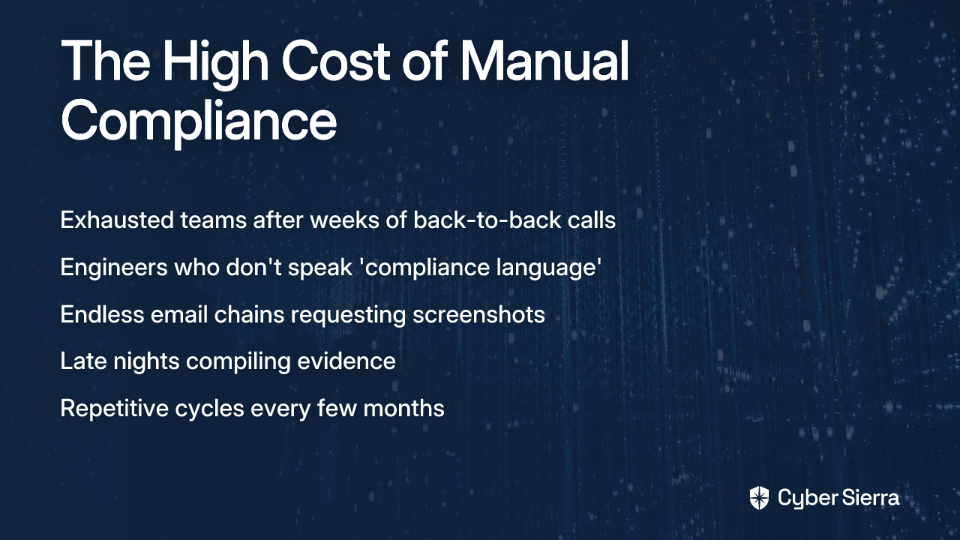
As one compliance professional put it: "The most painful part of an audit is typically evidence gathering. You end up on long calls with engineers who may or may not speak GRC and hope they remember where to find a config and take a screenshot with a time stamp. It's painful and sucks up a lot of time, especially when you're running lean teams who still need to patch and otherwise keep lights on."
This manual control testing approach—periodic, point-in-time, and highly prone to human error—has become a significant bottleneck for modern security and compliance teams. It creates "audit fatigue" while draining resources that could be used for proactive security measures.
The solution? Automation and Continuous Control Monitoring (CCM).
Automating control testing isn't about eliminating jobs—it's about augmenting your team's capabilities. While it may not shorten the official audit period, it can "lighten your load by 100%" and reduce workload "by a factor of 30-40%" for small to midsize businesses, according to professionals who've made the transition.
Let's explore five powerful tools that can help your organization move from tedious manual checks to efficient, automated control testing.
1. Cyber Sierra
Overview: Cyber Sierra provides an AI-enabled cybersecurity platform designed to simplify and automate the entire security compliance lifecycle, moving organizations away from periodic manual checks toward proactive, near real-time risk management.
Key Features for Automation:
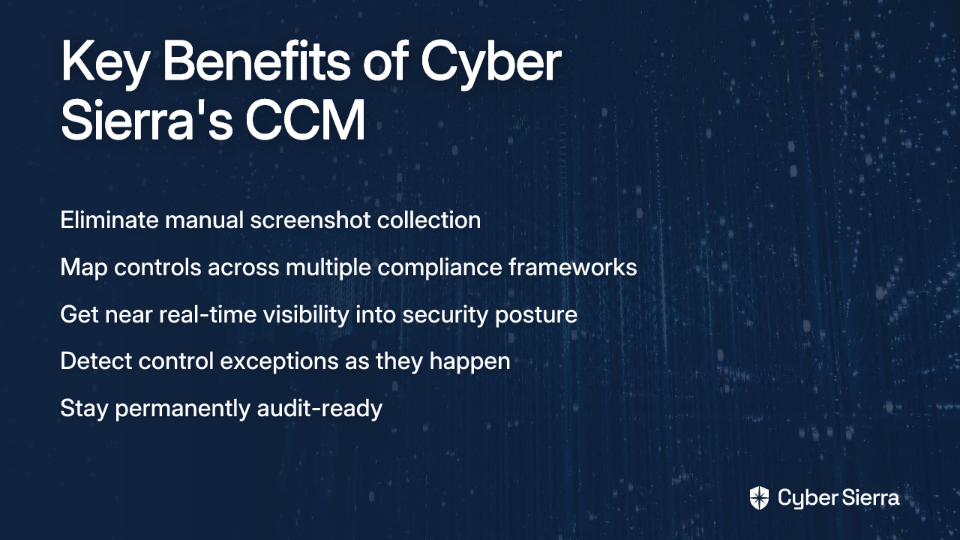
- Continuous Control Monitoring (CCM): The core module for replacing manual testing
- Automated Control Testing & Validation: Directly automates the process of checking if security controls are implemented and operating effectively, eliminating manual screenshot collection
- Central Controls Repository: Creates a single source of truth for all controls, mapping them across multiple compliance frameworks (NIST, ISO 27001, PCI DSS, GDPR, HIPAA)
- Near Real-Time Updates & Anomaly Detection: Provides ongoing visibility into your security posture and detects exceptions as they happen, not just during audit windows
- Governance, Risk & Compliance (GRC): Automates data collection, risk assessments, and generates comprehensive reports and audit trails, making your organization audit-ready at any time
Who It Helps:
- Compliance Managers: Drastically reduces the manual evidence collection burden
- CISOs: Provides a unified, near real-time view of control effectiveness
- IT Managers: Automates compliance checks, freeing up time for core IT functions
Why It's a Top Replacement: Cyber Sierra directly tackles the primary pain point of manual evidence gathering. Its integrated platform not only automates testing via CCM but also streamlines the entire GRC process, transforming security from a reactive, periodic task into a continuous, automated program.
Learn More about Cyber Sierra's Continuous Control Monitoring
2. MetricStream
Overview: A comprehensive and established GRC platform that facilitates the systematic evaluation and testing of internal controls to ensure both design and operational effectiveness.
Key Features for Automation:
- Automated Testing Engine: Allows users to "automate testing with a push of a button" and build a reusable repository of tests
- Significant Time Reduction: MetricStream claims its automation can reduce "initial testing time by 40%-60% and subsequent testing by 70%-90%"
- Diverse Testing Methods: Supports various testing techniques, including Inquiry, Observation, Inspection, Re-performance, and Computer-Assisted Audit Techniques (CAATs)
- Continuous Monitoring Dashboards: Provides real-time alerts and access to a repository of previous test results for trend analysis
Who It Helps:
- Large enterprises with complex GRC requirements looking for a robust, all-in-one solution
- Internal audit teams aiming to improve efficiency and fraud detection capabilities
Why It's a Top Replacement: MetricStream offers a powerful, dedicated solution for automating the mechanics of control testing. Its proven time-saving statistics and support for advanced CAATs make it a strong contender for organizations looking to mature their GRC programs.
Learn More about MetricStream Control Testing
3. AuditBoard
Overview: A modern, cloud-based platform specifically designed to streamline audit, risk, and compliance management for internal audit and compliance teams.
Key Features for Automation:
- Centralized Controls Library: Maintains a single, comprehensive library of controls, simplifying management and reducing redundancy
- Streamlined Testing Workflows: Automates repetitive audit tasks, evidence requests, and issue management, integrating them directly with risk management processes
- Real-time Collaboration: Provides features that allow teams to collaborate on audits and control testing in real-time, eliminating version control issues with spreadsheets
Who It Helps:
- Internal Auditors seeking to move away from spreadsheets and manual documentation
- Compliance Managers who need to streamline processes for frameworks like SOX, ISO 27001, etc.
Why It's a Top Replacement: AuditBoard excels at improving the workflow and collaboration around control testing. While other tools focus on technical data integration, AuditBoard's strength lies in organizing the human element of audits, reducing administrative overhead and enhancing team efficiency.
4. Panaseer
Overview: A Continuous Controls Monitoring platform that focuses on measuring the effectiveness of cybersecurity controls by aggregating, correlating, and visualizing data from disparate security and IT tools.
Key Features for Automation:
- Automated Data Collection & Normalization: Uses "agentless intelligent data connectors" to gather data from security, IT, and business tools, creating a unified asset inventory
- Automated Measurement and Dashboards: Measures security control metrics against policies and regulations (NIST, CIS) automatically, providing over 50 dashboards and 200 best practice metrics for visualization
- Risk-Based Prioritization: Enriches asset data with business context (location, business unit) to prioritize remediation based on business impact
- Business-Friendly Translation: Converts complex cybersecurity metrics into understandable scorecards for non-technical stakeholders, improving communication between security and the business
Who It Helps:
- Security teams struggling to prove control effectiveness to leadership
- Organizations with a complex stack of security tools that need a single pane of glass for control posture
Why It's a Top Replacement: Panaseer automates the difficult task of data aggregation and translation. Instead of manually pulling reports from 20 different tools to test a control, Panaseer does it continuously, providing a clear, quantifiable, and business-relevant view of control health.
Explore Panaseer Continuous Controls Monitoring
5. Diligent (formerly HighBond/Galvanize)
Overview: An integrated GRC platform that leverages data analytics and AI to automate controls testing and provide predictive insights into risk and compliance.
Key Features for Automation:
- AI-Powered Controls Testing: Uses AI and data analytics for real-time assessment of control performance, moving beyond simple pass/fail checks
- Predictive Insights: Employs advanced analytics to "detect control weaknesses before failures occur", enabling a more proactive risk management approach
- Integrated Risk Management: Links audit and control testing outcomes directly to the broader enterprise risk management strategy, ensuring alignment
- Robotics and Automation: Offers automation tools for risk assessments, compliance tracking, and integrating with other enterprise systems
Who It Helps:
- GRC professionals and audit teams in data-driven organizations
- Leaders who want to leverage predictive analytics for strategic risk management
Why It's a Top Replacement: Diligent goes a step beyond simple automation by introducing predictive capabilities. This helps teams shift from a reactive stance (fixing failed controls) to a proactive one (identifying and mitigating weaknesses before they lead to failure), representing a higher level of maturity in a GRC program.
Making the Shift to Continuous, Automated Compliance
The transition from manual, point-in-time control testing to automated, continuous monitoring is essential for modern cybersecurity and compliance. The tools listed provide a pathway to escape the cycle of manual evidence gathering and audit fatigue.
However, it's important to acknowledge that these tools are not magic bullets. As one user noted, they "can come with a steep learning curve and can cost up to $10k annually." You'll "still need someone to configure and maintain these tools, draft and update the documents," which will cost time and resources.
Despite these considerations, the value proposition is clear: automated control testing tools significantly lighten your workload and reduce the risk of non-compliance and security gaps. They empower lean teams to do more with less, enhance accuracy, and provide the real-time visibility needed to make informed, data-driven security decisions.
Perhaps most importantly, automation makes your organization perpetually "audit-ready," transforming compliance from a periodic scramble into a continuous state of preparedness.
Frequently Asked Questions
What is automated control testing?
Automated control testing is the use of technology to continuously verify that security and compliance controls are implemented correctly and operating effectively. Unlike manual testing, which relies on periodic, point-in-time evidence collection like screenshots, automation tools connect directly to your systems to gather evidence in near real-time, eliminating repetitive human tasks and reducing the risk of errors.
Why is Continuous Control Monitoring (CCM) important?
Continuous Control Monitoring (CCM) is important because it transforms compliance from a periodic, stressful event into an ongoing, manageable process. It provides real-time visibility into your security posture, allowing you to detect and remediate control failures as they happen, not months later during an audit. This proactive approach reduces audit fatigue, ensures you are always prepared for an audit, and strengthens your overall security.
How does a compliance automation tool work?
A compliance automation tool works by integrating with your organization's various IT and security systems (e.g., cloud providers like AWS, identity providers like Okta, and HR systems). It automatically collects data from these sources, maps the evidence to specific controls across different compliance frameworks (like ISO 27001 or SOC 2), and continuously checks for deviations. When a control fails, the tool alerts the relevant team to address the issue promptly.
What is the difference between GRC and CCM?
GRC (Governance, Risk, and Compliance) is a broad strategic framework for managing an organization's overall governance, risk management, and compliance with regulations. CCM (Continuous Control Monitoring) is a specific technological process that supports the "Compliance" and "Risk" pillars of GRC. In short, GRC is the overall strategy, while CCM is a powerful tool used to automate a critical part of that strategy.
Can automation completely replace our compliance team?
No, automation does not replace a compliance team; it augments it. Compliance automation tools are designed to handle the repetitive, time-consuming tasks of evidence collection and monitoring, freeing up your human experts to focus on higher-value activities. Your team is still essential for strategic planning, interpreting control effectiveness, managing exceptions, and overseeing the GRC program as a whole.
How can we get started with compliance automation?
Getting started with compliance automation can be broken down into a few key steps. First, identify your most time-consuming manual compliance tasks and the frameworks you need to adhere to (e.g., SOC 2, HIPAA). Next, evaluate automation platforms that integrate with your existing technology stack. Finally, start with a pilot project, automating controls for one specific area to demonstrate value before expanding across the organization.
To see how an integrated platform can automate control testing and simplify your entire GRC program, explore how Cyber Sierra's Continuous Control Monitoring provides a single source of truth for your security posture. By implementing the right automation tool, you can finally break free from the manual testing cycle and focus on what matters most: strengthening your security posture and driving business value.