



5 Third Party Risk Management Platforms That Track BAAs and DPAs

Join thousands of professionals and get the latest insight on Compliance & Cybersecurity.
Summary
- Manually tracking vendor agreements like BAAs and DPAs is unsustainable and risks severe penalties, with HIPAA fines alone reaching up to $1.5 million annually.
- Relying on spreadsheets for vendor compliance creates critical blind spots, remediation gaps, and significant stress during audits.
- Adopt a Third-Party Risk Management (TPRM) platform to automate vendor assessments, centralize agreements, and continuously monitor security posture.
- Cyber Sierra's TPRM module automates BAA and DPA tracking and provides continuous compliance monitoring to ensure nothing falls through the cracks.
Your vendor list has grown. So has your exposure.
Every third-party tool your team onboards — your EHR integration, your cloud storage provider, your billing platform — carries contractual obligations that don't manage themselves. Business Associate Agreements (BAAs) under HIPAA. Data Processing Agreements (DPAs) under the General Data Protection Regulation (GDPR). Miss one, and you're not just looking at an audit finding. You're looking at potential fines that can reach $1.5 million annually under HIPAA alone.
This article covers five Third-Party Risk Management (TPRM) platforms built to centralize, automate, and continuously monitor your vendor compliance obligations — including BAA and DPA tracking.
Why Tracking BAAs and DPAs Is a Nightmare (and a Necessity)
Before diving into the tools, it's worth understanding why these agreements are so difficult to manage manually — and what's at stake when tracking breaks down.
What Is a Business Associate Agreement (BAA)?
A BAA is a legally binding contract required under the Health Insurance Portability and Accountability Act (HIPAA) between a covered entity and any third party that handles Protected Health Information (PHI) on its behalf.
Covered entities include health plans, healthcare providers, and healthcare clearinghouses. Business associates include any vendor — IT providers, billing companies, data analytics firms — that creates, receives, maintains, or transmits PHI as part of their services.
Per the Ironclad BAA guide, a valid BAA must:
- Specify permitted uses of PHI
- Require appropriate safeguards
- Mandate breach reporting
- Extend compliance requirements to subcontractors
In practice, this creates a layered challenge. As MSP professionals have discussed online, even navigating BAA documentation for major vendors like Microsoft can be confusing — poorly organized, hard to locate, and unclear on whether a signed version is actually on file.
What Is a Data Processing Agreement (DPA)?
A DPA is a legally binding contract between a data controller and a data processor governing how personal data is handled. Under GDPR Article 28, a written DPA is mandatory any time a third party processes personal data on your behalf.
A compliant DPA must cover:
- Specific processing instructions
- Confidentiality obligations
- Security measures
- Breach notification timelines
- Your right to audit the processor
As the HyperStart DPA overview explains, this applies broadly — including services like Google Analytics, web hosting providers, and marketing platforms, which is a source of frequent confusion among compliance teams operating across multiple jurisdictions.
The Problem with Manual Tracking
The problem isn't that teams don't know these agreements matter. It's that tracking them across dozens — sometimes hundreds — of vendors using spreadsheets and shared drives is unsustainable. As one compliance professional noted in a community thread, gathering evidence for audits is tedious and time-consuming, especially with lean teams.
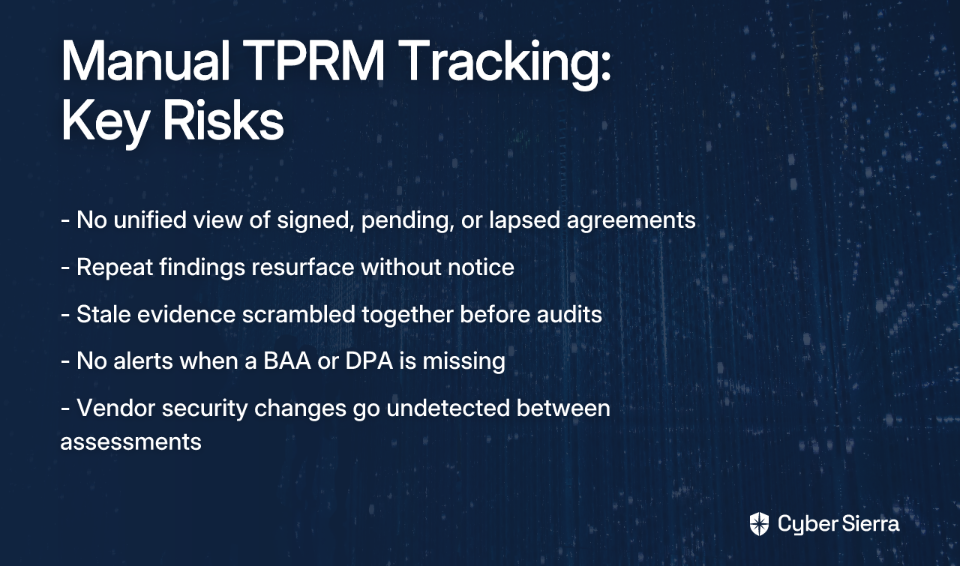
Spreadsheets don't send alerts when a BAA is missing. They don't flag when a vendor's security posture has changed since the last assessment. And they don't tell you whether a remediated finding has actually stayed remediated.
The real-world consequences include:
- Vendor risk blind spots. No unified view of which vendors have signed agreements, which are pending, and which have lapsed.
- Remediation gaps. As users in TPRM discussions have noted, many tools still don't track repeat findings effectively — meaning previously remediated issues resurface without notice.
- Audit readiness anxiety. Evidence collection becomes a scramble, and by the time it's assembled, some of it is already stale.
5 Platforms That Tame Your BAA and DPA Chaos
The following platforms address these challenges through centralized repositories, automated workflows, and continuous monitoring. Each takes a different approach — here's how they compare.
1. Cyber Sierra
Best for: CISOs and Compliance Managers in regulated industries like HealthTech and BFSI who need a unified platform combining TPRM, GRC, and continuous control monitoring.
Supported frameworks: HIPAA, GDPR, SOC 2, ISO 27001, PCI DSS, NIST CSF.
Deployment: Cloud-based SaaS.
Cyber Sierra's TPRM module moves beyond one-time questionnaires by providing near real-time visibility into vendor security posture throughout the vendor lifecycle — onboarding, ongoing monitoring, and offboarding. When paired with the GRC module, it creates a centralized hub for tracking vendor agreements like BAAs and DPAs alongside the controls that enforce them.
What sets it apart for BAA and DPA tracking specifically is its ability to automate documentation workflows and flag compliance gaps before they become audit findings. Rather than chasing vendors for updated security evidence manually, the platform surfaces risk intelligence continuously — so your team isn't relying on point-in-time snapshots that go stale between assessments.
Cyber Sierra is recognized in the Gartner® Hype Cycle™ for Cyber-Risk Management, 2024, and accredited by the Cyber Security Agency of Singapore (CSA) as a trusted service provider.
Key features:
- Automated vendor assessments. Simplifies collection of security documentation, including BAAs and DPAs, through customizable workflows.
- Continuous compliance monitoring. Provides ongoing visibility into vendor controls, helping identify gaps before they become audit findings.
- Centralized documentation repository. Acts as a single source of truth for vendor contracts, assessments, and remediation evidence.
- Advanced risk intelligence. Prioritizes vendor risks based on business impact and real-time security posture, reducing analysis paralysis.
2. OneTrust
Best for: Large enterprises requiring deep integration between privacy management, GRC, and vendor risk.
Supported frameworks: GDPR, CCPA/CPRA, HIPAA, ISO 27001.
Deployment: Cloud-based SaaS.
OneTrust is well established in the privacy and GRC space. Its TPRM capabilities are particularly strong for organizations that need to connect vendor risk data into a broader enterprise compliance program. According to UpGuard's TPRM software overview, OneTrust excels at automating vendor onboarding and generating predictive risk insights related to privacy and governance — making it a natural fit for teams managing DPAs at scale across global operations.
Key features:
- Predictive risk insights. Gathers privacy and governance data to proactively identify high-risk third parties.
- Comprehensive lifecycle automation. Automates vendor management from onboarding and due diligence through offboarding.
- GRC integration. Connects vendor risk data with broader compliance and privacy modules for a unified view.
3. UpGuard
Best for: Mid-market organizations seeking fast deployment with continuous external monitoring and questionnaire management.
Supported frameworks: GDPR, ISO 27001, NIST CSF.
Deployment: Cloud-based SaaS.
UpGuard Vendor Risk focuses on continuous monitoring of vendors' external attack surfaces and security ratings. As detailed in their TPRM platform documentation, the platform automates security questionnaires and maps responses to industry standards — simplifying the process of collecting and validating the evidence that underpins BAA and DPA compliance. It's particularly effective at surfacing risk across third and fourth-party vendor dependencies.
Key features:
- Automated security ratings. Provides an objective, data-driven score of each vendor's security posture.
- Questionnaire automation. Offers a library of customizable questionnaires mapped to standards including GDPR and ISO 27001.
- Third and fourth-party discovery. Continuously maps your vendor ecosystem to surface hidden dependencies and downstream risks.
4. Panorays
Best for: Teams looking to reduce vendor fatigue with intelligent questionnaires combined with continuous external monitoring.
Supported frameworks: SOC 2, ISO 27001, HIPAA, GDPR.
Deployment: Cloud-based SaaS.
Panorays takes a unified approach by integrating external attack surface monitoring with vendor-friendly self-assessment workflows. As noted in their TPRM software analysis, this reduces the burden on vendors while giving your team comprehensive insight into the supply chain — including downstream dependencies that often go untracked. For BAA and DPA management, this matters because compliance doesn't stop at your direct vendor; it extends to their subprocessors too.
Key features:
- External attack surface monitoring. Delivers real-time intelligence on vendor cyber posture without relying solely on self-reported data.
- Vendor-friendly assessments. Integrates external signals with self-assessment questionnaires to shorten response time and reduce friction.
- Explainable risk scoring. Translates technical risk into clear, business-relevant metrics that support executive reporting.
5. BitSight
Best for: Organizations that rely on objective security ratings and data-driven benchmarking to manage portfolio-level vendor risk.
Supported frameworks: NIS 2, SOC 2.
Deployment: Cloud-based SaaS.
BitSight is a recognized leader in security ratings, providing continuously updated, externally observable data on third-party security performance. As referenced in both UpGuard's and Panorays' analyses of the TPRM market, BitSight's ratings give compliance teams an at-a-glance view of vendor posture — useful for flagging vendors whose security may have degraded since a BAA or DPA was originally signed. It's less focused on agreement tracking workflows and more on the continuous intelligence layer that informs those decisions.
Key features:
- Security ratings. Provides a comprehensive A–F rating per vendor based on externally observable performance data.
- Portfolio benchmarking. Compares vendor security performance against industry peers to contextualize risk.
- Actionable findings. Delivers detailed analytics to support vendor communication and targeted remediation.
How to Choose the Right TPRM Platform
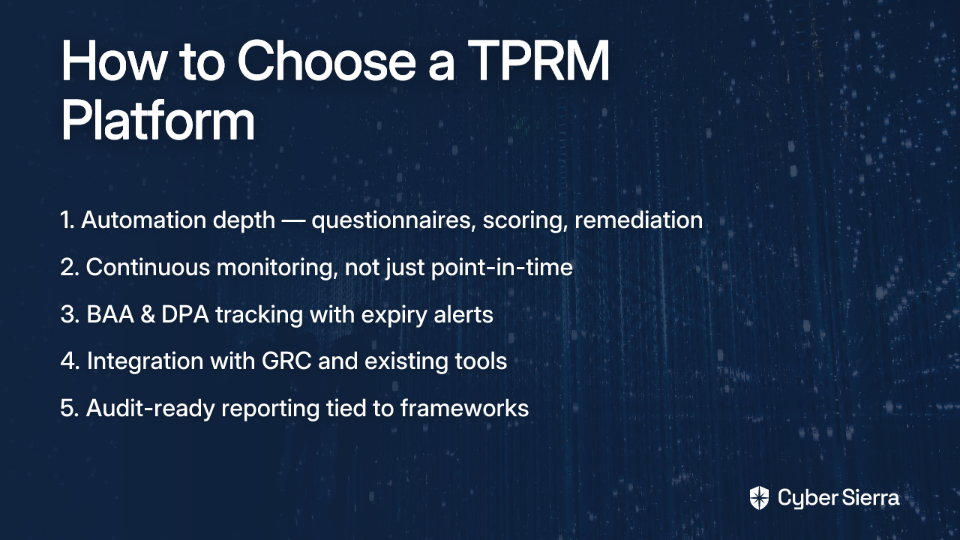
Not every platform will fit every team. Based on guidance from Panorays and Cynomi, evaluate options across these criteria before committing:
From Spreadsheet Chaos to Compliance Control
Manually tracking BAAs and DPAs isn't just inefficient—it's a direct threat to your compliance posture. Spreadsheets create blind spots, don't alert you to expired agreements, and make audit prep a high-stress scramble for stale evidence.
The solution is to shift from reactive tracking to proactive oversight. A dedicated Third-Party Risk Management (TPRM) platform automates the entire vendor lifecycle, from onboarding assessments to continuous security monitoring. This ensures your vendor agreements are always current and, more importantly, that your vendors are upholding the security controls they promised.
Here’s a clear next step: review your top three vendors that handle sensitive data. Can you locate a signed, up-to-date BAA or DPA for each in under 60 seconds? If not, it's time to centralize.
When you're ready to replace compliance anxiety with automated control, see how Cyber Sierra gives you a single source of truth for vendor risk. Book a Cybersierra demo and stop letting vendor agreements fall through the cracks.
Frequently Asked Questions
What is the main purpose of a BAA and DPA?
A Business Associate Agreement (BAA) and Data Processing Agreement (DPA) are legally required contracts. They ensure third-party vendors who handle sensitive data (like PHI under HIPAA or personal data under GDPR) adhere to specific security and privacy standards, protecting your organization.
Why is manually tracking vendor agreements with spreadsheets a risk?
Manual tracking is a risk because spreadsheets lack automation and real-time visibility. They don't send alerts for missing or expired agreements, can't monitor a vendor's security posture continuously, and make audit preparation a time-consuming, error-prone scramble for evidence.
How does a TPRM platform solve BAA and DPA tracking challenges?
A Third-Party Risk Management (TPRM) platform automates the entire vendor compliance lifecycle. It centralizes all agreements, automates assessment workflows, provides continuous monitoring of vendor security, and flags risks or missing documentation, ensuring you are always audit-ready.
Who needs a BAA under HIPAA?
A BAA is required between a HIPAA-covered entity (e.g., a healthcare provider) and any business associate. A business associate is any third-party vendor that creates, receives, maintains, or transmits Protected Health Information (PHI) on your behalf, such as a cloud or billing provider.
What should I look for when choosing a TPRM platform?
Look for a platform with strong automation, continuous monitoring, and integrated GRC capabilities. Key features include automated questionnaires, real-time risk scoring, a centralized document repository with expiry alerts, and the ability to generate audit-ready reports for specific frameworks.
What is the difference between TPRM and vendor management?
Vendor management focuses on operational aspects like performance and contracts, while TPRM focuses specifically on the risks vendors introduce. TPRM is a discipline dedicated to identifying, assessing, and mitigating security, compliance, and operational risks posed by third parties.
