



RBI Outsourcing Compliance Software for Indian Banks (2026)

Join thousands of professionals and get the latest insight on Compliance & Cybersecurity.
- The RBI's 2023 Outsourcing Directions require all Indian financial institutions to implement a formal Third-Party Risk Management (TPRM) program, rendering manual spreadsheet-based tracking non-compliant.
- The most critical mandate is "continuous monitoring" of vendor risk, which requires ongoing, near real-time visibility that annual questionnaires cannot provide.
- AI-powered TPRM platforms are essential for meeting these new requirements by automating due diligence, vendor monitoring, and audit trail generation.
- To achieve compliance, regulated entities should adopt a solution like Cyber Sierra's TPRM platform to automate continuous vendor oversight and help them stay audit-ready.
The Reserve Bank of India (RBI) Outsourcing of Information Technology Services Directions 2023, effective October 1, 2023, created a mandatory new compliance obligation for every Indian bank, Non-Banking Financial Company (NBFC), and payment system operator. Every Regulated Entity (RE) must now operate a formal, technology-backed Third-Party Risk Management (TPRM) program. Selecting the right RBI outsourcing compliance software has become a board-level decision, not an IT purchasing exercise.
Annual questionnaires and vendor registers built in spreadsheets can no longer satisfy the "continuous monitoring" standard the RBI now enforces. Point-in-time checks leave dangerous gaps between review cycles, and manual processes struggle to scale as vendor populations grow. This guide evaluates the RBI outsourcing compliance software options purpose-built to meet the new regulatory standard, so compliance officers and IT risk leaders at Indian banks can make an informed choice.
What RBI IT Outsourcing Directions 2023 Require
The RBI Outsourcing of IT Services Directions 2023 outline a comprehensive framework for managing risks that arise from IT outsourcing arrangements. The summary below is directional; readers should consult the official RBI circular and qualified compliance counsel for definitive legal interpretation.
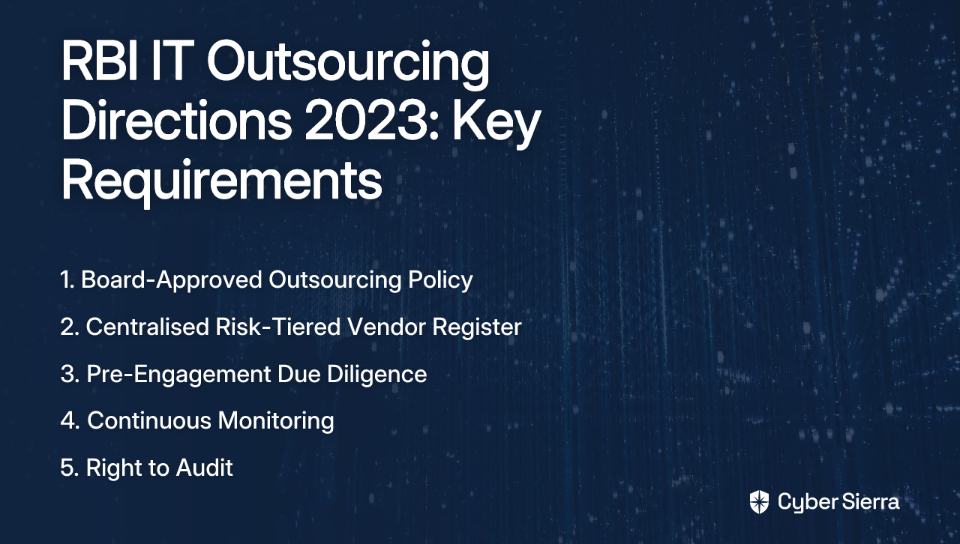
Board-Approved Outsourcing Policy. Every RE must establish a comprehensive, board-approved policy covering the entire outsourcing lifecycle, from vendor selection through exit. This policy is the governance anchor for the entire program, and its controls must be traceable through every subsequent vendor engagement.
Centralised Risk-Tiered Vendor Register. The directions require a centralised inventory of all third-party IT service providers, categorised by risk tier. Risk tiering allows institutions to focus due diligence and monitoring resources on the vendors whose failure would create the greatest operational or regulatory impact.
Pre-Engagement Due Diligence. Before signing any agreement, an RE must conduct exhaustive due diligence covering the prospective vendor's cybersecurity posture, financial stability, subcontracting arrangements, and business continuity capabilities. Shallow, checkbox-style assessments are not compliant with this expectation.
Continuous Monitoring. This is the most operationally demanding requirement. The RBI expects REs to move beyond point-in-time reviews and maintain ongoing visibility into each service provider's risk profile throughout the contract term.
Right to Audit. All outsourcing contracts must include explicit clauses granting the RE and the RBI the right to audit the service provider's operations, systems, and documentation. Maintaining documentary evidence of this right, and exercising it, is essential for supervisory examinations.
How AI TPRM Software Addresses Each RBI Requirement
Modern RBI outsourcing compliance software maps directly to each of the five mandates above. The table below is not hypothetical; it reflects the actual feature architecture of leading TPRM platforms available to Indian regulated entities today.
Board-Approved Policy → Centralised GRC Platform. A Governance, Risk and Compliance (GRC) platform stores the board-approved policy and algorithmically links its controls to every vendor record and assessment. Auditors can trace any finding back to the specific policy control it violates, creating the clear and defensible evidence trail supervisors expect.
Centralised Vendor Register → Dynamic TPRM Registry. RBI IT outsourcing compliance requires more than a spreadsheet list. A software-driven vendor registry automatically classifies each vendor into a risk tier using configurable risk-scoring logic. New vendors are onboarded into structured workflows, not email threads, and the register stays current without manual reconciliation.
Pre-Engagement Due Diligence → AI-Powered Assessment Workflows. TPRM platforms automate the distribution and collection of standardised assessments, including Shared Assessments Questionnaires and custom RBI-specific due diligence forms.
An AI Analyst can then review vendor responses for inconsistencies, evasive language, and unanswered controls, flagging high-risk areas for human review before a contract is signed.
Continuous Monitoring → AI-Driven Controls Monitoring. This is where RBI outsourcing compliance software delivers its clearest return. An AI Analyst can continuously monitor a vendor's external security posture, verifying in near-real-time whether a claimed control fix is actually reflected in the vendor's environment.
SOC 2 Reports and other evidence documents are reviewed automatically, freeing analyst hours for higher-judgment work.
Right to Audit → Automatic Audit Trails. A dedicated TPRM platform logs every action, decision, and piece of evidence without manual effort. When an RBI examiner or internal auditor asks for documentation of due diligence conducted 18 months ago, the answer is retrievable in minutes, not days.
According to ATLA Systems, purpose-built RBI outsourcing compliance platforms can reduce audit preparation time by up to 40%.
Best RBI Outsourcing Compliance Software for Indian Banks
Several platforms support RBI IT outsourcing compliance, but they differ significantly in local India presence, AI depth, and the specificity of their TPRM feature sets. The five options below represent the most relevant choices for Indian banks and NBFCs heading into 2026.
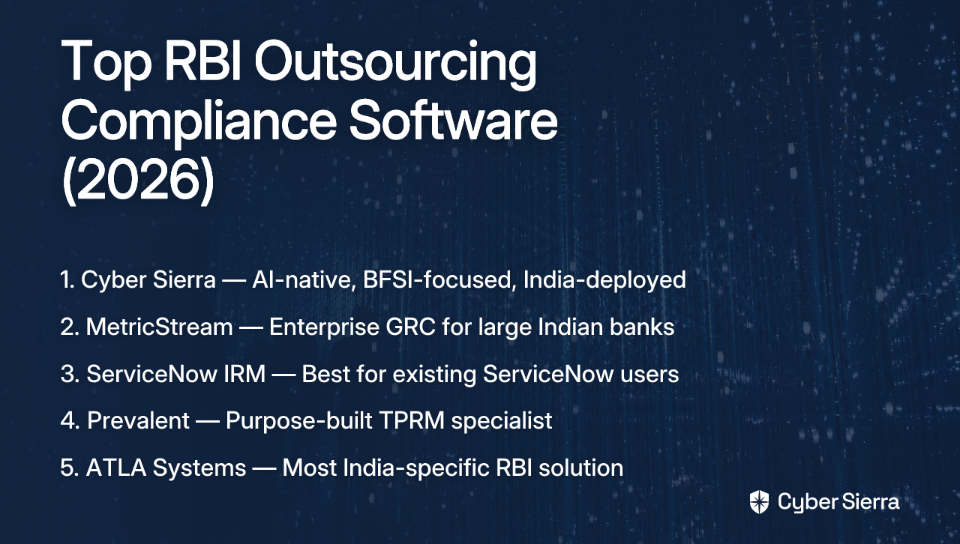
1. Cyber Sierra
RBI requirement coverage: End-to-end coverage of the full TPRM lifecycle mandated by the RBI, from initial risk tiering and pre-engagement due diligence through continuous monitoring and exit documentation.
India deployment: Bengaluru office providing on-the-ground support; deployment in the customer's own cloud environment (such as AWS Mumbai region) addresses data sovereignty requirements for Indian regulated entities.
AI capabilities: Specialised AI capabilities for assessment response review, evidence analysis, control break detection, and ongoing vendor risk monitoring.
Cyber Sierra's RBI outsourcing compliance software is built specifically for the continuous monitoring paradigm the RBI now mandates. Its AI capabilities go beyond routing questionnaires to actively interrogate vendor responses and compare claimed remediation against real-world external exposure data. This directly addresses the practitioner pain of needing to track remediated findings effectively rather than simply accepting a vendor's self-attestation.
For organizations concerned about GRC tool reliability, Cyber Sierra's Bengaluru office and active BFSI client base in India represent a committed, long-term market presence. The platform also connects to existing core banking and security tooling, helping teams work from a unified view rather than an isolated silo.
2. MetricStream
RBI requirement coverage: Broad GRC platform with dedicated third-party risk management modules that align to RBI requirements for vendor assessment, risk reporting, and policy management.
India deployment: Established and significant India presence, making it a familiar name in large Indian banking institutions.
AI capabilities: AI-powered risk intelligence for identifying and prioritising emerging third-party risks within the broader GRC context.
MetricStream is a legacy GRC leader built for the scale of large financial institutions. Its RBI compliance software for Indian banks covers many risk domains beyond TPRM, which can be an advantage for organizations seeking a single platform for enterprise-wide GRC.
The trade-off is platform complexity, as implementations typically require significant configuration and specialist consulting resources. MetricStream is frequently shortlisted by larger Indian banks, especially those already invested in the broader MetricStream ecosystem.
3. ServiceNow IRM
RBI requirement coverage: The Integrated Risk Management (IRM) module supports ongoing risk and compliance workflows, vendor risk processes, and policy management relevant to RBI IT outsourcing compliance.
India deployment: Strong enterprise market presence, particularly in organizations already running ServiceNow for IT Service Management.
AI capabilities: Native AI and workflow automation to manage compliance tasks and connect vendor risk data to broader operational processes on the ServiceNow platform.
ServiceNow IRM is the natural choice for institutions already operating the ServiceNow platform at scale. The key advantage is integrating vendor risk into a single platform alongside IT operations and incident management.
For banks where IT and compliance teams share the same ServiceNow environment, this RBI outsourcing compliance platform reduces context-switching and consolidates audit evidence in one place. It is a strong option for organizations prioritising ecosystem consolidation over TPRM specialisation.
4. Prevalent
RBI requirement coverage: As a dedicated TPRM platform, its features are sharply focused on the vendor risk lifecycle and align closely with the RBI's specific outsourcing requirements, including due diligence depth and continuous monitoring.
India deployment: Available to the Indian market for organizations requiring a best-of-breed, purpose-built TPRM solution rather than a broader GRC suite.
AI capabilities: AI-assisted automation to scale vendor risk assessments and flag anomalies during continuous monitoring cycles.
Prevalent's specialisation in TPRM is its defining strength as RBI outsourcing compliance software. Because the platform is not a generalised GRC tool, its feature depth for vendor lifecycle management is strong.
Indian banks that want a solution focused exclusively on meeting the RBI's third-party risk mandates, rather than a broader platform requiring significant customisation, will find Prevalent's scope-limited approach appealing.
5. ATLA Systems
RBI requirement coverage: The ComplyScore product is explicitly designed for RBI outsourcing compliance, with purpose-built workflows for Material Outsourcing Assessments (MOS), due diligence documentation, and concentration risk analysis.
India deployment: Local operational support for the Indian market, with integrations to Indian core banking systems including Finacle and Flexcube.
AI capabilities: AI-driven dynamic risk evaluation and real-time monitoring of service providers, with automated workflows for board and senior management approval processes.
ATLA Systems' ComplyScore is the most India-specific RBI TPRM software on this list. Its concentration risk module is particularly relevant for Indian banks managing exposure to large cloud providers or shared IT infrastructure vendors, a scenario the RBI directions specifically address.
According to ATLA Systems, the platform delivers four to six times faster vendor onboarding and a 40% reduction in audit preparation time. The native integrations with Finacle and Flexcube reduce implementation friction for Indian banks running these core banking platforms.
Make Your TPRM Program Audit-Proof
The RBI's 2023 directives have drawn a line in the sand: annual questionnaires and spreadsheet-based vendor tracking are officially obsolete. Staying compliant requires a fundamental shift, not just a new tool.
The path forward boils down to two key actions:
- Embrace continuous monitoring. You need real-time visibility into your vendors' security posture, not just a point-in-time snapshot from last year's assessment.
- Use AI-powered automation. Let software handle the heavy lifting of due diligence, evidence collection, and audit trail generation, freeing your team for strategic risk management.
Here’s a practical next step: identify your five most critical IT vendors. Can you prove their controls are effective today? If that question gives you pause, it’s time to see how a dedicated platform provides the answers.
When you’re ready to move from chasing vendors to managing risk, you can book a TPRM platform demo and see how to become audit-ready.
Frequently Asked Questions
What are the RBI's new rules for IT outsourcing?
The RBI's 2023 directions mandate a formal framework for managing third-party IT risks. Key requirements include a board-approved policy, a centralised risk-tiered vendor register, pre-engagement due diligence, continuous vendor monitoring, and a contractual right to audit service providers.
Why are spreadsheets no longer sufficient for RBI IT outsourcing compliance?
Spreadsheets cannot meet the RBI's requirement for "continuous monitoring" of vendor risk. Manual tools create dangerous gaps between reviews and cannot scale effectively. The RBI now expects real-time visibility into a vendor's risk posture, which requires a dedicated software platform to manage.
How does TPRM software help meet the RBI's continuous monitoring requirement?
TPRM software automates the ongoing collection and analysis of vendor risk data in near-real-time. AI-driven platforms can continuously scan a vendor's external security posture, review evidence documents, and track remediation efforts automatically, providing constant visibility that manual checks cannot.
What should I look for in RBI outsourcing compliance software?
Look for a platform that directly maps to RBI mandates, especially continuous monitoring and audit trail creation. Key features include a centralised vendor registry with risk-tiering, automated assessment workflows, AI-driven monitoring, and robust reporting. An India presence is also important for support.
Who must comply with the RBI Outsourcing of IT Services Directions 2023?
All Regulated Entities (REs) must comply with these directions. This includes all Indian commercial banks (including foreign banks in India), cooperative banks, Non-Banking Financial Companies (NBFCs), and payment system operators and providers.
What is a risk-tiered vendor register as required by the RBI?
It is a centralised inventory of all third-party IT vendors, categorised by their level of risk. This allows institutions to focus more intensive due diligence and monitoring on high-risk vendors whose failure would have the greatest operational or regulatory impact, ensuring resources are allocated effectively.
