



Transforming Security Operations with AI


Join thousands of professionals and get the latest insight on Compliance & Cybersecurity.
Executive Summary
You've built your security operations with the best tools available—a sophisticated stack of SIEM, SOAR, EDR, and compliance platforms. But as threats evolve at machine speed and data volumes explode, these traditional systems are showing their limitations. They're rigid, siloed, and fundamentally reactive. When a zero-day strikes or a compliance audit looms, your team is still scrambling to connect the dots manually.
This situation is all too familiar for CISOs today. The security landscape is rapidly transforming, characterized by increasingly sophisticated AI-driven threats, exponential data growth across distributed environments, and regulatory requirements that seem to multiply overnight. Traditional security tools—designed for a different era—struggle to keep pace, often leaving security teams overwhelmed by alerts, repetitive tasks, and disjointed workflows.
Enter agentic infrastructure: AI-powered, goal-oriented systems that work autonomously to protect your enterprise. Unlike conventional automation, these security agents don't just follow static playbooks—they understand context, adapt to changing conditions, and collaborate to achieve security objectives with minimal human intervention.
For CISOs navigating today's complex threat landscape, understanding and strategically implementing agentic infrastructure isn't just an innovation opportunity—it's becoming a competitive necessity. This guide explores how this emerging paradigm is transforming enterprise security and compliance, and why forward-thinking security leaders need to embrace it.
Understanding Security Agents and Agentic Infrastructure
What Are Security Agents?
Security agents are autonomous software entities designed to perform specific security tasks or make decisions based on their environment and objectives. Unlike traditional scripts or automation tools that follow predetermined paths, agents can:
- Process and interpret complex data from multiple sources
- Make context-aware decisions based on organizational policies
- Learn from previous actions and outcomes
- Coordinate with other agents and systems to achieve broader goals
The key distinction between agents and conventional automation lies in their level of autonomy and intelligence. While scripts and playbooks execute predefined instructions in response to specific triggers, agents can understand their objectives and determine the best path to achieve them in changing conditions.
Core Characteristics of Security Agents

Security agents are defined by several key attributes that separate them from traditional security automation:
- Autonomy: Agents can operate independently without constant human oversight, making decisions within defined parameters and taking initiative when needed.
- Context-Awareness: Unlike rules-based systems, agents understand the broader situation—they can interpret data in context, considering factors like user behavior patterns, business criticality, and threat intelligence.
- Adaptability: Agents can adjust their approach based on new information or changing circumstances, rather than following rigid workflows.
- Collaboration: Modern security agents can communicate and coordinate with other agents, creating a network of specialized entities working toward common security goals.
- Goal-Orientation: Rather than simply executing tasks, agents work toward specific security objectives, determining the best actions to take based on current conditions.
Agentic Infrastructure: The Foundation
Agentic infrastructure refers to the underlying architecture that enables security agents to function effectively within an enterprise environment. This includes:
- The computational resources agents need to operate
- Communication channels between agents and other systems
- Data access and processing capabilities
- Governance frameworks and safety mechanisms
- Integration points with existing security tools and workflows
Think of agentic infrastructure as the nervous system that allows your security agents to sense, process, communicate, and act within your environment. Without robust infrastructure, even the most sophisticated agents will be limited in their effectiveness.
Types of Agentic Infrastructure
Not all agentic systems are created equal. Organizations can implement various models based on their security needs, organizational structure, and maturity level. Here's a breakdown of the main architectural approaches:
| Type | Description | Best For | Key Considerations |
|---|---|---|---|
| Single-Agent Systems | Individual specialized agents deployed for specific security functions | • Organizations new to agents • Targeted use cases with clear boundaries • Quick deployment needs | • Limited scope • Easier to implement and govern • May create new silos |
| Multi-Agent Systems | Multiple specialized agents working together on different aspects of security | • Mid-sized enterprises • Organizations with diverse security needs • Environments with clear domain boundaries | • Requires coordination mechanisms • More complex to manage • Better coverage of security domains |
| Supervisor-Subagent Models | Hierarchical structure with high-level agents directing specialized subagents | • Large enterprises • Complex security operations • Environments needing centralized oversight | • Scalable and manageable • Clear chain of command • Potential single points of failure |
| Distributed Agent Mesh | Decentralized network of peer agents with dynamic relationships | • Advanced security operations • Organizations with mature AI capabilities • Highly dynamic environments | • Maximum resilience and adaptability • Complex to implement and govern • Requires sophisticated monitoring |
| Human-in-the-Loop Hybrid | Agents that collaborate with human analysts at key decision points | • Regulated industries • High-stakes security decisions • Early adoption stages | • Balances automation with oversight • Reduces but doesn't eliminate human workload • Clear escalation paths required |
Most organizations begin with single-agent or human-in-the-loop models for specific use cases, gradually evolving toward more sophisticated architectures as they gain experience and confidence in agentic systems.
Strategic Value for the CISO
The shift to agentic infrastructure represents more than just a technological upgrade—it's a strategic transformation that addresses many of the most pressing challenges facing security leaders today.
From Reactive to Proactive Security
Traditional security operations are inherently reactive: detect a threat, analyze it, then respond. This approach creates an asymmetric advantage for attackers, who need to succeed only once while defenders must be perfect every time.
Agentic infrastructure flips this paradigm by enabling systems that continuously hunt for threats, identify vulnerabilities before they're exploited, and adapt defenses in real time. Instead of waiting for alerts to trigger, security agents can:
- Proactively search for attack indicators across your environment
- Identify and prioritize vulnerabilities based on actual exploitation potential
- Automatically strengthen defenses around critical assets when threats emerge
- Learn from attempted attacks to improve future security posture
Accelerated Incident Response
When incidents do occur, the speed of response directly impacts their business impact. Security agents dramatically compress response timelines by:
- Automatically triaging and investigating alerts without analyst intervention
- Gathering relevant context from multiple sources in seconds rather than hours
- Initiating containment actions based on predefined parameters
- Documenting incident details for compliance and learning purposes
Organizations implementing agentic security systems report reductions in mean time to respond (MTTR) of 60-80% for common incident types, freeing their analysts to focus on more complex threats that truly require human expertise.
Always-On Compliance
Regulatory compliance has traditionally been a point-in-time exercise, with organizations scrambling to gather evidence and remediate issues before audits. Agentic infrastructure enables continuous compliance through:
- Ongoing monitoring of compliance-relevant systems and controls
- Automatic evidence collection and documentation
- Real-time identification of compliance drift
- Proactive remediation of control failures
This shift from periodic to continuous compliance not only reduces audit preparation costs but also significantly improves an organization's actual security posture by eliminating compliance gaps between assessment periods.
Analyst Augmentation and Retention
Security talent is scarce and burnout is common, with analysts overwhelmed by alert volumes and repetitive tasks. Security agents serve as "digital teammates" that:
- Handle routine investigations, reducing alert fatigue
- Provide relevant context for complex cases requiring human judgment
- Learn from analyst decisions to improve future automation
- Scale capabilities without proportional headcount increases
By automating the mundane aspects of security operations, organizations can both improve retention of valuable talent and enable those professionals to work at a higher level of expertise and impact.
Data-Driven Security Decisions
Security has always been data-intensive, but extracting actionable insights from that data has required significant manual effort. GenAI-powered agents can:
- Continuously analyze security data to identify patterns and trends
- Generate natural language summaries of complex security situations
- Provide evidence-based recommendations for security investments
- Quantify risk in business-relevant terms for executive communication
This capability transforms security from a cost center to a strategic business enabler, helping CISOs communicate more effectively with boards and business leaders.
Real-World Applications of Security Agents
Security agents are already transforming operations across the security lifecycle. Here are some of the most impactful applications being implemented today:
Automated Alert Triage and Investigation
One of the most immediate benefits of security agents is their ability to handle the overwhelming volume of security alerts generated by modern environments.
How it works: Triage agents ingest alerts from multiple security tools, enrich them with contextual data from across the environment, determine severity based on business context, and either resolve false positives automatically or escalate true threats with comprehensive context for human analysts.
Impact: Organizations implementing alert triage agents typically report 80-90% reductions in alerts requiring human attention, with corresponding improvements in mean time to detect (MTTD) for significant threats.
Intelligent Vulnerability Management
Traditional vulnerability management struggles with prioritization—simply scanning for CVEs results in thousands of vulnerabilities without clear guidance on what to fix first.
How it works: Vulnerability agents continuously monitor for new vulnerabilities, assess them against your specific environment (considering factors like accessibility, exploitability, and business impact), and generate prioritized remediation plans that optimize security improvement per unit of effort.
Impact: Organizations using agentic vulnerability management report reducing their effective attack surface by 70-80% while patching 50% fewer vulnerabilities—focusing effort where it truly matters rather than chasing vulnerability counts.
Third-Party Risk Surveillance
As supply chain attacks increase, monitoring the security posture of partners and vendors has become critical—but manual assessments are point-in-time and resource-intensive.
How it works: Risk surveillance agents continuously monitor external signals about third parties (including public breach data, dark web mentions, infrastructure changes, and security ratings), correlating this information with the specific services and access each third party has to your environment.
Impact: Organizations employing these agents detect potential third-party compromises an average of 26 days earlier than traditional methods, allowing for proactive mitigation before their own environments are affected.
Continuous Compliance Evidence Collection
Preparing for compliance audits typically involves weeks or months of manual evidence gathering across disparate systems.
How it works: Compliance agents map regulatory requirements to specific technical controls, continuously monitor those controls, automatically collect and organize evidence of proper functioning, identify control gaps, and maintain real-time compliance dashboards.
Impact: Organizations using compliance agents report 70% reductions in audit preparation time and a 90% decrease in findings during actual audits, as issues are identified and remediated continuously rather than discovered during audit preparation.
Behavior-Based Insider Threat Prevention
Traditional security tools struggle to detect insider threats because they often involve legitimate credentials performing actions that are technically permitted but inappropriate in context.
How it works: Insider threat agents establish behavioral baselines for users and entities, detecting anomalies that may indicate compromise or malicious intent. They consider factors like time of activity, peer group comparison, historical patterns, and business context to identify concerning behaviors without overwhelming security teams with false positives.
Impact: Organizations implementing these systems report detecting credential compromise an average of 72% faster than with traditional tools, while simultaneously reducing false positive investigations by over 80%.
Key Considerations Before Adopting Agentic Infrastructure
While the benefits of agentic infrastructure are compelling, successful implementation requires careful planning and consideration of several critical factors:
Defining Agent Scopes and Guardrails
Security agents require clear boundaries and constraints to operate safely and effectively. Before deployment, organizations should:
- Define specific objectives and success criteria for each agent
- Establish explicit limitations on what actions agents can take autonomously
- Implement technical guardrails that prevent agents from exceeding their authority
- Create monitoring mechanisms to detect unexpected agent behaviors
As one security leader noted in a recent discussion on securing AI agents: "These agents have access to tons of data and can automate tasks like never before. We need to adapt our usual security measures specifically for them."
Governance and Human Oversight
Even the most advanced agentic systems require appropriate human governance. Organizations should:
- Establish clear lines of accountability for agent actions
- Design appropriate human approval workflows for high-impact decisions
- Create transparent audit trails of agent activities and decisions
- Develop escalation procedures for exceptional situations
- Regularly review and update agent parameters based on performance
The most successful implementations follow a "trust but verify" approach, gradually expanding agent autonomy as confidence grows while maintaining appropriate oversight.
Data Quality and Integration Readiness
Agents are only as good as the data they can access. Before implementing agentic infrastructure, organizations should assess:
- The completeness and quality of security data across the environment
- Integration capabilities of existing security tools and data sources
- Data governance policies and access controls
- Real-time data availability for agent decision-making
Poor data quality or access is the most common reason for agent performance issues, making this assessment critical to success.
Organizational Readiness and Skills
Implementing agentic infrastructure represents a significant change in how security teams operate. Organizations should consider:
- Current team skills and experience with AI and automation
- Cultural readiness to trust and collaborate with autonomous systems
- Training needs for effective agent oversight and management
- Process changes required to incorporate agents into workflows
As noted in discussions about the CISO role, there's often a "scarcity of [security leaders] who possess both strategic acumen and technical expertise" to drive these transformations effectively. Addressing this gap through training or strategic hiring is essential.
Ethics and Explainability
As security decisions become more automated, ensuring those decisions are ethical and explainable becomes increasingly important. Organizations should:
- Implement mechanisms to explain agent decisions in human-understandable terms
- Test for and mitigate potential biases in agent behavior
- Consider the ethical implications of autonomous security actions
- Balance security effectiveness with privacy and civil liberties concerns
Getting Started: A Roadmap for CISOs
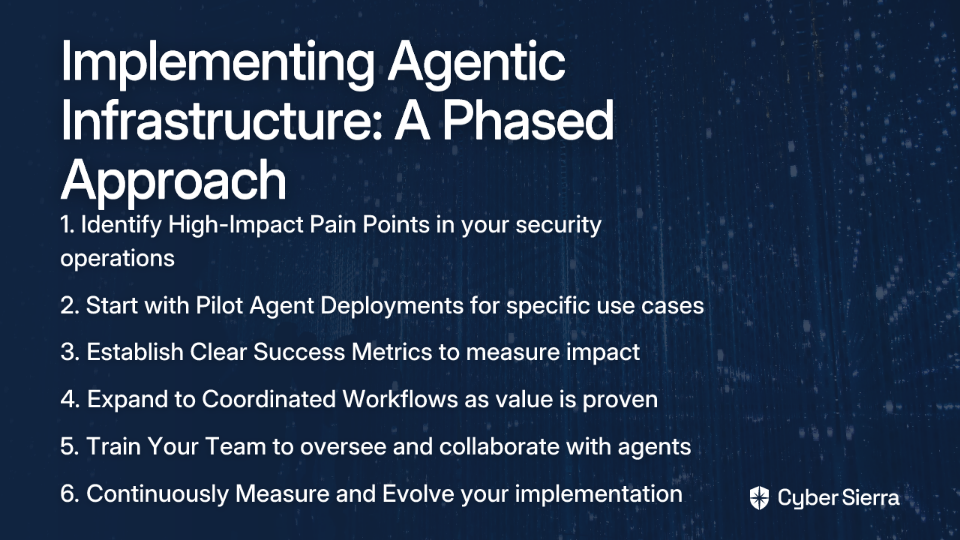
Implementing agentic infrastructure doesn't need to happen all at once. The most successful organizations follow a measured, iterative approach:
- Identify High-Impact Pain Points: Begin by assessing your current security operations to identify areas where agents could provide the greatest value. Look for:
- Processes with high manual workload but clear decision criteria
- Security functions suffering from significant backlogs
- Areas where speed of response directly impacts business outcomes
- Functions where skilled analysts spend time on routine tasks
- Start with Pilot Agent Deployments: Select 1-2 specific use cases for initial implementation, such as:
- Alert triage for a specific detection system
- Vulnerability prioritization for a defined asset group
- Compliance monitoring for a single regulatory framework
- Establish Clear Success Metrics: Define how you'll measure the impact of your agentic systems, such as:
- Reduction in alert handling time
- Improvement in mean time to detect/respond
- Decrease in analyst workload for routine tasks
- Compliance posture improvements
- Expand to Coordinated Workflows: As individual agents prove their value, begin connecting them into more sophisticated workflows where multiple agents collaborate on broader security objectives.
- Train Your Team: Invest in developing the skills your security team needs to effectively oversee, maintain, and collaborate with agentic systems.
- Continuously Measure and Evolve: Regularly assess both the technical performance and business impact of your agentic infrastructure, using these insights to guide further development.
Conclusion: Embracing the Future
Agentic infrastructure represents a fundamental shift in how we approach cybersecurity and compliance—moving from static, reactive systems to intelligent, adaptive defenses that operate at machine speed. For CISOs navigating today's complex threat landscape, this transition isn't just a technological evolution; it's a strategic necessity.
By understanding the capabilities, architectures, and applications of security agents, and by thoughtfully implementing them to address your organization's specific challenges, you can:
- Transform your security operations from reactive to proactive
- Enable your team to focus on truly strategic work
- Build security and compliance processes that scale with your business
- Demonstrate the business value of security investments
The organizations that thrive in the coming years will be those that successfully harness the power of agentic infrastructure to create security operations that are not just more efficient, but fundamentally more effective at protecting their critical assets and enabling business success.
Are you ready to begin your journey toward agentic security operations? Start by identifying your highest-impact use cases today, and take the first steps toward a more intelligent and adaptive security posture for your organization.
Frequently Asked Questions
What is agentic infrastructure in cybersecurity?
Agentic infrastructure in cybersecurity refers to the underlying architecture that enables AI-powered, goal-oriented software systems, known as security agents, to autonomously protect an enterprise. This infrastructure provides the necessary computational resources, communication channels, data access, and governance frameworks for these agents to operate effectively. It allows them to sense, process, communicate, and act within the enterprise environment to achieve security objectives with minimal human intervention.
How do security agents differ from traditional security automation?
Security agents differ from traditional security automation primarily in their autonomy, context-awareness, and adaptability. Unlike traditional automation that follows predefined scripts or playbooks, security agents can understand objectives, interpret complex data, make context-aware decisions, learn from outcomes, and adapt their actions to changing conditions. They are designed to achieve goals rather than just execute tasks.
Why should CISOs consider implementing agentic infrastructure?
CISOs should consider implementing agentic infrastructure because it offers a strategic transformation to address modern security challenges, moving from reactive to proactive security, accelerating incident response, and enabling continuous compliance. This technology helps manage exploding data volumes and sophisticated AI-driven threats by automating routine tasks, augmenting human analysts, and providing data-driven insights. It allows security teams to become more efficient, focus on strategic work, and better protect critical assets.
What are some common use cases for security agents in an enterprise?
Common use cases for security agents include automated alert triage and investigation, intelligent vulnerability management, third-party risk surveillance, continuous compliance evidence collection, and behavior-based insider threat prevention. For example, triage agents can significantly reduce the volume of alerts requiring human attention, while vulnerability agents can prioritize remediation efforts based on actual risk. Compliance agents can automate evidence gathering, and insider threat agents can detect anomalous behavior indicative of compromise.
What are the key challenges when adopting agentic infrastructure?
Key challenges when adopting agentic infrastructure include defining clear agent scopes and guardrails, establishing robust governance and human oversight, ensuring high-quality data and integration readiness, preparing the organization and team skills, and addressing ethics and explainability concerns. Successfully implementing agentic systems requires careful planning around these areas. For instance, agents need well-defined operational boundaries, and organizations must ensure they can trust and verify agent actions. Data quality is crucial for agent performance, and teams need to be trained to work with these new systems.
How can an organization start implementing agentic infrastructure?
An organization can start implementing agentic infrastructure by first identifying high-impact pain points, then beginning with pilot deployments for specific use cases, and establishing clear success metrics. A measured, iterative approach is recommended. This involves selecting initial areas where agents can provide significant value, such as alert triage or vulnerability prioritization. As these pilots demonstrate success, organizations can expand to more coordinated workflows, train their teams, and continuously measure and evolve their agentic systems.
Can agentic systems completely replace human security analysts?
No, agentic systems are not intended to completely replace human security analysts but rather to augment and empower them. Security agents excel at handling routine, high-volume tasks, reducing alert fatigue, and providing context for complex investigations. This frees up human analysts to focus on more strategic, complex threats that require human intuition, critical thinking, and nuanced judgment. The most effective models often involve a human-in-the-loop hybrid approach, where agents and humans collaborate.
