
How to Measure Cyber Resilience Maturity in 2025



Join thousands of professionals and get the latest insight on Compliance & Cybersecurity.
You've implemented security controls, conducted risk assessments, and established incident response plans. Yet, as cyber threats grow increasingly sophisticated, a persistent question remains: "How resilient is my organization, really?" With 72% of organizations reporting increased cyber risks in 2025 and 35% of small businesses admitting their cyber resilience is insufficient, this question has never been more critical.
The challenge? There's no single universal standard for measuring cyber resilience maturity. As one security professional recently lamented, "Is there a standard to assess cyber resilience? Where do I even start?" The maze of frameworks—some prescriptive, some risk-based—can be overwhelming.
This guide will demystify cyber resilience measurement in 2025, breaking down key frameworks, providing a step-by-step assessment process, and explaining how to evolve from periodic checks to continuous resilience monitoring.
Understanding Cyber Maturity: The Core Components
Before diving into measurement frameworks, let's clarify what we're measuring. Cyber resilience isn't just about preventing attacks—it's about an organization's "ability to minimize the impact of significant cyber incidents on its primary goals and objectives," according to the World Economic Forum. The focus is shifting from "stopping every attack" to "surviving any attack."
A cyber maturity assessment is an in-depth evaluation of this ability, yielding a maturity score that indicates where your organization stands. SentinelOne research reveals only 5% of organizations currently achieve the highest maturity level.
Seven core components must be measured in any comprehensive assessment:
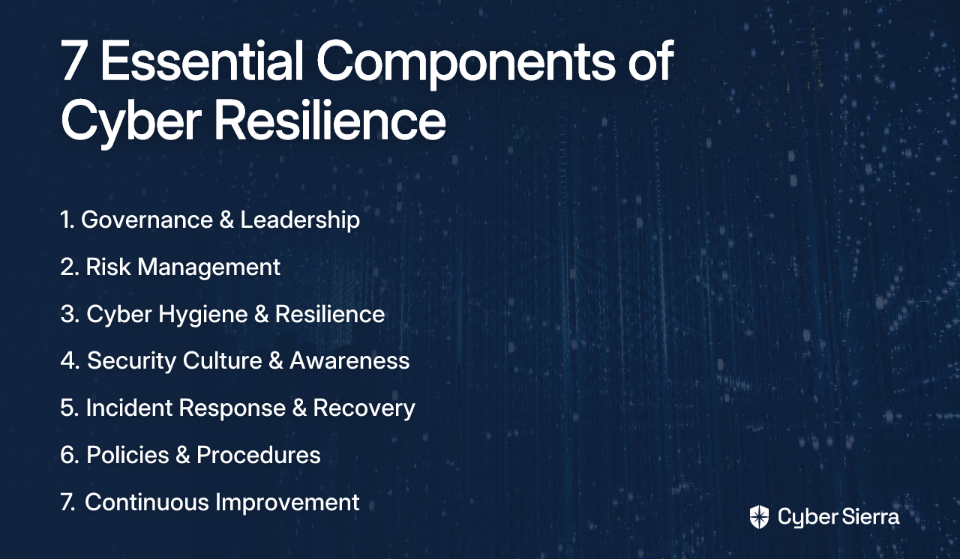
- Governance and Leadership: Clear objectives, defined roles, and accountability for cybersecurity at all levels.
- Risk Management: Processes to recognize, assess, and prioritize risks.
- Cyber Hygiene and Resilience: Fundamental practices like patch management and access controls.
- Security Culture and Awareness: Training and education to minimize human error.
- Incident Response and Recovery: A clear, tested strategy for detection, containment, and recovery.
- Policies and Procedures: Documented security expectations and best practices.
- Continuous Improvement: A feedback loop to regularly assess and adapt the cybersecurity posture.
Navigating the Maze of Cyber Resilience Frameworks
"There are a number of standards that can be used," notes a cybersecurity professional in online discussions. This abundance of options creates confusion. To simplify, we can categorize the major frameworks into three types:
Cyber Maturity Models (Focus on Hygiene & Controls)
- NIST Cybersecurity Framework: A voluntary, risk-based approach with five core functions: Identify, Protect, Detect, Respond, and Recover. It's an excellent starting point for most organizations due to its comprehensive yet flexible nature. Learn more about NIST CSF.
- ISO/IEC 27001: An international standard for managing information security, focusing on a continuous improvement loop through an Information Security Management System (ISMS). Learn more about ISO 27001.
- CIS Controls: A prioritized, prescriptive list of security measures categorized as foundational, basic, and organizational. Particularly useful for organizations seeking specific, actionable controls. Explore CIS Controls.
Threat-Led Testing Frameworks (Focus on Adversarial Simulation)
- MITRE ATT&CK: A globally-accessible knowledge base of adversary tactics and techniques based on real-world observations. Excellent for organizations wanting to test resilience against specific threat actors. Learn more about MITRE ATT&CK.
- CBEST: A framework for delivering controlled, bespoke, intelligence-led cyber security tests for critical infrastructure. Particularly relevant for financial institutions. Learn more about CBEST.
Operational & Quantitative Risk Frameworks (Focus on Recovery & Financial Impact)
- Basel Principles: Focus on operational resilience and recovery planning, particularly relevant for financial institutions. Learn more about Basel principles.
- FAIR Framework: A quantitative model to measure and manage cyber risks in financial terms, helping organizations understand the ROI of security investments. Learn more about FAIR.
Recommendation: While all frameworks have value, the NIST Cybersecurity Framework provides a flexible and comprehensive foundation for most organizations to begin their maturity assessment journey. It's widely adopted, regularly updated, and integrates well with other frameworks as your program matures.
A 5-Step Guide to Conducting Your Cyber Resilience Assessment
Now that we understand what to measure and which frameworks to consider, let's walk through a practical approach to assessing your organization's cyber resilience maturity:
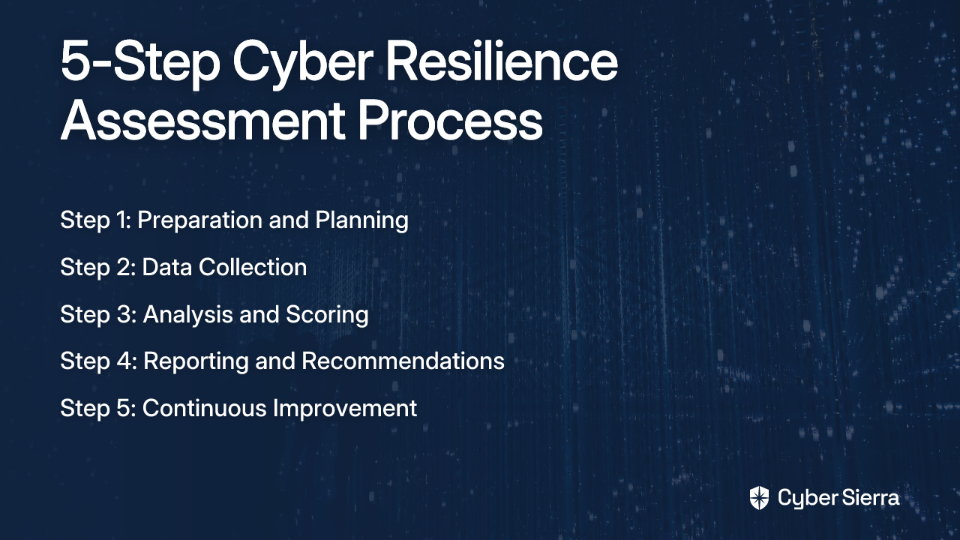
Step 1: Preparation and Planning
Begin by identifying key departments, systems, and assets to include in the assessment. Choose a suitable framework from the options above based on your industry, size, and specific needs. Inform stakeholders and clearly define the assessment's objectives—whether it's meeting regulatory requirements, securing cyber insurance, or identifying improvement opportunities.
Step 2: Data Collection
This critical phase involves gathering evidence through interviews, surveys, document reviews, and infrastructure assessments. The challenge? Manual evidence gathering is time-consuming and prone to gaps.
Modern solutions like Cyber Sierra's Governance, Risk & Compliance (GRC) module can automate data collection, risk assessments, and evidence tracking for frameworks like SOC2 and ISO 27001. This automation significantly reduces manual effort, improves accuracy, and makes enterprises audit-ready faster.
Step 3: Analysis and Scoring - Defining Your Maturity Level
Once data is collected, map it against your chosen framework to determine your current maturity level. According to the Pacific Northwest National Laboratory, most maturity models follow five progressive stages:
- Level 1: Initial: Ad hoc responses, limited awareness, reactive approach
- Level 2: Developing: Basic controls and incident response plans being implemented
- Level 3: Defined: Established processes for risk management; regular training in place
- Level 4: Managed: Proactive risk management and continuous improvement integrated across the organization
- Level 5: Optimizing: Advanced threat intelligence and adaptive, fully integrated resilience strategies
Step 4: Reporting and Recommendations
A comprehensive assessment report should go beyond a simple score. It should include your current maturity level, identified strengths and weaknesses, and prioritized, actionable recommendations for improvement. This report becomes the roadmap for your cyber resilience enhancement strategy.
Step 5: Fostering a Culture of Continuous Improvement
Cyber resilience is a continuous process, not a one-time project. The assessment results should feed into a strategic plan for ongoing enhancement, with regular reassessments to track progress and adjust course as needed.
The Future is Continuous: Moving Beyond Point-in-Time Assessments
Traditional cyber resilience assessments face a fundamental flaw: they provide only a snapshot in time, while threats and environments evolve continuously. Organizations aiming for higher maturity levels (Managed and Optimizing) need to move beyond periodic assessments.
Continuous Control Monitoring (CCM) has emerged as the solution. CCM is the process of using technology to continuously test and validate the effectiveness of security controls in near real-time, rather than through annual or quarterly assessments.
Platforms like Cyber Sierra's CCM module transform security from periodic checks to continuous, automated monitoring. Key capabilities include:
- Central Controls Repository: Building a single source of truth for all controls with near real-time updates
- Real-time Posture Visibility: Continuously monitoring security controls and detecting exceptions or anomalies as they happen
- Automated Testing & Validation: Automating control checks, streamlining compliance and freeing up security teams
- Actionable Risk Intelligence: Delivering data-driven insights to prioritize remediation efforts effectively
This continuous approach allows organizations to detect and respond to control failures before they can be exploited, significantly enhancing resilience.
Overcoming Common Hurdles on Your Maturity Journey
As you work to enhance your cyber resilience maturity, you'll likely encounter several challenges:
- The Constantly Evolving Threat Landscape: Threats change faster than traditional assessment cycles can adapt.
- Aligning Cybersecurity with Business Objectives: Security must support business goals, not hinder them.
- Resource Constraints: Limited budget, staffing, and expertise can impede progress.
- Cultural and Organizational Barriers: Resistance to change can slow implementation of new practices.
To overcome these challenges:
- Make Assessment an Ongoing Program: Treat maturity assessment as a continuous process, not a periodic event.
- Invest in Employee Training & Awareness: A strong security culture is non-negotiable. Tools like Cyber Sierra's Employee Security Training can build a stronger "human firewall" through interactive training and simulated phishing campaigns.
- Leverage Automation & AI: Use technology to scale efforts and gain deeper insights, particularly for continuous monitoring and threat detection.
Conclusion
Measuring cyber resilience maturity in 2025 requires a strategic, comprehensive approach. By understanding the core components, selecting appropriate frameworks, following a systematic assessment process, and embracing continuous monitoring, organizations can build genuine resilience against an ever-evolving threat landscape.
The critical shift is from static, periodic assessments to a dynamic, continuous approach powered by automation and real-time monitoring. This is the hallmark of a truly mature and resilient organization in today's threat landscape.
Take the first step by using this guide to initiate your own cyber resilience maturity assessment—your business continuity may depend on it.
Frequently Asked Questions
What is a cyber resilience maturity assessment?
A cyber resilience maturity assessment is a thorough evaluation of an organization's ability to withstand and recover from significant cyber incidents. It measures key components like governance, risk management, incident response, and security culture against a defined framework. The result is a maturity score (typically on a scale of 1 to 5) that helps organizations understand their current capabilities and identify areas for improvement, moving from a reactive to a proactive and adaptive security posture.
Why is it important to measure cyber resilience?
Measuring cyber resilience is important because it provides a clear, objective understanding of your organization's ability to survive a cyber attack, moving beyond simply cataloging security controls. It helps prioritize security investments, meet regulatory and compliance requirements, secure better cyber insurance terms, and build a strategic roadmap for continuous improvement. Without measurement, it's impossible to know if your security efforts are truly effective against sophisticated threats.
How do I choose the best cyber resilience framework for my organization?
The best cyber resilience framework depends on your organization's industry, size, regulatory requirements, and specific goals. For most organizations, the NIST Cybersecurity Framework is an excellent starting point due to its flexibility and comprehensiveness. Financial institutions might lean towards CBEST or Basel Principles. Organizations looking for prescriptive controls can benefit from CIS Controls, while those focused on quantitative risk might use the FAIR framework. The key is to select a framework that aligns with your business context and provides actionable guidance.
What is the difference between a point-in-time assessment and continuous monitoring?
A point-in-time assessment is a periodic snapshot of your security posture, while continuous monitoring provides a real-time, ongoing view of your security controls. Traditional assessments, often done annually or quarterly, can quickly become outdated as threats and systems change. Continuous Control Monitoring (CCM) uses automation to constantly test and validate security controls, allowing you to detect and remediate weaknesses as they arise, rather than waiting for the next scheduled audit.
How can small businesses improve their cyber resilience?
Small businesses can improve their cyber resilience by focusing on foundational security practices and adopting a scalable framework. Start with the basics covered in frameworks like the CIS Controls, which prioritize essential actions like patch management, access control, and employee security training. Leveraging automated tools for GRC and continuous monitoring can help manage security effectively, even with a smaller team.
What are the biggest challenges to improving cyber resilience?
The biggest challenges include the rapidly evolving threat landscape, resource constraints (budget and staff), aligning security with business goals, and overcoming organizational resistance to change. To overcome these hurdles, organizations should treat resilience as an ongoing program, not a one-off project. Investing in automation, fostering a strong security culture through continuous employee training, and demonstrating the business value of resilience are key strategies for success.