What Makes Varonis Worth $200K+ for Compliance Teams?

Join thousands of professionals and get the latest insight on Compliance & Cybersecurity.
You've set up your security program. You've survived your first SOC2 and ISO27001 audits. But now you're faced with the reality that maintaining compliance isn't a one-time achievement—it's an ongoing battle.
"I'd rather have these reports generated every day rather than only when the auditors come," laments one cybersecurity professional on Reddit, echoing a common frustration among compliance teams everywhere.
If you're responsible for your organization's compliance posture, you've likely encountered high-end data security platforms like Varonis—and experienced sticker shock at their $200,000+ price tags. As one Reddit user put it, "Varonis is expensive, but a fantastic tool for compliance, security, and governance."
This begs the question: What exactly makes these premium compliance tools worth their hefty price tags? Is the ROI truly there, or are there more cost-effective alternatives that can deliver similar results for your GRC (Governance, Risk Management, and Compliance) program?
Let's dissect what you're really paying for with a solution like Varonis, and determine if such an investment makes sense for your organization's compliance needs.
The Modern Compliance Minefield: Why Basic Tools Fall Short
Today's enterprise environments are more complex than ever—a chaotic mix of on-premises systems, cloud infrastructure, and SaaS applications housing sensitive data in structured and unstructured formats. This complexity creates an expanding attack surface that basic security tools struggle to address effectively.
When it comes to compliance frameworks like SOC2, ISO27001, GDPR, and HIPAA, the landscape has evolved beyond simple checkbox exercises:
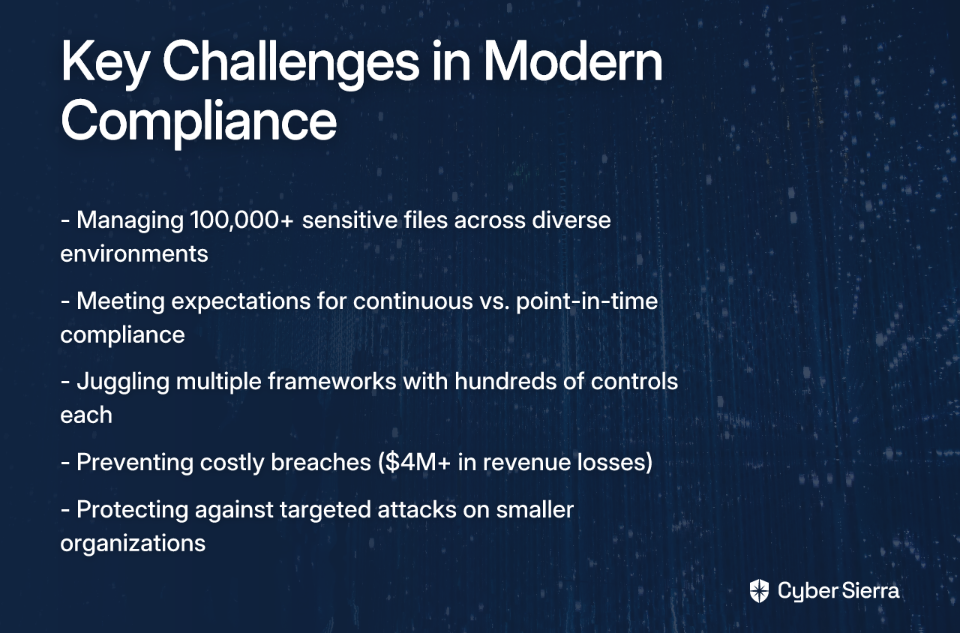
- Volume challenge: The average enterprise manages over 100,000 sensitive files, many containing regulated data that requires protection
- Continuous monitoring: Point-in-time assessments have given way to expectations of continuous compliance
- Multi-framework juggling: Most organizations must simultaneously maintain compliance with multiple frameworks, each with hundreds of controls and requirements
The stakes couldn't be higher. According to research, businesses can lose up to $4 million in revenue and face additional $5 million in operational disruptions from a single data breach. For smaller organizations, the impact can be existential—despite making up 43% of all cyberattack targets.
This explains why traditional approaches to compliance—policy documents without enforcement mechanisms, manual reviews without automation, and basic file scanning without classification intelligence—simply don't cut it anymore.
Deconstructing Varonis: A Deep Dive into its Core Capabilities
Varonis has established itself as a premium player in the data security and compliance space. Its core value proposition revolves around discovering, classifying, monitoring, and protecting sensitive data, particularly unstructured data (documents, spreadsheets, presentations, etc.) that often contains your organization's most valuable and regulated information.
Let's break down the key features that command Varonis's premium price:
1. Automated Data Classification and Discovery
At its foundation, Varonis employs sophisticated algorithms to automatically discover, classify, and label sensitive data across your environment. This isn't just basic pattern matching—it uses AI-driven context analysis to understand data relationships and sensitivity levels.
The platform can identify:
- Regulated data (PII, PHI, PCI)
- Intellectual property
- Financial records
- Strategic documents
- Customer information
This automated discovery process runs continuously, ensuring new data is classified as it's created. For compliance teams, this addresses a fundamental challenge: you can't protect what you don't know exists.
2. Overexposure Analysis and Remediation
Once sensitive data is identified, Varonis analyzes who has access to it through a comprehensive permissions analysis engine. This capability:
- Maps every user's access rights across the organization
- Identifies excessive permissions and potential access violations
- Quantifies your "blast radius" (how much damage could be done if a single account is compromised)
- Automates the implementation of least privilege principles
For compliance frameworks that require strict access control (virtually all of them), this automated approach to enforcing least privilege eliminates countless manual hours of permissions review.
3. User Behavior Analytics and Threat Detection
Varonis continuously monitors user interactions with sensitive data, establishing baselines of normal behavior and flagging anomalies that could indicate insider threats, compromised accounts, or ransomware activity.
This capability directly supports compliance requirements around:
- Monitoring system activity (SOC2 CC7.2)
- Detecting unauthorized access (ISO27001 A.9.4.1)
- Identifying unusual activity patterns (PCI DSS 10.6)
The SIEM (Security Information and Event Management) capabilities extend beyond simple logging to provide context-aware security intelligence about who is accessing what data and whether that access is appropriate.
4. Automated Compliance Reporting and Documentation
Perhaps most valuable to compliance teams is Varonis's ability to automatically generate evidence and reports specifically designed for auditors. The platform includes:
- Pre-built reports for major frameworks (SOC2, ISO27001, GDPR, HIPAA, PCI DSS)
- Automated data privacy governance documentation
- Data Subject Access Request (DSAR) fulfillment tools
- Evidence of continuous control monitoring
As one Reddit user noted, these automated audit reports can be "generated every day rather than only when the auditors come," creating a continuous compliance posture instead of periodic scrambles.
5. Data Security Posture Management (DSPM)
Varonis has evolved to offer comprehensive DSPM capabilities that automatically:
- Identify security gaps and misconfigurations
- Prioritize risks based on potential impact
- Remediate issues through automated workflows
- Provide compliance posture visualization through intuitive dashboards
This proactive approach represents a significant advancement over reactive security measures, especially for compliance teams trying to maintain continuous adherence to complex frameworks.
The ROI of a Premium Compliance Tool: Is it Worth $200K+?
When evaluating the return on a substantial investment like Varonis, compliance leaders need to look beyond the sticker price and consider both quantitative and qualitative benefits:
Risk Reduction and Breach Prevention
The primary ROI comes from preventing data breaches and compliance violations:
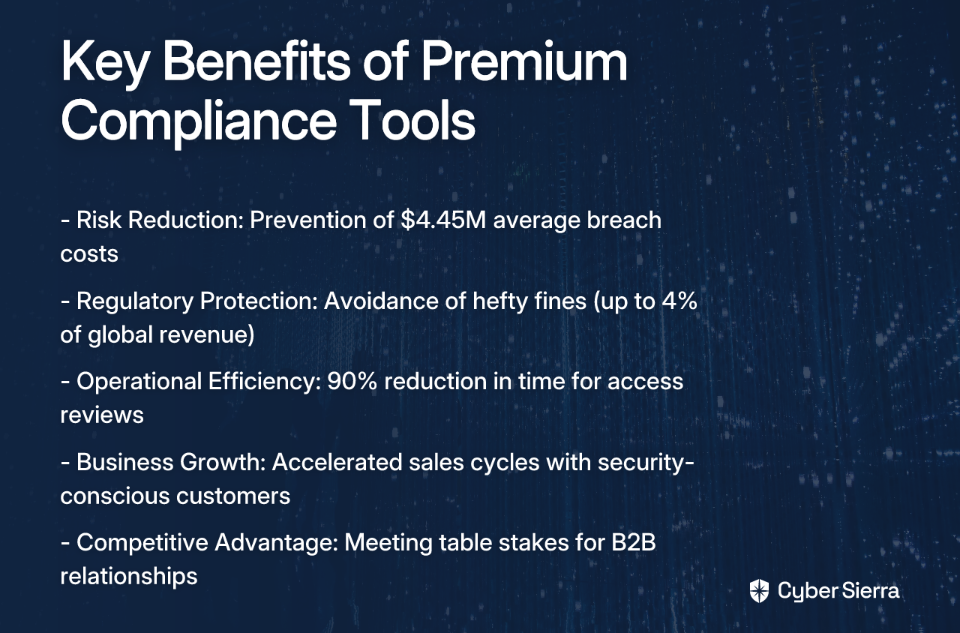
- Average cost of a data breach: $4.45 million (IBM Cost of Data Breach Report)
- Regulatory fines: Up to 4% of global revenue under GDPR
- Legal costs and settlements: Often in the millions for serious breaches
- Reputation damage: Potentially incalculable long-term impact
For organizations managing highly sensitive data or operating in regulated industries, a single prevented breach can justify the entire investment.
Operational Efficiency Gains
Premium compliance tools dramatically reduce manual effort:
- Automated data discovery eliminates the need for manual data inventories
- Continuous monitoring replaces periodic manual reviews
- Automated reporting saves hundreds of hours during audit cycles
- Self-service capabilities reduce the burden on IT and security teams
One Varonis customer reported reducing the time required for access reviews by 90%, freeing up their team for more strategic tasks.
Business Growth Enablement
Strong compliance isn't just a cost center—it's increasingly a business differentiator:
- 72% of companies complete audits specifically to secure new business
- Demonstrable compliance capabilities accelerate sales cycles with security-conscious customers
- SOC2 and ISO27001 certifications have become table stakes for B2B software companies
For organizations that leverage compliance as a competitive advantage, the ROI extends directly to the top line.
Varonis vs. Alternatives: Evaluating Your Options
While Varonis offers comprehensive capabilities, it's worth examining alternatives across the price spectrum:
Enterprise Alternatives
Other enterprise data security platforms like CyberArk, Netwrix, and SailPoint offer similar features but with different emphases:
- Cyera: Offers deep classification capabilities but more limited remediation options
- Sentra: Focuses on data discovery with less endpoint remediation
- Microsoft Purview: Provides basic data governance at a lower price point but requires significant customization
Mid-Market Options
Organizations with more modest requirements might consider:
- Spirion: Offers data discovery and classification at a lower price point
- BigID: Provides strong data discovery with less emphasis on behavioral analytics
- Egnyte: Combines file management with basic data governance features
Open-Source and Low-Cost Approaches
For organizations with limited budgets, some options include:
- Wazuh: Offers Security Compliance Assessment (SCA) features but requires significant configuration
- OpenCTI: Provides threat intelligence with some compliance capabilities
- DIY approach: Combining basic tools with custom scripts and manual processes
The right choice depends on your specific needs, technical maturity, and risk profile. As one Reddit user observed, "These compliance tools seem to be not tailored specifically to the compliance monitoring needs" of every organization.
Beyond a Single Tool: Building a Holistic GRC Program
While Varonis excels at data-centric security, a complete GRC program requires broader capabilities. Industry experts increasingly recommend "a layered approach to data security by integrating multiple solutions" for a holistic security and compliance posture.
This is where no-code platforms like Cyber Sierra can complement a data security tool like Varonis. While Varonis focuses on securing your sensitive data, Cyber Sierra provides:
- Continuous Control Monitoring (CCM): Automated testing and validation of controls across your entire security program, not just data security
- Governance, Risk & Compliance (GRC): Management of multiple compliance frameworks from a central repository
- Third-Party Risk Management (TPRM): Assessment and monitoring of vendor security postures
This combination creates a comprehensive solution that addresses both data security and the broader compliance landscape.
For example, Cyber Sierra's CCM module can automate evidence collection for non-data controls, providing a single source of truth for your entire compliance program. Its GRC capabilities help manage policy documents and streamline audits across multiple frameworks simultaneously.
Is Varonis Worth It for Your Team?
The answer depends on your organization's specific circumstances:
Varonis may be worth the investment if:
- You manage large volumes of sensitive, unstructured data
- You operate in heavily regulated industries (finance, healthcare, government)
- You face sophisticated threats including insider risks
- You need to maintain compliance with multiple overlapping frameworks
- Your team is stretched thin and needs significant automation
You might consider alternatives if:
- Your data landscape is relatively simple or mostly structured
- You have a smaller attack surface with fewer users and permissions
- You face a single dominant compliance framework
- You have specialized technical resources for customizing solutions
- Your budget constraints are severe
For organizations that fit the first profile, the $200K+ investment in Varonis often delivers substantial returns through risk reduction, operational efficiency, and business enablement.
Conclusion: The Future of Compliance Automation
The compliance landscape continues to evolve, with increasing expectations for continuous monitoring, automated controls, and comprehensive reporting. Tools like Varonis represent the leading edge of this evolution, offering unprecedented visibility and automation for data security compliance.
The most effective approach for modern compliance teams isn't about finding a single magic bullet, but rather integrating best-in-class tools for data security (like Varonis) with comprehensive platforms for continuous compliance management and GRC (like Cyber Sierra).
By combining these capabilities, organizations can build a resilient, efficient, and truly continuous compliance framework that not only satisfies auditors but also builds trust with customers and partners.
As compliance requirements grow more complex and cyber threats more sophisticated, the question may shift from "Can we afford a premium compliance tool?" to "Can we afford not to have one?"
Frequently Asked Questions
What does a data security platform like Varonis actually do?
A data security platform like Varonis automatically discovers, classifies, and protects sensitive data, analyzes user access and behavior, and helps automate compliance reporting. It specializes in securing unstructured data (like documents and spreadsheets) by identifying what's sensitive, who has access to it, and flagging unusual activity. This helps enforce principles like least privilege and provides continuous monitoring required by many compliance frameworks.
Why are premium compliance tools like Varonis so expensive?
Premium compliance tools like Varonis are expensive due to their advanced automation, continuous monitoring capabilities, sophisticated AI-driven analytics, and comprehensive features that replace significant manual effort. You're paying for a platform that can automatically classify massive volumes of data, analyze complex permissions, detect subtle threats through user behavior analytics, and generate audit-ready reports on demand. This level of automation and intelligence significantly reduces operational costs and the risk of costly data breaches.
What is the primary ROI of investing in a tool like Varonis?
The primary ROI comes from three key areas: reducing the risk of costly data breaches and regulatory fines, gaining significant operational efficiency by automating manual tasks, and enabling business growth by demonstrating a strong security posture. By preventing a single major data breach (which can cost millions), the tool can pay for itself. Furthermore, it saves hundreds of hours for compliance and security teams during audits and daily operations, and a strong compliance record can be a key differentiator that helps win new business.
How does Varonis help with specific audits like SOC 2 or ISO 27001?
Varonis directly supports audits like SOC 2 and ISO 27001 by providing automated evidence for key controls related to access management, activity monitoring, and data classification. It offers pre-built reports mapped to specific requirements, such as monitoring system activity (SOC 2 CC7.2) or detecting unauthorized access (ISO 27001 A.9.4.1). This continuous evidence collection transforms audit preparation from a periodic scramble into a state of continuous readiness.
When should my organization consider alternatives to Varonis?
You should consider alternatives to Varonis if your organization has a relatively simple data environment, a smaller attack surface, limited budget, or the in-house technical expertise to customize open-source solutions. If your data is mostly structured, you have few users, and you only need to comply with one framework, a full-scale platform like Varonis might be overkill. Mid-market or open-source tools could provide the necessary functionality at a lower cost, though they often require more manual configuration and integration effort.
Is a data security tool like Varonis sufficient for our entire GRC program?
No, a data security tool like Varonis is a critical component but is not typically sufficient for an entire GRC program on its own. Varonis excels at data-centric security and compliance. However, a complete GRC program also requires managing policies, tracking risks, monitoring non-data-related security controls, and managing third-party vendor risk. For a holistic approach, it's best to integrate a data security platform with a comprehensive GRC and Continuous Control Monitoring (CCM) platform like Cyber Sierra.