



7 Vendor Risk Management Steps to Meet PDPA Compliance


Join thousands of professionals and get the latest insight on Compliance & Cybersecurity.
Summary
- Under Singapore's Personal Data Protection Act (PDPA), your organization is accountable for data breaches that occur at third-party vendors, making a formal vendor risk program mandatory.
- An effective program moves beyond manual spreadsheets and follows a structured approach, including creating a vendor inventory, tiering risks, and enforcing contractual controls.
- A critical shift from legacy methods is adopting continuous monitoring for a real-time view of vendor security, as point-in-time annual reviews are no longer sufficient.
- Automating vendor assessments, monitoring, and compliance documentation with a TPRM platform streamlines the entire process and ensures you are always audit-ready.
Here's a regulatory reality many Singapore organizations discover the hard way: under the Personal Data Protection Act, your accountability for personal data doesn't stop at your own firewall. If your payroll processor, cloud hosting vendor, or CRM provider suffers a breach involving your customers' data, the Personal Data Protection Commission will still be looking at you.
And yet, trying to manage this exposure with manual spreadsheets and inconsistent questionnaires often leads to frustration and compliance gaps. Without a structured program, even expensive tools fail. What organizations need is a deliberate, sequential framework that builds the right foundations first — and then automates for scale.
This guide gives you exactly that: a 7-step vendor risk management program designed to meet PDPA obligations, close the compliance gaps that auditors love to find, and move your team from reactive fire-fighting to proactive, continuous risk management.
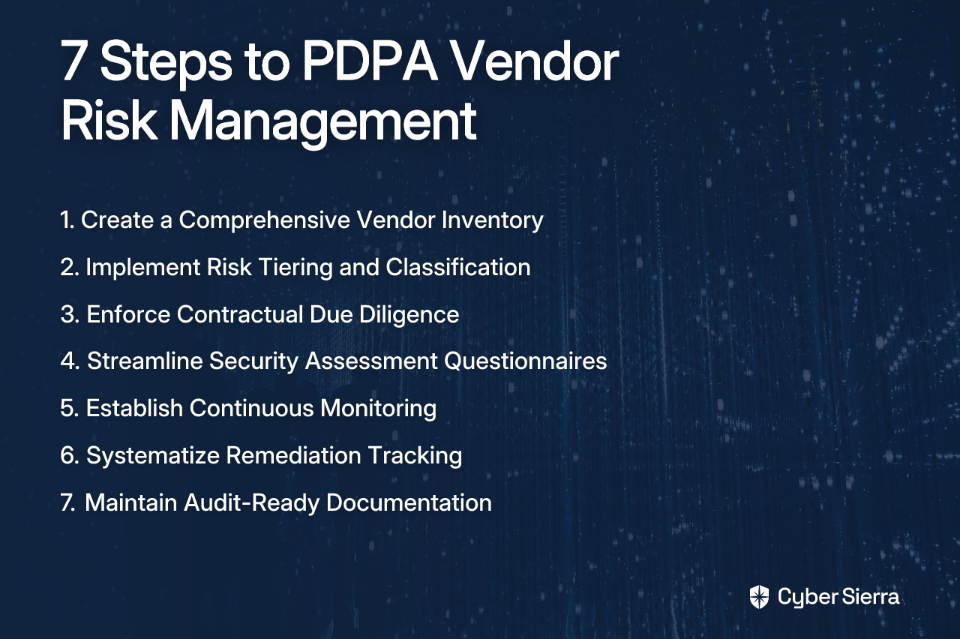
Step 1: Create a Comprehensive Vendor Inventory
The foundation of any vendor risk management PDPA program is knowing who your vendors actually are.
Before you can assess risk, you need a complete, centralized list of every third party that accesses, processes, stores, or transmits personal data on your behalf — cloud providers, SaaS tools, payment processors, HR platforms, and beyond.
Manual/Legacy Approach: Most teams start with a spreadsheet, but as one practitioner noted on Reddit, this often leads to frustration: "But Excel? Getting the data from that or comparing suppliers — that is pain." The problem is that these lists go stale almost immediately. New vendors get onboarded without being logged, contracts lapse, and shadow IT brings in unapproved tools. The list you have is never the list you actually have.
Automated Approach: Tools like Cyber Sierra's TPRM platform provide a dynamic, centralized vendor registry that streamlines onboarding, captures key metadata (data types accessed, contract status, risk tier), and keeps the inventory current and accessible across teams.
📋 Mapping to PDPA Obligations
Accountability Obligation — Under the PDPA, organizations must be accountable for all personal data in their possession or under their control, including data held by data intermediaries (vendors). You cannot demonstrate accountability for data you cannot see. A documented vendor inventory is the foundation of this obligation. See the PDPC's Advisory Guidelines for guidance on the scope of accountability.
Step 2: Implement Risk Tiering and Classification
Not every vendor deserves the same scrutiny. Risk tiering lets you focus your limited resources where exposure is highest.
A payroll provider with access to 10,000 employee records poses a fundamentally different risk than a catering company you use for office events. Treating them identically wastes effort on low-risk vendors while leaving critical ones under-examined.
Manual/Legacy Approach: Ad-hoc risk labels ("low," "medium," "high") applied inconsistently and without documented criteria. This leads to subjective assessments and an uncomfortable reality: your highest-risk vendors may be getting the lightest scrutiny simply because nobody formally defined what "high risk" means.
Automated Approach: Adopt a structured risk scoring methodology based on factors like volume and sensitivity of personal data accessed, depth of system integration, business criticality, and geographic jurisdiction of the vendor. As one practitioner noted in community discussions, vendors are "tiered by risk (low, medium, high/critical), which determines how much due diligence is required." For large providers, independent assurance like SOC 2 reports can supplement or replace lengthy questionnaires.
📋 Mapping to PDPA Obligations
Protection Obligation (Section 24, PDPA) — The Act requires organizations to make "reasonable security arrangements" to protect personal data. A risk-tiered approach is central to demonstrating reasonableness — it shows that you've calibrated your due diligence based on actual exposure, not treated all vendors as equivalent.
Step 3: Enforce Contractual Due Diligence
Contracts are your primary legal instrument for transferring PDPA obligations to your vendors. Without the right clauses, you're exposed.
This is where many organizations stumble. They onboard vendors quickly, sign standard terms, and discover only after an incident that there was no breach notification requirement, no audit right, and no defined data handling standard.
Manual/Legacy Approach: Legal and procurement reviewing contracts manually at signing or annual renewal — a slow, inconsistent process that relies heavily on individual judgment. The critical question — "What requirements will you contractually put on vendors, and what happens if a vendor says no?" — often goes unresolved without a standardized process.
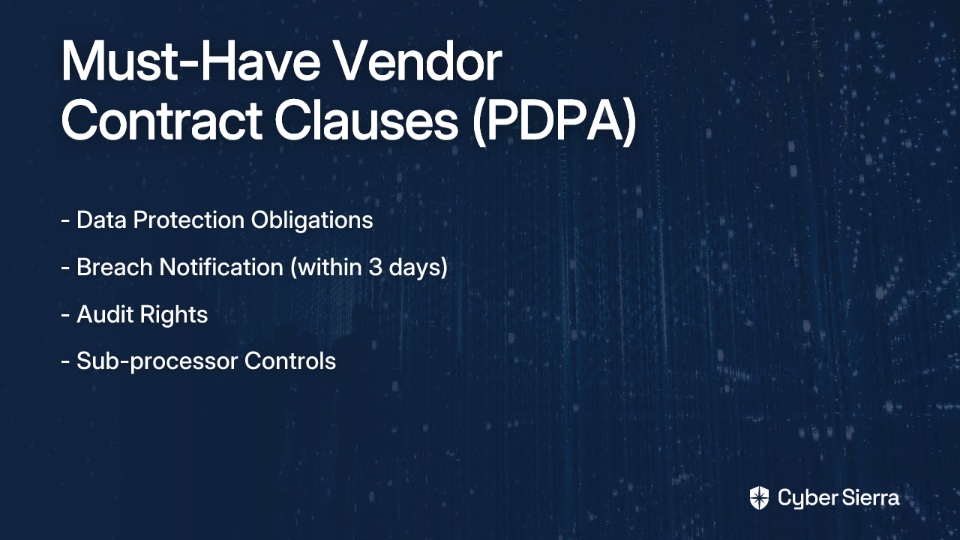
Automated Approach: Implement pre-approved legal templates and contract management workflows that ensure every vendor agreement consistently includes:
📋 Mapping to PDPA Obligations
Protection & Accountability Obligations — Contracts are the mechanism by which an organization formally governs how its data intermediaries handle personal data. The PDPC's Guide to Data Protection emphasizes the importance of clear contractual agreements that explicitly address data protection responsibilities.
Step 4: Streamline Security Assessment Questionnaires
Knowing a vendor has a contract isn't the same as knowing they're secure. Security assessment questionnaires give you a structured view of their actual controls.
Manual/Legacy Approach: Emailing static questionnaires as Word documents or spreadsheets, then chasing vendors for responses over weeks. Comparing answers across dozens of vendors is nearly impossible. Worse, it's entirely self-attestation — vendors can say whatever they like, and there's no efficient way to verify.
Automated Approach: Cyber Sierra's TPRM platform automates the entire questionnaire lifecycle — distributing standardized or custom assessments, sending automated follow-up reminders, centralizing all responses in a single dashboard, and instantly flagging high-risk answers for your team's review. This transforms what was once a months-long email chain into a consistent, repeatable, and auditable process that scales as your vendor portfolio grows.
📋 Mapping to PDPA Obligations
Protection Obligation (Section 24, PDPA) — Conducting security assessments is how you verify that vendors have "reasonable security arrangements" in place for the personal data you've entrusted to them. Documented questionnaire results are also key evidence during PDPC investigations or audits, demonstrating that due diligence was performed prior to engagement.
Step 5: Establish Continuous Monitoring
Annual vendor reviews tell you how a vendor looked 11 months ago. Continuous monitoring tells you how they look today.
This is one of the most significant gaps in traditional vendor risk management PDPA programs — and one of the most dangerous. Threat landscapes change. Vendors make infrastructure changes. Software vulnerabilities are discovered. A vendor that passed your questionnaire in January may have a critical misconfiguration by March.
Manual/Legacy Approach: Annual compliance reviews or sporadic questionnaire re-sends. As security practitioners have flagged in Reddit threads, this means "relying on vendors to self-report changes." Self-reporting is not monitoring — it's hope.
Automated Approach: Cyber Sierra's Continuous Control Monitoring (CCM), integrated with its TPRM module, delivers near real-time, 24/7 visibility into vendor security posture. It monitors external attack surfaces, flags misconfigurations, detects anomalies, and surfaces actionable intelligence so you can act on emerging risks before they become incidents — rather than discovering them during an annual review.
📋 Mapping to PDPA Obligations
Protection Obligation (ongoing) — The PDPA's Protection Obligation is not a one-time checkbox — it applies for the entire duration of your engagement with a vendor. Continuous monitoring is how you demonstrate that the "reasonable security arrangements" you verified at onboarding remain in place throughout the vendor lifecycle.

Step 6: Systematize Remediation Tracking
Identifying a risk is only half the job. The other half is proving you fixed it — and that requires a formal, trackable process.
Without structured remediation workflows, identified gaps fall into the void of email threads, Slack messages, and meeting action items. Ownership is unclear. Deadlines are missed. Risks that were "accepted" are never actually managed. As one practitioner put it bluntly: "You still have to manage and monitor accepted risks. You don't just accept them and move on."
Manual/Legacy Approach: Tracking remediation in spreadsheets or shared documents with no accountability mechanism. This produces exactly what auditors hate: gaps in the record that suggest risks were identified but never addressed.
Automated Approach: Cyber Sierra's TPRM and GRC platform turns identified risks into structured remediation tasks with assigned owners, defined deadlines, and tracked statuses. Whether the risk surfaced from a questionnaire response or a continuous monitoring alert, it enters a workflow — and stays tracked until verified closure. This creates the audit trail that turns your risk management from reactive to demonstrably systematic.
📋 Mapping to PDPA Obligations
Accountability Obligation — Accountability isn't just about identifying what could go wrong; it's about demonstrating that your organization takes a disciplined approach to fixing it. Systematic remediation tracking provides the documented, auditable evidence that your VRM program is not just a paper exercise.
Step 7: Maintain Audit-Ready Documentation
Under the PDPA, it's not enough to be compliant — you must be able to prove it.
When the PDPC investigates a breach or complaint involving a vendor, the question isn't just "what happened?" It's "what did you do to prevent it, and can you show us?" Organizations that cannot produce a clear record of their vendor due diligence, risk assessments, and remediation activities are, in practical terms, unable to defend their compliance posture — regardless of how much work they actually did.
Manual/Legacy Approach: Vendor documentation scattered across shared drives, email inboxes, personal hard drives, and archived spreadsheet versions. Gathering evidence for an audit becomes a frantic, weeks-long exercise that's as stressful as it is unreliable. As one security practitioner observed, "If you know which vendors touch sensitive data, have a baseline per tier, and can show why you accepted certain gaps, most auditors are satisfied" — but getting to that point manually is a major undertaking.
Automated Approach: Cyber Sierra's GRC module serves as a centralized, always-current repository for all vendor compliance artifacts. It automates evidence collection, maintains a detailed audit trail of every assessment, communication, and remediation action, and generates comprehensive compliance reports on demand — so you're audit-ready every day, not just in the weeks before a review.
📋 Mapping to PDPA Obligations
Accountability Obligation — The PDPC explicitly expects organizations to maintain documentation that demonstrates compliance. This includes records of how personal data is handled by third parties, the due diligence conducted before engagement, and how identified risks were managed. Centralized, organized documentation is your most important defense in any regulatory inquiry.

Shift From Reactive Compliance to Proactive Governance
Managing vendor risk under PDPA has moved beyond spreadsheets and annual check-ins. A modern, defensible program is built on a simple premise: you can't delegate accountability. To protect your organization, you need to shift from paper-based compliance to proactive, technology-driven governance.
Remember these core principles from this guide:
- Your vendors are your responsibility. Under PDPA, you are accountable for their data security failures. A formal program is not optional.
- Annual reviews are no longer enough. The threat landscape changes daily. Continuous monitoring gives you the real-time visibility needed to spot and fix risks as they emerge.
Your first step today can be simple: start building a complete vendor inventory. It's the foundation for everything that follows.
When you're ready to trade manual effort for automated assurance, see how a dedicated TPRM platform makes this entire process manageable. Book your platform demo and discover how to gain the real-time visibility and audit-ready documentation needed to face any regulatory scrutiny with confidence.
Frequently Asked Questions
What is vendor risk management under PDPA?
Vendor risk management under PDPA is the process of ensuring third-party vendors who handle personal data comply with Singapore's data protection laws. This involves identifying, assessing, and mitigating risks posed by vendors to meet your accountability and protection obligations under the Act.
Why is a vendor inventory the first step for PDPA compliance?
A complete vendor inventory is the first step because you cannot protect data you don't know about. The PDPA's Accountability Obligation requires you to be responsible for all personal data in your control, including data held by vendors. An inventory is the foundation for all risk management.
How does continuous monitoring differ from traditional vendor reviews?
Continuous monitoring provides real-time visibility into a vendor's security, while traditional reviews are periodic, point-in-time snapshots. This proactive approach helps detect new risks as they emerge, rather than waiting for an annual assessment, ensuring ongoing PDPA compliance.
What are the essential contractual clauses for vendors under PDPA?
Essential clauses include data protection obligations, breach notification requirements (within 3 days), audit rights, and controls over their sub-processors. These contractual terms legally bind your vendors to protect the personal data they handle on your behalf, making your PDPA requirements enforceable.
Who is responsible if a vendor has a data breach in Singapore?
Your organization remains accountable to the PDPC for a data breach, even if it occurs on a vendor's system. Under the PDPA, you are responsible for the personal data in your control. A robust vendor risk management program is your key defense to demonstrate you performed due diligence.
How can automation help with vendor risk management for PDPA?
Automation streamlines and scales your vendor risk management program, replacing error-prone manual tasks. It helps maintain a live inventory, automates assessments, enables continuous monitoring, and centralizes documentation, ensuring your program is efficient, consistent, and always audit-ready.
