



Vendor Risk Management for Startups

Join thousands of professionals and get the latest insight on Compliance & Cybersecurity.
You've found the perfect SaaS tool to supercharge your startup's operations. It ticks all the boxes functionally, and the price is right. But when you ask about their SOC 2 compliance, you're met with an awkward silence or vague promises about "security being a priority." Sound familiar?
For growing startups, this scenario creates a genuine dilemma: do you walk away from an otherwise perfect vendor, or do you take on unknown security risks that could come back to haunt you?
The SOC 2 Gold Standard (And Why It Falls Short)
SOC 2 (System and Organization Controls 2) has become the de facto security framework for SaaS companies. Developed by the American Institute of Certified Public Accountants (AICPA), it's based on five Trust Services Criteria:
- Security (protection against unauthorized access)
- Availability (system uptime and reliability)
- Processing Integrity (accurate, complete processing)
- Confidentiality (protection of sensitive information)
- Privacy (personal information handling)
A SOC 2 Type I report provides a snapshot of controls at a point in time, while a Type II report (the more valuable one) assesses controls over 3-12 months.
When a vendor has SOC 2 compliance, it signals that an independent auditor has verified their security practices. That's why many enterprises won't even consider vendors without it.
The Problem: SOC 2 Isn't Everything It Seems
Despite its status as a gold standard, SOC 2 has limitations that savvy security professionals understand:
- As one security professional on Reddit notes: "Many vendors jump through hoops doing the bare minimum and haven't actually implemented a secure system."
- SOC 2 reports "can be manipulated to meet certain narratives" since they're essentially audit reports, not compliance certificates.
- The scope matters enormously: "You need to ask more questions if the stuff that is handling your data isn't in the SOC 2 audit scope."
This skepticism is healthy. A SOC 2 report is a useful data point, but it's not a security guarantee. And for startups working with newer, smaller vendors, SOC 2 compliance might not be available at all.
A Risk-Based Framework for Vendor Assessment
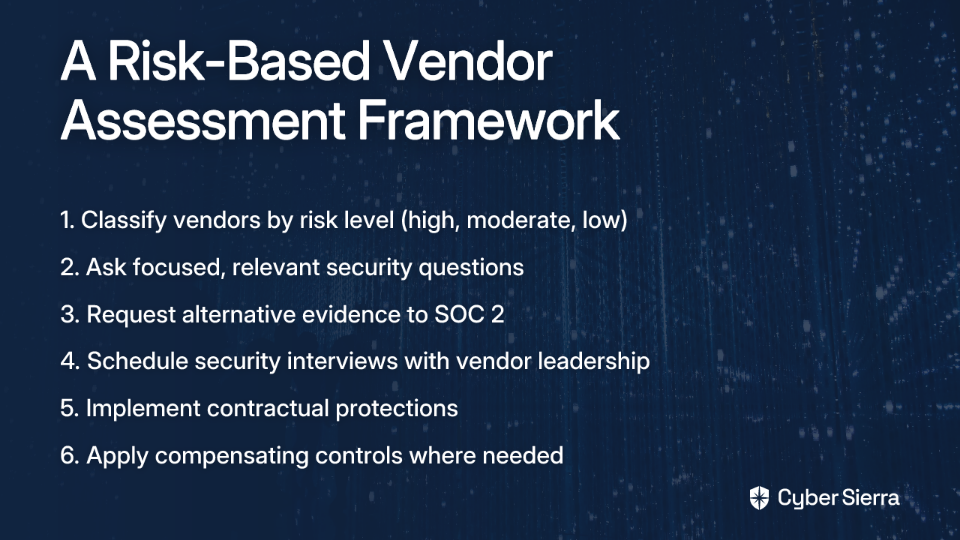
Rather than treating SOC 2 as a binary yes/no decision, startups need a more nuanced approach to vendor risk management. Here's a practical framework that balances security with business needs:
Step 1: Classify Your Vendor by Risk Level
Not all vendors pose the same level of risk. Your assessment efforts should be proportional to the potential damage a security incident might cause:
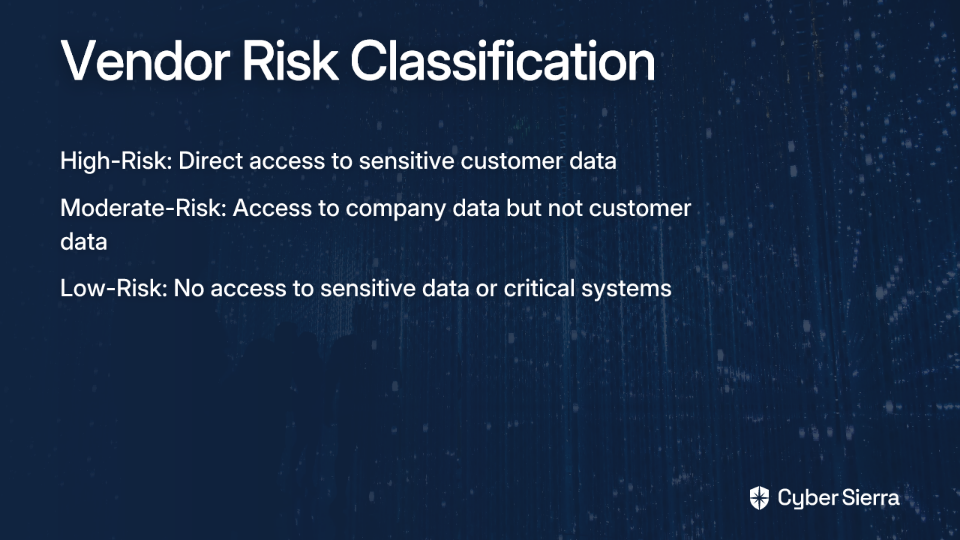
- High-Risk/Critical Vendor: Has direct access to or processes sensitive customer data (PII, financial information), or their failure would significantly disrupt your service.
- Moderate-Risk Vendor: Interacts with your systems or accesses less sensitive company data, but not customer data. Their failure would be inconvenient but not catastrophic.
- Low-Risk Vendor: Provides ancillary services with no access to sensitive data or critical systems (e.g., office supplies, certain marketing tools).
This classification helps you focus your limited resources on the vendors that matter most.
Step 2: Ask Focused, Relevant Questions
Vendors often reject lengthy, generic security questionnaires because "it's just not scalable" to answer custom questions for every client. Instead, create a short, focused questionnaire tailored to the vendor's risk level and the specific services they provide.
For high-risk vendors without SOC 2, your questions should cover the spirit of the Trust Services Criteria:
Information Security & Access Control:
- How do you enforce access controls to systems that would process our data?
- Do you have a formal information security policy? Can we review it?
- What security awareness training do your employees receive?
Availability & Business Continuity:
- What are your uptime SLAs?
- Do you have a documented disaster recovery plan? When was it last tested?
Confidentiality & Data Handling:
- How is our confidential information protected? Do employees sign NDAs?
- What are your data encryption practices (both in transit and at rest)?
Vulnerability Management & Incident Response:
- Do you perform regular vulnerability scanning and penetration testing?
- What is your policy for vulnerability notification? How and when will you inform us of security incidents?
- What is your process for emergency patching of critical vulnerabilities?
Step 3: Request Alternative Evidence
If a vendor can't provide a SOC 2 report, ask what they can provide as evidence of their security maturity:
- ISO 27001 certification: Another globally recognized security standard
- Penetration test results: Even redacted summaries can provide valuable insights
- Cyber liability insurance: Proof they've at least been vetted by an insurer
- Internal documentation: Their information security policy, incident response plan, or vendor management policy
- Security whitepapers: Detailed explanations of their security architecture
Step 4: Schedule a Security Interview
As one security professional noted, "a call can be more productive than a questionnaire." For any high-risk vendor, schedule a 30-45 minute call with their CISO, Head of Engineering, or security lead.
This direct conversation allows you to:
- Ask follow-up questions about their security practices
- Gauge their security culture and maturity
- Build a relationship with their security team
The way a vendor responds to security questions often reveals more than the answers themselves. Evasiveness or defensiveness may be red flags, while transparency and detailed explanations suggest a mature security posture.
Mitigating the Risk: Contracts and Compensating Controls
Once you've assessed a vendor, you need to formalize protections and implement additional safeguards.
Leverage Your Vendor Contract
Your contract is your most powerful tool for managing vendor risk. Even when a vendor lacks SOC 2, you can include clauses that require:
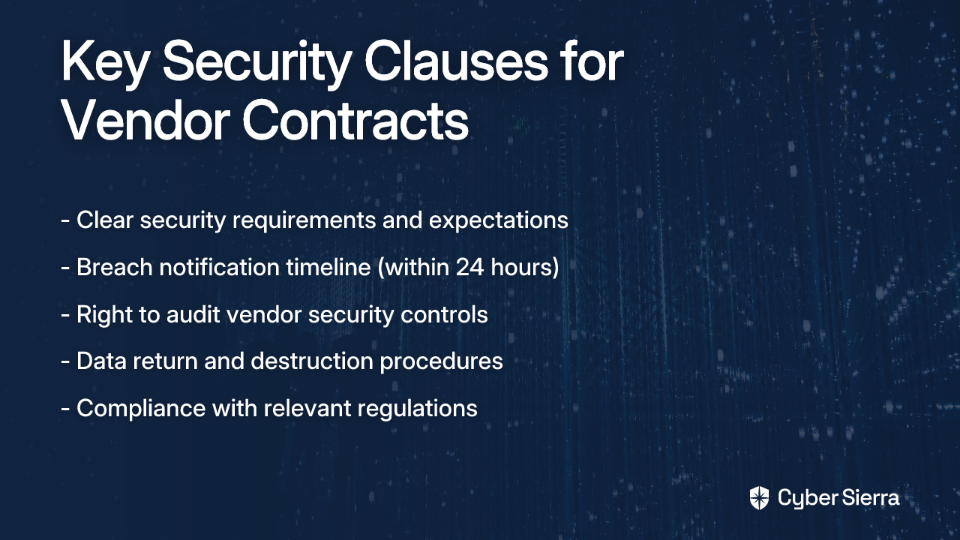
- Clear security expectations: Specify requirements like data encryption, access controls, and personnel security.
- Breach notification: Define the timeline for notifying you of a breach (e.g., within 24 hours).
- Right to audit: Include a clause that gives you the right to assess their security controls, especially following a security incident.
- Data return and destruction: Outline procedures for securely returning or destroying your data upon contract termination.
- Compliance with relevant regulations: Ensure they agree to comply with regulations applicable to your business (e.g., HIPAA, GDPR, PCI DSS).
Implement Compensating Controls
If a vendor has specific security weaknesses, determine if you can mitigate them on your end:
- Can you encrypt sensitive data before sending it to the vendor?
- Could you implement additional monitoring for that vendor's access?
- Is it possible to limit the scope of data they can access?
Document Everything for Your Compliance
This entire process isn't just about vetting vendors; it's about building your own defensible vendor risk management program. This documentation becomes critical if your own company undergoes a SOC 2 audit, as AICPA Criterion CC9.2 specifically requires that "the entity assesses and manages risks associated with vendors and business partners."
From Risk Aversion to Risk Intelligence
A vendor lacking a SOC 2 report isn't necessarily a deal-breaker. It's a signal to perform deeper, more hands-on due diligence. By taking a risk-based approach that classifies vendors, asks focused questions, seeks alternative evidence, and secures contractual protections, startups can make informed decisions about which vendors to trust.
Building a robust vendor risk management process is a sign of a mature startup. It protects your data, your reputation, and your customers while enabling you to partner confidently with the vendors you need to succeed.
Remember: effective security isn't about saying no to every vendor without a compliance certificate. It's about understanding the real risks, applying appropriate scrutiny, and making deliberate decisions about which risks you're willing to accept – and which ones you're not.
Frequently Asked Questions
What is SOC 2 and why is it important for SaaS vendors?
SOC 2 is a security framework that demonstrates a vendor's ability to securely manage and protect customer data based on five Trust Services Criteria: Security, Availability, Processing Integrity, Confidentiality, and Privacy. It's considered a gold standard because it involves an independent audit of a company's security controls over a period of time (for a Type II report). For many enterprises, SOC 2 compliance is a mandatory requirement as it provides a baseline level of assurance about their security posture.
Why shouldn't a startup automatically reject a vendor without SOC 2?
Startups should not automatically reject vendors without SOC 2 because many innovative or newer tools may not have undergone the lengthy and expensive audit process yet, and a SOC 2 report itself is not a complete guarantee of security. A rigid, SOC 2-only policy can limit your access to valuable tools that could accelerate your growth. Instead of a simple yes/no, a better approach is to use a risk-based framework to evaluate the actual risk the vendor poses and perform due diligence proportional to that risk.
How can I assess a vendor's security without a SOC 2 report?
You can assess a vendor's security without a SOC 2 report by adopting a four-step risk-based framework: classify the vendor's risk level, ask focused security questions, request alternative evidence of security, and conduct a direct security interview. First, determine if the vendor is high, moderate, or low risk based on the data they will handle. Then, ask targeted questions about their security policies and incident response plans. Request alternative proof like ISO 27001 certification or penetration test results. Finally, a direct conversation with their security lead can provide crucial insights into their security maturity.
What are the most important security questions to ask a high-risk vendor?
For a high-risk vendor, you should focus your questions on the core principles of security, availability, and data handling. Key questions include how they enforce access controls, protect confidential data with encryption, and their process for responding to security incidents. It's also crucial to ask about their disaster recovery plans, employee security training, and vulnerability management processes, such as how they perform scanning and handle emergency patching. These questions get to the spirit of the SOC 2 criteria without requiring the report itself.
What are some acceptable alternatives to a SOC 2 report?
Acceptable alternatives to a SOC 2 report include other security certifications like ISO 27001, recent penetration test results, proof of cyber liability insurance, and internal documentation like their information security policy or incident response plan. These documents serve as valuable evidence of a vendor's security posture. For example, a summary of a recent penetration test shows they are proactively testing their defenses, while an ISO 27001 certification is another globally recognized standard for security management.
How can I legally protect my company when using a vendor without SOC 2?
You can legally protect your company by incorporating specific security requirements and clauses into your vendor contract. This is your most powerful tool for managing risk when a formal certification is absent. Your contract should clearly define expectations for data protection, such as encryption standards and access controls. It must include a strict breach notification clause (e.g., notification within 24 hours), a right-to-audit clause, and procedures for secure data return or destruction when the contract ends.
