



Top Use Cases of Generative AI in Vendor Risk & Control Mapping

Join thousands of professionals and get the latest insight on Compliance & Cybersecurity.
Summary
- Third-party vendors cause 62% of data breaches, highlighting the failure of slow, manual risk management processes.
- Generative AI accelerates vendor risk management by automating compliance framework mapping and vendor assessment analysis, saving up to 80% in assessment time.
- The most effective strategy combines AI for data analysis with human experts for final validation and strategic decision-making.
- Cyber Sierra's GRC platform operationalizes these AI-driven workflows to streamline vendor risk, automate control monitoring, and ensure continuous compliance.
You've just reviewed the 50-page SOC 2 report from your new cloud service provider, and now you need to map their controls to your ISO 27001 framework—manually, of course. Meanwhile, three more critical vendors are waiting for assessment, regulatory requirements keep evolving, and your CISO wants an updated risk dashboard by Friday. Sound familiar?
For security and compliance professionals, vendor risk management has reached a breaking point. With 62% of data breaches occurring via third-party vendors, and each breach costing an average of $4.45 million, the stakes couldn't be higher.
Enter generative AI—not as a replacement for human judgment, but as a powerful ally that's transforming how organizations manage vendor risk and compliance mapping. Let's explore the most impactful applications that are already delivering tangible results.
The Breaking Point: Why Traditional VRM Can't Keep Up
Traditional vendor risk management is buckling under its own weight:
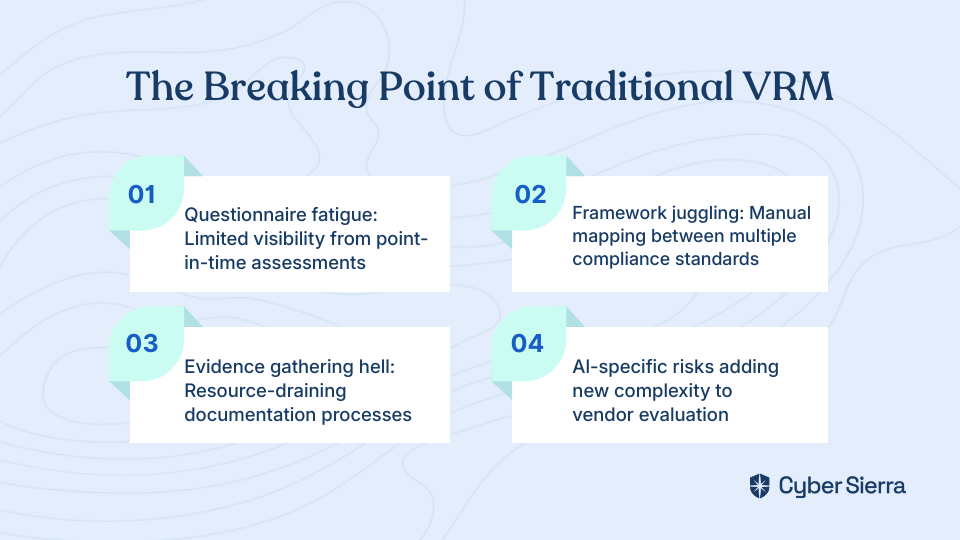
- Questionnaire fatigue: Static, point-in-time assessments provide limited visibility and quickly become outdated.
- Framework juggling: As one cybersecurity professional on Reddit noted, "GRC is way too complicated to just leave to AI." Manual mapping between NIST CSF, ISO 27001, SOC 2, and other frameworks is painstaking due to terminology differences and constant updates.
- Evidence gathering hell: "The most painful part of an audit is typically evidence gathering," shared another Reddit user. This tedious process drains resources that could be focused on actual risk mitigation.
With the addition of AI-specific risks ("Where does our data actually go? What guardrails prevent sensitive information from leaking?"), traditional methods simply cannot keep pace.
The Top 5 Use Cases of Generative AI in Vendor Risk & Control Mapping
1. Automated Framework Crosswalking
What it is: The process of mapping security controls across disparate compliance frameworks to identify overlaps and gaps.
How AI does it: Generative AI employs semantic similarity analysis to understand the intent and context of controls, enabling accurate mapping even when terminology differs. For example, what ISO 27001 calls "Access Control" might appear as "Identity and Access Management" in NIST CSF, but AI recognizes they address the same fundamental security concept.
Impact: According to CyberSaint research, organizations using AI for framework mapping achieve up to 80% time savings in compliance assessments and 50% control automation, allowing teams to focus on strategic risk management rather than spreadsheet maintenance.
2. Continuous Control Automation (CCA) & Monitoring
What it is: The shift from periodic, manual checks to real-time compliance monitoring.
How AI does it: By integrating with your security stack (cloud providers, endpoint protection, etc.), AI automatically collects evidence, tests control effectiveness, and provides a near real-time view of compliance status. When controls drift out of compliance, the system alerts stakeholders immediately.
Impact: This directly addresses the "evidence gathering hell" pain point. Instead of scrambling to collect documentation during audits, evidence is continuously captured and organized. The FS-ISAC guide on Generative AI highlights how this transforms security from reactive to proactive, identifying control failures before they lead to breaches.
3. Intelligent Vendor Assessment & Questionnaire Analysis
What it is: Using AI to rapidly analyze vendor-submitted documentation (questionnaires, SOC 2 reports, security policies) to identify risks and validate claims.
How AI does it: AI algorithms can scan hundreds of pages in minutes, flagging inconsistencies, identifying missing controls, and summarizing key risk areas that require human follow-up. The AI can also compare vendor responses against industry benchmarks to detect potential misrepresentations.
Impact: This dramatically accelerates the due diligence process and enhances assessment accuracy. According to ProcessBolt, organizations using AI for vendor assessments report up to 70% faster review cycles and identification of 35% more potential risks than manual methods.
4. Automated Gap Analysis & Prioritized Remediation
What it is: Identifying compliance gaps across all frameworks and helping teams prioritize which issues to address first.
How AI does it: AI analyzes the severity of control gaps, the criticality of associated assets, and relevant threat intelligence to generate a risk-based prioritization score. This approach ensures that limited resources are directed toward the most significant vulnerabilities.
Impact: Instead of treating all gaps equally, security teams can focus on what matters most. For example, the AI might determine that missing multi-factor authentication controls for systems containing PII represent a higher risk than documentation gaps in asset management procedures.
5. Real-Time Risk Reporting & Executive Dashboards
What it is: Consolidating complex risk and compliance data into clear, intuitive dashboards for stakeholders.
How AI does it: AI automatically aggregates data from continuous monitoring and assessments, generating visualizations that provide an at-a-glance view of vendor risk posture. Natural language generation capabilities can also create executive summaries that translate technical findings into business impact.
Impact: Facilitates data-driven decision-making and simplifies communication of risk to leadership. These dashboards can show trends over time, allowing security leaders to demonstrate progress and justify investment in vendor risk management programs.
Putting AI into Practice: Balancing Automation with Human Expertise
Despite these powerful capabilities, implementing AI in vendor risk management requires a thoughtful approach. As one Reddit user candidly stated, "I don't trust AI ENTIRELY, so I still would still need some human input."
This skepticism is healthy. The most effective implementations follow a "human-in-the-loop" approach where AI handles data collection and initial analysis, while human experts perform final validation, strategic assessment, and decision-making—avoiding the common pitfall of over-reliance on AI.
Consider these best practices for responsible AI adoption:
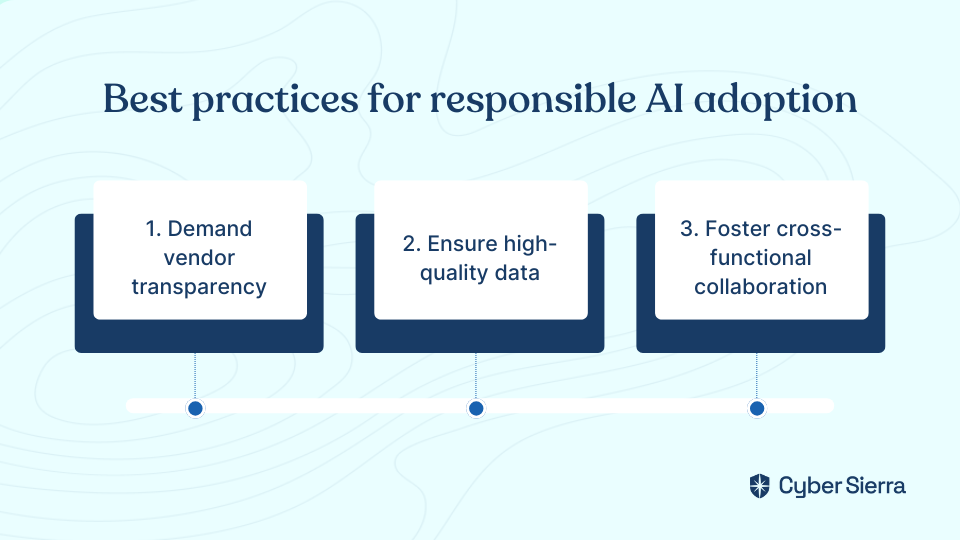
- Demand vendor transparency: Ask potential AI vendors tough questions: Where is our data stored? How is it used for training? What security certifications do you have? As one cybersecurity professional advised, "If a vendor can't tell you where your data lives, how it's locked down, what certs they've got, and whether a human still has the final say - you probably shouldn't be signing with them."
- Ensure high-quality data: AI insights are only as good as the data they're fed. Poor data quality leads to misleading results and potentially dangerous security blind spots.
- Foster cross-functional collaboration: The most successful AI implementations involve close collaboration between security, compliance, legal, and IT teams to ensure a holistic approach to risk management.
How Modern GRC Platforms are Leading the Charge
While these use cases sound powerful in theory, they become truly transformative when integrated into a unified platform. Modern platforms like Cyber Sierra are built to operationalize this AI-driven approach to risk management.
For example, Cyber Sierra's Third-Party Risk Management (TPRM) module automates vendor assessments, prioritizes vendor inventory based on risk levels, and provides 24/7 visibility into vendor compliance status. This directly addresses Use Cases 3 (Intelligent Vendor Assessment) and 5 (Real-Time Risk Reporting).
Similarly, the Continuous Control Monitoring (CCM) module builds a central controls repository with near real-time updates and automates control testing. This implementation of Use Case 2 (Continuous Control Automation) helps organizations move from periodic, manual checks to proactive, continuous monitoring.
The Governance, Risk & Compliance (GRC) module manages multiple compliance frameworks (SOC2, ISO 27001, HIPAA, etc.) simultaneously, making automated framework crosswalking (Use Case 1) a reality. This integration helps organizations maintain compliance across multiple standards without duplicating effort.
What makes these platforms particularly effective is their ability to combine AI automation with human expertise. As one security professional noted on Reddit, "The balance is automating the data gathering and monitoring while keeping humans firmly in charge of risk assessment."
The Future of Vendor Risk Management
As generative AI continues to evolve, we can expect even more sophisticated applications in vendor risk management:
- Predictive risk analytics that forecast potential vendor issues before they materialize
- Natural language interfaces that allow security teams to query their compliance data using everyday language
- Autonomous remediation recommendations that suggest specific actions to address identified risks
However, the foundation will remain the same: using AI to handle the repetitive, data-intensive aspects of vendor risk management while empowering human experts to focus on strategic decision-making.
Conclusion
Generative AI is fundamentally transforming vendor risk and control mapping from a static, labor-intensive discipline to a dynamic, intelligent process. Organizations that embrace these technologies stand to gain significant advantages:
- Dramatic efficiency improvements through automation of manual tasks
- Enhanced accuracy in risk identification and prioritization
- A shift from reactive to proactive risk management
The future of resilient security and compliance programs will be defined by the successful partnership between AI-powered automation and strategic human oversight. As one cybersecurity leader aptly put it, "The best GRC programs come from the right mix of both AI and human expertise."
By focusing on the five key use cases outlined in this article, organizations can begin their journey toward more efficient, effective vendor risk management—turning what was once an overwhelming burden into a strategic advantage.
Frequently Asked Questions
What is AI-powered vendor risk management?
AI-powered vendor risk management uses artificial intelligence, particularly generative AI, to automate and enhance the process of assessing, monitoring, and managing risks associated with third-party vendors. It automates repetitive tasks like analyzing security reports, mapping compliance controls between different frameworks (like SOC 2 and ISO 27001), and continuously monitoring vendor security posture, allowing human experts to focus on strategic decision-making.
How does generative AI help with compliance framework mapping?
Generative AI helps with compliance framework mapping by using semantic analysis to understand the intent and context of security controls, even when the terminology differs across frameworks. This process, known as "framework crosswalking," allows the AI to accurately map controls from one standard (e.g., NIST CSF) to another (e.g., ISO 27001), identifying overlaps and gaps automatically. This saves security teams significant time compared to manual mapping.
Can AI completely replace humans in vendor risk management?
No, AI is not a complete replacement for human expertise in vendor risk management. The most effective approach is a "human-in-the-loop" model where AI handles the data-intensive, repetitive tasks like evidence collection and initial analysis. Human professionals then provide the crucial final validation, strategic risk assessment, and decision-making, ensuring that context and business-specific nuances are considered.
What are the main benefits of using AI for vendor assessments?
The main benefits of using AI for vendor assessments are increased speed and accuracy. AI can scan hundreds of pages of documentation, such as SOC 2 reports and security questionnaires, in minutes to flag inconsistencies, identify missing controls, and summarize key risks. This leads to significantly faster review cycles (up to 70% faster) and helps identify more potential risks than traditional manual methods.
How can I get started with AI in my vendor risk management program?
To get started, begin by identifying the most manual and time-consuming parts of your current VRM process, such as framework mapping or evidence gathering. Then, explore modern GRC platforms that have integrated AI capabilities, like automated vendor assessments or continuous control monitoring. It's crucial to demand transparency from any AI vendor regarding data security and to ensure you maintain human oversight in the process.
What risks should I consider when using an AI vendor for compliance?
When using an AI vendor, you must consider data security and privacy risks. It's essential to ask potential vendors where your data will be stored, how it is secured, and what security certifications they hold. Additionally, be aware of the risk of "garbage in, garbage out"—the AI's insights are only as good as the data it's fed, so ensuring high-quality data inputs is critical to avoid misleading results.
Want to learn more about how AI-enabled platforms can transform your organization's approach to vendor risk management and control mapping? Explore Cyber Sierra's integrated security and compliance platform to see how these capabilities come together in practice.
