



What CISOs Need to Know About GRC


Join thousands of professionals and get the latest insight on Compliance & Cybersecurity.
You've just taken on the CISO role at a growing organization and inherited a complex tapestry of security practices, compliance requirements, and a team still debating the best approach to governance. As you review the current state, you notice siloed operations, Excel spreadsheets tracking critical compliance data, and a growing tension between your security engineers and GRC specialists. The board is asking about your strategy for the upcoming audit season, while your inbox fills with regulatory updates requiring immediate attention.
Sound familiar? For many CISOs, the challenge isn't just understanding GRC (Governance, Risk, and Compliance) - it's transforming it from a perceived bureaucratic overhead into a strategic enabler that both protects and propels the business forward.
What is GRC in Cyber Security?
At its core, GRC represents the strategic integration of three critical functions that together form the backbone of modern cybersecurity management:
Governance establishes the framework for how security decisions are made, involving leadership oversight, policy development, and allocation of resources aligned with organizational objectives. Governance answers the fundamental question: "How do we ensure our security strategy supports our business goals?"
Risk Management provides the methodical approach to identifying, assessing, and mitigating potential threats before they materialize into actual incidents. This component follows frameworks like NIST 800-53 and addresses the question: "What could harm our organization, and how do we prevent it?"
Compliance ensures adherence to regulatory requirements, industry standards, and internal policies, protecting the organization from legal penalties while maintaining stakeholder trust. This component answers: "Are we meeting our obligations to regulators, customers, and partners?"
When properly implemented, these three components work in harmony to create a comprehensive security posture that addresses both external threats and internal requirements.
Why GRC Matters More Than Ever for CISOs
The stakes for effective GRC implementation have never been higher. According to recent industry surveys, organizations with mature GRC practices experience 50% fewer security incidents and respond 30% faster when breaches do occur. Beyond security benefits, strong GRC practices deliver tangible business advantages:
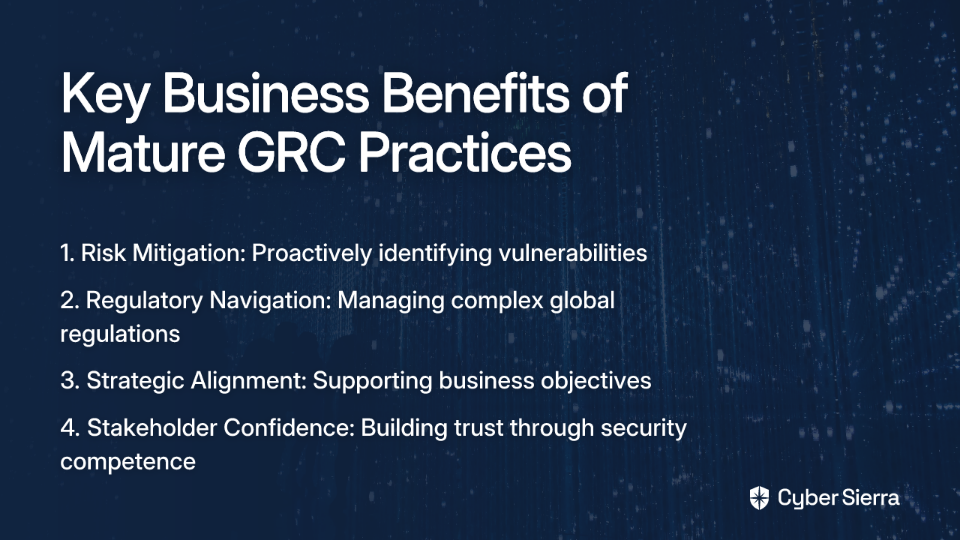
- Risk Mitigation: Proactively identifying and addressing vulnerabilities before they can be exploited
- Regulatory Navigation: Systematically managing the increasingly complex landscape of global regulations
- Strategic Alignment: Ensuring security investments directly support business objectives
- Stakeholder Confidence: Building trust with customers, partners, and investors through demonstrated security competence
The Core Components of an Effective GRC Framework
Governance: Setting the Foundation
Effective governance starts with clear leadership and accountability. This means:
- Establishing a security steering committee with representation from across the organization
- Developing comprehensive policies that reflect both business needs and security requirements
- Creating a security strategy that aligns with the organization's broader objectives
- Ensuring proper resource allocation for security initiatives
As one CISO from a financial services firm noted on a recent industry forum: "Good governance isn't about creating bureaucracy—it's about ensuring everyone understands their role in security and has the resources to fulfill it."
Risk Management: The Methodical Approach
Risk management requires a structured methodology that includes:

- Risk Identification: Systematically discovering potential threats across the organization
- Risk Assessment: Evaluating the likelihood and potential impact of each identified risk
- Risk Treatment: Implementing controls to mitigate, transfer, accept, or avoid risks
- Continuous Monitoring: Regularly reassessing the risk landscape as conditions change
Many organizations struggle here because they lack a consistent approach. According to research from Bitsight, organizations that implement structured frameworks like NIST or ISO 27001 demonstrate significantly better security outcomes.
Compliance: Beyond the Checkbox
Effective compliance goes beyond simply checking boxes on audit forms. It requires:
- Understanding the intent behind regulations, not just their technical requirements
- Integrating compliance into everyday operations rather than treating it as a periodic exercise
- Establishing automated monitoring for continuous compliance
- Maintaining documentation that demonstrates due diligence
"The goal isn't just to pass audits," explains a compliance director quoted on Wizard Cyber, "it's to build a culture where compliance is a natural outcome of good security practices."
Common GRC Challenges for CISOs
The Cultural Divide
One of the most persistent challenges in GRC implementation is the divide between security engineering teams and GRC specialists. As one security engineer candidly stated on Reddit: "Engineers by default think you are an idiot and you will work up from there. This is caused by some dysfunctional org's where GRC is used as a dumping ground for engineers that can't do the thing they were hired for."
This perception creates a significant barrier to effective collaboration. Successful CISOs address this by:
- Ensuring GRC teams have technical credibility
- Creating opportunities for engineers to understand the business impact of compliance
- Establishing collaborative processes that leverage both technical and governance expertise
Tool Proliferation vs. Spreadsheet Hell
Organizations often swing between two extremes: an overwhelming collection of disconnected GRC tools or an overreliance on spreadsheets for critical compliance tracking. Neither approach is optimal.
"Some people really like Excel forms," noted one GRC professional with evident frustration in an online discussion. This dependency on manual processes creates significant risks around data accuracy, consistency, and accessibility.
The solution lies in implementing integrated GRC platforms that:
- Connect risk, compliance, and governance activities
- Automate routine compliance tasks
- Provide real-time visibility into the organization's security posture
- Offer robust reporting capabilities for different stakeholders
The Compliance-Security Balance
Many CISOs face pressure to achieve compliance even at the expense of actual security. As one practitioner noted: "occasionally you get cast as the bad guy that's forcing a change when the reality is that [regulators] will have a screaming fit if they come onsite and find out what's occurring."
This tension often stems from a fundamental misunderstanding of GRC's purpose. Compliance should enhance security, not compete with it. Effective CISOs approach this challenge by:
- Explaining how compliance requirements map to actual security benefits
- Implementing controls that satisfy multiple frameworks simultaneously
- Prioritizing security measures that also advance compliance goals
- Using risk-based approaches to determine when exceptions are appropriate
Building a Successful GRC Strategy: A CISO's Roadmap
1. Assess Your Current Maturity
Before implementing new GRC initiatives, conduct a thorough assessment of your organization's current maturity. Consider:
- Existing policies and their effectiveness
- The state of your risk management processes
- Current compliance status across relevant frameworks
- Available tools and resources
- Team capabilities and knowledge gaps
This baseline understanding will help you set realistic goals and prioritize improvements.
2. Establish Clear Governance Structures
According to Right Hand Cybersecurity, organizations with well-defined governance structures experience 60% fewer security incidents than those with ambiguous security leadership.
Effective governance requires:
- Clearly defined roles and responsibilities
- Regular security steering committee meetings
- Documented decision-making processes
- Executive sponsorship and engagement
3. Implement Risk-Based Approaches
Move beyond compliance checklists to true risk management by:
- Adopting a recognized framework like NIST or ISO 27005
- Developing a consistent risk assessment methodology
- Creating a risk register that captures both technical and business risks
- Establishing regular risk review cycles
"It's best to start with a framework when starting from scratch," advised one security professional on Reddit, emphasizing the importance of structure in risk management.
4. Integrate GRC with Business Processes
GRC shouldn't exist in isolation. To be effective, it must be integrated into:
- Product development lifecycles
- Vendor management processes
- Change management procedures
- Incident response planning
5. Leverage Technology Appropriately
Select GRC tools that meet your specific needs rather than adopting the most complex solution available. Consider:

- Scalability as your organization grows
- Integration capabilities with existing tools
- Automation features for routine tasks
- Reporting capabilities for different stakeholders
The Future of GRC: Emerging Trends for CISOs
As you refine your GRC approach, keep these emerging trends in mind:
Third-Party Risk Management Evolution
With organizations increasingly reliant on vendors and partners, third-party risk management has become a critical component of GRC. According to Cypago, third-party breaches account for over 60% of all data breaches.
Focus on:
- Implementing continuous monitoring of vendor security postures
- Developing tiered assessment processes based on data access
- Creating clear security requirements for all vendors
- Establishing incident response protocols that include third parties
GRC Automation
The future of GRC lies in automation. Leading organizations are:
- Implementing continuous control monitoring
- Using AI to identify emerging compliance issues
- Automating evidence collection for audits
- Deploying real-time risk dashboards
Integrated Security and Compliance
The most successful organizations are breaking down silos between security operations and compliance functions. This integration enables:
- Faster response to new regulations
- More efficient resource allocation
- Comprehensive security monitoring
- Improved reporting to stakeholders
Conclusion: From Compliance Burden to Business Enabler
GRC doesn't have to be a bureaucratic burden that drags down your security program. When properly implemented, it becomes a strategic advantage that protects your organization while enabling business growth.
As one CISO shared: "When we stopped treating GRC as a checkbox exercise and started seeing it as a way to understand and communicate our security posture, everything changed. The board became more supportive, engineers were more engaged, and we actually improved our security—not just our compliance."
By following the strategies outlined in this article, you can transform your GRC program from a source of frustration to a foundational element of your security success. Remember that effective GRC isn't about perfect documentation or passing audits—it's about building a resilient organization that can confidently pursue its mission while managing risks appropriately.

Frequently Asked Questions (FAQ)
What is GRC in cybersecurity and why is it essential for CISOs?
GRC in cybersecurity refers to the integrated collection of capabilities that enable an organization to reliably achieve objectives, address uncertainty, and act with integrity; these are Governance, Risk Management, and Compliance. It's essential for CISOs because it provides a structured framework to align security initiatives with business goals, manage cyber risks effectively, ensure adherence to legal and regulatory requirements, and build trust with stakeholders, ultimately transforming security into a strategic business enabler.
How can CISOs bridge the cultural divide between security engineers and GRC specialists?
CISOs can bridge this divide by fostering mutual understanding and collaboration, ensuring GRC teams have sufficient technical credibility, and clearly articulating the value GRC brings to security operations. This involves creating opportunities for engineers to understand the business context and impact of compliance, integrating GRC perspectives into technical projects early, and establishing shared goals that highlight how GRC and engineering functions are complementary.
What are the core components of an effective GRC framework?
The core components are Governance, which establishes clear roles, responsibilities, decision-making processes, and strategic direction for security; Risk Management, which involves systematically identifying, assessing, treating, and monitoring risks to organizational assets; and Compliance, which ensures adherence to relevant laws, regulations, standards, and internal policies. These three components must work in harmony for a GRC framework to be truly effective.
What is the recommended first step for a CISO looking to build or improve a GRC strategy?
The recommended first step is to assess the current GRC maturity of the organization. This involves a thorough review of existing policies, procedures, risk management practices, compliance levels, tools, and team capabilities. Understanding this baseline allows a CISO to identify gaps, set realistic goals, prioritize initiatives, and tailor the GRC strategy to the organization's specific needs and context.
How does GRC automation benefit cybersecurity management?
GRC automation benefits cybersecurity management by significantly improving efficiency, consistency, and the ability to provide real-time insights into an organization's risk and compliance posture. It can automate repetitive tasks like evidence collection, control testing, and reporting, reduce human error, enable continuous monitoring, and free up GRC and security personnel to focus on more strategic activities, such as risk analysis and mitigation planning.
Why is GRC considered more than just a compliance checkbox exercise?
GRC is more than a compliance checkbox because its fundamental aim is to embed a culture of risk-aware decision-making and continuous improvement throughout the organization, rather than simply meeting the minimum requirements of an audit. Effective GRC focuses on achieving business objectives by managing uncertainty and acting with integrity, where compliance becomes a natural outcome of well-governed and risk-managed operations, leading to enhanced security and organizational resilience.
Additional Resources
For CISOs looking to deepen their GRC expertise, these resources provide valuable insights:
