



What is the NYDFS Cybersecurity Regulation?

Join thousands of professionals and get the latest insight on Compliance & Cybersecurity.
You've been tasked with implementing a new cybersecurity regulation for your financial institution, but as you sift through the dense legal language of official documents, you find yourself increasingly frustrated. The requirements are complex, deadlines seem confusing, and you're not even sure where to begin documenting your compliance efforts.
If this scenario sounds familiar, you're not alone. Many financial services professionals struggle with understanding and implementing the New York Department of Financial Services (NYDFS) Cybersecurity Regulation, formally known as 23 NYCRR Part 500.
Understanding 23 NYCRR Part 500: The Essentials
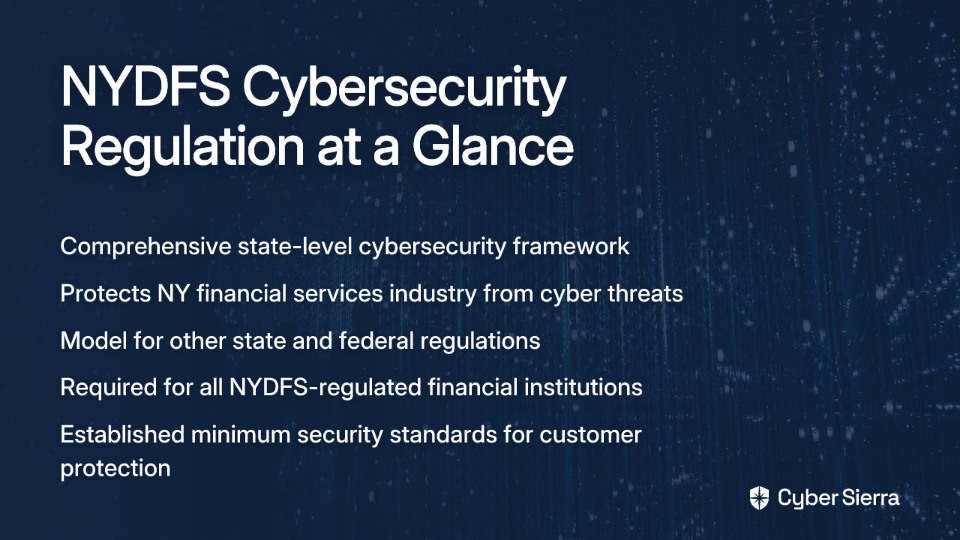
The NYDFS Cybersecurity Regulation represents one of the most comprehensive and stringent state-level cybersecurity regulations in the United States. Introduced in 2017, it was designed to protect New York's financial services industry and consumers from the growing threats of cyberattacks.
Key aspects to understand:
- Effective Date: Initially effective March 1, 2017, with a phased implementation approach
- Covered Entities: Banks, insurance companies, mortgage brokers, and other financial services institutions regulated by the NYDFS
- Core Purpose: To establish minimum cybersecurity requirements for financial services companies that protect customer information and the information technology systems of regulated entities
What makes this regulation particularly significant is that it has become a model for other states and even federal regulations. Even if you're not directly subject to NYDFS oversight, understanding these requirements can help prepare your organization for similar regulations that may apply to you now or in the future.
Key Requirements of the NYDFS Cybersecurity Regulation
1. Establish a Comprehensive Cybersecurity Program
The foundation of compliance is developing, implementing, and maintaining a robust cybersecurity program designed to:
- Identify and assess internal and external cybersecurity risks
- Use defensive infrastructure to protect information systems and nonpublic information
- Detect cybersecurity events
- Respond to identified cybersecurity events
- Recover from cybersecurity events and restore normal operations
- Fulfill applicable regulatory reporting requirements
For CISOs like Sarah Chen, this means moving beyond point solutions to create an integrated security strategy that addresses the entire attack lifecycle.
2. Implement a Written Cybersecurity Policy
Covered entities must maintain a written policy addressing:
- Information security
- Data governance and classification
- Access controls
- Business continuity planning
- Systems operations and availability
- Systems and network security
- Systems and application development
- Physical security and environmental controls
- Customer data privacy
- Vendor and third-party service provider management
- Risk assessment
- Incident response
For compliance managers like David Lee, this requires extensive documentation that is regularly reviewed and approved by a Senior Officer or board.
3. Designate a Chief Information Security Officer (CISO)
Organizations must appoint a qualified CISO responsible for:
- Overseeing and implementing the cybersecurity program
- Enforcing the cybersecurity policy
- Reporting to the Board of Directors at least annually on:
- The organization's cybersecurity posture
- Material cybersecurity risks
- Critical cybersecurity events
- Recommendations for remediation
The CISO role can be filled by an internal resource or by an external service provider, providing flexibility for smaller organizations that may not have the resources to maintain a full-time executive-level security position.
4. Conduct Regular Risk Assessments
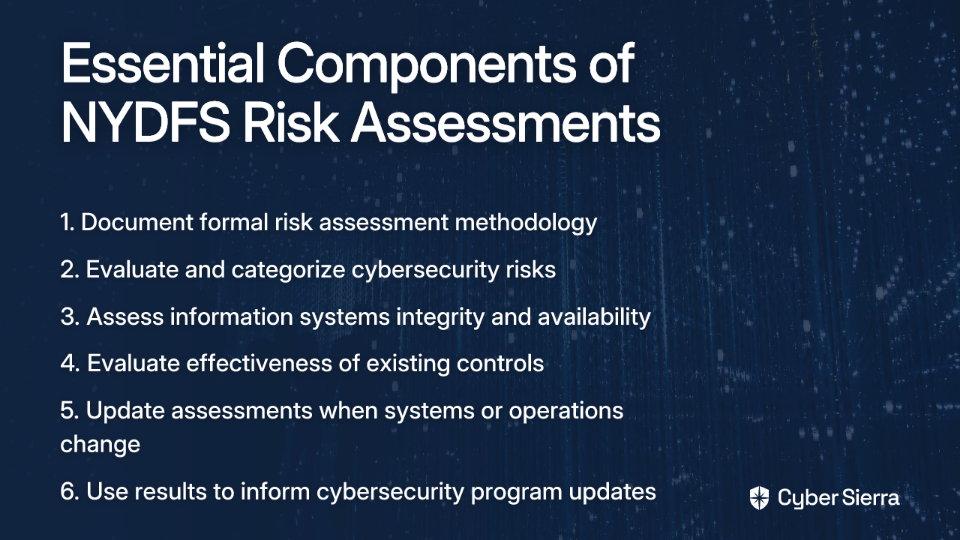
The regulation requires periodic risk assessments that:
- Evaluate and categorize cybersecurity risks
- Assess the confidentiality, integrity, and availability of information systems
- Evaluate existing controls in the context of identified risks
- Inform the cybersecurity program and policies
These assessments must follow a formal, documented methodology and must be updated as necessary to address changes in information systems, nonpublic information, or business operations.
5. Implement Strong Access Controls
Covered entities must limit user access privileges to information systems that contain nonpublic information and periodically review these access privileges. This includes:
- Multi-factor authentication for external access to the network
- Risk-based authentication for accessing internal networks
- Regular review of access privileges
- Timely termination of access following departures or role changes
For Third-Party Risk Managers like Ben Carter, this extends to ensuring vendors with access to your systems have similar controls in place.
6. Deploy Cybersecurity Tools and Controls
The regulation mandates specific technical controls including:
- Penetration testing and vulnerability assessments
- Audit trail systems to reconstruct financial transactions and detect cybersecurity events
- Application security procedures, including security testing
- Data encryption of nonpublic information both in transit and at rest
- Secure disposal of nonpublic information that's no longer necessary
Security professionals like Priya Sharma need to ensure these controls are not only in place but continuously monitored for effectiveness.
7. Develop an Incident Response Plan
Covered entities must establish a written incident response plan designed to:
- Respond to and recover from cybersecurity events
- Define clear roles and responsibilities
- Include external and internal communications plans
- Identify requirements for remediating weaknesses
- Document lessons learned
- Establish reporting procedures
This plan must be tested and updated regularly to ensure its effectiveness.
8. Manage Third-Party Service Provider Security
The regulation places significant emphasis on third-party risk management, requiring covered entities to:
- Develop written policies and procedures for vendor risk management
- Identify and risk-assess all service providers with access to nonpublic information
- Establish minimum cybersecurity practices required of service providers
- Perform due diligence in evaluating service providers' cybersecurity practices
- Periodically assess service providers based on the risk they present
These requirements are particularly challenging for businesses with extensive vendor ecosystems, as noted by procurement specialists who must manage hundreds or thousands of vendor relationships.
9. Report Cybersecurity Events
One of the most stringent aspects of the regulation is the requirement to notify the NYDFS Superintendent of certain cybersecurity events within 72 hours. This includes:
- Events that require notice to any government body, regulatory agency, or self-regulatory agency
- Events that have a reasonable likelihood of materially harming the normal operations of the covered entity
- Extortion payments related to a cybersecurity event, which must be reported within 24 hours
The 2023 amendments added additional requirements related to ransomware and extortion payments, reflecting the growing threat of these attacks.
10. Annual Compliance Certification
Covered entities must submit an annual certification of compliance to the NYDFS, confirming that they are in compliance with the requirements. If there are areas of noncompliance, the entity must identify those areas and document remediation plans.
2023 Amendments: What's Changed
In November 2023, the NYDFS finalized significant amendments to the cybersecurity regulation, creating more stringent requirements, particularly for larger entities. Key changes include:
- Creation of "Class A Companies" - Organizations with at least $20 million in gross annual revenue in New York and either:
- Over 2,000 employees worldwide, or
- Over $1 billion in gross annual revenue in each of the last two fiscal years
- Enhanced Requirements for Class A Companies:
- Independent audit of cybersecurity programs
- Systematic monitoring, including endpoint detection and response solutions
- Privileged access management
- Password management
- Automated vulnerability scans
- Additional Requirements for All Covered Entities:
- Asset management and periodic data classification
- Enhanced access controls
- Cloud security assessments
- Updated incident response plans that address ransomware
- Stronger governance with annual approval of policies by senior management
- More comprehensive risk assessments
These amendments reflect the evolving threat landscape and provide more specific guidance on what constitutes adequate cybersecurity controls.
Common Challenges in NYDFS Compliance
Despite the regulation being in effect for several years, organizations continue to face significant challenges in achieving and maintaining compliance:
1. Difficulty Accessing User-Friendly Documentation
As one compliance professional noted in a recent discussion: "I was surprised to see that the regulations are not laid out in a fairly digestible format (e.g. spreadsheet with requirements) and are presented in a PDF format on the official NYDFS website."
This accessibility issue creates unnecessary barriers for teams trying to systematically track and manage compliance requirements.
2. Resource Constraints and Expertise Gaps
Many organizations lack dedicated compliance expertise. As one Reddit user mentioned, "my vCISO has declared that he is 'not a compliance guy' lol." This expertise gap often forces companies to rely heavily on external consultants, which can be cost-prohibitive, especially for smaller institutions.
3. Tight Implementation Timelines
The phased implementation approach and subsequent amendments have created confusion around deadlines. "I know that the deadline passed for reporting but my company just went through this for the first time and we ran into the same issue," reported one compliance manager, highlighting the pressure organizations face when navigating these requirements for the first time.
4. Manual Evidence Collection and Documentation
For IT teams already stretched thin, the documentation requirements of NYDFS can be overwhelming. Manual evidence collection across disparate systems creates inefficiency and increases the risk of incomplete or inaccurate compliance documentation.
5. Third-Party Risk Management at Scale
For organizations with extensive vendor ecosystems, managing third-party risk according to NYDFS requirements presents a significant operational challenge, especially when relying on spreadsheets and manual questionnaire processes.
Best Practices for NYDFS Compliance
To address these challenges, forward-thinking organizations are adopting several best practices:
1. Use Standardized Frameworks and Mappings
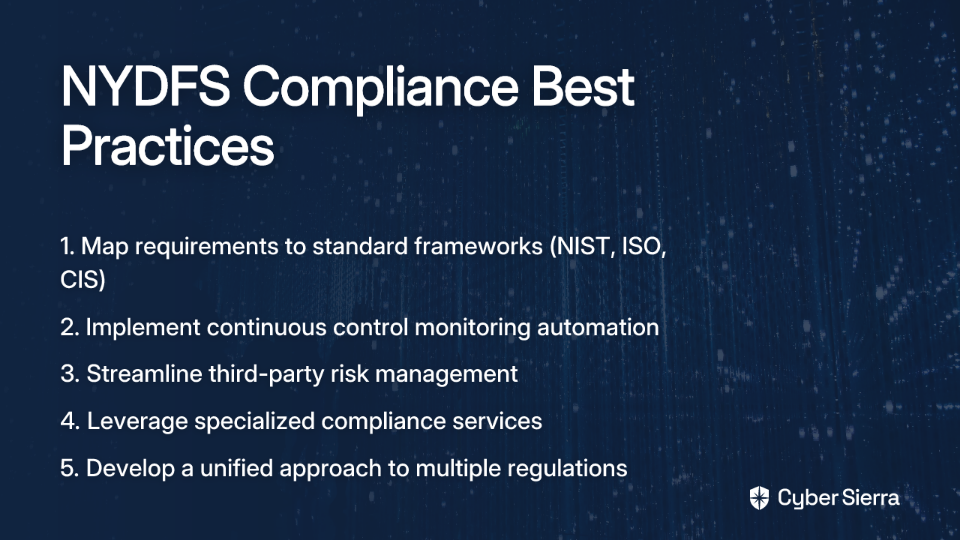
"The Secure Controls Framework has it mapped against a billion things, including NIST, ISO, and CIS," noted one practitioner. Leveraging these established frameworks can help translate the NYDFS requirements into actionable controls and simplify compliance efforts.
2. Implement Continuous Control Monitoring
Rather than point-in-time assessments, leading organizations are implementing continuous monitoring of security controls. This approach not only supports compliance but also improves overall security posture by enabling rapid detection and remediation of control failures.
Modern platforms like CyberSierra's Continuous Control Monitoring (CCM) module can significantly streamline this process by automating evidence collection across multiple systems and providing real-time visibility into control effectiveness. This is particularly valuable for organizations subject to multiple regulatory frameworks beyond just NYDFS.
3. Automate Third-Party Risk Management
Given the emphasis on vendor security in the NYDFS regulation, automating the vendor assessment process can yield significant efficiency gains. Tools that streamline questionnaire distribution, track remediation efforts, and provide continuous monitoring of vendor security posture can transform this traditionally manual process.
4. Consider Specialized Compliance Services
For smaller organizations with limited resources, specialized compliance services can provide a cost-effective alternative to building in-house expertise or engaging large consulting firms. As one Reddit user shared, "we used Cyber Pop-up and got it done in a week (and didn't cost an arm and a leg like the big 4 consulting companies)."
5. Develop a Unified Compliance Approach
Rather than treating NYDFS compliance as a standalone initiative, integrate it into a broader compliance program that addresses multiple frameworks. This unified approach reduces duplication of effort and creates a more sustainable compliance program.
The Future of NYDFS and Financial Cybersecurity Regulation
The NYDFS regulation has already influenced other regulatory frameworks, including the Federal Trade Commission's Safeguards Rule for financial institutions and various state-level regulations. As cyber threats continue to evolve, we can expect further refinements to the NYDFS requirements and greater harmonization across regulatory frameworks.
For organizations subject to NYDFS oversight, investing in automation, continuous monitoring, and integrated compliance solutions will provide not only immediate compliance benefits but also prepare them for the evolving regulatory landscape.
Conclusion
The NYDFS Cybersecurity Regulation (23 NYCRR Part 500) represents a significant regulatory mandate for financial institutions, establishing comprehensive requirements for cybersecurity programs, policies, and controls. While compliance presents challenges, particularly around documentation, expertise, and resource constraints, a structured approach leveraging frameworks, automation, and specialized tools can significantly reduce the compliance burden.
By implementing continuous control monitoring, automating third-party risk management, and adopting a unified compliance approach, organizations can not only achieve NYDFS compliance but also strengthen their overall security posture and prepare for future regulatory requirements.
For organizations needing to streamline their NYDFS compliance efforts, platforms like CyberSierra offer integrated solutions that automate evidence collection, simplify control mapping across multiple frameworks, and provide continuous visibility into compliance status. By moving from manual, point-in-time assessments to automated, continuous monitoring, security and compliance teams can focus more on strategic security improvements and less on documentation exercises.
Frequently Asked Questions (FAQ)
What is the NYDFS Cybersecurity Regulation (23 NYCRR Part 500)?
The NYDFS Cybersecurity Regulation (23 NYCRR Part 500) is a set of rules from the New York Department of Financial Services mandating cybersecurity standards for financial institutions. Its core purpose is to protect customer data and the IT systems of regulated entities from cyber threats. First effective in 2017, this regulation is significant for establishing comprehensive minimum requirements and has influenced other cybersecurity regulations.
Who must comply with 23 NYCRR Part 500?
Compliance with 23 NYCRR Part 500 is mandatory for all financial services institutions regulated by the New York Department of Financial Services (NYDFS). This broad category includes entities such as banks, insurance companies, mortgage brokers, and other financial service providers operating under an NYDFS license or charter in New York State.
What are the key requirements of the NYDFS Cybersecurity Regulation?
Key requirements include establishing a comprehensive cybersecurity program, implementing a detailed written cybersecurity policy, and appointing a Chief Information Security Officer (CISO). Organizations must also conduct regular risk assessments, enforce strong access controls, utilize specific cybersecurity tools (like penetration testing and encryption), develop a robust incident response plan, manage third-party vendor risks, report cybersecurity incidents within 72 hours, and submit an annual compliance certification to NYDFS.
How did the 2023 amendments impact the NYDFS Cybersecurity Regulation?
The 2023 amendments significantly updated the regulation by introducing more stringent requirements, especially for larger "Class A Companies," which now face obligations like independent cybersecurity program audits and systematic threat monitoring. For all covered entities, the amendments expanded requirements related to asset management, access controls, cloud security, ransomware-inclusive incident response plans, governance (requiring annual policy approval by senior management), and the comprehensiveness of risk assessments.
What are common challenges organizations face with NYDFS compliance?
Organizations commonly struggle with the lack of easily digestible official documentation, internal resource limitations and shortages of cybersecurity expertise, and pressure from tight implementation deadlines. Further challenges include the burden of manual evidence collection and documentation across various systems, and the operational complexity of managing third-party service provider risks at scale, especially for those with extensive vendor networks.
How can businesses best approach NYDFS compliance?
Businesses can best approach NYDFS compliance by mapping the regulation's requirements to established cybersecurity frameworks (like NIST, ISO 27001, or CIS Controls), which can translate legal language into actionable controls. Implementing continuous control monitoring and automation can streamline evidence collection and provide real-time visibility. Additionally, automating third-party risk management, considering specialized compliance services for expertise gaps, and developing a unified compliance strategy that addresses NYDFS alongside other regulations are crucial best practices.
The most effective approach treats NYDFS compliance not as a checkbox exercise but as an opportunity to build a more resilient and mature security program that protects both the organization and its customers in an increasingly threatening digital landscape.
