



Why Every GRC Platform Sucks (And What CISOs Actually Use Instead)

Join thousands of professionals and get the latest insight on Compliance & Cybersecurity.
You've just completed another exhausting vendor demo for a GRC platform promising to revolutionize your compliance program. The sales rep confidently declared their solution will streamline your SOC2 audits, automate evidence collection, and provide real-time risk visibility across your organization. The price tag? A mere six figures annually, plus implementation costs.
Yet something feels off. You've heard these promises before.
"I know a lot of CISOs (many hundreds) and not one of them wakes up in the morning and says 'OMG, I'm so glad I spent 2 million dollars on Archer' or any other GRC platform for that matter," confesses one security leader in a brutally honest Reddit thread.
This sentiment isn't isolated. Across forums, conferences, and private conversations, cybersecurity leaders share a dirty secret: the expensive GRC platforms that promised compliance nirvana have largely failed to deliver. Instead, they've created new problems while solving few of the old ones.
This article pulls back the curtain on why GRC platforms consistently disappoint even the most optimistic security teams, and reveals what battle-tested CISOs are actually using to manage their governance, risk, and compliance programs effectively.
The Great GRC Platform Failure: A Litany of Broken Promises
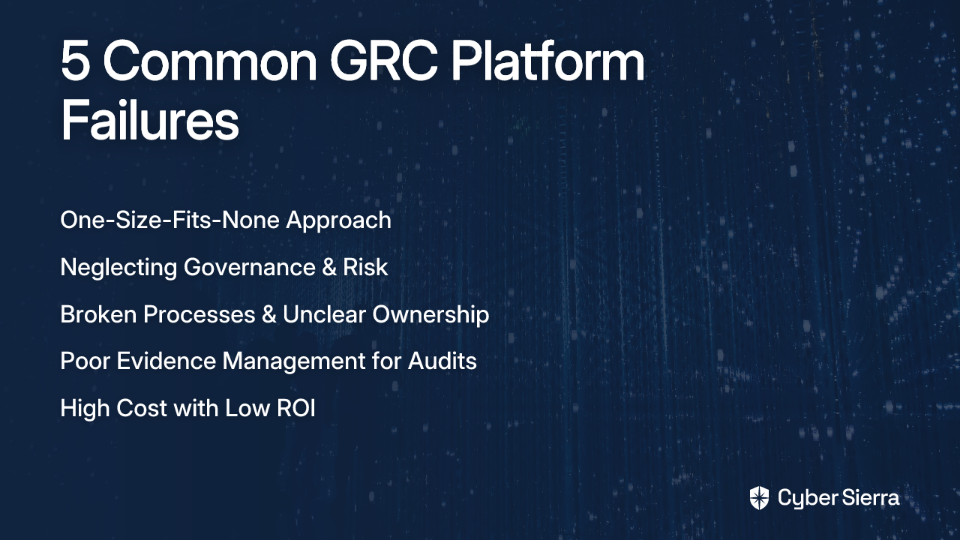
Pitfall 1: The One-Size-Fits-None Approach
Most GRC platforms are built on a fundamental misconception: that compliance and risk management follow universal patterns that can be standardized across organizations.
"One big problem is that most of the platforms are inflexible and try really hard to commoditize compliance by pushing for a one-size-fits-all program," explains one practitioner. This creates an impossible dilemma: "You either build your entire GRC program around a tool that exists and deal with the problems it brings, or you don't and you suffer the problems with tools that don't fit your processes."
The reality is that "each organization has unique needs, structures, and regulatory requirements that make it challenging to find an actual good GRC solution." What works for a financial institution facing strict regulatory requirements won't necessarily work for a healthcare provider or a SaaS startup.
Pitfall 2: Forgetting the "G" and "R" in GRC
A common complaint among security leaders is that most platforms "focus on compliance and forget about the R and especially the G." This myopic view reduces governance and risk management to checkbox exercises, missing the strategic value they should provide.
While compliance frameworks offer useful structure, they're meant to complement, not replace, thoughtful governance and risk management. True GRC should enable leaders to make informed decisions about security investments, not just generate compliance reports.
Parrish Gunnels, CISO at Sunflower Bank, highlighted this disconnect when he stated, "We're not spending our time chasing down compliance checkboxes — we're actively analyzing trends." This proactive stance is what GRC platforms promise but rarely deliver.
Pitfall 3: Broken Processes and the Ownership Black Hole
No technology can fix fundamentally broken processes. Many GRC implementations fail because they're deployed atop unclear roles and responsibilities.
Poor RACI (Responsible, Accountable, Consulted, Informed) models during implementation and a persistent lack of ownership doom many GRC initiatives from the start. When responsibilities are murky, a platform that was supposed to centralize information instead becomes another information silo.
James Wade, CISO at MCS, described a common pre-GRC environment: "We were a very siloed company... we had different business units... each doing their own thing. We weren't reporting back on the software used or the risks encountered." Unfortunately, many GRC platforms perpetuate rather than solve this problem.
Pitfall 4: The Evidence Shell Game and Audit Mistrust
Perhaps the most damning indictment comes from auditors themselves: "Most legit auditors don't trust the data from the platforms outright since they don't source their evidence well enough," reports one security professional.
This flaw undermines the entire value proposition. If organizations must still manually collect and present evidence for SOC2 or ISO27001 audits, what exactly is the platform doing to earn its six-figure price tag?
Pitfall 5: The High Cost of Disappointment
All these failures would be frustrating at any price point. But when platforms like Archer cost millions to implement, and even mid-tier solutions like Hyperproof have high minimum commitments, the disappointment is compounded by financial pain.
As one cybersecurity professional bluntly puts it, "It seems like every solution is either riddled with bugs, lacks basic features and integrations, or is built around nickel and dime-ing their customers for frameworks."
The CISO's Real-World Toolkit: What Actually Works
Given these persistent issues, what are security leaders actually using to manage their GRC programs? The answers might surprise you.
The Unkillable Duo: Excel and SharePoint
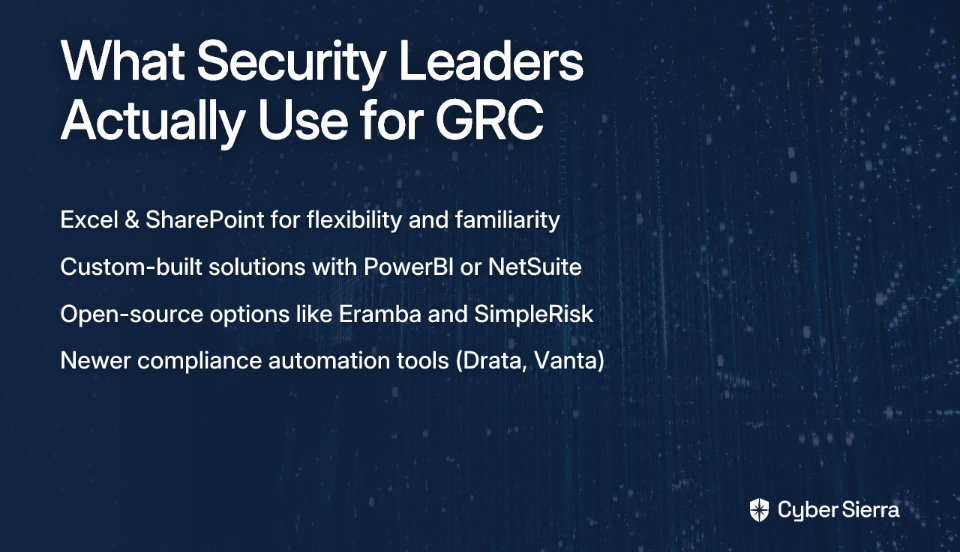
Despite billions invested in GRC technology, many organizations—including sophisticated enterprises—still rely heavily on Excel spreadsheets and SharePoint for tracking risks and managing compliance evidence.
This approach offers flexibility, ubiquity, and minimal learning curve. For smaller organizations especially, these tools provide "good enough" functionality without the integration headaches and steep costs of dedicated platforms.
"I've switched from excels to CISO assistant and I find it to be so much better than trying to create multiple files and synchronize data between them," notes one practitioner, highlighting the challenges but also the prevalence of spreadsheet-based approaches.
Going Custom: The Bespoke GRC Build
When off-the-shelf products disappoint, some organizations choose to build rather than buy. One security professional shared: "Had a client transform their SOPs and controls into a custom NetSuite platform. Other than that, I've seen piecemeal solutions."
Others recommend "Build your own with PowerBI" or note they've created solutions with Airtable that match commercial GRC platform functionality. While these custom builds require ongoing development effort, they can be tailored precisely to organizational needs.
The Open-Source Rebellion: Eramba and its Kin
Open-source GRC solutions are gaining traction as cost-effective, flexible alternatives to commercial platforms. Eramba, frequently mentioned in discussions among security professionals, offers customizability without the enterprise price tag.
SimpleRisk, another popular option, receives praise for being "a pretty good option, especially if price is a concern."
These solutions may not offer the polished interfaces of their commercial counterparts, but many security teams find they provide the essential functionality without the frustrations and costs.
The "Compliance Automation" Tier: Drata, Vanta, and the New Guard
A newer generation of compliance-focused platforms like Drata, Vanta, and SecureFrame has emerged, particularly targeting startups and growth-stage companies pursuing SOC2 certification.
User feedback on these platforms is mixed but generally more positive than traditional GRC solutions: "Just got Drata at my new place. Best so far but still frustrating," reports one security leader.
These platforms focus narrowly on specific compliance frameworks rather than attempting to solve the broader GRC challenge, which may explain their relative success.
Forging a Path Forward: A Practical GRC Strategy
Beyond cataloging failures and alternatives, what actionable advice can we offer for building an effective GRC program?
Principle 1: Strategy Before Software
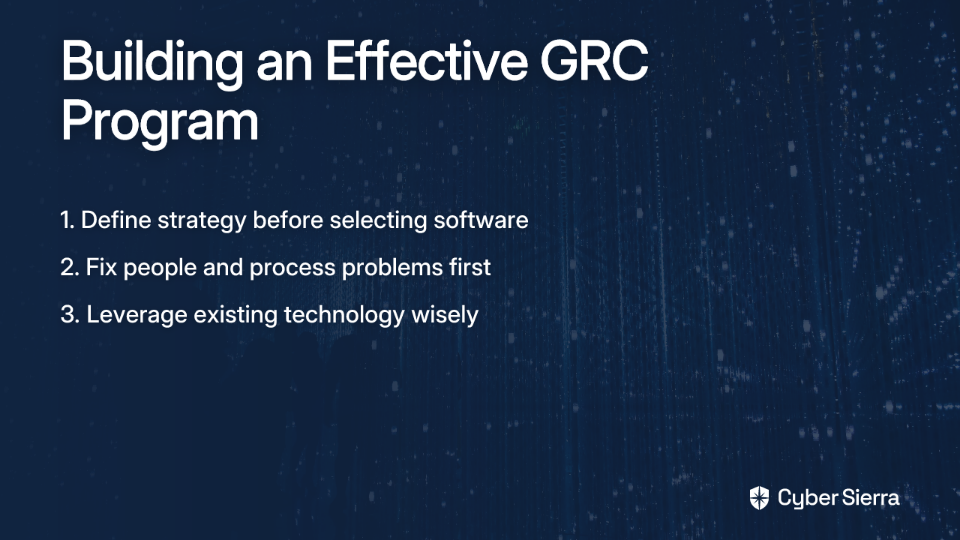
The first step is always defining clear objectives for your GRC initiative. What specific problems are you trying to solve? Which compliance frameworks are mandatory for your business? What risk visibility do stakeholders require?
A tool is a means to an end, not the end itself. Many organizations waste resources by purchasing platforms before clarifying their GRC strategy and requirements.
Principle 2: Fix the People and Process Problems First
Technology cannot fix broken processes or unclear responsibilities. Before evaluating any GRC platform, establish a solid RACI model that clearly defines who owns what in your compliance and risk management program.
This requires a human-centric approach that values expertise instead of trying to automate it away. As one practitioner notes, many GRC platforms "completely take the human aspect that is absolutely necessary out of the equation."
Don't forget to invest in training to ensure everyone understands their role in the GRC process.
Principle 3: Leverage Technology Wisely
When you do select technology, choose tools based on your specific organizational needs rather than marketing promises. Before buying anything new, evaluate the tools you already own—many companies have Microsoft 365 licenses, and Microsoft Purview is an increasingly viable option for basic GRC functionality.
Remember the journey: Start with what you have (Excel), explore building what you need (custom solutions), and consider the value of open-source alternatives (Eramba) before committing to another expensive, inflexible platform.
The Inconvenient Truth About GRC
The GRC platform market continues to grow despite widespread dissatisfaction. Perhaps the most honest assessment comes from a security professional who jokingly suggested: "It's a conspiracy by GRC professionals to stay employed."
While tongue-in-cheek, this comment highlights an important truth: effective governance, risk management, and compliance require human judgment that no platform can fully automate or replace.
The most successful organizations recognize that GRC is fundamentally about people making informed decisions about risk, not about having the fanciest dashboard or the most extensive framework library.
Until GRC platform vendors acknowledge this reality and build tools that enhance rather than replace human expertise, security leaders will continue cobbling together their own solutions—from Excel to custom builds to open-source alternatives—that actually deliver the results they need.
And they certainly won't be waking up excited about that $2 million Archer investment.

Frequently Asked Questions
What are the main problems with traditional GRC platforms?
Traditional GRC platforms often fail due to their inflexible one-size-fits-none approach, an overemphasis on compliance checkboxes at the expense of governance and risk, and their inability to fix underlying broken processes. They attempt to standardize GRC in a way that doesn't fit unique organizational needs, and many reduce GRC to simple compliance reporting, missing the strategic value of risk management. Furthermore, they can't solve issues like unclear ownership and often become another silo rather than a central source of truth.
Why do auditors often distrust GRC platforms?
Auditors often distrust data from GRC platforms because the platforms frequently fail to source and document evidence adequately for audits like SOC2 or ISO27001. This fundamental flaw undermines a key value proposition of GRC tools. If auditors cannot rely on the platform's data, security teams must still perform manual evidence gathering, which calls into question the high cost and supposed efficiency gains of the platform.
What tools do CISOs actually use for GRC instead of expensive platforms?
Many CISOs use a practical mix of tools including standard office software like Excel and SharePoint, custom-built solutions using platforms like PowerBI or Airtable, and open-source GRC tools like Eramba or SimpleRisk. Many organizations find that the flexibility and low cost of spreadsheets are "good enough," while others with specific needs opt to build their own tailored solutions or use open-source software to get core functionality without the high price tag.
How can I build an effective GRC program without a big budget?
You can build an effective GRC program by focusing on strategy before software, fixing internal processes first, and wisely leveraging technology you already have. Start by defining your GRC objectives and clarifying roles and responsibilities with a solid RACI model. Often, the biggest gains come from improving human processes. Before buying a new tool, evaluate what you can accomplish with existing software like Microsoft 365, and consider cost-effective options like open-source solutions.
What is the difference between GRC platforms and compliance automation tools like Drata or Vanta?
Traditional GRC platforms aim to be broad, all-in-one solutions for governance, risk, and compliance, while newer compliance automation tools like Drata and Vanta are narrowly focused on helping companies achieve specific certifications like SOC2. GRC platforms try to cover the entire GRC landscape, which can make them complex and inflexible. In contrast, compliance automation tools are designed to automate evidence collection and streamline the audit process for a particular framework, which is why they have found success with startups and growth-stage companies.
Is an open-source GRC tool like Eramba a good choice?
Yes, open-source GRC tools like Eramba can be an excellent choice, offering significant customizability and cost savings compared to commercial enterprise platforms. While they may require more technical expertise to set up and might lack a polished user interface, they provide core GRC functionality without high licensing fees and allow for unparalleled flexibility to be tailored to your organization's specific processes.
