



Why Every GRC Platform Sucks (And What CISOs Actually Use Instead)


Join thousands of professionals and get the latest insight on Compliance & Cybersecurity.
You've just signed the purchase order for that shiny new GRC platform. Two million dollars and countless implementation hours later, you're left wondering if you've made a colossal mistake. If this scenario sounds familiar, you're not alone.
"I know a lot of CISOs (many hundreds) and not one of them wakes up in the morning and says 'OMG, I'm so glad I spent 2 million dollars on Archer' or any other GRC platform for that matter," confesses one security leader.
The brutal reality? Despite vendor promises, most Governance, Risk, and Compliance (GRC) platforms are "riddled with bugs, lack basic features and integrations, or are built around nickel and dime-ing their customers for frameworks." Many security professionals have come to a troubling conclusion: "It's a conspiracy by GRC professionals to stay employed."
This widespread disillusionment stems from a fundamental dilemma: "You either build your entire GRC program around a tool that exists and deal with the problems it brings, or you don't and you suffer the problems with tools that don't fit your processes."
But why exactly do these expensive platforms consistently fail to deliver, and what are savvy CISOs using instead? Let's dive into the painful truth and explore the alternatives that actually work.
The Brutal Reality: Why GRC Platforms Fail
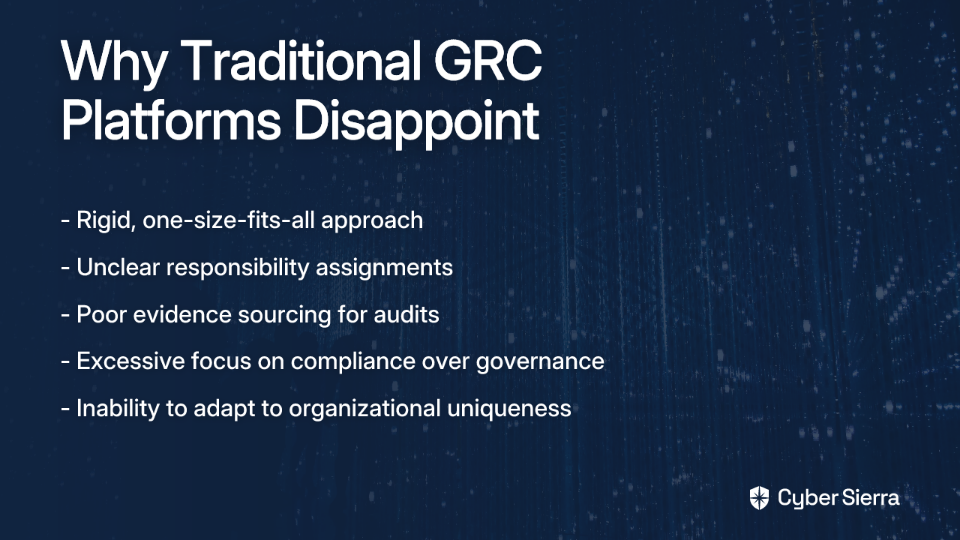
The Core Conflict: Inflexible, One-Size-Fits-None Approach
The most glaring issue with commercial GRC platforms is their fundamental inability to adapt to organizational uniqueness.
"Each organization has unique needs, structures, and regulatory requirements that make it challenging to find an actual good GRC solution," explains one cybersecurity professional. This mismatch creates friction from day one.
Even industry heavyweight Archer faces criticism for being "too rigid and doesn't meet our varied compliance needs." Most platforms "try really hard to commoditize compliance by pushing for a one-size-fits-all program," which strips away the contextual nuance that makes compliance meaningful.
Broken Processes: Poor RACI Models and Lack of Ownership
A recurring theme in GRC platform failures is the absence of clear responsibility assignment. Many implementations suffer from a "Poor RACI model for initial configuration," creating confusion about who owns what.
James Wade, CISO at MCS, points to the problem of siloed risk management where "different business units... each doing their own thing." Without clear ownership, compliance tasks fall through the cracks, and the platform becomes an expensive repository of outdated information.
Effective GRC requires cross-functional collaboration involving executives, legal, finance, HR, and IT—something many platforms struggle to facilitate despite their hefty price tags.
The Evidence Black Hole: Weak Sourcing and Auditor Distrust
Perhaps the most damning failure of GRC platforms is their inability to satisfy the very purpose they were designed for: simplifying audits.
"Most legit auditors don't trust the data from the platforms outright since they don't source their evidence well enough," notes one security professional. This fundamental flaw means "auditors end up asking for a lot of evidence in addition to what is in the platform already"—defeating the entire purpose of having a GRC system in the first place.
The difficulty in automating evidence collection and maintaining its integrity creates a credibility gap that expensive platforms have failed to bridge, especially when dealing with frameworks like SOC2 or ISO27001.
Forgetting the 'G' and 'R': The Compliance-Only Trap
Many platforms have a myopic focus: "Most of them focus on compliance and forget about the R and especially the G," observes a cybersecurity leader.
This fixation on "chasing down compliance checkboxes" means the broader goals of governance and proactive risk management are often neglected. Parrish Gunnels, CISO of Sunflower Bank, echoes this sentiment, noting that without proper governance, compliance becomes a hollow exercise.
The Real-World CISO Toolkit: What Actually Works
Faced with these persistent failures, what are CISOs and security leaders actually using to manage their GRC programs? The answers might surprise you.
The Old Guard: Excel & SharePoint
Despite billions invested in GRC platforms, many organizations still rely on the humble spreadsheet.
For smaller firms or specific tasks, Excel and SharePoint often prove "more effective" due to their flexibility and familiarity. They allow teams to adapt quickly to changing requirements without the overhead of reconfiguring an enterprise platform.
However, this approach isn't without drawbacks. "'It's in SharePoint' becomes fighting words" in many organizations, and security teams report challenges with "trying to create multiple files and synchronize data between them."
The Custom Route: Building Your Own GRC Engine
Rather than forcing their operations into the constraints of a commercial platform, some organizations are taking matters into their own hands.
One security professional shares how a client "transformed their SOPs and controls into a custom Netsuite platform." Others recommend "Build your own with PowerBI" or using flexible databases like Airtable.
While custom development requires initial investment, it creates solutions perfectly aligned with organizational processes. The tradeoff is clear: "There is a cost to continuously develop your own if you go down that route," but many find this preferable to fighting with an ill-fitting commercial platform.
The Rise of Open-Source: Flexible, Transparent, and Cost-Effective
A growing movement in the GRC space embraces open-source solutions that offer customization and control without the enterprise price tag.
Eramba has emerged as a leading open-source GRC platform, focused on information security management. It offers comprehensive policy management, risk assessments, compliance packages for frameworks like ISO 27001 and GDPR, and powerful task automation. While it has a steeper learning curve than some commercial alternatives, organizations appreciate its structured approach to risk tracking and the availability of commercial support when needed.
Other open-source tools gaining traction include CISO Assistant, a lighter "digital checklist" for security officers that's particularly user-friendly for small teams. One user who switched from Excel reports it's "so much better than trying to create multiple files and synchronize data between them."
For organizations specifically concerned with AI governance, VerifyWise offers specialized compliance features aligned with the EU AI Act, showing how niche open-source tools are addressing emerging regulatory needs.
The New Breed: Compliance Automation Tools (with Caveats)
A new category of compliance automation platforms is gaining popularity, though with important limitations.
Drata receives praise for being "excellent for compliance automation with many integrations for collecting evidence." One CISO notes, "Just got Drata at my new place. Best so far but still frustrating."
The key caveat: these tools focus on "controls compliance rather than being a true holistic GRC tool." They excel at solving the evidence collection problem for specific frameworks like SOC2 but may not cover the full governance and risk management spectrum.

Forging a Path Forward: A Pragmatic GRC Strategy
The lesson from countless GRC implementation failures is clear: start with strategy, not with a tool.
Before selecting any software, define your GRC framework, establish clear ownership (RACI), and map your processes. The tool should serve your program, not the other way around. The most effective GRC programs use dashboards that "bridge the gap between technical risks and business priorities," making risk information actionable for leadership.
When evaluating options, ask critical questions:
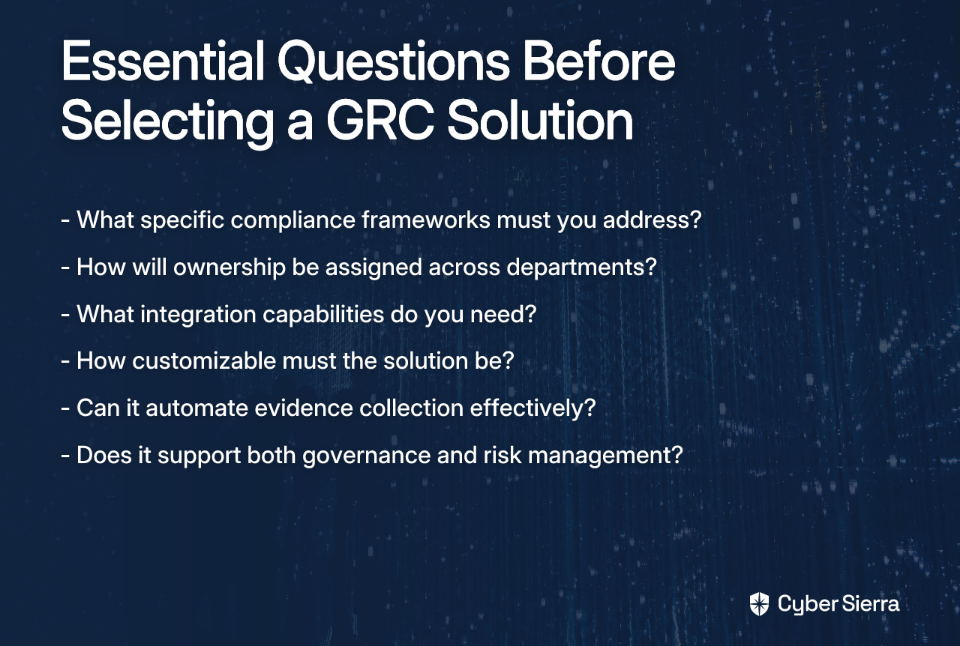
- Are you focused on broad infosec governance or also emerging domains like AI systems?
- Do you need a comprehensive framework or to solve a specific compliance challenge?
- How important are customization, community support, and cost?
Finally, look for solutions that integrate with your existing systems. Users recommend platforms with "integrations into inventory management & Jira" or tools that complement existing investments like "Clear Skies with ServiceNow."
Conclusion: GRC is a Program, Not a Platform
The failure of expensive, monolithic GRC platforms stems from their inflexibility, poor process support, and inability to meet unique organizational needs. No wonder CISOs aren't waking up excited about their multi-million dollar investments.
The path forward isn't finding one "perfect" platform, but building a tailored GRC program using pragmatic tools—whether that's SharePoint, a custom-built NetSuite module, a flexible open-source solution like Eramba, or a targeted compliance tool like Drata.
True GRC success comes from prioritizing people and processes first. It requires clear ownership, cross-functional collaboration, and a toolset that serves your program—not the other way around. The $2 million elephant in the room doesn't have to be your reality.
Frequently Asked Questions
Why do most GRC platforms fail?
Most GRC platforms fail because their rigid, one-size-fits-all approach cannot adapt to an organization's unique needs, processes, and regulatory requirements. This fundamental inflexibility leads to broken processes, a lack of clear ownership, and an inability to source evidence effectively, which auditors often distrust. As a result, they become expensive, underutilized systems that don't solve the core governance, risk, and compliance challenges they were purchased to address.
What are the best alternatives to expensive GRC platforms?
The best alternatives depend on your organization's needs but often include a mix of flexible spreadsheets (Excel/SharePoint), custom-built solutions (using PowerBI or Netsuite), open-source platforms (like Eramba), and specialized compliance automation tools (like Drata). For smaller tasks, many still find Excel effective. For total control, custom development offers a perfect fit. Open-source solutions provide a balance of features and flexibility without the high cost, while automation tools excel at specific tasks like evidence collection for SOC2.
What is the difference between a GRC platform and a compliance automation tool?
A traditional GRC platform aims to be a holistic, all-in-one solution for Governance, Risk, and Compliance, while a compliance automation tool focuses specifically on automating evidence collection and control monitoring for specific frameworks like SOC2 or ISO 27001. GRC platforms are designed to manage the entire program, including policy management and risk assessments. Compliance automation tools are more tactical; they are excellent for simplifying audits but may not offer the broader risk management and governance capabilities of a true GRC system.
How can I start building a GRC program without a big budget?
Start by focusing on strategy, not software. Begin by defining your GRC framework, mapping your key processes, and establishing a clear RACI (Responsible, Accountable, Consulted, Informed) model to assign ownership for tasks. You can manage this initial framework using familiar, low-cost tools like Excel and SharePoint. As your program matures, consider adopting a cost-effective open-source tool like Eramba to digitize your processes without the need for a massive enterprise platform.
Are open-source GRC tools secure and reliable for enterprise use?
Yes, leading open-source GRC tools like Eramba can be highly secure and reliable for enterprise use, offering transparency and control that many proprietary platforms lack. The key advantage of open-source is flexibility and the absence of vendor lock-in. While they may require more initial setup, mature projects like Eramba have strong community support and also offer paid commercial support, training, and enterprise-level features, providing a customizable core with professional support when needed.
What is the single most important factor for a successful GRC program?
The single most important factor is treating GRC as a program centered on people and processes, not as a piece of software. Technology is only an enabler. A successful GRC program is built on a foundation of clear strategy, defined ownership across business units, and well-documented processes. The tool you choose should be selected to support this program, not the other way around.
