



Top Audit Readiness Tools for IT Compliance Managers in 2025

Join thousands of professionals and get the latest insight on Compliance & Cybersecurity.
You're on another call with an engineer who doesn't "speak GRC," trying to explain what evidence you need and why you need a timestamped screenshot of a specific configuration. Meanwhile, your inbox is filling with audit requests, and the deadline is approaching. Sound familiar?
"The most painful part of an audit is typically evidence gathering. You end up on long calls with engineers who may or may not speak GRC and hope they remember where to find a config and take a screenshot with a time stamp. It's painful and sucks up a lot of time, especially when you're running lean teams." - Reddit user in r/cybersecurity
This scenario plays out in organizations worldwide, with concerning implications. According to one study, 32% of businesses face over $1 million in audit-related financial liabilities, and 31% require more than 10 people just for audit-related tasks.
The good news? Modern audit readiness tools can transform this experience. While they aren't a magic bullet—as one compliance professional noted, they "cannot 'do' the work for you for most parts" (Source)—they can significantly reduce your workload. By some estimates, these tools can "lighten your load by a factor of 30-40%" for small to midsize businesses.
This guide will cut through the marketing noise to help you identify the best audit readiness tools for 2025, focusing on features that solve the most significant compliance challenges.
The Core Challenge of Modern Audit Readiness: Beyond Spreadsheets
The Evidence Collection Nightmare
If you're still managing compliance with spreadsheets and manual processes, you're likely familiar with the routine: chasing different teams for screenshots, dealing with inconsistent evidence formats, lacking a central repository, and constantly worrying about human error. This approach not only consumes valuable time but also increases the risk of missing critical compliance gaps.
Persistent Audit Fatigue and Spiraling Costs
The continuous cycle of preparation, auditing, and remediation leads to burnout among IT and security teams. When you're allocating 10+ people to audit-related tasks (as 31% of companies do), you're diverting significant resources from innovation and core business functions.
The Blind Spots of Point-in-Time Assessments
Traditional compliance methods offer only a snapshot of your security posture. A control that was compliant yesterday could be misconfigured today, leaving your organization exposed until the next manual check. In today's rapidly evolving threat landscape, these blind spots represent unacceptable risk.
The Growing Threat of Supply Chain Risk
In our interconnected world, your compliance posture is only as strong as your weakest vendor. Supply chain attacks are increasing, making Third-Party Risk Management (TPRM) a critical component of any comprehensive audit readiness strategy.
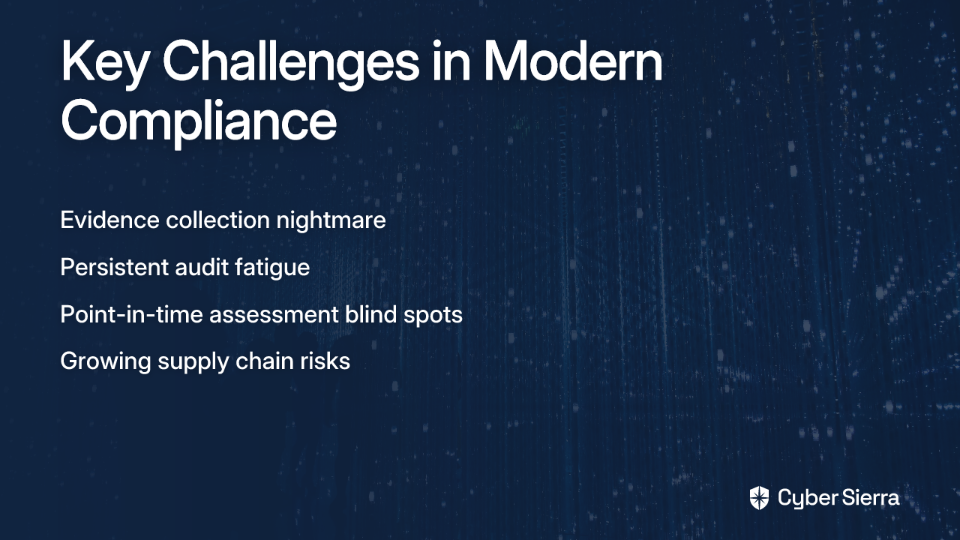
Essential Features in an Audit Readiness Tool
Before examining specific solutions, let's establish what features a modern audit readiness tool should include:
1. Continuous Control Monitoring (CCM)
This is the cornerstone feature that transforms compliance from a periodic, stressful event to an ongoing, manageable state. CCM is defined as "an automated process that constantly observes an organization's IT systems to detect security threats, performance issues, or compliance problems in real time".
2. Automated Evidence Collection
This directly addresses the number one pain point reported by compliance professionals. Your tool should have a robust integration ecosystem that connects with cloud providers (AWS, Azure, GCP), identity providers (Okta), code repositories (GitHub), and other critical systems to pull evidence automatically, eliminating those tedious manual requests.
3. Multi-Framework Support and Control Mapping
An effective solution should support multiple frameworks out-of-the-box (SOC 2, ISO 27001, PCI DSS, HIPAA, NIST) and allow you to map a single piece of evidence or control to requirements across multiple frameworks. This "test once, comply many" approach dramatically improves efficiency.
4. Centralized Dashboards and Audit-Ready Reporting
Your tool should provide a single source of truth with real-time dashboards showing your organization's compliance posture. It should also generate comprehensive reports that can be shared directly with auditors, simplifying communication and reducing back-and-forth.
5. Integrated Third-Party Risk Management (TPRM)
Look for features like automated vendor assessments, risk scoring, and continuous monitoring of vendor security posture to ensure your supply chain doesn't become your compliance Achilles' heel.
6. Policy Management and Audit Trails
The solution should act as a central repository for policies and procedures and maintain detailed, immutable audit logs of all compliance activities (control changes, evidence submission, etc.).
Top Audit Readiness Tools for 2025: A Comparative Look
All-in-One GRC & Compliance Automation Platforms
These tools aim to be a single pane of glass for all compliance and risk activities.
Cyber Sierra
Description: An AI-enabled cybersecurity platform that simplifies and automates security compliance through a unified suite of tools.
Key Strengths:
- True Continuous Control Monitoring: Provides ongoing, near real-time visibility into security controls, building a central repository to proactively fix gaps (Source).
- Automation-First GRC: Automates data collection, risk assessments, and reporting for frameworks like SOC 2, ISO 27001, and HIPAA, directly targeting audit fatigue (Source).
- Integrated Platform: Uniquely combines GRC with Third-Party Risk Management (TPRM), Threat Intelligence, and Employee Security Training for a holistic approach to risk.
Ideal For: Organizations seeking to mature their GRC program by moving from manual checks to proactive, continuous, and automated risk management across their entire digital ecosystem.
Drata
Description: A well-known leader in continuous compliance automation, particularly for cloud-native and SaaS companies.
Key Features: Centralized audit hub, automated workflows, strong integration library.
Considerations: Can have a steep learning curve, according to some market analyses (Source).
Scrut Automation
Description: A platform focused on streamlining audit preparation through deep automation.
Key Features: Automated evidence collection from over 100 integrations, continuous monitoring, and support for 50+ frameworks. Claims to reduce audit prep time by over 70% (Source).
Vanta
Description: Another popular choice for compliance automation, often compared with Drata.
Considerations: Strong on core compliance management but may have less mature features for continuous monitoring of third-party risks compared to specialized TPRM tools (Source).
Enterprise & Customizable Risk Platforms
These platforms are often suited for larger organizations with complex, unique processes.
AuditBoard
Description: An auditor-built platform focused on simplifying audit, risk, and compliance workflows.
Pros: Intuitive user interface and strong expert support.
Cons: Can be more expensive and offer limited customization compared to other enterprise tools (Source).
LogicGate Risk Cloud
Description: A highly flexible, no-code platform that allows companies to build and customize their own GRC applications.
Pros: Extremely customizable to fit unique business processes.
Cons: May have some features still under development (Source).
Specialized Monitoring & Management Tools
These tools excel in a specific domain of audit readiness.
UpGuard
Description: A leading solution for Third-Party Risk Management (TPRM) and attack surface management.
Key Features: Provides security ratings to quantify vendor risk and uses AI-enhanced security questionnaires to automate due diligence (Source).
How to Choose the Right Tool for Your Organization
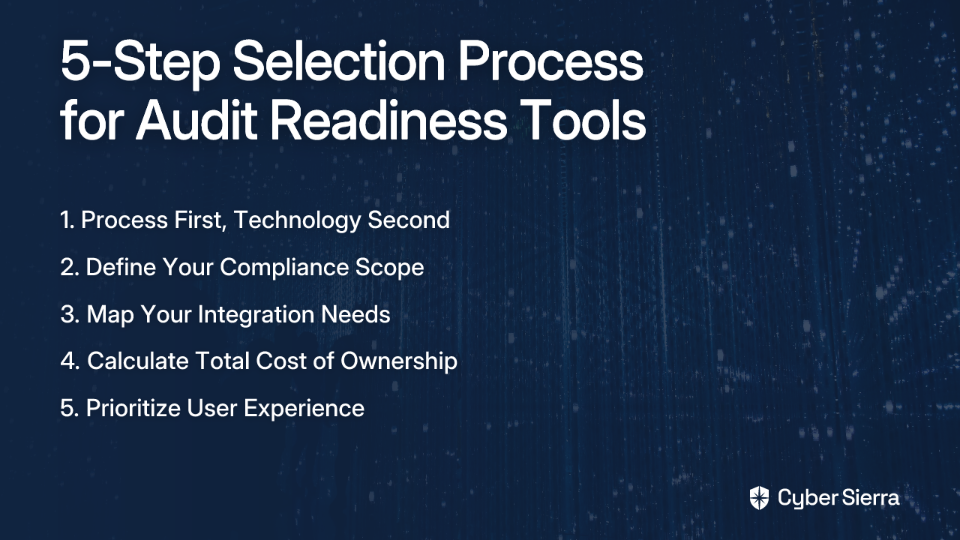
Step 1: Process First, Technology Second
Before you buy any tool, map and streamline your existing GRC processes. As highlighted in Cyber Sierra's analysis of GRC solutions, "automating a broken process only creates faster problems" (Source). Invest time in understanding your current workflows and pain points.
Step 2: Define Your Compliance Scope
Are you a startup aiming for your first SOC 2, or a mature enterprise managing ISO 27001, PCI DSS, and HIPAA simultaneously? Your required frameworks will narrow the field of suitable tools.
Step 3: Map Your Integration Needs
List every critical system in your tech stack (e.g., AWS, Azure, Jira, Slack, GitHub). The right tool must have robust, pre-built integrations for these systems to enable true automation.
Step 4: Calculate the Total Cost of Ownership (TCO)
Look beyond the sticker price. As one Reddit user noted, "you still need someone to configure and maintain these tools" (Source). Factor in implementation fees, training time, and the internal resources required to manage the platform.
Step 5: Prioritize User Experience (UX)
A clunky interface will lead to poor adoption. Request demos and choose a tool with an intuitive dashboard that provides clear, actionable insights.
Conclusion: From Audit Scramble to Continuous Compliance
The era of managing compliance with spreadsheets and last-minute scrambles is over. The risks are too high, and the manual effort is unsustainable. As one security professional advised, "You need to do this about a year to 8 months before major audits to avoid the scramble" (Source).
Modern audit readiness tools transform compliance from a painful, periodic event into a continuous, automated state of readiness. Their real value isn't just easier audits, but a fundamentally stronger and more resilient security posture. As one enthusiastic compliance manager put it: "What took days now takes minutes" (Source).
Evaluate your own audit preparation processes against the features we've discussed. Platforms like Cyber Sierra, with their focus on continuous monitoring and integrated risk management, offer a clear path to leaving audit fatigue behind and embracing proactive compliance in 2025.
While no tool can completely eliminate the work of compliance (especially for process-heavy frameworks like ISO 27001), the right solution can transform your approach from reactive scrambling to proactive management—and that's a change worth making.
Frequently Asked Questions
What is an audit readiness tool?
An audit readiness tool is a software platform designed to automate and streamline the process of preparing for security and compliance audits. It helps organizations by continuously monitoring their systems, automatically collecting evidence, managing policies, and generating audit-ready reports. This replaces manual, error-prone methods like spreadsheets, reducing the time and effort required to prove compliance with frameworks such as SOC 2, ISO 27001, and HIPAA.
Why is continuous control monitoring (CCM) so important?
Continuous control monitoring (CCM) is important because it transforms compliance from a periodic, point-in-time assessment into a real-time, ongoing process. Instead of discovering a misconfiguration during a stressful pre-audit scramble, CCM automatically and constantly checks your security controls against compliance requirements. This allows you to identify and fix gaps as they occur, maintaining a consistently strong security posture and ensuring you are always prepared for an audit.
Can an audit readiness tool fully automate compliance?
No, an audit readiness tool cannot fully automate compliance, but it can significantly reduce the manual workload. These tools excel at automating technical evidence collection and continuous monitoring. However, compliance also involves crucial human-led activities, such as defining policies, managing risk, and implementing procedural controls. The tool acts as a powerful assistant, handling the repetitive tasks so your team can focus on strategic GRC functions.
What is the most important feature to look for in an audit readiness tool?
The single most important feature is automated evidence collection through deep integrations with your technology stack. The primary pain point in any audit is the manual, time-consuming process of gathering evidence. A tool that can automatically connect to your cloud providers, identity systems, and code repositories to pull timestamped proof of compliance is what truly separates modern solutions from glorified spreadsheets.
How do I choose the best audit readiness tool for a small business?
To choose the best tool for a small business, prioritize solutions that offer a user-friendly interface, strong integration with your existing tech stack, and a clear total cost of ownership (TCO). Start by identifying your primary compliance goal (e.g., achieving SOC 2), list the critical systems that need integration, and choose a platform that provides clear, actionable insights without requiring a dedicated team to manage it.
