



Top Ways AI-Driven Anomaly Detection is Changing Third-Party Risk Monitoring


Join thousands of professionals and get the latest insight on Compliance & Cybersecurity.
Summary
- With 80% of organizations experiencing a third-party data breach, traditional vendor risk management based on static questionnaires is dangerously inadequate.
- AI-driven anomaly detection revolutionizes TPRM by shifting from periodic checks to continuous, real-time monitoring of a vendor's security posture.
- Key benefits include automating the entire vendor risk lifecycle, gaining predictive insights to prevent threats, and scaling risk management across your entire vendor ecosystem.
- Implement a modern platform, like Cyber Sierra's Third-Party Risk Management (TPRM) solution, to automate assessments and gain continuous visibility into vendor risk.
You've set up a third-party risk management program. Your team diligently emails questionnaires to vendors, collects their responses, and then... what happens next? For many organizations, the answer is disturbingly little. As one security professional recently lamented, "We email a massive spreadsheet to a new vendor, they fill it out badly, email it back, and then it just... sits in a folder. There's no real follow-up, no way to track remediation for the issues we find, and no easy way to see our overall risk level from vendors."
This scenario is all too common. In an era where 80% of organizations have experienced a data breach caused by a third party, and nearly 31% of vendors could cause significant damage if breached, this traditional approach to vendor risk assessment has become dangerously inadequate.
The good news? Artificial intelligence—specifically, AI-driven anomaly detection—is transforming third-party risk monitoring from a static, point-in-time exercise into a dynamic, continuous process that can detect emerging threats before they become breaches.
The Cracks in Traditional TPRM: Why the Old Ways No Longer Work
Traditional third-party risk management typically revolves around annual questionnaires administered through basic tools like Excel, Microsoft Forms, or Google Forms. This approach is fundamentally flawed for several reasons:
The Manual Treadmill
The conventional process is labor-intensive and reactive. Security teams spend countless hours sending questionnaires, following up with vendors, and manually reviewing responses. This creates data silos and makes it impossible to gain a holistic view of your vendor ecosystem's risk posture.
A Spectrum of Unmonitored Risks
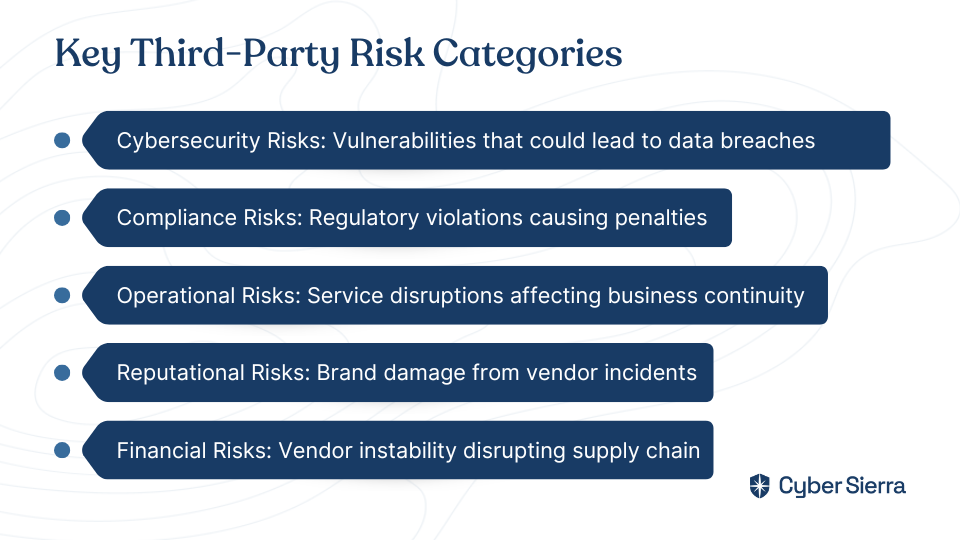
Beyond basic cybersecurity, third parties introduce various risks that often go unmonitored between assessments:
The Dangerous Consequences
This outdated approach creates significant blind spots:
- Lack of Real-Time Visibility: Static assessments provide only a snapshot that's outdated almost immediately
- Inability to Scale: Manual processes become unsustainable as your vendor ecosystem grows
- Delayed Threat Detection: Without continuous oversight, new vulnerabilities or security incidents in a vendor's environment can go unnoticed for months
The AI Engine: How Anomaly Detection Redefines Risk Monitoring
Anomaly detection is the process of identifying unusual patterns or outliers that don't conform to expected behavior within a dataset. In cybersecurity and third-party risk management, this capability is revolutionary.
The Technology Behind the Curtain
AI and machine learning models analyze vast streams of data to establish a baseline of "normal" behavior for each vendor. When deviations occur, these systems can flag potential risks in real-time. Key technologies powering this transformation include:
- Recurrent Neural Networks (RNNs): These are effective at processing sequential data (like logs or network traffic over time) because they have a "memory" of previous inputs, making them ideal for detecting temporal anomalies.
- Long Short-Term Memory (LSTM) Networks: An advanced type of RNN that excels at complex risk assessment tasks. They can learn long-term dependencies in data, even in noisy environments, to detect subtle changes that might indicate a compromise.
Unlike traditional rule-based systems that can only detect known threats, AI-powered anomaly detection can identify novel or zero-day threats without prior knowledge of specific attack signatures.
The Top 5 Ways AI is Revolutionizing TPRM
1. From Static Questionnaires to Continuous, Real-Time Monitoring
AI enables a fundamental shift from periodic checks to constant evaluation, providing real-time visibility into a vendor's security posture. This is achieved by continuously analyzing data from multiple sources:
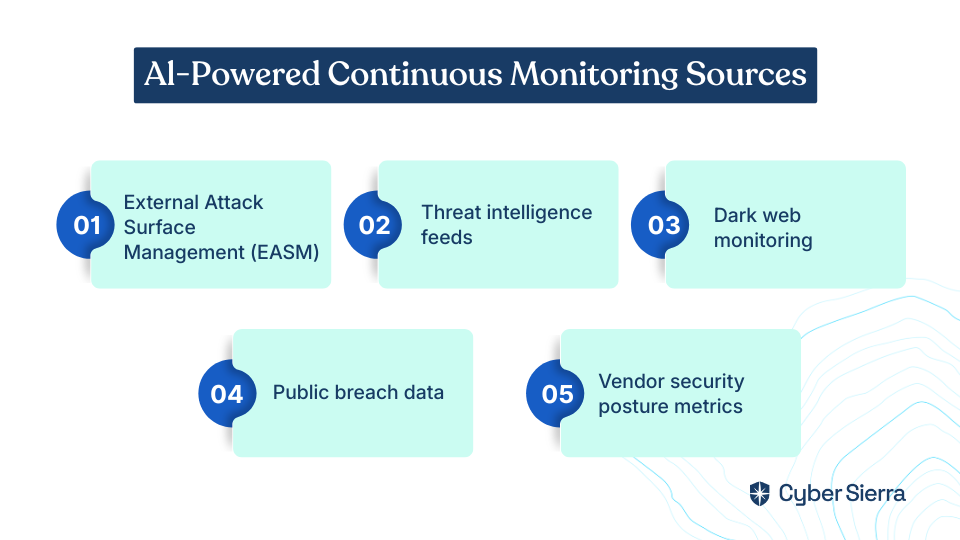
Cybersierra's TPRM Platform exemplifies this approach, providing "near real-time, 24/7 visibility into vendors' security compliance with alerts for corrective actions," transforming TPRM into a proactive, ongoing process.
2. Automating the Full Vendor Risk Lifecycle
AI-powered platforms automate tedious, manual tasks, directly solving the pain of assessments that just "sit in a folder."
- Automated Assessment & Onboarding: AI can automatically send, collect, and analyze vendor questionnaires, flagging responses that require attention
- Risk Prioritization: Algorithms can automatically categorize vendors into high, medium, or low risk level tiers based on their access to sensitive data and the results of continuous monitoring
- Remediation Tracking: Instead of a dead-end process, findings are automatically tracked, and reminders are sent until remediation is confirmed, creating a closed-loop system
3. Gaining Predictive Insights to Proactively Mitigate Threats
AI moves beyond simple detection. By analyzing historical data and trends, it can perform predictive analytics to forecast potential risks before they materialize.
For example, an AI model might flag a vendor showing a gradual degradation in security hygiene (e.g., more open ports, slower patching cadence) as being at high risk for a future breach, allowing your organization to intervene before an incident occurs. This shift from reactive to proactive risk management represents one of the most significant advantages of AI in TPRM.
4. Enhancing Detection Accuracy and Slashing False Positives
A major challenge in security monitoring is "alarm fatigue" from excessive false positives. AI models help solve this by continuously learning and refining their understanding of what constitutes a genuine anomaly versus benign noise.
Machine learning models improve over time as they process more data, leading to increasingly accurate alerts. This directly addresses concerns about the "accuracy of AI models" by emphasizing the self-improving nature of these systems.
5. Scaling TPRM Programs for the Modern Enterprise
Manually managing risk for hundreds or thousands of third parties is impossible. AI provides the scalability needed to monitor a vast vendor ecosystem simultaneously without a proportional increase in headcount or resources.
This allows organizations to apply a consistent and high standard of risk management across their entire supply chain, not just their top-tier vendors.
Putting AI to Work: Best Practices for Implementation
Before implementing AI-driven anomaly detection in your TPRM program, consider these best practices:
Start with Clear Objectives: Before looking at any grc tool, answer the question: "What exactly do you want to accomplish with the TPRM program?" Are you focused on compliance, operational resilience, or data breach prevention? Your goals will determine the right solution.
Prioritize Integration: Choose platforms that can integrate with your existing security and IT infrastructure. This ensures a seamless flow of data and avoids creating another information silo.
Centralize and Automate with a Modern TPRM Platform: Leverage technology solutions for automated assessments, continuous monitoring, and threat intelligence integration. A centralized platform helps build a cross-functional TPRM team by giving Security, Legal, Procurement, and Compliance a single source of truth.
This is where a solution like Cyber Sierra shines, by providing an AI-enabled platform that unifies Governance, Risk & Compliance (GRC), Continuous Control Monitoring (CCM), and Third-Party Risk Management (TPRM).
Don't Forget the Human Element: Ensure your team is trained to use the tools effectively and interpret the AI-generated insights to make strategic decisions.
Conclusion
AI-driven anomaly detection is no longer a futuristic concept; it is a fundamental requirement for effective third-party risk management. It transforms TPRM from a static, compliance-focused chore into a dynamic, intelligent, and proactive security function.
By embracing AI, organizations can achieve enhanced resilience, reduce the risk of costly third-party breaches, streamline compliance, and build a more secure vendor ecosystem.
Frequently Asked Questions
What is AI-driven anomaly detection in third-party risk management?
AI-driven anomaly detection is the use of artificial intelligence to continuously monitor vendor data, identify unusual patterns that deviate from normal behavior, and flag potential security risks in real-time. This technology moves beyond static questionnaires by analyzing vast streams of data—such as network traffic, public breach data, and dark web activity—to establish a baseline for each vendor. When a vendor's activity deviates from this baseline, the AI flags it as a potential threat, enabling proactive intervention.
How does AI improve upon traditional vendor risk assessments?
AI improves traditional vendor risk assessments by replacing periodic, manual questionnaires with continuous, automated, and real-time monitoring of your entire vendor ecosystem. While traditional methods provide a static snapshot that quickly becomes outdated, AI provides dynamic visibility. It automates data collection, prioritizes risks based on real-time data, offers predictive insights to prevent future breaches, and scales to cover thousands of vendors without a proportional increase in manual effort.
What are the main benefits of using AI for TPRM?
The main benefits of using AI for TPRM include real-time threat detection, automation of the entire risk lifecycle, predictive risk mitigation, improved accuracy with fewer false positives, and the ability to scale your program effectively. By continuously monitoring vendors, AI helps you spot emerging threats instantly. It automates tedious tasks like sending questionnaires and tracking remediation and can predict which vendors are at high risk for a future breach, allowing you to act proactively.
Can AI-powered TPRM help with compliance requirements?
Yes, AI-powered TPRM significantly helps with compliance by providing continuous evidence of a vendor's security posture and automating the documentation needed for audits. Many regulations require organizations to demonstrate ongoing due diligence for their third parties. AI provides a constant stream of monitoring data and generates alerts for non-compliant activities, creating a detailed, auditable trail that proves you are proactively managing vendor risk.
What is the first step to implementing an AI-driven TPRM program?
The first step to implementing an AI-driven TPRM program is to define your objectives clearly by identifying what specific risks you want to mitigate, such as data breach prevention, operational resilience, or regulatory compliance. Once your goals are set, you can evaluate modern TPRM platforms that offer AI-powered continuous monitoring and automation. Starting with a clear strategy ensures you choose the right technology to solve your most pressing vendor risk challenges.
Does AI replace the need for human oversight in TPRM?
No, AI does not replace the need for human oversight in TPRM; it enhances it by automating repetitive tasks and providing actionable intelligence. AI acts as a powerful assistant for your security team, handling the heavy lifting of data collection and analysis. This frees up human experts to focus on strategic decision-making, investigating complex alerts, and collaborating with vendors on remediation.
Stop letting vendor assessments languish in forgotten folders. It's time to move beyond the spreadsheet. To see how an AI-enabled platform can automate and elevate your vendor risk management, explore Cyber Sierra's Third-Party Risk Management (TPRM) solution or book a demo to witness continuous monitoring in action.
