
Top 7 Reasons Why Traditional GRC Tools Fail CISOs


Join thousands of professionals and get the latest insight on Compliance & Cybersecurity.
Summary
- With data breaches up 72% between 2021 and 2023, it's evident that traditional GRC tools are failing to protect modern enterprises.
- Key failures of legacy GRC include siloed operations, reliance on error-prone manual processes, and a lack of real-time visibility, leading to critical security blind spots.
- To build a resilient security posture, organizations must move from periodic audits to a continuous, automated, and integrated approach to risk management.
- Cyber Sierra’s Governance, Risk & Compliance (GRC) platform helps unify compliance frameworks, automate monitoring, and manage vendor risk from a single source of truth.
Is your GRC tool just expensive "shelfware"? Are you tired of chasing a "blinking green light dashboard" that only automates the "low hanging fruit"? You're not alone.
In an era where the threat landscape is constantly evolving, traditional Governance, Risk, and Compliance (GRC) tools are falling dangerously short of protecting organizations. With data breaches seeing a staggering 72% increase from 2021 to 2023, it's clear that legacy approaches are inadequate for modern challenges.
This article explores the seven critical ways traditional GRC tools are failing security leaders and how a shift towards an integrated, continuous, and intelligent platform is essential for survival and success in today's threat landscape.
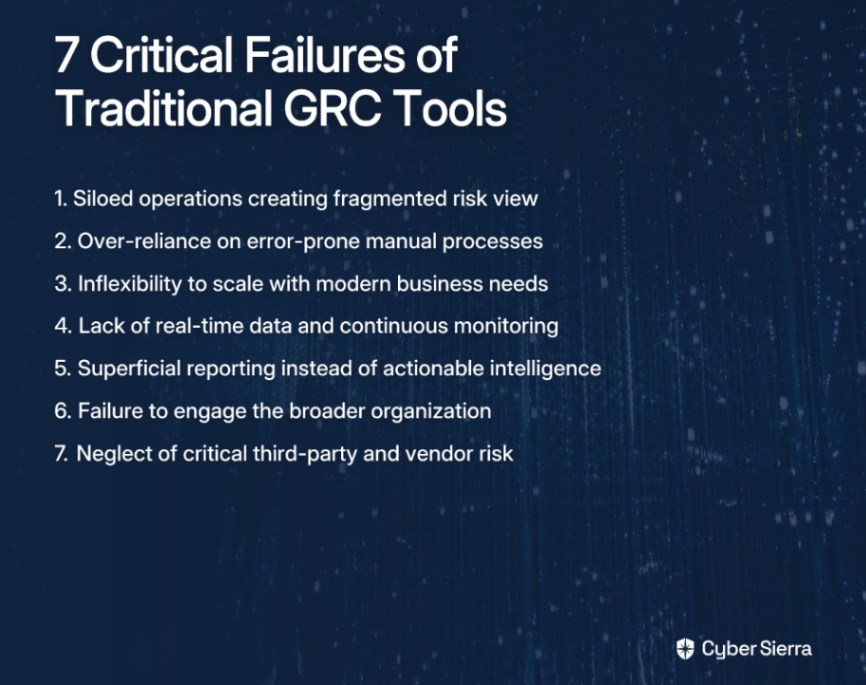
1. They Operate in Silos, Creating a Fragmented View of Risk
Traditional GRC tools often operate as isolated systems for governance, risk, and compliance, preventing a unified, holistic view of the organization's security posture.
Many organizations use separate tools for different frameworks—one for ISO 27001, another for SOC2, and yet another for HIPAA—increasing management complexity and crippling visibility. This leads to inconsistent data, process duplication, and scattered information, making it impossible to get a single source of truth.
For CISOs, this fragmentation means they cannot accurately assess overall risk or make informed, strategic decisions. They're left trying to piece together a puzzle with missing pieces, often resulting in dangerous blind spots and redundant controls.
2. Over-Reliance on Manual Processes Prone to Human Error
Legacy GRC systems are heavily dependent on manual data collection, spreadsheet tracking, and periodic updates. This is not only inefficient but also a breeding ground for costly errors.
Many GRC processes are secondary to core business operations, leading to incomplete and inaccurate information because they are not integrated into daily workflows. This manual approach consumes valuable time and resources, diverting security teams from proactive risk management to repetitive administrative tasks.
The result? "Compliance fatigue" sets in. Teams are burned out, and the risk of a critical mistake slipping through the cracks increases exponentially. Audit preparation becomes a frantic, last-minute fire drill that distracts from actual security improvement.
3. Inflexibility and Inability to Scale with Modern Business
Traditional tools are rigid. They cannot easily adapt to new regulations, evolving business needs, or the modern threat landscape. They are often built on outdated threat models and frameworks that don't address current cyber risks from cloud infrastructure, SaaS applications, and complex supply chains.
As a business grows, these tools become a bottleneck. They can't scale to manage new compliance requirements, leading to fractured systems and duplicated efforts. This inflexibility forces the CISO to manually "crosswalk" controls between standards and find workarounds, hindering agility and slowing down business innovation.
4. Lack of Real-Time Data and Continuous Monitoring
Legacy GRC relies on point-in-time assessments and manually updated data, leaving massive visibility gaps between audits. A lot can go wrong in the weeks or months between checks.
This lack of integration with live security and IT platforms means incident response is delayed, as teams cannot correlate compliance controls with real-time security events. Users have expressed frustration with tools that simply provide a "blinking green light dashboard" without offering genuine, continuous visibility.
Effective risk management requires real-time data access. Without it, CISOs are making critical decisions based on outdated information, lacking the continuous visibility needed to proactively identify and remediate security gaps before they become breaches.
5. Superficial Reporting Instead of Actionable Intelligence
These tools often generate simplistic, high-level reports that fail to provide the granular detail needed for data-driven decision-making. This is the "blinking green light dashboard" that creates a false sense of security.
Without real-time analytics, assessing compliance status becomes guesswork, and strategic planning is hampered by a reliance on outdated information.
This superficial reporting makes it impossible for CISOs to prioritize remediation efforts effectively or confidently report the organization's true security posture to the board or executives. It's no wonder that many security leaders view their GRC tools as "solutions searching for dollars rather than solutions for solving problems," as one user aptly put it.
6. They Fail to Engage the Broader Organization
Traditional GRC tools are often complex systems used only by a small GRC team. This fosters a cultural divide where the rest of the organization sees security and compliance as a bureaucratic burden, not a shared responsibility.
Successful security programs involve everyone. When tools fail to engage all team members, a culture of security cannot take root. This creates tension between security/GRC specialists and engineering/IT teams, who may see compliance tasks as a hindrance to their work.
The CISO struggles to get organizational buy-in as a result. The "human firewall" remains weak, and security becomes an isolated function rather than an integrated part of the business culture, leaving the organization vulnerable to attacks that exploit human factors.
7. They Neglect Critical Third-Party and Vendor Risk
The supply chain is a primary attack vector, yet most traditional GRC tools have poor or non-existent vendor risk management capabilities. They do not effectively manage vendor compliance or provide a way to conduct customized security assessments for third parties.
This leaves the organization blind to significant risks introduced by its vendors and partners. The CISO has limited control or visibility over a massive portion of the company's attack surface, making third-party risk one of the most dangerous blind spots in the security program.
The Way Forward: From Legacy GRC to an Integrated Platform
The failures of traditional tools highlight the need for a fundamental shift in approach—from periodic, manual, and siloed GRC to a continuous, automated, and unified strategy.
This is where modern, AI-enabled platforms are changing the game. By integrating multiple security functions into a single platform, they address the core failures of legacy systems head-on:
Breaking Silos
Modern platforms provide a central controls repository and dashboard, offering a single source of truth. Solutions like Cyber Sierra's GRC module allow managing multiple frameworks like SOC2, ISO 27001, and HIPAA from one place, eliminating the fragmentation that plagues traditional approaches.
Embracing Automation
Next-generation platforms automate data collection, risk assessments, and evidence gathering. Continuous Control Monitoring (CCM) capabilities provide near real-time updates and detect anomalies automatically, freeing up teams for strategic work rather than manual data entry.
Achieving Real-Time Visibility
CCM offers ongoing visibility into security controls, transforming security from periodic checks to a continuous, proactive process. This addresses the dangerous gap between audits that traditional tools leave open.
Managing Vendor Risk
Dedicated modules like Third-Party Risk Management (TPRM) automate vendor assessments and provide 24/7 visibility into vendor security posture, closing one of the most significant blind spots in traditional GRC approaches.
Fostering a Security Culture
Integrated platforms can include modules for Employee Security Training, using simulated phishing campaigns and interactive learning to strengthen the human firewall across the entire organization, not just the security team.
Providing Actionable Intelligence
Modern platforms leverage AI and advanced analytics to transform raw data into actionable intelligence. Rather than simply showing a "blinking green light," they provide context-aware insights that help prioritize remediation efforts based on real risk, not just compliance checklists.
Adapting to Changing Requirements
Cloud-native solutions can quickly adapt to new regulations, business models, and threat vectors through regular updates and flexible architectures, eliminating the rigidity that makes traditional tools obsolete so quickly.
Building a Proactive and Resilient Security Posture
The era of managing risk with disconnected spreadsheets and outdated GRC tools is over. They are inefficient, inflexible, and create dangerous blind spots that leave organizations vulnerable to evolving threats.
For today's CISOs, the mission is to build a security program that is proactive, not reactive. This requires adopting a modern platform that provides:
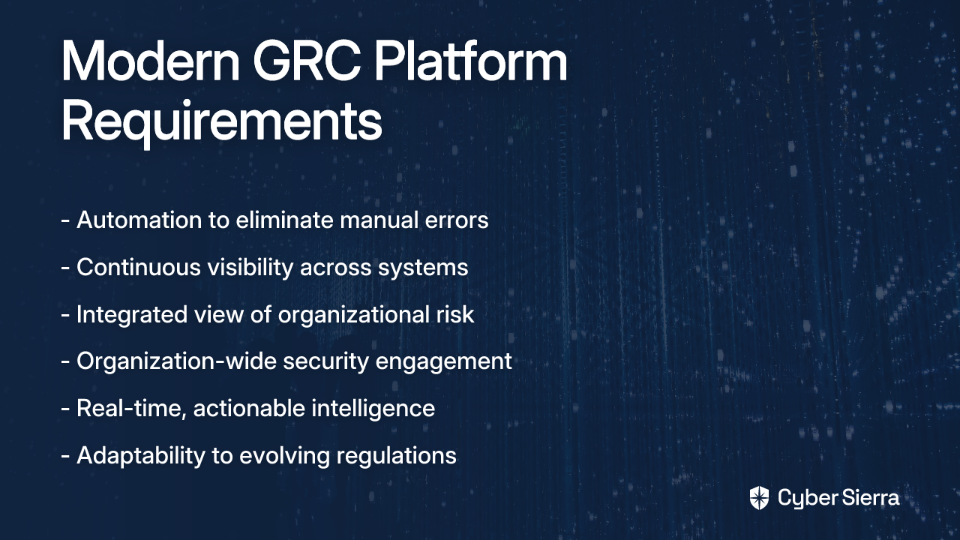
- Automation to eliminate manual errors and free up resources
- Continuous visibility instead of point-in-time snapshots
- An integrated view of risk across the entire digital ecosystem
- Tools that engage the whole organization in security efforts
- Real-time, actionable intelligence for decision-making
- Adaptability to keep pace with evolving regulations and threats
Platforms like Cyber Sierra are leading this transition, helping organizations move beyond traditional GRC's limitations toward a more resilient, continuous approach to security and compliance.
As cyber threats grow more sophisticated and regulatory requirements more complex, CISOs can no longer afford to rely on tools that deliver only "rubber stamping" and superficial compliance. The stakes are too high, and the cost of failure—in terms of breaches, regulatory penalties, and lost trust—is too great.
It's time to move beyond the limitations of traditional GRC and embrace a smarter, more resilient approach to governance, risk, and compliance—one that provides real security, not just the illusion of it.
Frequently Asked Questions
What are the main problems with traditional GRC tools?
Traditional GRC tools primarily fail due to their siloed operations, over-reliance on manual processes, and lack of real-time data. These limitations create a fragmented view of risk, are prone to human error, and cannot scale with modern business needs. They often provide superficial reports instead of actionable intelligence and neglect critical areas like third-party vendor risk, leaving organizations with dangerous security blind spots.
How do modern GRC platforms differ from traditional ones?
Modern GRC platforms differ by being integrated, automated, and continuous, providing a unified view of risk in real-time. Unlike traditional tools that operate in silos, modern solutions consolidate multiple frameworks (like SOC2, ISO 27001) into a single dashboard. They leverage automation for data collection and continuous control monitoring (CCM) to eliminate manual work and provide ongoing visibility, turning compliance from a periodic chore into a proactive security function.
Why is continuous monitoring important for GRC?
Continuous monitoring is important because it closes the dangerous visibility gaps left between traditional point-in-time audits. The threat landscape changes constantly, and manual, periodic checks mean security posture is outdated most of the time. Continuous Control Monitoring (CCM) provides real-time data from your IT and security systems, allowing you to proactively identify and remediate security gaps before they can be exploited, rather than discovering them during an audit.
How can an integrated GRC platform improve vendor risk management?
An integrated GRC platform improves vendor risk management by automating assessments and providing continuous visibility into your entire third-party ecosystem. Many traditional tools have poor or non-existent vendor risk capabilities. Modern platforms with dedicated Third-Party Risk Management (TPRM) modules automate the process of evaluating vendor security posture, monitoring their compliance, and managing risks, effectively closing a major attack vector that is often overlooked.
What is the role of automation in next-generation GRC?
In next-generation GRC, automation's role is to eliminate error-prone manual tasks, free up security teams for strategic work, and provide real-time data for decision-making. Automation handles repetitive tasks like evidence collection, risk assessments, and control monitoring. This not only reduces "compliance fatigue" and the risk of human error but also ensures that the data feeding into your GRC program is timely and accurate, enabling more effective and proactive risk management.
How does a modern GRC tool help build a better security culture?
A modern GRC tool helps build a security culture by making security and compliance a shared, accessible responsibility rather than the exclusive domain of a small team. Traditional tools are often complex and siloed, alienating other departments. Modern platforms are designed to be more user-friendly and can integrate security tasks into daily workflows, engaging the entire organization and strengthening the "human firewall."
Is your organization struggling with the limitations of traditional GRC tools? Learn how Cyber Sierra's integrated platform can transform your approach to security and compliance with automation, continuous monitoring, and actionable intelligence.