



Top 8 CCM Platforms That Integrate with SIEM Tools



Join thousands of professionals and get the latest insight on Compliance & Cybersecurity.
Summary
- Integrating Continuous Control Monitoring (CCM) with SIEM platforms is essential for shifting from reactive, periodic checks to proactive, real-time compliance.
- This integration can reduce incident response times by up to 80% and automates evidence gathering, making your organization continuously audit-ready.
- When choosing a CCM platform, prioritize seamless SIEM integration, industry-specific controls, and scalability to match your environment.
- Cyber Sierra's Continuous Control Monitoring (CCM) module provides an AI-enabled platform to automate these processes, creating a single source of truth for security and compliance.
Are you finding your current compliance tools to be too generic? Part of a small GRC team managing big compliance requirements with a large AWS or Snowflake footprint? Maybe you've been searching for a solution that "does checks in real time, catches issues, and just works without us having to keep an eye on it the whole time."
If any of these pain points sound familiar, you're not alone. Many organizations are discovering that traditional, siloed approaches to compliance no longer suffice in today's complex threat landscape. The key to moving from reactive, periodic checks to proactive, continuous assurance lies in integrating Continuous Control Monitoring (CCM) with Security Information and Event Management (SIEM) platforms.
This article explores why this integration is a game-changer for modern security and compliance programs and introduces the top 8 CCM platforms that excel at seamlessly working with SIEM tools.
Why Integrating CCM with SIEM is a Non-Negotiable Strategy
Traditional compliance approaches suffer from a fundamental flaw: they're often siloed and point-in-time, creating dangerous visibility gaps. SIEMs excel at detecting threats, but without GRC context, security teams struggle to map these threats to specific compliance controls. Similarly, CCM platforms automate control checks but need real-time event data from SIEMs to be truly effective.
The solution? A unified approach that bridges the gap between security operations and compliance requirements.
Key benefits of integrating CCM with SIEM include:
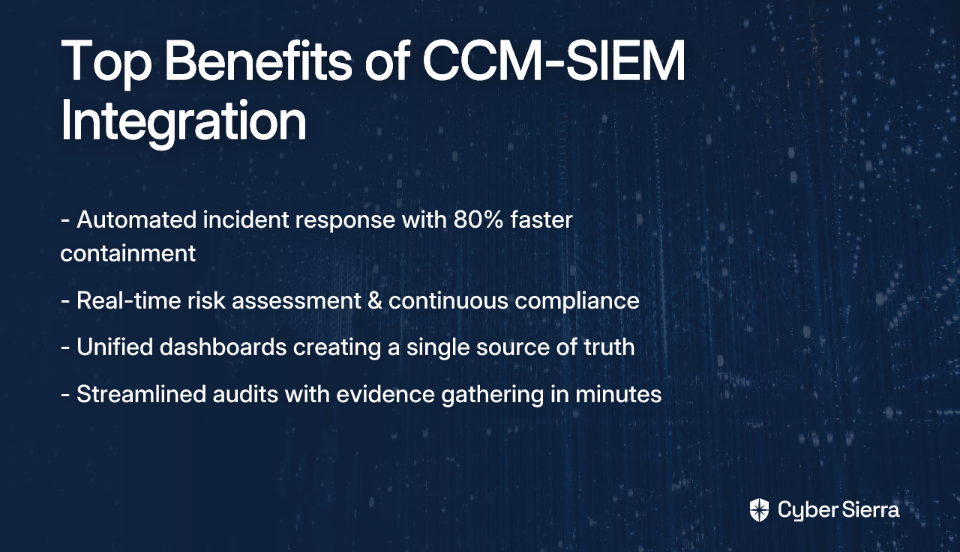
- Automated Incident Response: SIEM alerts can automatically trigger workflows in the CCM/GRC tool to flag non-compliant controls. This integration can reduce the time from detection to containment by up to 80%, dramatically improving your security posture.
- Real-Time Risk Assessment & Continuous Compliance: Move beyond periodic audits. This integration provides continuous visibility into control effectiveness, allowing organizations to maintain a compliant status at all times and achieve true "audit readiness."
- Unified Dashboards for a Single Source of Truth: Break down silos between security and compliance teams. A unified view helps both teams understand the full context of risks and events, improving collaboration and response times.
- Streamlined Audits: Automate the painful process of evidence gathering. The integration allows teams to pull real-time data from the SIEM as evidence for control effectiveness, transforming audit preparation "from weeks into minutes."
Let's explore the top 8 CCM platforms that offer powerful SIEM integration capabilities to help you achieve these benefits.
The Top 8 CCM Platforms with Powerful SIEM Integration
1. Cyber Sierra
Overview: Cyber Sierra stands out as an AI-enabled platform designed to transform security from periodic checks into a continuous, automated assurance model. It's purpose-built to address the pain points of manual evidence collection and lack of real-time posture visibility.
Key CCM & SIEM Integration Features:
- The Continuous Control Monitoring (CCM) module builds a central controls repository with near real-time updates by ingesting data from various sources, including SIEMs.
- Automates control testing and validation, detecting exceptions and anomalies as they happen. This provides the "hands-off" experience many GRC teams desire.
- Integrates with its own Threat Intelligence module for vulnerability scanning and attack surface insights, enriching compliance data with security context.
- Manages multiple compliance frameworks out-of-the-box (NIST, ISO 27001, PCI DSS, GDPR, SOC 2, HIPAA), avoiding the "generic" feel by offering industry-specific customizations.
Best For: CISOs and Compliance Managers who need a unified, single source of truth for controls; organizations in regulated industries (Financial Services, Healthcare) needing tailored compliance monitoring; teams looking to automate manual evidence gathering for multiple frameworks.
Unique Selling Point: Cyber Sierra excels at bridging the gap between security operations and compliance by providing a holistic platform that combines CCM, GRC, TPRM, and threat intelligence, enabling truly proactive risk management.
2. MetricStream
Overview: A mature GRC platform known for its configurable workflows and ability to integrate GRC operations with real-time SIEM data.
Key Features: Provides a unified view of security and compliance by correlating SIEM events with GRC controls.
Strengths: Strong, established GRC capabilities with extensive compliance framework support.
Limitations: Its CCM can be periodic rather than truly continuous and may require significant customization to achieve real-time assurance.
Best For: Organizations with established GRC programs looking to incrementally enhance their monitoring capabilities.
3. Splunk
Overview: While primarily a SIEM, Splunk offers extensive GRC and compliance capabilities through its apps and add-ons, like the user-mentioned "Q-compliance."
Key Features: Offers extensive integration capabilities and customizable reporting tools. Users can build their own CCM workflows and set alerts on control failures.
Strengths: Highly flexible and powerful for organizations already invested in the Splunk ecosystem. It can ingest data from virtually any source.
Limitations: Requires significant expertise and resources to configure and maintain for CCM purposes. It's not a purpose-built, out-of-the-box CCM solution.
Best For: Tech-savvy security teams with deep Splunk expertise who want to build a custom CCM solution on top of their existing SIEM.
4. IBM Security QRadar
Overview: A leading SIEM platform that incorporates compliance monitoring features tailored for highly regulated industries.
Key Features: Provides real-time threat detection correlated with compliance mandates. Features behavioral profiling and extensive integration options.
Strengths: Excellent for threat intelligence and real-time event correlation.
Limitations: Like Splunk, its CCM capabilities are an extension of its core SIEM function rather than a standalone, dedicated CCM module.
Best For: Enterprises, especially in finance and healthcare, that need a powerful SIEM with integrated compliance reporting features.
5. LogRhythm
Overview: A SIEM platform that facilitates automated compliance reporting and offers integrated Security Operations Center (SOC) features.
Key Features: AI-based threat detection, customizable dashboards, and automated workflows for compliance management.
Strengths: Strong focus on automating compliance tasks directly within the SIEM environment.
Limitations: The focus is more on security-first use cases, with compliance being a key feature rather than the core product.
Best For: Organizations looking for a SIEM that can heavily automate compliance reporting for frameworks like PCI DSS and HIPAA.
6. Rapid7 (InsightIDR)
Overview: A cloud-native SIEM (InsightIDR) that provides unified visibility across security and compliance data.
Key Features: Centralized log management, network security scanning, and user behavior analytics to provide context around security events.
Strengths: User-friendly interface and strong detection and response capabilities.
Limitations: Less focused on the GRC workflow and control management aspects compared to dedicated CCM platforms.
Best For: Teams that want a modern, cloud-native SIEM with built-in compliance dashboards and easy-to-use reporting.
7. Sumo Logic
Overview: A cloud-native platform for continuous intelligence, offering a Cloud SIEM solution with strong compliance monitoring capabilities.
Key Features: Provides continuous monitoring and analytics to help organizations understand their real-time compliance status. Includes User and Entity Behavior Analytics (UEBA).
Strengths: Excellent for cloud-heavy environments (addressing the "big AWS footprint" pain point). Strong in data analytics and visualization.
Limitations: May require configuration to map security events to specific GRC controls comprehensively.
Best For: Cloud-native companies that need deep visibility into their infrastructure and want to leverage a data analytics platform for security and compliance.
8. Exabeam
Overview: A security management platform known for its advanced analytics and machine learning to enhance threat detection.
Key Features: Uses AI and ML to minimize false positives and provide context-rich timelines of security incidents, which can be mapped to compliance controls.
Strengths: Powerful behavioral analytics that can detect insider threats and compromised credentials, which are critical for many compliance frameworks.
Limitations: Primarily a security tool; integrating it deeply into a GRC/CCM workflow may require custom work or third-party connectors.
Best For: Security-mature organizations that want to leverage advanced AI/ML for threat detection as a source of evidence for their CCM program.
How to Choose the Right CCM Platform for Your Needs
With so many options available, finding the right fit can be daunting—especially when you've been "trying Wiz and a few others" without success. Here are some actionable criteria, based on industry best practices, to help you make the right choice:

- Focus on Your Specific Needs: Are you in a regulated industry? Do you have a "big AWS footprint" or use Snowflake? Don't settle for a generic tool if you need specialized controls. As one user put it, "Wiz compliance is very generic," so consider solutions with customization options for your unique environment.
- Ease of Integration: Ensure the platform has pre-built connectors (plugins) for your existing systems (SIEM, cloud providers, vulnerability scanners) to avoid heavy customization. Look for platforms that mention "the most plugins" for your tech stack.
- Scalability: Choose a solution that can grow with your business and handle increasing data volumes and compliance frameworks. This is especially important for organizations with "big infrastructure, big compliance requirements."
- Ease of Use: Look for an intuitive interface and automation features that deliver a "hands-off" experience, reducing the burden on your team. As one user noted about their chosen solution, "It does checks in real time, catches issues and just works without us having to keep an eye on it the whole time."
- Budget and ROI: Consider both initial and recurring costs. Evaluate the platform's value in terms of time saved on audits, reduced manual effort, and proactive risk mitigation.
Conclusion
The era of manual, periodic compliance checks is over. The future requires an integrated, automated approach where CCM and SIEM work in tandem to provide real-time assurance and continuous compliance monitoring.
When evaluating platforms, look beyond flashy features to find solutions that truly understand the need to bridge the gap between compliance requirements and security operations. Consider tools like Cyber Sierra, which are purpose-built to deliver this unified vision, ensuring resilience against evolving threats and complex regulatory challenges.
By selecting the right CCM platform with robust SIEM integration, you can transform your compliance program from a periodic, resource-intensive burden into a continuous, automated advantage that enhances your overall security posture and readiness for whatever audit comes your way.
Frequently Asked Questions
What is Continuous Control Monitoring (CCM)?
Continuous Control Monitoring (CCM) is an automated process that continuously tests and validates the effectiveness of your organization's security and compliance controls in near real-time. Instead of relying on periodic, manual checks (like quarterly or annual audits), CCM uses technology to constantly monitor your systems, applications, and infrastructure to ensure they remain compliant with internal policies and external regulations.
Why is integrating a CCM platform with a SIEM so important?
Integrating a CCM platform with a SIEM is crucial because it bridges the gap between security operations and compliance management, creating a single source of truth for your organization's risk posture. This integration allows you to correlate real-time security events (from the SIEM) with specific compliance controls (in the CCM), enabling automated incident response, continuous risk assessment, and dramatically streamlined audit preparation.
What's the difference between a SIEM with compliance features and a dedicated CCM tool?
The primary difference lies in their core focus. A SIEM (Security Information and Event Management) is fundamentally a security tool designed for real-time threat detection, log aggregation, and incident analysis. While many SIEMs have compliance reporting features, these are often an extension of their security function. A dedicated CCM platform, on the other hand, is purpose-built for compliance management, focusing on automating control testing, evidence collection, and managing multiple compliance frameworks. A CCM provides the GRC context that a SIEM often lacks.
How does a CCM-SIEM integration help with audit readiness?
A CCM-SIEM integration significantly improves audit readiness by automating the evidence collection process, which is often the most time-consuming part of an audit. Instead of manually gathering screenshots and reports, the integrated system can pull real-time data and logs from the SIEM as direct evidence that a control is operating effectively. This transforms audit preparation from a process that takes weeks into one that can be done in minutes, ensuring you are always "audit-ready."
Can these platforms monitor compliance in cloud environments like AWS or Snowflake?
Yes, modern CCM platforms are specifically designed to monitor complex cloud environments. Leading solutions offer pre-built integrations with major cloud providers like AWS, Azure, and Google Cloud, as well as data platforms like Snowflake. They can ingest data from cloud-native security tools and logs to continuously assess controls related to configuration, access management, data protection, and more, addressing the challenges of managing compliance in a large cloud footprint.
What key criteria should I use to select the right CCM platform?
When selecting a CCM platform, you should focus on several key criteria to ensure it fits your organization's needs. Look for a platform that:
- Addresses your specific industry and environment, offering customization beyond generic templates.
- Integrates easily with your existing security stack, especially your SIEM and cloud services.
- Is scalable to handle growing data volumes and additional compliance frameworks.
- Offers an intuitive user interface and high levels of automation to reduce the manual workload on your team.
