



How AI Is Changing Enterprise Risk Management

Join thousands of professionals and get the latest insight on Compliance & Cybersecurity.
Summary
- Traditional enterprise risk management is failing, with Gartner reporting that less than 20% of risk owners meet mitigation expectations due to reactive, manual processes.
- AI transforms ERM from a periodic chore into a proactive, continuous discipline, enabling real-time control monitoring, predictive vendor risk assessment, and proactive threat intelligence.
- The key takeaway for professionals is that AI will augment, not replace, their roles; future success depends on leveraging AI to focus on strategic judgment and complex problem-solving.
- Organizations can begin this transformation by implementing a strong governance framework and starting with high-impact pilot projects using integrated platforms like Cyber Sierra's GRC solution to automate compliance and gain a unified view of risk.
"I'm growing increasingly concerned at the future of a career in risk management with how many layoffs I'm seeing..."
"AI could probably do a year's worth of work in a day..."
Sound familiar? These anxieties, expressed in recent online discussions among risk professionals, reflect a growing uncertainty about how artificial intelligence will reshape enterprise risk management (ERM). But here's the reality that's emerging: AI won't replace you, but a risk manager using AI will.
The End of Reactive Risk Management
Traditional enterprise risk management has long been characterized by its limitations:
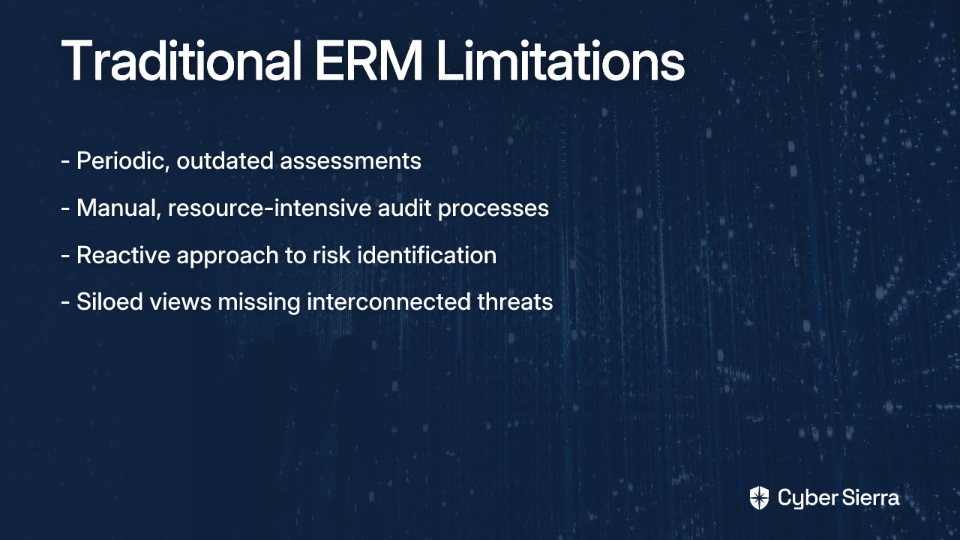
- Periodic, point-in-time assessments that quickly become outdated
- Manual, resource-intensive evidence collection for audits
- Reactive approaches that identify risks after they've materialized
- Siloed views that miss interconnected threats
These constraints have led to a concerning statistic: according to Gartner, less than 20% of enterprise risk owners are meeting risk mitigation expectations. This critical gap in delivering high-quality risk information and intended risk reductions reveals the shortcomings of traditional approaches.
AI is fundamentally transforming ERM from a reactive, periodic exercise into a proactive, continuous, and predictive discipline. For risk professionals who adapt, this shift represents an opportunity to add more strategic value than ever before.
The AI Revolution in Core Risk Functions
From Periodic Audits to Continuous Control Monitoring (CCM)
The "reactivity cycle" of compliance—where teams scramble for evidence before audits, only to discover failures too late—is being disrupted by AI-powered continuous control monitoring.
The Problem: Manual monitoring is ineffective, with 59% of organizations citing resource constraints as a key barrier. Teams can't keep up with the volume, velocity, and variety of data needed to monitor controls effectively.
The AI Solution: AI-powered CCM automates the validation of security and compliance controls in near real-time:
- Automated Evidence Collection: AI agents gather audit-ready evidence for frameworks like ISO 27001, SOC2, PCI DSS, GDPR, and HIPAA without constant human intervention.
- Predictive Analytics: AI identifies patterns in control data to predict potential failures before they happen, shifting from reactive to preventive risk management.
- Dynamic Adaptation: AI models can adapt to new regulations, reducing the manual effort of updating compliance programs.
Modern platforms like Cyber Sierra's Continuous Control Monitoring (CCM) module operationalize this approach by building a central controls repository with near real-time updates, providing actionable risk intelligence for data-driven remediation, and automating control testing to detect anomalies in real-time.

Supercharging Third-Party Risk Management (TPRM)
The Problem: The expanding web of third-party relationships creates unmonitored "fourth-party" risks. Traditional annual risk assessments can't keep pace. According to EY's Global TPRM Survey, operational risk has become a top priority for 57% of organizations, up from 40% in 2023.
The AI Solution: AI enables a shift to continuous, data-driven vendor monitoring:
- Real-time Monitoring: AI algorithms scan diverse external data sources (news, financial reports, cyber threat intelligence) to assess vendor risk continuously rather than annually.
- Predictive Insights: AI can predict potential supply chain disruptions or vendor failures, allowing for proactive mitigation strategies.
- Efficiency Gains: AI automates the tedious process of sending, collecting, and analyzing vendor security questionnaires.
Despite these benefits, only 13% of companies have fully integrated AI into their TPRM processes, often due to fragmented structures and cost concerns. Solutions like Cyber Sierra's TPRM platform address this by automating vendor assessments, providing 24/7 visibility into vendor compliance, and streamlining the due diligence process.
Proactive Threat Intelligence and Cybersecurity
The Problem: Traditional cybersecurity is often reactive, detecting breaches after damage has occurred. The complexity of modern threats outpaces manual assessment capabilities.
The AI Solution: AI enhances cybersecurity by identifying threats before they are exploited:
- Anomaly Detection: AI algorithms establish a baseline of normal network activity and flag deviations in real-time, indicating a potential threat.
- Vulnerability Prioritization: AI analyzes vulnerabilities across the attack surface and prioritizes them based on exploitability and potential business impact.
- Automated Response: AI can initiate rapid incident response actions to contain threats faster.
This is where tools like Cyber Sierra's Threat Intelligence module come into play, offering comprehensive security scorecards, network and cloud vulnerability scanning, and an outside-in view of the attack surface.
Navigating the Challenges and Risks of AI in ERM
Despite its potential, integrating AI into ERM comes with significant challenges that must be addressed head-on.
The "Black Box" Problem
Risk professionals are understandably "fussy about avoiding black-box solutions" that can't be explained or audited. This concern is valid and requires attention to:
- Explainability (XAI): AI models used in risk management must be transparent and auditable, especially for regulators. Decisions must be traceable to specific inputs and reasoning.
- AI Bias: AI models can amplify flaws and biases present in their training data, potentially leading to discriminatory risk assessments. Continuous monitoring and auditing of AI systems is essential.
The Regulatory Minefield
"Good luck explaining to the regulators that 'AI' is running your risk management program" is a common sentiment that highlights the regulatory challenges.
- Emerging Regulations: The EU Artificial Intelligence Act could impose fines of up to €35 million or 7% of global revenue for non-compliance by 2026. Similar regulations are emerging globally.
- Human-in-the-Loop: Full automation can be risky from both a regulatory and practical standpoint. The most effective approach combines AI's processing power with human oversight, judgment, and ultimate accountability.
AI as a New Risk Surface
As one risk professional aptly noted, "AI is a risk in and of itself." Deploying AI introduces new vulnerabilities:
- Data Poisoning & Prompt Injections: These emerging threats can corrupt AI models or manipulate their outputs, potentially introducing severe risks into automated decision-making.
- Model Drift: AI models can degrade over time as conditions change, requiring continuous monitoring and retraining.
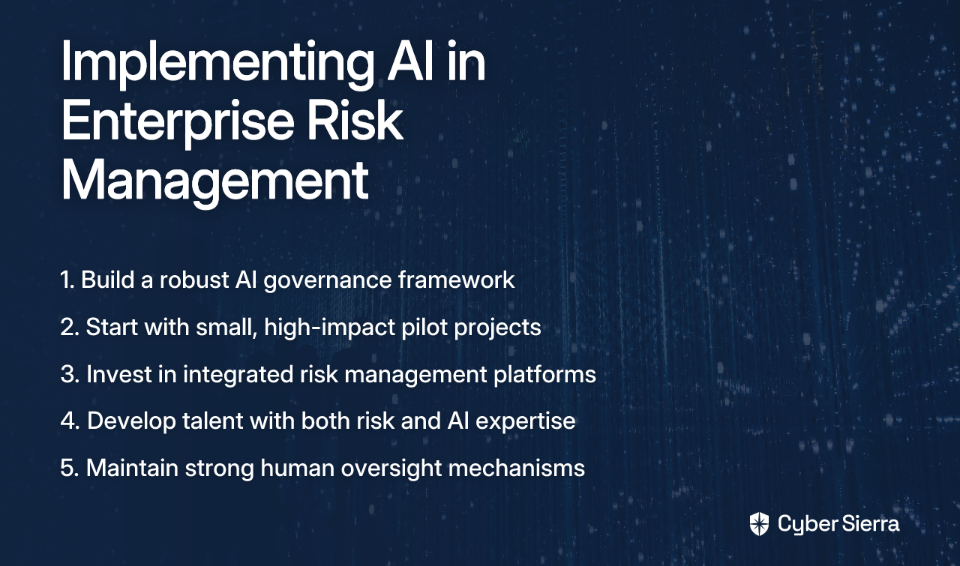
Effective mitigation requires robust safeguards, attack simulation, and maintaining strong human oversight mechanisms.
A Practical Framework for AI Adoption in ERM
For Organizations: A Phased Approach
- Build a Governance Framework: Establish clear policies on AI use, data privacy, ethical considerations, and compliance oversight before full-scale deployment. This is critical for managing the risks of AI itself.
- Start Small, Prove Value: Don't try to boil the ocean. Identify one critical, high-impact control or process for a pilot program. For example, automate evidence collection for a single compliance framework before expanding to broader applications.
- Invest in Integrated Platforms: Break down data silos with unified platforms. An integrated solution like Cyber Sierra's GRC platform provides a single source of truth by connecting governance, risk, compliance, third-party risk management, and threat intelligence, giving leaders a holistic view of their risk posture.
For Professionals: Future-Proofing Your Career
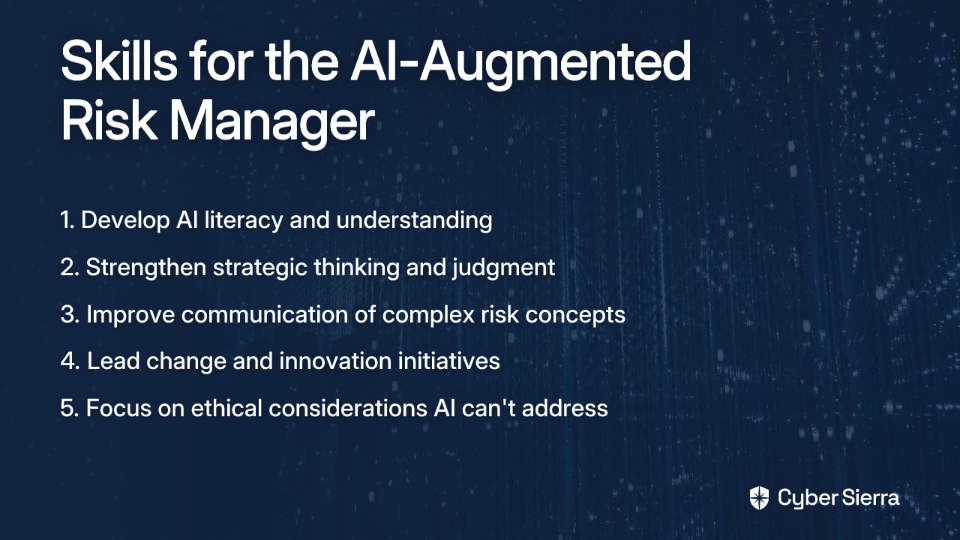
The central message from industry discussions is clear: "Learn how to use AI to your advantage and you will be fine." Here's how:
- Become AI-Literate: You don't need to be a data scientist, but you should understand the principles, capabilities, and limitations of AI in risk management. Pursue training and certification in AI for risk management.
- Develop Strategic Skills: Focus on skills AI can't replicate: critical thinking, ethical judgment, complex problem-solving, and communicating risk to leadership. AI handles the "what," you explain the "so what" and "now what."
- Champion Change: Be the person in your organization who understands both risk management principles and the potential of new technology. Lead pilot projects and demonstrate the value of an AI-augmented approach.
The Augmented Risk Manager
AI is not a distant threat but a present-day reality that is transforming ERM into a more proactive, predictive, and efficient function. The future belongs not to AI alone, but to the augmented risk manager who leverages AI to:
- Process vast amounts of data that would overwhelm human analysts
- Identify patterns and correlations invisible to the human eye
- Automate routine compliance tasks to focus on strategic risk management
- Provide near real-time risk intelligence to inform better decisions
The goal is not just to manage risk, but to turn risk management into a strategic enabler of business growth. AI is the key to unlocking that potential.
As regulatory requirements grow more complex and threats evolve more rapidly, organizations that strategically integrate AI into their ERM frameworks—with appropriate governance, explainability, and human oversight—will gain a significant competitive advantage.
The question is no longer whether AI will transform risk management, but whether you and your organization will lead or follow in that transformation.
Frequently Asked Questions
Will AI replace risk management professionals?
No, AI is not expected to replace risk management professionals. Instead, it will augment their capabilities by automating routine tasks and providing deeper insights, allowing them to focus on strategic decision-making, ethical judgment, and complex problem-solving. The professionals who will thrive are those who learn to leverage AI tools to their advantage.
How does AI change traditional enterprise risk management?
AI transforms traditional enterprise risk management from a reactive, periodic process into a proactive, continuous, and predictive discipline. While traditional methods rely on point-in-time assessments that quickly become outdated, AI enables continuous control monitoring, real-time threat intelligence, and predictive analytics to identify and mitigate risks before they materialize.
What are the main benefits of using AI in risk management?
The main benefits of using AI in risk management are increased efficiency, deeper predictive insights, and real-time monitoring across core functions. AI automates tedious processes like evidence collection for audits (Continuous Control Monitoring), continuously assesses third-party vendor risks (TPRM), and proactively identifies cybersecurity threats, allowing teams to manage risks more effectively with data-driven decisions.
What are the biggest challenges when implementing AI for risk management?
The biggest challenges include the "black box" problem (lack of model transparency), navigating a complex and emerging regulatory landscape, and managing AI itself as a new potential risk surface. Organizations must ensure AI models are explainable and auditable, comply with new laws like the EU AI Act, and protect against new threats like data poisoning and model drift. Strong human oversight is essential to mitigate these challenges.
How can an organization start implementing AI in its risk management program?
An organization can start by building a strong AI governance framework, beginning with small, high-impact pilot projects, and investing in integrated risk management platforms. It's crucial to first establish clear policies for AI use. Then, prove AI's value by automating a specific process, such as evidence collection for one compliance framework, before scaling up.
What skills do risk managers need to stay relevant in the age of AI?
To stay relevant, risk managers should focus on developing AI literacy, strengthening strategic and critical thinking, and improving communication skills. While deep technical expertise isn't required, understanding AI's capabilities and limitations is key. The most valuable skills are those AI cannot replicate: ethical judgment, complex problem-solving, and effectively communicating risk insights to leadership.
Cyber Sierra provides an AI-enabled cybersecurity platform designed to simplify and automate security compliance for enterprises through Continuous Control Monitoring, Third-Party Risk Management, GRC automation, and proactive Threat Intelligence. Learn more at cybersierra.co.
