



NIST CSF Scoring Across Industries: 5 Benchmark Standards for 2026



Join thousands of professionals and get the latest insight on Compliance & Cybersecurity.
Summary
- Key Stats: By 2026, industries should target specific NIST CSF 2.0 maturity levels, such as Financial Services (80%+, Tier 3-4), Healthcare (75%+, Tier 3), and Technology (85%+, Tier 4).
- Key Learnings: The new 'Govern' function in NIST CSF 2.0 elevates cybersecurity to a strategic, enterprise-level risk, requiring executive oversight and accountability.
- Key Action Items: Use the CSF to create a "Current Profile" of your security posture and a "Target Profile" for your goals; this gap analysis will form your strategic improvement plan.
- Automate Your GRC: Achieving these benchmarks requires moving from periodic checks to a continuous approach. Cybersierra's GRC platform automates evidence collection and provides industry-specific templates to track progress in near real-time.
If you've ever found yourself thinking, "I'm having a rough time finding benchmarking data by industry for Cybersecurity Maturity," you're not alone. This valuable data is often guarded as "intellectual property" by major consulting firms, making it nearly impossible for most organizations to access reliable benchmarks to measure themselves against.
The good news? The NIST Cybersecurity Framework (CSF) provides a common language and structure to solve this problem. With the release of NIST CSF 2.0 in February 2024, organizations of all sizes now have an expanded framework focused on better risk management and security posture improvement.
This article delivers five concrete benchmark standards for 2026 across financial services, healthcare, manufacturing, retail, and technology sectors. These benchmarks will help you "sanity check" your current security posture and plan strategically for the future.
Understanding NIST CSF 2.0: The Foundation for Benchmarking
Before diving into industry-specific benchmarks, let's establish a shared understanding of NIST CSF 2.0's key components:
Core Functions
The framework is organized around six core functions:

- Identify: Develop organizational understanding to manage cybersecurity risk
- Protect: Develop safeguards to ensure delivery of critical services
- Detect: Develop activities to identify cybersecurity events
- Respond: Develop activities to take action regarding a detected event
- Recover: Develop activities to restore capabilities impaired by a cybersecurity event
- Govern (new in 2.0): Elevates cybersecurity to an enterprise-level risk with three categories:
- Organizational Context (GV.OC): Links cybersecurity to organizational goals
- Oversight (GV.OV): Ensures executive visibility and accountability
- Risk Management Strategy (GV.RM): Establishes a formal strategy for managing cyber risk
Implementation Tiers
NIST CSF defines four tiers of cybersecurity maturity, which are crucial for self-assessment and benchmarking:

- Tier 1 (Partial): Ad hoc, reactive security measures
- Tier 2 (Risk-Informed): Approved risk practices, but applied inconsistently
- Tier 3 (Repeatable): Formalized, consistently applied policies and procedures
- Tier 4 (Adaptive): Proactive, predictive, and continuously improving based on threat intelligence
Profiles
Profiles allow an organization to tailor the CSF to its specific needs, objectives, and industry risks. Creating a Current Profile (where you are) and a Target Profile (where you want to be) enables strategic planning and gap analysis.
For a deeper dive into these components, refer to the official NIST CSF 2.0 document.
5 Industry Benchmark Standards for NIST CSF Scoring
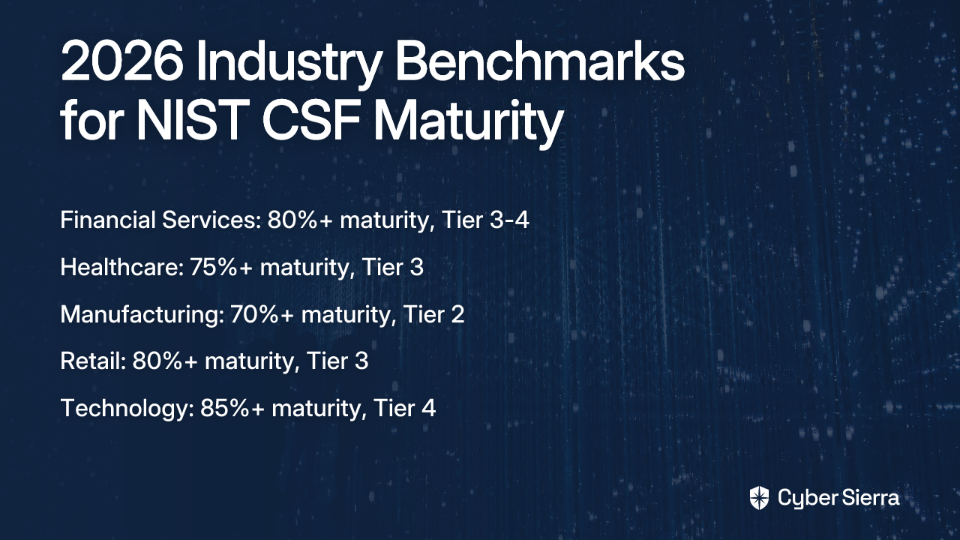
1. Financial Services: The Gold Standard for Governance and Resilience
Benchmark Goal (2026): Aim for over 80% maturity in key areas like Identity Management and Incident Response. Target a Tier 3 (Repeatable) or Tier 4 (Adaptive) maturity level.
Industry Context: Financial institutions face heavy regulatory oversight and must align with industry-specific guidance like the Financial Services Sector Cybersecurity Profile (CRA) and the Cyber Risk Institute's Profile V2.0, which aligns completely with NIST CSF 2.0.
Common Gaps: The financial sector often struggles with inadequate data encryption, underdeveloped incident response plans, and significant risks from third-party vendors. As one security professional noted, "Trying to manage their security questionnaires, compliance certs, and risk assessments is becoming a massive operational bottleneck."
CSF 2.0 Focus: The new Govern function is critical for demonstrating executive oversight. The enhanced focus on Supply Chain Security is non-negotiable for financial institutions, given their complex vendor ecosystems.
How Cyber Sierra Helps: Achieving a Tier 4 posture requires moving beyond periodic checks. Cyber Sierra's AI-enabled platform helps track progress against these benchmarks with industry-specific templates. Our Governance, Risk & Compliance (GRC) module automates data collection for the Govern function, while the Third-Party Risk Management (TPRM) platform provides near real-time visibility into vendor security, streamlining assessments and moving beyond static questionnaires.
2. Healthcare: Protecting Patients and Critical Data
Benchmark Goal (2026): A minimum of 75% maturity in Risk Assessment and Asset Management. The target is a solid Tier 3 (Repeatable) maturity.
Industry Context: Healthcare organizations must focus on protecting Protected Health Information (PHI), ensuring data availability for patient care, and adhering to HIPAA regulations. The HPH Sector CSF Implementation Guide provides specialized guidance for this sector.
Common Gaps: Healthcare frequently suffers from insufficient access controls, reliance on outdated software and legacy systems, and poor visibility into the security of connected medical devices (IoMT).
CSF 2.0 Focus: Prioritize the Identify function (specifically Asset Management) to gain a full inventory of all systems and devices handling PHI. The Protect function (Access Control) is critical for enforcing least-privilege principles in clinical environments.
Achieving the Benchmark: Cyber Sierra's Continuous Control Monitoring (CCM) module provides a near real-time, centralized view of security controls. It automatically detects anomalies and policy exceptions, helping identify outdated systems and weak access controls before auditors do.
3. Manufacturing: Securing the Convergence of IT and OT
Benchmark Goal (2026): Achieve over 70% maturity in Asset Management and Continuous Monitoring. A key goal for many is progressing from Tier 1 (Partial) to a stable Tier 2 (Risk-Informed) level.
Industry Context: Manufacturing faces the unique challenge of protecting both Information Technology (IT) and Operational Technology (OT), including legacy systems, interconnected supply chains, and high-value intellectual property. The specialized NIST CSF 2.0 Profile for Semiconductor Manufacturing provides a valuable model.
Common Gaps: Manufacturers typically struggle with lack of visibility into OT environments, insecure legacy equipment, and an IT/OT skills gap that complicates security implementation.
CSF 2.0 Focus: Implementation should follow practical, OT-specific steps:
Identify: Use passive discovery tools for asset mappingProtect: Implement OT-specific endpoint protection and USB whitelistingDetect: Deploy OT network intrusion detection systems and log correlationRespond: Establish OT-inclusive incident response playbooks
(Source)
Achieving the Benchmark: Cyber Sierra's Threat Intelligence platform provides an outside-in view of your attack surface, conducting network and cloud vulnerability scanning to identify risks in converged IT/OT environments before they can be exploited.
4. Retail: Defending the Point-of-Sale and Customer Trust
Benchmark Goal (2026): Reach 80% or higher in Access Control and Awareness & Training. Aim for Tier 3 (Repeatable) practices.
Industry Context: Retail organizations manage high-volume transactions, customer Personally Identifiable Information (PII), and must maintain strict PCI DSS compliance requirements.
Common Gaps: The retail sector often suffers from weak external perimeter defenses on point-of-sale (POS) systems and insufficient employee security training, making staff a primary target for phishing attacks.
CSF 2.0 Focus: The Protect function (specifically Awareness and Training) is a top priority to build a strong "human firewall." The Detect function is also critical for identifying anomalous network behavior that could indicate a POS system compromise.
Achieving the Benchmark: Address the human element head-on with Cyber Sierra's Employee Security Training module, which empowers your workforce with interactive training, quizzes, and simulated counter-phishing campaigns to build a resilient, security-conscious culture.
5. Technology Sector: Protecting Innovation at Speed
Benchmark Goal (2026): Aim for 85% maturity in Threat Detection and Response capabilities. A Tier 4 (Adaptive) posture is the gold standard.
Industry Context: The technology sector is characterized by rapid innovation, agile development cycles (DevOps), and the need to protect both valuable intellectual property and massive volumes of user data.
Common Gaps: Technology companies often struggle with insufficient threat intelligence sharing and difficulty embedding security practices into fast-paced development pipelines (DevSecOps).
CSF 2.0 Focus: Heavy emphasis on the Respond and Recover functions, with a focus on automation and speed. The Govern function is key to ensuring security is a strategic consideration from the start, not an afterthought.
Achieving the Benchmark: A proactive, integrated approach is essential. Cyber Sierra's Threat Intelligence platform delivers proactive insights into your attack surface, while our CCM and GRC modules ensure that continuous monitoring and compliance are woven directly into your workflows, supporting a mature DevSecOps culture.
Moving Beyond Numbers: Building True Cyber Resilience for 2026
NIST CSF scores are more than a compliance checkbox—they're a strategic tool for communicating risk to the board, prioritizing investments, and driving continuous improvement. The benchmarks established here provide a roadmap for where your organization should aim to be by 2026, based on industry best practices and emerging threats.
However, remember that the ultimate goal isn't just achieving a specific score but building a resilient security program tailored to your organization's unique risk landscape. According to a McKinsey survey on organizational cyber maturity, organizations that focus on continuous improvement rather than point-in-time assessments consistently show greater resilience against emerging threats.
To effectively track your progress toward these industry benchmarks, you need:

- Continuous visibility into your control effectiveness
- Industry-contextualized assessment templates
- Automated evidence collection to reduce manual effort
- Executive-friendly dashboards to communicate progress
Cyber Sierra provides all these capabilities in a unified platform, helping you move from reactive, point-in-time assessments to a proactive, continuous monitoring approach. Our industry-specific templates align directly with the benchmarks outlined in this article, giving you confidence that you're measuring what matters most for your sector.
Frequently Asked Questions
What is a good NIST CSF maturity score?
A "good" NIST CSF maturity score depends heavily on your industry, risk tolerance, and regulatory requirements. For example, by 2026, a financial services firm should aim for an 80%+ maturity score (Tier 3-4), while a manufacturing company may target 70%+ (Tier 2). The goal is to align your score with your specific risk profile rather than chasing a universal number.
How do I start implementing NIST CSF 2.0?
To start implementing NIST CSF 2.0, begin by creating a "Current Profile" to assess your existing cybersecurity practices against the framework's functions and categories. Next, establish a "Target Profile" that defines your desired maturity level. This gap analysis forms the basis of your strategic roadmap for prioritizing security improvements.
What is the biggest change in NIST CSF 2.0?
The most significant change in NIST CSF 2.0 is the addition of the Govern function. This new core function elevates cybersecurity from a purely technical issue to a strategic, enterprise-level risk management concern. It emphasizes executive oversight, accountability, and the integration of cybersecurity strategy with overall business objectives.
Why are cybersecurity benchmarks different for each industry?
Cybersecurity benchmarks differ by industry because each sector faces unique threat landscapes, regulatory pressures, and operational risks. For instance, healthcare must prioritize protecting patient data (PHI) under HIPAA, while manufacturing needs to secure both IT and Operational Technology (OT) systems. Tailored benchmarks ensure security efforts are relevant and effective for the specific risks an industry confronts.
What are the NIST CSF Implementation Tiers?
The NIST CSF Implementation Tiers describe the maturity of an organization's cybersecurity risk management practices. They range from Tier 1 (Partial), where practices are ad hoc and reactive, to Tier 4 (Adaptive), where an organization is proactive and continuously improving its security posture based on predictive threat intelligence and lessons learned.
How can I measure my organization's NIST CSF score?
You can measure your NIST CSF score by conducting a self-assessment against the framework's core functions and categories, often using spreadsheets or specialized software. For a more robust and continuous approach, platforms like Cyber Sierra use automated evidence collection and Continuous Control Monitoring (CCM) to provide a near real-time, data-driven view of your maturity against industry-specific templates.
Ready to See Where You Stand?
Struggling to measure your NIST CSF maturity against your industry peers? Wondering if your security investments are focused on the right priorities? Cyber Sierra provides the visibility, automation, and industry-specific templates you need to move from guesswork to a data-driven security program.
Contact us today to see how your organization stacks up against these 2026 benchmarks and get a personalized roadmap for achieving cyber resilience in your industry.
