



SaaS Vendor Compromise Prevention: How to Build a Continuous Monitoring Strategy in 2026


Join thousands of professionals and get the latest insight on Compliance & Cybersecurity.
Summary
- Traditional vendor security checks create dangerous blind spots, with 46% of companies assessing vendors monthly or less while breaches take an average of 277 days to contain.
- Shifting from periodic assessments to continuous monitoring provides real-time visibility into your vendors' security posture, allowing you to detect threats before they escalate into breaches.
- Implement a continuous monitoring framework by prioritizing vendors based on risk, establishing clear security mandates in contracts, and automating control testing.
- A unified platform like Cyber Sierra can automate this process by integrating Continuous Control Monitoring (CCM) and Third-Party Risk Management (TPRM) for a complete view of vendor risk.
Are you tired of the last-minute chaos before an audit? Worried about the growing security debt from unaddressed vendor risks? The complexity of maintaining compliance in a cloud-centric environment can be overwhelming, especially when it comes to your SaaS vendors.
The vendor ecosystem has become the new frontier for cyberattacks. The infamous SolarWinds hack, which impacted 18,000 organizations through a single compromised vendor update, proved that your security is only as strong as your weakest link. And yet, most organizations continue to rely on outdated, point-in-time security assessments that leave dangerous blind spots between audits.
In 2026, moving from periodic checks to a continuous, automated monitoring strategy is no longer a luxury—it's a necessity for survival. This guide will show you how to shift from reactive to proactive approaches by implementing a comprehensive continuous monitoring framework that catches security lapses before they become breaches.
The Escalating Threat: Why Traditional Vendor Security Fails
The statistics around SaaS vendor compromise are alarming:
- In 2024, a staggering 41% of third-party breaches affected healthcare organizations alone, demonstrating the widespread vulnerability across sectors.
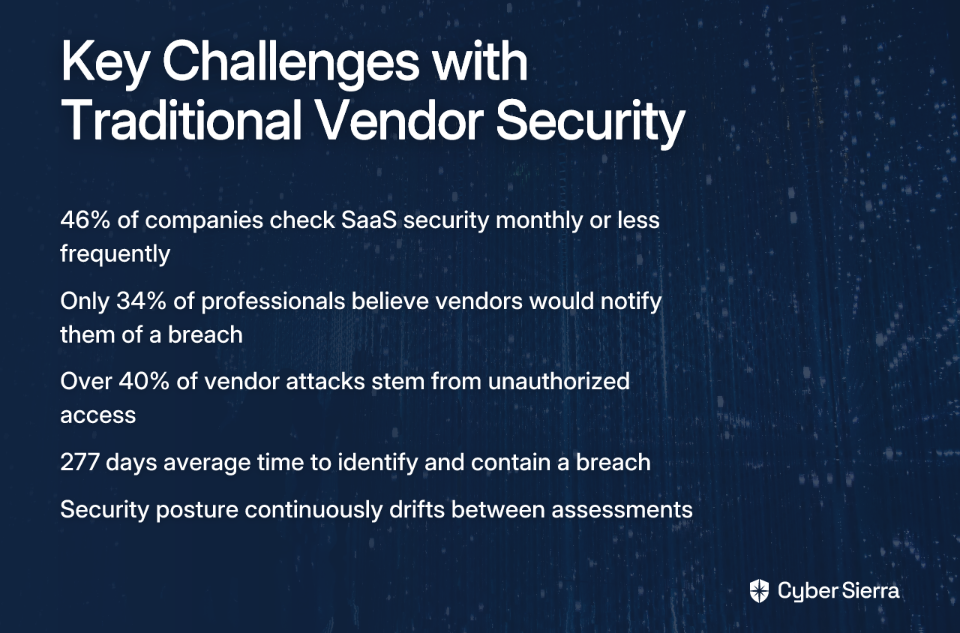
- According to research, 46% of companies conduct SaaS security checks monthly or less frequently, while another 5% don't check at all. This leaves critical vulnerabilities undetected for weeks or even months.
- A Ponemon Institute study found that only 34% of security professionals are confident that their vendors would notify them of a breach.
The fundamental problem lies in the outdated approach to vendor security. Traditional methods rely on point-in-time assessments—annual questionnaires, periodic audits, and compliance certifications that represent a snapshot of a vendor's security posture at a specific moment.
But what happens the day after an assessment? Or the week after? Or six months later?
The reality is that security postures drift. Configurations change, new vulnerabilities emerge, and compliance gaps develop. Over 40% of vendor attacks stem from unauthorized access, a risk that periodic checks easily miss. This "security drift" creates an expanding blind spot that grows larger with each passing day after an assessment.
When the next annual review finally comes around, it's often too late—the damage has already been done.
The Paradigm Shift: From Point-in-Time to Continuous Monitoring
The solution to this growing threat is a paradigm shift in how we approach vendor security—moving from reactive, point-in-time assessments to proactive, continuous monitoring.
Continuous monitoring is exactly what it sounds like: an ongoing process of collecting and analyzing real-time data about your vendors' security posture. Rather than relying on annual questionnaires or certifications, you maintain constant visibility into your vendors' compliance with security requirements, configurations, and potential vulnerabilities.
The benefits of this approach are substantial:
1. Drastically Reduced Time to Detection
According to IBM, the average time to identify and contain a data breach is 277 days. That's more than nine months during which attackers can freely access your systems and data. Continuous monitoring aims to shrink this window from months to minutes, allowing you to detect and respond to issues before they become breaches.
2. Measurable Efficiency Improvements
Organizations using continuous monitoring tools resolve SaaS misconfigurations 73% faster than those relying on manual methods. The majority (73%) resolve issues within a day, compared to a month or longer for those without automated monitoring capabilities.
3. Compliance as a Competitive Advantage
Regulations like GDPR, HIPAA, and DORA implicitly require continuous oversight of vendors. By automating this process, compliance becomes a seamless, ongoing activity rather than a periodic, resource-draining fire drill. This not only helps avoid legal penalties but also builds trust with customers and partners who increasingly demand proof of robust security practices.
4. Resource Optimization
Security teams are chronically understaffed and overwhelmed. Continuous monitoring automates routine tasks, freeing up your team to focus on strategic initiatives rather than chasing down vendor questionnaires or scrambling to prepare for audits.
The core pillars of this new approach are Continuous Control Monitoring (CCM) and Third-Party Risk Management (TPRM)—two complementary capabilities that, when integrated, provide complete visibility across your vendor ecosystem.
Building Your Continuous Monitoring Framework: A 5-Step Guide
Implementing a continuous monitoring strategy for SaaS vendor compromise prevention isn't as daunting as it might seem. Here's a step-by-step approach to building a robust framework by 2026:
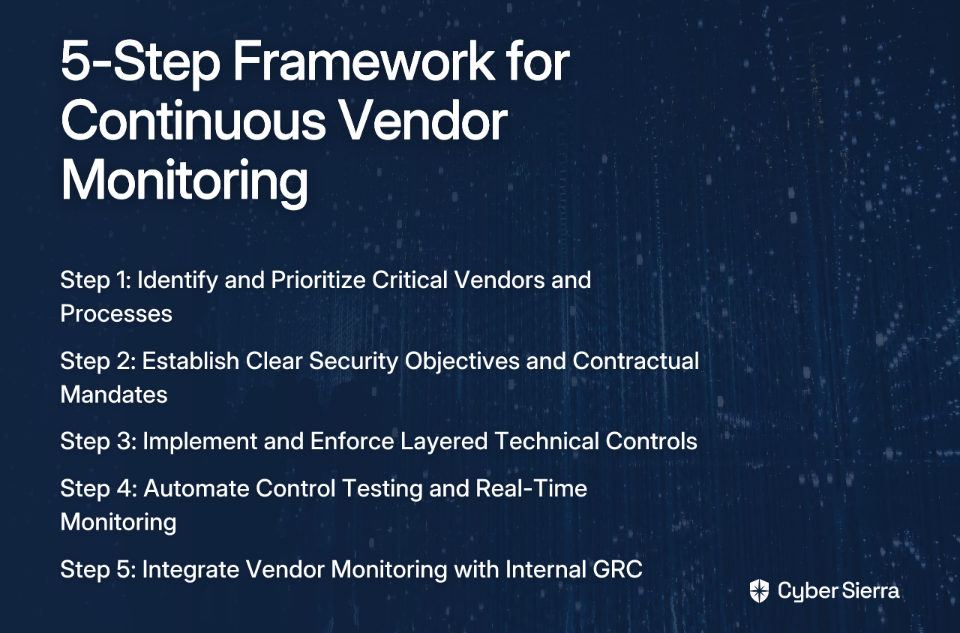
Step 1: Identify and Prioritize Critical Vendors and Processes
Not all vendors pose the same level of risk. Begin by mapping your vendor ecosystem and prioritizing based on:
- Risk Ranking: List vendors by their associated risks (financial, operational, regulatory) and prioritize controls that target the riskiest ones.
- Data Sensitivity: Identify which vendors have access to your most sensitive data or critical systems.
- Business Impact: Assess how a compromise of each vendor would impact your operations.
For example, a vendor with access to your customer PII or financial data would be classified as high-risk and prioritized for continuous monitoring, while a newsletter service with minimal data access might require less rigorous oversight.
Cyber Sierra's TPRM module can assist with this initial assessment by automatically categorizing vendors based on risk levels and data access, ensuring you focus your resources where they matter most.
Step 2: Establish Clear Security Objectives and Contractual Mandates
Don't just trust; verify and codify. Your vendor relationships should have clear security expectations formalized in contracts:
- Define Security Controls in Contracts: Mandate prompt breach notifications (within 24-72 hours), required security audits (SOC 2, ISO 27001), and compliance with relevant industry regulations.
- Set SMART Objectives: Ensure control objectives are Specific, Measurable, Attainable, Relevant, and Time-bound to provide clear benchmarks for performance.
- Include Right-to-Audit Clauses: Reserve the right to conduct security assessments or request evidence of control effectiveness at any time, not just during scheduled audits.
These contractual mandates serve as the foundation for your continuous monitoring program, establishing both expectations and consequences for non-compliance.
Step 3: Implement and Enforce Layered Technical Controls
Establish non-negotiable security baselines for vendor access:
- Principle of Least Privilege: Limit vendor access to only the data and systems absolutely necessary for their function. Avoid default admin-level access.
- Identity and Access Control: Enforce multi-factor authentication (MFA) for all vendor personnel with data access and monitor identity management practices.
- Request a Software Bill of Materials (SBOM): An SBOM provides a comprehensive list of components in your vendor's software, allowing you to proactively identify and manage vulnerabilities in their supply chain.
These technical controls create a security foundation that continuous monitoring can build upon.
Step 4: Automate Control Testing and Real-Time Monitoring
This is where the manual-to-automated shift happens. Develop automated tests to continuously check control effectiveness, reducing manual oversight and human error.
Cyber Sierra's Continuous Control Monitoring (CCM) module transforms this strategy by providing:
- A central repository for all security controls with near real-time updates
- Automated testing and validation of control effectiveness
- Real-time detection of exceptions and anomalies
- Actionable risk intelligence to prioritize remediation efforts
Instead of waiting for an annual report, you get a live view of your vendors' security posture against frameworks like NIST, ISO 27001, and PCI DSS. This allows you to identify issues as they emerge rather than discovering them months later during an audit.
Step 5: Integrate Vendor Monitoring with Internal GRC for a Unified View
Vendor risk is not a silo; it's part of your overall risk landscape. A truly effective strategy connects external vendor monitoring with your internal Governance, Risk, and Compliance (GRC) program.
This is achieved by combining CCM with a robust Third-Party Risk Management (TPRM) solution. Integrating these capabilities provides:
- A single source of truth for vendor security posture
- Clear visibility into how vendor security impacts your overall compliance status
- Automated workflows for remediation when issues are detected
- Comprehensive reporting for stakeholders and auditors
By integrating CCM and TPRM, you can see not only if a vendor's controls are failing but also how that failure impacts your organization's risk score and compliance status, enabling data-driven decisions about vendor relationships.
Automate Your Vendor Security Posture for 2026 and Beyond
In 2026, relying on manual, point-in-time vendor checks is an invitation for a breach. The future belongs to organizations that embrace proactive, automated, and continuous monitoring strategies.
This approach doesn't just prevent SaaS vendor compromise; it eliminates audit chaos, reduces security debt, and empowers your team to focus on strategic initiatives rather than chasing down paperwork. The continuous monitoring framework outlined above provides:
- Early detection of security drift before it leads to a breach
- Automated evidence collection that simplifies compliance with frameworks like SOC 2 and ISO 27001
- Real-time visibility into your entire vendor ecosystem
- Data-driven insights that enable proactive risk management
Cyber Sierra provides the unified AI-enabled platform to make this a reality. By seamlessly integrating Continuous Control Monitoring and Third-Party Risk Management, we give you complete, real-time visibility across your entire vendor ecosystem, transforming your approach to vendor security from reactive to proactive.

Ready to move beyond the checklist and build a resilient vendor security program? See how Cyber Sierra can automate your continuous monitoring strategy. Book a demo today.
Frequently Asked Questions
What is continuous monitoring for vendor security?
Continuous monitoring for vendor security is an automated, ongoing process of collecting and analyzing real-time data about your vendors' security posture. Unlike traditional point-in-time assessments (like annual questionnaires), it provides constant visibility into a vendor's compliance, configurations, and potential vulnerabilities. This allows you to detect "security drift" and address issues as they happen, rather than months later during an audit.
Why are traditional vendor security checks no longer effective?
Traditional vendor security checks are no longer effective because they rely on point-in-time assessments, which create dangerous blind spots between audits as security postures continuously change. These outdated methods, such as annual questionnaires and certifications, only capture a vendor's security at a specific moment. The reality is that configurations drift and new vulnerabilities emerge, leaving organizations vulnerable for extended periods.
How does continuous monitoring help with compliance like SOC 2 or ISO 27001?
Continuous monitoring helps with compliance frameworks like SOC 2 and ISO 27001 by automating the collection of evidence and providing real-time validation of security controls. Instead of scrambling to gather evidence before an audit, a continuous monitoring system automatically tests controls against compliance requirements around the clock. This simplifies the audit process, reduces preparation time, and ensures you remain compliant year-round.
What is the difference between CCM and TPRM?
Continuous Control Monitoring (CCM) focuses on automatically testing the effectiveness of a vendor's specific security controls in real-time. In contrast, Third-Party Risk Management (TPRM) is the broader process of identifying, assessing, and mitigating risks associated with all third-party vendors. An effective strategy integrates both: TPRM identifies the risks, and CCM continuously verifies that the controls meant to mitigate those risks are working.
What is the first step to implementing a continuous vendor monitoring program?
The first step to implementing a continuous vendor monitoring program is to identify and prioritize your critical vendors based on the level of risk they pose to your organization. Not all vendors require the same level of scrutiny. Start by mapping your vendor ecosystem and ranking them based on their access to sensitive data and their impact on your business operations. This allows you to focus your initial monitoring efforts where they are needed most.
