



10 Security Continuous Monitoring Tools That Automate Compliance & Reduce Risk

Join thousands of professionals and get the latest insight on Compliance & Cybersecurity.
Summary
- Enterprises are moving away from traditional point-in-time audits towards continuous security monitoring to provide constant proof that security controls are effective.
- AI is a critical component in this shift, with 69% of enterprises leveraging it to automate compliance, detect threats in real-time, and manage risks proactively.
- To select the right tool, assess your organization's security maturity, identify your primary compliance or risk management goals, and prioritize solutions with strong integration and automation features.
- For a unified approach, consider an AI-enabled platform like Cyber Sierra's Continuous Control Monitoring to automate GRC, risk management, and compliance across multiple frameworks.
In today's cybersecurity landscape, enterprises face mounting pressure to move beyond traditional "point-in-time" audits toward continuous security verification. As one security professional confessed, "I've done security for years and don't fully understand what they're asking for." What clients increasingly demand is "ongoing proof that security controls are functioning not just that they existed at audit time."
This shift represents a fundamental evolution in how organizations approach compliance and risk management. But with numerous tools claiming to offer continuous monitoring capabilities, how do you know which solution best fits your organization's needs?
What is Security Continuous Monitoring?
Security Continuous Monitoring (SCM) involves implementing automated systems that constantly assess your organization's security posture, controls, and compliance status in near real-time. Unlike traditional audits that provide a snapshot at a specific moment, continuous monitoring creates an ongoing, dynamic assessment of your security environment.
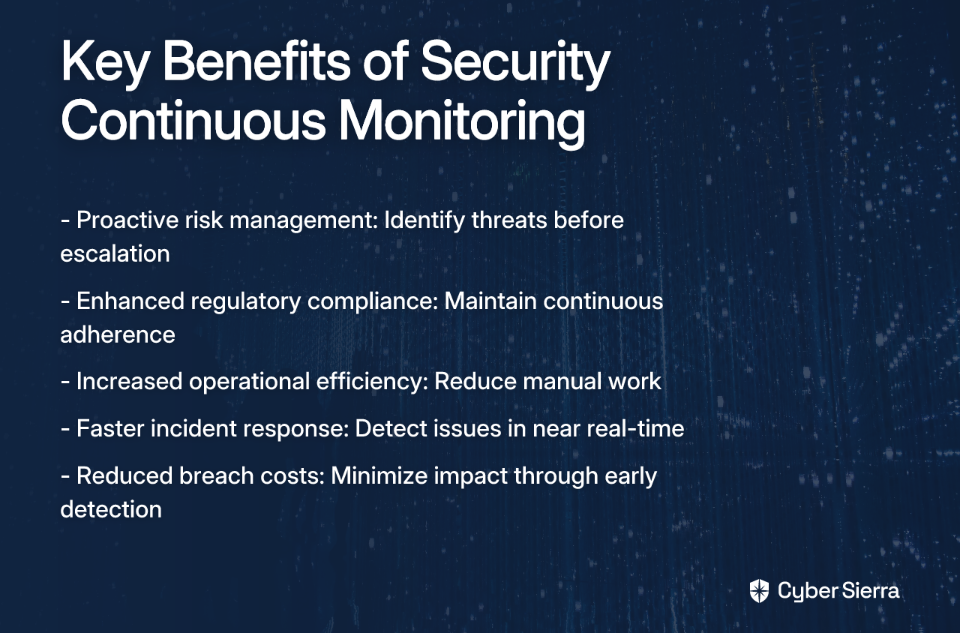
The benefits are substantial:
- Proactive risk management: Identify and address threats before they escalate
- Enhanced regulatory compliance: Maintain continuous adherence to frameworks like SOC 2, ISO 27001, and NIST
- Increased operational efficiency: Reduce manual evidence collection and reporting
- Faster incident response: Detect and remediate issues in near real-time
- Reduced breach costs: Minimize the impact of security incidents through early detection
This approach is increasingly powered by AI, with 69% of enterprises now viewing AI as critical for cybersecurity. The global AI market is projected to grow at a 36.6% CAGR by 2030, signaling a major shift toward intelligent automation in security and compliance.
Let's examine the top 10 security continuous monitoring tools available today, categorized by their primary functions to help you navigate this complex landscape.
Top 10 Security Continuous Monitoring Tools
Category 1: Integrated GRC & Compliance Automation Platforms
1. Cyber Sierra
Best for: Enterprises seeking a unified, AI-enabled platform to automate GRC, risk management, and continuous monitoring across multiple frameworks.
Key Features:
- Continuous Control Monitoring (CCM): Creates a central controls repository with near real-time updates, providing actionable risk intelligence and automating control testing.
- Governance, Risk & Compliance (GRC): Automates data collection for frameworks like SOC2, ISO 27001, GDPR, HIPAA, and PCI DSS.
- Third-Party Risk Management (TPRM): Simplifies vendor risk by automating assessments and providing 24/7 visibility into vendor security compliance.
- Threat Intelligence: Conducts vulnerability scanning across network and cloud infrastructure.
- Employee Security Training: Strengthens the "human firewall" with simulated phishing campaigns.
Why it stands out: Cyber Sierra integrates multiple security functions into a single, AI-driven platform, directly addressing the need for comprehensive continuous monitoring that provides a single source of truth for controls, risks, and compliance.
2. Vanta
Best for: Companies, particularly startups and SMBs, focused on achieving and maintaining compliance for SOC 2 and ISO 27001.
Key Features:
- Automates evidence collection for compliance frameworks
- Integrates with third-party vulnerability scanners like AWS Inspector and Snyk
- Streamlines audit preparation
Why it stands out: Vanta is a leader in compliance automation that simplifies audits by integrating vulnerability visibility, making it ideal for organizations seeking SOC 2 compliance without extensive security teams.
3. Hyperproof
Best for: Organizations looking to streamline compliance operations and risk management.
Key Features:
- Continuous monitoring across critical controls
- Streamlined assessment processes through automation
- Efficient compliance and risk workflow management
Why it stands out: Hyperproof offers robust automation for compliance assessments, making it an excellent option for businesses focused on operationalizing their compliance programs.
Category 2: Vulnerability and Asset Management Tools
4. Syxsense
Best for: Organizations needing strong endpoint security with automated vulnerability scanning and patch management.
Key Features:
- Automates the entire patch scanning and deployment process
- Provides real-time visibility and management of endpoints
- Combines security scanning with IT management functions
Why it stands out: Syxsense delivers targeted endpoint security, ensuring all devices connected to the network are secure and compliant—a critical component of comprehensive continuous monitoring.
5. Panaseer
Best for: Security leaders who need a clear, metric-driven view of their security posture and asset inventory.
Key Features:
- Aggregates data from existing security tools
- Automates vulnerability analysis and remediation prioritization
- Provides robust cyber asset management capabilities
Why it stands out: Panaseer excels at making sense of data you already have, providing a single pane of glass for security posture management and helping prioritize remediation efforts.
6. Jit
Best for: Development and security teams aiming to embed security directly into the software development lifecycle.
Key Features:
- Integrated DevSecOps orchestration platform
- Automates scanning of code changes within developer environments like GitHub and GitLab
- Prioritizes vulnerabilities based on runtime context
Why it stands out: Jit represents the "shift-left" approach to security, aligning with advanced continuous attestation driven by CI/CD pipeline automation.
Category 3: Infrastructure & Log Monitoring Tools
7. Splunk
Best for: Enterprises needing a powerful, highly customizable SIEM solution for deep log analysis and threat detection.
Key Features:
- Supports extensive data ingestion from virtually any source
- Real-time analysis, search, and visualization of machine data
- Highly customizable dashboards and alerting capabilities
Why it stands out: Splunk is an industry standard for log analysis and SIEM, directly addressing the need for "real-time monitoring" as part of a continuous security verification strategy.
8. Nagios
Best for: Organizations seeking a flexible, powerful, and open-source solution for monitoring servers, networks, and applications.
Key Features:
- Comprehensive monitoring of network protocols, services, and system metrics
- Extensible architecture with thousands of community-developed plugins
- Multiple APIs for easy integration with other systems
Why it stands out: As a leading open-source tool, Nagios offers a cost-effective and highly customizable option for teams with the technical expertise to manage it, proving that continuous monitoring doesn't always require a massive budget.
Category 4: Specialized Monitoring Tools
9. Cloudflare
Best for: Any organization with a web presence that needs protection against external threats like DDoS attacks, bots, and application-layer attacks.
Key Features:
- Global Content Delivery Network (CDN) with built-in security
- Web Application Firewall (WAF) and DDoS mitigation
- Zero Trust network access solutions
Why it stands out: Cloudflare provides a critical layer of real-time defense for web-facing assets, an essential component of continuous security monitoring that protects your perimeter.
10. XM Cyber
Best for: Organizations wanting to understand and remediate attack paths before they can be exploited.
Key Features:
- Attack path management and continuous controls monitoring
- Real-time threat detection based on potential attacker movements
- Automated remediation guidance
Why it stands out: XM Cyber offers a unique, attacker-centric perspective on continuous monitoring, focusing on identifying and closing the most critical security gaps that could lead to a breach.
How to Choose the Right Continuous Monitoring Tool
Choosing a tool can feel overwhelming, especially with concerns about cost and complexity. Here's a checklist to guide your decision:
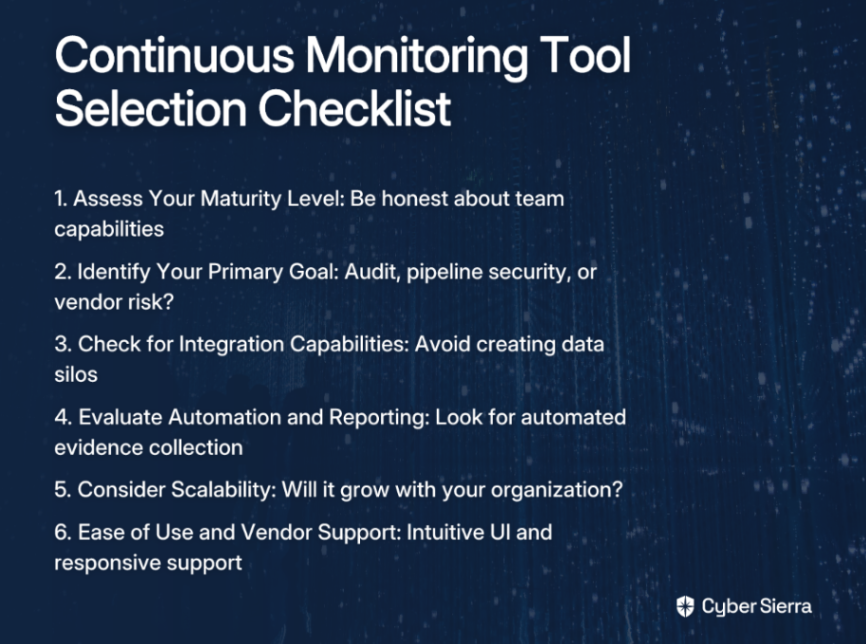
- Assess Your Maturity Level: Be honest about your team's capabilities. Are you ready for a full GRC platform, or should you start with a focused tool like a vulnerability scanner? This addresses the common concern about not operating at the required "Cybersecurity Maturity Level."
- Identify Your Primary Goal: Are you trying to pass a SOC 2 audit, secure your CI/CD pipeline, or gain visibility into vendor risk? Your primary objective will dictate the best tool category.
- Check for Integration Capabilities: The best tools integrate with your existing security stack. Avoid creating more data silos.
- Evaluate Automation and Reporting: Does the tool automate evidence collection and provide audit-ready reports? This saves significant time and effort.
- Consider Scalability: Will the tool grow with your organization? This is crucial for large organizations with "thousands of vendors/providers."
- Ease of Use and Vendor Support: A powerful tool is useless if your team can't use it effectively. Look for an intuitive UI and responsive support.
The Future is AI-Driven: Moving Beyond Traditional Monitoring
Traditional monitoring often relies on periodic scans and manual correlation, leading to alert fatigue and missed threats. The future of compliance and security is intelligent automation.
According to the Cloud Security Alliance, AI is revolutionizing compliance practices in several key ways:
- AI-Enabled Compliance Monitoring: Machine learning algorithms analyze vast volumes of data to detect anomalies and policy violations that humans would miss.
- AI-Driven Incident Response: AI enhances threat detection speed and can automate initial response actions, containing threats faster.
- Predictive Compliance: AI tools can predict potential incidents based on data usage patterns and user behavior, enabling proactive defense.
Platforms like Cyber Sierra are at the forefront of this shift, using AI not just to monitor, but to provide actionable risk intelligence. This moves security from a reactive, checkbox-ticking exercise to a proactive, data-driven strategy.
Conclusion
Continuous monitoring is no longer a "nice-to-have" for mature organizations; it's becoming a standard expectation for businesses of all sizes. The move away from point-in-time audits towards continuous verification is a permanent shift in the cybersecurity landscape.
While specialized tools play an important role, integrated platforms that unify GRC, risk, and threat intelligence offer the most efficient path to building a resilient and compliant security program.
To see how an AI-enabled platform can automate your compliance, provide continuous visibility into your security controls, and reduce risk across your entire organization, explore Cyber Sierra's Continuous Control Monitoring solution.
Frequently Asked Questions
What is security continuous monitoring?
Security Continuous Monitoring (SCM) is the automated, real-time process of assessing an organization's security posture, controls, and compliance status. Unlike point-in-time audits, it provides ongoing visibility for proactive risk management.
Why is continuous monitoring more effective than traditional audits?
Continuous monitoring provides a real-time, dynamic view of your security posture, while traditional audits offer only a static snapshot. This proactive approach helps identify issues as they arise, ensuring controls are always functioning.
How does continuous monitoring help with compliance?
Continuous monitoring automates evidence collection and constantly verifies that security controls meet framework requirements like SOC 2 or ISO 27001. This reduces manual audit prep and provides ongoing proof of compliance.
What should I look for when choosing a continuous monitoring tool?
Look for a tool with strong integration capabilities, automated evidence collection, audit-ready reporting, and scalability. Also, consider your team's maturity level and primary goal, whether it's GRC, vulnerability management, or vendor risk.
What role does AI play in continuous monitoring?
AI enhances monitoring by analyzing vast data sets to detect anomalies and policy violations that humans might miss. It enables faster threat detection, powers predictive compliance, and helps automate incident response, making security more proactive.
The right continuous monitoring tool won't just help you satisfy client demands for "ongoing proof" that security controls are functioning—it will transform your security operations, making your organization more efficient, resilient, and trusted in an increasingly complex threat landscape.
