



Best GRC Software for Singapore Financial Institutions

Join thousands of professionals and get the latest insight on Compliance & Cybersecurity.
Summary
- Singapore financial institutions face intense regulatory pressure, with over 250 daily alerts and potential MAS TRM fines exceeding S$1 million.
- Relying on spreadsheets for compliance is unsustainable; regulators now expect a continuous, automated posture that only specialized GRC software can provide.
- Key features to look for in a GRC platform include Continuous Control Monitoring (CCM), integrated Third-Party Risk Management (TPRM), and automation to ensure audit readiness.
- A unified platform like Cyber Sierra's GRC suite helps automate MAS TRM compliance, vendor risk, and control monitoring to reduce manual overhead.
Managing compliance in Singapore's financial sector isn't just complex — it's relentless. Between the Monetary Authority of Singapore's Technology Risk Management (MAS TRM) Guidelines, overlapping international frameworks, and hundreds of daily alerts, Governance, Risk, and Compliance (GRC) teams are stretched thin. And yet, many are still tracking controls in spreadsheets, asking themselves: "How do you make sure every change in cloud infrastructure is reflected in your spreadsheets?"
The honest answer is: you can't. Not reliably, not at scale.
This article cuts through the noise to evaluate the best GRC software for Singapore financial institutions — tools built to handle the specific demands of MAS TRM compliance, Third-Party Risk Management (TPRM), and continuous control monitoring without the overhead of managing it all manually.
Why Singaporean Financial Institutions Need Specialized GRC Software
Singapore's financial sector operates under intense scrutiny, and the numbers reflect it. According to Straits Times reporting, Singaporean financial institutions (FIs) spent US$5.7 billion in 2022 on fighting cybercrime and meeting regulatory obligations. The threat environment compounds this: according to MetricStream, banking and financial services firms are 300 times more likely to face cyberattacks than other sectors, and institutions now handle an average of 257 regulatory alerts per day.
The regulatory burden doesn't show signs of easing. The MAS TRM Guidelines are the foundational framework every Singapore-licensed FI must operate against. They aren't optional guidance — they define the minimum standards for technology risk governance, and non-compliance can result in fines exceeding S$1 million.
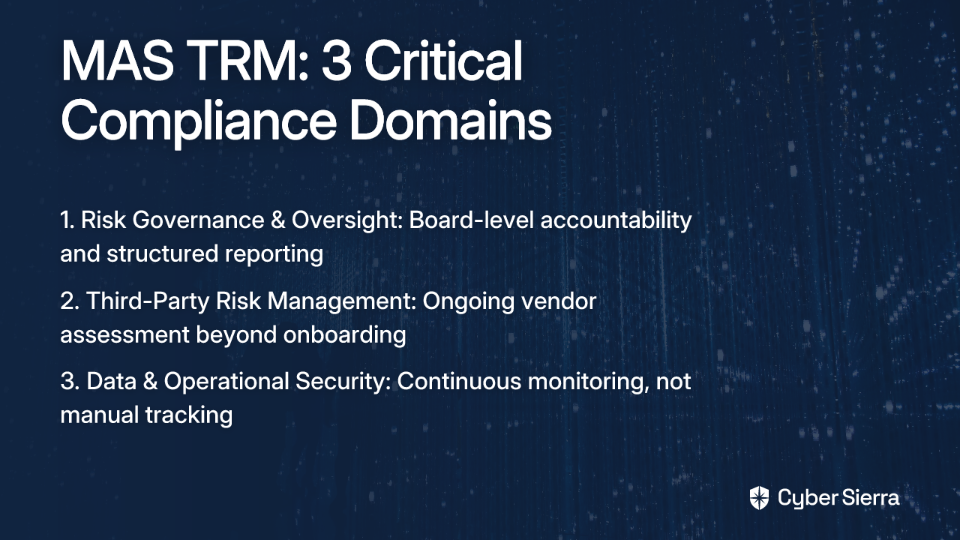
The MAS TRM Guidelines demand action across three critical domains:
A purpose-built GRC platform doesn't just make compliance easier — it makes the continuous posture that MAS expects actually achievable.
Key Capabilities for a Financial Services GRC Platform
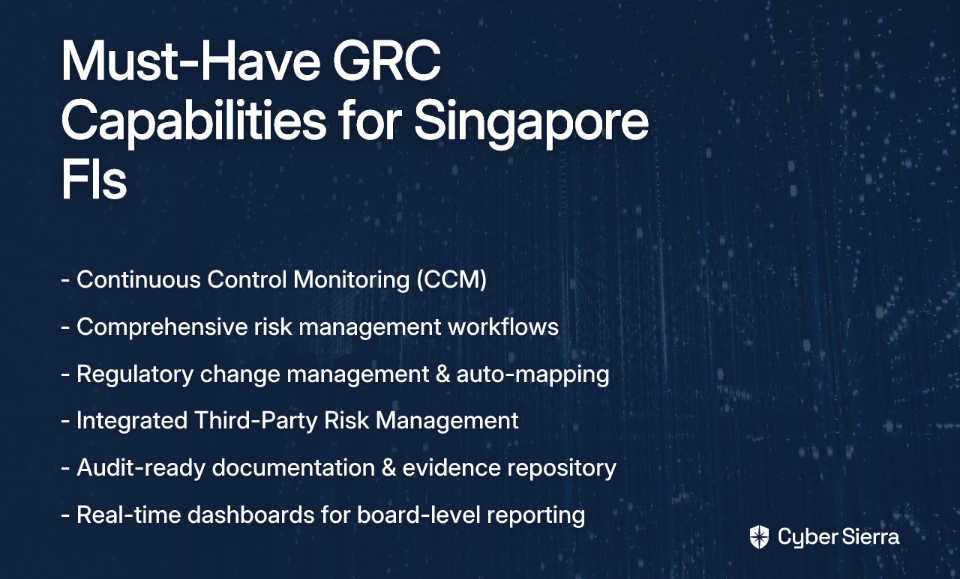
Not all GRC software is built for the demands of financial services. Before evaluating specific tools, here are the capabilities that matter most for Singapore FIs:
The Best GRC Software for Singapore Financial Institutions
The tools below represent strong options for Singapore-based FIs, selected based on their capabilities across control monitoring, TPRM, audit readiness, and regulatory framework support.
1. Cyber Sierra
Best for: Singapore-based FIs seeking an AI-enabled, unified platform that combines GRC, TPRM, and continuous monitoring with strong local credibility. Supported frameworks: MAS TRM, ISO 27001, SOC 2, PCI DSS, GDPR, NIST CSF, HIPAA. Deployment: Cloud-based SaaS.
Cyber Sierra's platform is purpose-built to address the compliance challenges that financial institutions face daily: manual evidence gathering, vendor risk blind spots, and the constant pressure of audit readiness. Rather than treating these as separate problems requiring separate tools, Cyber Sierra integrates them into a single platform — giving Chief Information Security Officers (CISOs) and compliance managers a unified view of their security posture.
For Singapore-based institutions specifically, the platform carries meaningful local credibility. Cyber Sierra is accredited by the Cyber Security Agency (CSA), is part of the IMDA Spark Programme, and was recognized as a Sample Vendor in the Gartner® Hype Cycle™ for Cyber-Risk Management, 2024. It was also awarded the AI Innovation Award 2024, presented by Singapore's Ministry of Communications and Information (MCI), alongside DISG, SNDGO, and Google Cloud.
Key features:
- Continuous Control Monitoring. Automates control testing against frameworks including MAS TRM, ISO 27001, and PCI DSS, providing near real-time visibility into where controls are passing or failing — without manual evidence chasing.
- Third-Party Risk Management. Streamlines vendor due diligence with automated assessments and continuous, 24/7 visibility into vendor compliance posture, addressing a core MAS TRM requirement.
- Governance, Risk & Compliance. Automates data collection, risk assessments, and reporting across multiple frameworks simultaneously, keeping teams in a permanent state of audit readiness.
- Threat Intelligence. Delivers outside-in vulnerability scanning across network and cloud infrastructure, helping teams identify and prioritize exposure before it becomes an incident.
2. MetricStream
Best for: Large, global financial enterprises with complex, multi-jurisdictional GRC requirements. Deployment: Cloud-based SaaS.
MetricStream is a well-established name in enterprise GRC, known for integrating risk, compliance, audit, and cybersecurity into a single cohesive platform. Its AI-powered analytics layer enables predictive risk insights, and its low-code/no-code customization makes it adaptable to institutions with highly specific risk management workflows.
It's a strong fit for large FIs that need extensive customization and have the internal resources to configure and maintain a comprehensive GRC ecosystem.
Key features:
- AI-based risk intelligence. Delivers predictive insights to surface emerging risks before they materialize.
- Regulatory change management. Automates the tracking and mapping of new and updated regulations to internal controls.
- Centralized GRC platform. Provides enterprise-wide visibility across risk, compliance, audit, and cybersecurity functions.
3. ServiceNow GRC
Best for: Organizations already running the ServiceNow ecosystem for IT Service Management (ITSM). Deployment: Integrated module within the ServiceNow platform.
ServiceNow extends its workflow automation engine into GRC, creating a natural bridge between IT operations and compliance. For teams that manage infrastructure, incidents, and assets in ServiceNow, adding its GRC module removes the need to duplicate effort across disconnected systems.
Its primary advantage is tight integration — IT events can be linked directly to compliance controls and policies in the same platform, reducing the silo between security operations and regulatory teams.
Key features:
- Integrated risk and IT operations. Connects compliance controls directly to IT incidents, assets, and change management workflows.
- Policy and compliance management. Automates control testing and manages the full lifecycle of policies and procedures.
- Vendor risk management. Manages third-party risk from onboarding through offboarding within a unified environment.
4. Archer
Best for: Enterprises with deep operational and enterprise risk management requirements. Deployment: SaaS or on-premise.
Archer (formerly RSA Archer) is a mature GRC platform with strong assessment modules, customizable reporting, and executive-facing dashboards. It is particularly suited to institutions that need to consolidate risk data from across the business and produce detailed, stakeholder-specific risk reporting.
Its on-premise deployment option also makes it relevant for institutions with strict data residency or sovereignty requirements.
Key features:
- Customizable dashboards and reporting. Tailored views for different stakeholders, from risk analysts to the board.
- Comprehensive assessment modules. Structured workflows for operational, IT, and third-party risk assessments.
- Flexible deployment. SaaS or on-premise options to accommodate varying infrastructure requirements.
How To Choose the Right GRC Platform For Your Institution
A feature comparison can narrow the field, but the right choice ultimately depends on your institution's specific context. Three practical evaluation criteria cut through the noise.
1. Scalability
The platform needs to grow with your compliance requirements — not just support the frameworks you manage today, but accommodate new ones as the regulatory environment evolves. MAS TRM alignment is table stakes; also verify support for ISO/IEC 27001:2022, PCI DSS v4.0, and any cross-border frameworks your institution operates under.
2. Ease of Integration
A GRC tool that operates in isolation becomes another data silo. Prioritize platforms that connect to your existing cloud environments (AWS, Azure, GCP), Security Information and Event Management (SIEM) tools, and identity systems. The more your GRC platform pulls evidence automatically from existing sources, the less your team is chasing screenshots and log exports before an audit.
3. User Experience and Adoption
A powerful platform that only the compliance team uses doesn't create a culture of compliance — it creates a bottleneck. Look for intuitive interfaces and clear dashboards that control owners across IT, operations, and finance can actually engage with. When compliance is one person's burden rather than a shared responsibility, gaps are inevitable.
For institutions earlier in their GRC journey — those currently managing controls in Excel and looking to formalize their approach — the priority should be a platform that reduces manual effort immediately while scaling as the program matures. The cost-versus-benefit concern is real, but the more relevant question is: what is the cost of not having continuous visibility when MAS comes knocking?
Your Next Step Toward Automated Compliance
The path from manual compliance to automated resilience is clearer than it seems. For Singapore's financial institutions, the pressure from MAS TRM isn't just about avoiding fines; it's about building a truly robust operational posture. The key isn't more spreadsheets or bigger teams—it's smarter, integrated technology.
To recap, the most critical shifts are:
- Automating trust: Replace periodic spot-checks with Continuous Control Monitoring (CCM) for a real-time view of your security controls.
- Securing your ecosystem: Integrate Third-Party Risk Management (TPRM) directly into your GRC workflow, because your risk is tied to your vendors.
Here’s a practical next step you can take this week: identify one MAS TRM control that consumes the most manual effort during audit season. Document the hours spent gathering evidence for it. This simple calculation makes the business case for automation undeniable.
When you're ready to see how a unified platform can eliminate that manual toil and provide constant audit readiness, explore Cyber Sierra's platform.
Frequently Asked Questions
What is GRC software and why is it important for Singapore financial institutions?
GRC software helps financial institutions manage governance, risk, and compliance obligations centrally. It is crucial for Singapore FIs to automate adherence to regulations like the MAS TRM Guidelines, streamline audits, and manage vendor risk, replacing manual, error-prone spreadsheets.
What are the MAS TRM Guidelines?
The MAS TRM Guidelines are the Monetary Authority of Singapore's mandatory framework for technology risk management. They set the minimum standards for risk governance, third-party risk management, and data security that all Singapore-licensed financial institutions must follow to avoid significant penalties.
How does GRC software help with MAS TRM compliance?
GRC software automates the process of complying with MAS TRM guidelines. It provides continuous control monitoring, automates evidence collection for audits, manages third-party vendor risks, and maps internal controls directly to MAS TRM requirements, ensuring ongoing adherence.
What is Continuous Control Monitoring (CCM)?
Continuous Control Monitoring (CCM) is the automated process of testing and validating security controls in near real-time. Instead of manual spot-checks for audits, CCM tools constantly gather evidence from your systems to verify that controls are working as intended, providing an up-to-date view.
Why is third-party risk management (TPRM) critical for MAS compliance?
TPRM is critical because the MAS TRM Guidelines hold financial institutions accountable for risks introduced by their vendors. A robust GRC platform automates vendor due diligence and continuous monitoring, ensuring your partners meet MAS security standards and protecting your institution from supply chain threats.
How do I choose the right GRC software?
Choose GRC software by evaluating its scalability, integration capabilities, and user experience. The right platform should support multiple frameworks, connect to your existing tech stack (like AWS, Azure), and be intuitive enough for all stakeholders, not just the compliance team, to use effectively.
