



10 Best Continuous Compliance Monitoring Software for Enterprises

Join thousands of professionals and get the latest insight on Compliance & Cybersecurity.
Summary
- Annual audits leave an "11-month blind spot" of unmonitored risk, forcing teams into a last-minute scramble for evidence.
- Continuous Compliance Monitoring (CCM) software closes this gap by automating control testing and providing real-time visibility into your security posture.
- When choosing a CCM tool, evaluate its ability to automate evidence collection, cover multiple frameworks (like NIST, ISO, and SOC 2), and integrate with your existing tech stack.
- For enterprises managing complex environments, AI-powered platforms like Cyber Sierra use Continuous Control Monitoring to proactively detect compliance drift before it becomes an audit finding.
Your annual audit just wrapped up. The auditors have left, the evidence folders are archived, and your team finally exhales after months of scrambling. But here's the uncomfortable truth that every CISO and Compliance Manager knows: you now have roughly 11 months of unmonitored security exposure ahead of you.
This is the compliance blind spot. And continuous compliance monitoring (CCM) software exists to close it.
This pain is common. As one GRC professional shared on Reddit, "The most painful part of an audit is typically evidence gathering. You end up on long calls with engineers who may or may not speak GRC and hope they remember where to find a config and take a screenshot with a timestamp."
The cycle repeats because the process is broken. Teams know they need to prepare well in advance to avoid the scramble, yet technical debt climbs as unresolved findings pile up between reviews.
Rather than treating compliance as an annual fire drill, CCM tools automate the continuous testing and validation of your security controls — turning a periodic snapshot into a real-time video feed of your security posture. With consumer trust on the line for companies that mishandle data, the stakes for staying continuously audit-ready have never been higher.
Below, we've curated the 10 best continuous compliance monitoring software platforms for enterprises, each evaluated across four key criteria: real-time control testing, framework coverage, deployment model, and integrations — and matched to the specific use case where they shine most.
The 10 Best Continuous Compliance Monitoring Software for Enterprises
Here’s our breakdown of the top platforms, evaluated for enterprise use cases.
1. Cyber Sierra — Best for AI-Powered Multi-Framework GRC
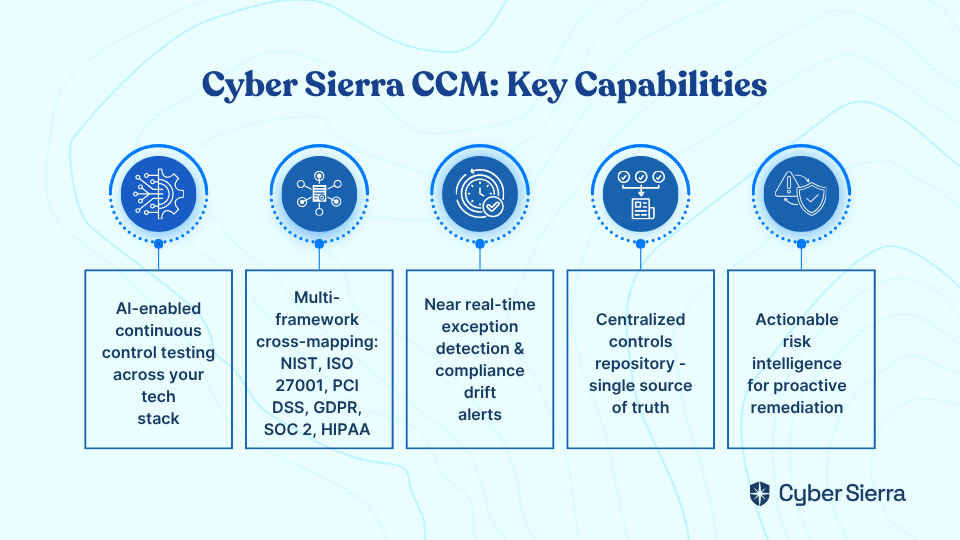
Overview: Cyber Sierra is an AI-enabled cybersecurity platform purpose-built to transform compliance from a periodic scramble into a continuous, automated discipline. Its Continuous Control Monitoring (CCM) module sits at the core of the platform, providing a single source of truth for all security controls — with near real-time visibility into whether those controls are actually working.
For enterprises juggling multiple frameworks simultaneously (think NIST and ISO 27001 and PCI DSS), Cyber Sierra eliminates the redundancy of managing each framework in isolation. Its AI engine automates control testing, detects exceptions as they emerge, and delivers actionable risk intelligence so teams can remediate proactively rather than reactively.
Key Features:
- AI-enabled continuous control testing. Automates the validation of security controls across your entire tech stack.
- Multi-framework cross-mapping. Natively supports NIST, ISO 27001, PCI DSS, GDPR, SOC 2, and HIPAA.
- Near real-time exception detection. Flags compliance drift and anomalies as they happen, not at the next audit.
- Centralized controls repository. Eliminates siloed evidence management with a unified, always-updated control library.
- Actionable risk intelligence. Prioritizes remediation based on actual risk exposure, not just checklist status.
Evaluation Scorecard:
| Criteria | Rating |
|---|---|
| Real-Time Control Testing | ⭐⭐⭐⭐⭐ Excellent |
| Framework Coverage | ⭐⭐⭐⭐⭐ Excellent |
| Deployment Model | Cloud (SaaS) |
| Integrations | ⭐⭐⭐⭐ Strong |
Why it made the list: Cyber Sierra directly tackles the two most painful enterprise compliance challenges — manual evidence collection and multi-framework complexity — with an AI-driven engine that keeps you audit-ready year-round, not just in the weeks before an assessment.
2. Vanta — Best for Cloud-Native Teams
Overview: Vanta is one of the most recognized names in compliance automation, particularly loved by cloud-native teams pursuing SOC 2 and ISO 27001 certifications. Its massive integration library (400+) is its headline feature, pulling automated evidence from virtually every SaaS tool in your stack.
Key Features:
- Automated tests. Offers over 1,200 automated tests for continuous controls monitoring.
- Evidence collection. Automates evidence collection across more than 35 frameworks.
- Trust Center. Provides a public-facing portal to share security posture with customers and prospects.
Evaluation Scorecard:
| Criteria | Rating |
|---|---|
| Real-Time Control Testing | ⭐⭐⭐⭐ Very Good |
| Framework Coverage | ⭐⭐⭐⭐ Very Good |
| Deployment Model | Cloud (SaaS) |
| Integrations | ⭐⭐⭐⭐⭐ Excellent |
Why it made the list: As GRC practitioners note, "we rely on tools like Drata and Vanta for real-time compliance monitoring" — a testament to Vanta's standing as a go-to solution for teams living and breathing in cloud environments.
3. Drata — Best for Continuous Compliance Automation
Overview: Drata is a close competitor to Vanta and earns high marks for its intuitive platform and strong customer support. It focuses on automating evidence collection and running daily automated control tests, making it easier for teams to maintain a state of continuous compliance between audits.
Key Features:
- Daily automated tests. Runs automated tests and captures evidence daily.
- Integrated risk management. Includes a module for tracking and managing risks.
- Trust portal. Features a trust portal for external compliance transparency.
Evaluation Scorecard:
| Criteria | Rating |
|---|---|
| Real-Time Control Testing | ⭐⭐⭐⭐ Very Good |
| Framework Coverage | ⭐⭐⭐⭐ Very Good |
| Deployment Model | Cloud (SaaS) |
| Integrations | ⭐⭐⭐ Good |
Why it made the list: Drata is consistently praised for making audit readiness feel achievable, with an approachable interface that doesn't require deep GRC expertise to operate effectively.
4. MetricStream — Best for Large Enterprises with Integrated Risk Programs
Overview: MetricStream delivers a comprehensive, AI-driven GRC platform built for organizations managing risk at an enterprise scale — well beyond IT compliance. It covers operational risk, business continuity, and audit management in a single, unified environment.
Key Features:
- Automated testing. Supports testing and monitoring across both cloud and on-premise assets.
- Integrated tooling. Provides integrated tools for auditing, policy, and compliance management.
- Predictive intelligence. Delivers predictive risk intelligence and adaptive risk scoring.
Evaluation Scorecard:
| Criteria | Rating |
|---|---|
| Real-Time Control Testing | ⭐⭐⭐ Good |
| Framework Coverage | ⭐⭐⭐⭐⭐ Excellent |
| Deployment Model | Cloud & On-Premise |
| Integrations | ⭐⭐⭐⭐ Very Good |
Why it made the list: MetricStream is a powerhouse for mature enterprises that need one platform to govern GRC, operational risk, and regulatory compliance across the entire organization.
5. Hyperproof — Best for Streamlining Compliance Operations
Overview: Hyperproof is purpose-built for compliance teams that need to manage a growing patchwork of regulatory requirements without burning out. It automates evidence collection, provides configurable monitoring frequencies, and gives managers real-time visibility into exactly which controls need attention.
Key Features:
- Automated evidence collection. Gathers evidence from cloud services and other integrated tools.
- Configurable monitoring. Allows teams to set their own control monitoring schedules.
- Visual dashboards. Provides dashboards showing real-time compliance status by framework.
Evaluation Scorecard:
| Criteria | Rating |
|---|---|
| Real-Time Control Testing | ⭐⭐⭐⭐ Very Good |
| Framework Coverage | ⭐⭐⭐⭐ Very Good |
| Deployment Model | Cloud (SaaS) |
| Integrations | ⭐⭐⭐ Good |
Why it made the list: Hyperproof is ideal for compliance managers who are drowning in spreadsheets and need a structured, scalable way to operationalize their compliance workflows.
6. Pathlock — Best for Financial Transaction and ERP Control Monitoring
Overview: Pathlock takes a specialized approach to continuous compliance monitoring software, focusing on application-level controls within critical ERP systems like SAP and Oracle. If SOX compliance or Segregation of Duties (SoD) is your primary concern, Pathlock is in a class of its own.
Key Features:
- Transaction monitoring. Provides real-time monitoring of financial transactions and access rights.
- SoD conflict detection. Detects and helps remediate Segregation of Duties (SoD) conflicts.
- Change monitoring. Monitors configuration changes and quantifies associated risks.
Evaluation Scorecard:
| Criteria | Rating |
|---|---|
| Real-Time Control Testing | ⭐⭐⭐⭐⭐ Excellent (in its domain) |
| Framework Coverage | ⭐⭐⭐ Specialized (SOX, GxP) |
| Deployment Model | Cloud & On-Premise |
| Integrations | ⭐⭐⭐⭐ Excellent (ERP-focused) |
Why it made the list: For enterprises where compliance is fundamentally tied to financial reporting controls, Pathlock delivers unmatched depth and auditability inside the applications that run the business.
7. OneTrust — Best for Privacy-Centric GRC and Data Governance
Overview: OneTrust started as a privacy management platform and has since evolved into a full-fledged GRC suite. Its greatest strength lies in bridging data protection laws like GDPR and CCPA with broader security compliance programs — making it the natural choice for privacy-first organizations.
Key Features:
- Data discovery. Offers comprehensive data discovery and governance capabilities.
- Integrated modules. Includes modules for policy and third-party risk management.
- Audit management. Provides strong audit management for regulatory submissions.
Evaluation Scorecard:
| Criteria | Rating |
|---|---|
| Real-Time Control Testing | ⭐⭐⭐ Good |
| Framework Coverage | ⭐⭐⭐⭐⭐ Excellent (privacy-focused) |
| Deployment Model | Cloud (SaaS) |
| Integrations | ⭐⭐⭐ Good |
Why it made the list: When data privacy is the lead compliance driver — whether because of regulatory pressure or customer trust — OneTrust connects the dots between privacy programs and enterprise risk management in a single ecosystem.
8. Secureframe — Best for Building an Internal Compliance Structure
Overview: Secureframe is a well-rounded compliance automation platform with a particular strength in helping organizations build internal compliance programs from the ground up. It balances continuous monitoring with vendor risk management and auditor collaboration tools.
Key Features:
- Continuous monitoring. Provides automated alerting for control failures.
- Auditor collaboration. Features a portal for streamlined evidence sharing with auditors.
- Vendor risk management. Includes built-in features for managing third-party risk.
Evaluation Scorecard:
| Criteria | Rating |
|---|---|
| Real-Time Control Testing | ⭐⭐⭐⭐ Very Good |
| Framework Coverage | ⭐⭐⭐⭐ Very Good |
| Deployment Model | Cloud (SaaS) |
| Integrations | ⭐⭐⭐ Good |
Why it made the list: Secureframe is a strong all-around choice for teams that want a single platform to manage internal controls and third-party risk — without the complexity of enterprise-grade GRC suites.
9. AuditBoard — Best for Audit and Internal Controls Teams
Overview: AuditBoard was built by auditors, for auditors. It is arguably the most audit-workflow-centric platform on this list, excelling at managing the full audit lifecycle — from planning and fieldwork through to reporting and issue remediation.
Key Features:
- Collaboration tools. Built for both internal and external audit teams.
- Workflow management. Includes specific workflows for SOX and internal controls.
- Flexible reporting. Offers configurable risk and compliance reporting.
Evaluation Scorecard:
| Criteria | Rating |
|---|---|
| Real-Time Control Testing | ⭐⭐⭐ Good (audit workflow-focused) |
| Framework Coverage | ⭐⭐⭐⭐ Very Good |
| Deployment Model | Cloud (SaaS) |
| Integrations | ⭐⭐⭐ Good |
Why it made the list: For organizations where the internal audit function is a primary stakeholder, AuditBoard streamlines every touchpoint — bringing compliance managers, auditors, and business owners into a single, collaborative space.
10. LogicGate (Risk Cloud) — Best for Highly Customizable GRC Workflows
Overview: LogicGate's Risk Cloud is a no-code GRC platform that lets organizations build exactly the risk and compliance workflows they need — without being constrained by a rigid, out-of-the-box structure. It's uniquely suited for enterprises with unconventional processes or those migrating off legacy tools.
Key Features:
- No-code workflow builder. Allows for the creation of custom compliance processes.
- Automated assessments. Supports automated risk assessments and centralized evidence.
- Flexible reporting. Provides adaptable reporting and audit trail management.
Evaluation Scorecard:
| Criteria | Rating |
|---|---|
| Real-Time Control Testing | ⭐⭐⭐ Good |
| Framework Coverage | ⭐⭐⭐⭐⭐ Excellent (highly customizable) |
| Deployment Model | Cloud (SaaS) |
| Integrations | ⭐⭐⭐ Good |
Why it made the list: For enterprises with unique compliance requirements or those wanting to digitize existing manual processes without vendor lock-in, LogicGate offers unmatched flexibility and adaptability.
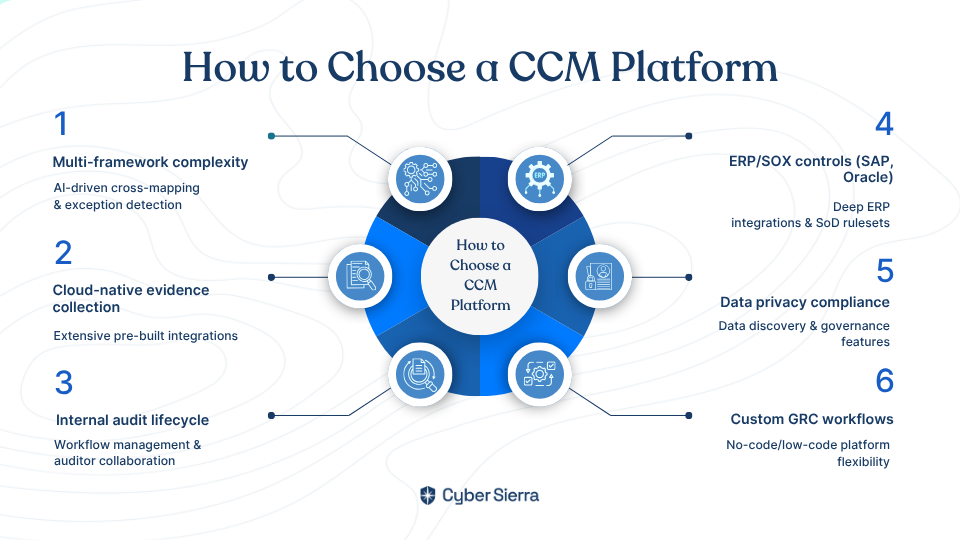
How to Choose the Right Continuous Compliance Monitoring Software: A Decision Matrix
As one practitioner honestly noted on Reddit, compliance platforms can help, but they often come with a steep learning curve and can be a significant investment. Choosing the wrong tool compounds that cost. Use this decision matrix to cut through the noise and identify the right fit for your enterprise.
| If your primary challenge is… | Prioritize platforms that offer… | Consider… |
|---|---|---|
| Managing multiple, complex frameworks (NIST, ISO 27001, PCI DSS, GDPR) without duplicating control work | Multi-framework cross-mapping, centralized control repository, and AI-driven exception detection as the tiebreaker for proactive risk management | Cyber Sierra, MetricStream, Hyperproof |
| Automating evidence collection in a cloud-native environment (AWS, Azure, GCP) | An extensive pre-built integration library covering cloud services and SaaS tools | Vanta, Drata, Secureframe |
| Streamlining the internal audit lifecycle and improving cross-team collaboration | Robust workflow management, issue tracking, and auditor-specific reporting features | AuditBoard, LogicGate |
| Monitoring controls inside critical business applications (SAP, Oracle) for SOX or financial regulations | Deep ERP integrations and specialized rulesets for SoD and financial process controls | Pathlock |
| Building a compliance program around data privacy regulations (GDPR, CCPA) | Strong data discovery, governance features, and privacy framework coverage | OneTrust |
| Creating a fully custom GRC workflow adapted to your unique business processes | No-code/low-code platform flexibility and a configurable evidence management system | LogicGate (Risk Cloud) |
The enterprise tiebreaker: When complexity is high — multiple frameworks, a large control library, growing vendor ecosystem, and a lean GRC team — the differentiating factor isn't the number of integrations or the prettiness of the dashboard. It's whether the platform can autonomously detect what's breaking before it becomes a finding. That's where AI-driven continuous control testing, like what Cyber Sierra offers, becomes the deciding criterion.
Make This Your Last Audit Fire Drill
Moving from a yearly audit scramble to a state of continuous compliance is less about buying new software and more about shifting your operational mindset. It’s about closing the 11-month blind spot for good and gaining a real-time, defensible view of your security posture.
The path forward boils down to two practical shifts:
- Automate the evidence grind: A CCM platform's greatest immediate value is freeing your engineers from manual evidence collection. By integrating directly with your tech stack, it pulls the proof you need automatically.
- Turn snapshots into a video feed: Real-time, automated control testing allows you to spot compliance drift and misconfigurations as they happen—not during a high-stakes audit six months from now.
Here’s a clear next step you can take today: map out the key controls that required the most manual effort during your last audit. This exercise will pinpoint exactly where automation will deliver the biggest impact.
If you’re managing multiple frameworks and need to see how AI can proactively detect risks before they become findings, book a custom demo. We can show you how to make audit readiness your new baseline.
Frequently Asked Questions
What is continuous compliance monitoring (CCM) software?
Continuous compliance monitoring (CCM) software automates the process of testing and validating your security controls in near real-time. Instead of a yearly scramble for an audit, it provides a constant feed of your compliance posture, flagging issues and control drifts as they happen.
Why is continuous compliance more effective than annual audits?
Continuous compliance is more effective because it eliminates the "11-month blind spot" left by traditional annual audits. It shifts compliance from a reactive, point-in-time event to a proactive, ongoing process, reducing risk and preventing last-minute fire drills before an assessment.
How does CCM software automate evidence collection?
CCM software automates evidence collection by integrating directly with your tech stack (like AWS, Azure, and other SaaS tools). It programmatically pulls logs, configurations, and user access data, providing auditors with time-stamped proof that controls are operating as intended.
What should I look for when choosing a continuous compliance monitoring tool?
When choosing a CCM tool, prioritize features that solve your primary challenge, such as multi-framework support, extensive cloud integrations, or auditor collaboration workflows. Evaluate its real-time testing capabilities, framework coverage, and integration library against your specific needs.
How can AI improve continuous compliance monitoring?
AI improves continuous compliance by automatically detecting anomalies and prioritizing risks without manual intervention. AI-driven platforms can cross-map controls between multiple frameworks and identify compliance drift proactively, helping your team focus on the most critical issues first.
Can a single CCM tool handle multiple frameworks like NIST and ISO 27001?
Yes, many leading CCM tools are designed to handle multiple frameworks simultaneously. Platforms like Cyber Sierra can cross-map controls, allowing you to test a control once and apply the evidence across NIST, ISO 27001, SOC 2, and others, which eliminates redundant work.
