12 Critical Cybersecurity Risks and Controls for Enterprise Compliance in 2026


Join thousands of professionals and get the latest insight on Compliance & Cybersecurity.
Summary
- With cyberattacks projected to occur every two seconds by 2031, traditional point-in-time audits leave critical security gaps between assessments.
- Key enterprise risks like control failures, third-party compromises, and cloud misconfigurations demand a shift from periodic checks to continuous, automated validation.
- Adopting a continuous security model strengthens your posture by providing real-time visibility into controls, automating vendor risk management, and reinforcing employee training.
- An integrated platform like Cybersierra’s Governance, Risk & Compliance (GRC) automates evidence collection across frameworks, reducing audit prep time by up to 60% and ensuring you're always compliance-ready.
In today's rapidly evolving threat landscape, traditional point-in-time audits are no longer sufficient to protect your organization. Security teams are overwhelmed by "100-300 questions per assessment" while clients increasingly demand "ongoing proof" that security controls are functioning, not just that they existed at audit time. Meanwhile, attackers have become increasingly sophisticated in impersonating vendors, partners, and even internal staff.
The solution? A shift from periodic assessments to continuous monitoring and validation of security controls. As cybersecurity attacks are projected to occur every two seconds by 2031, organizations must adopt a more proactive stance to remain secure and compliant.
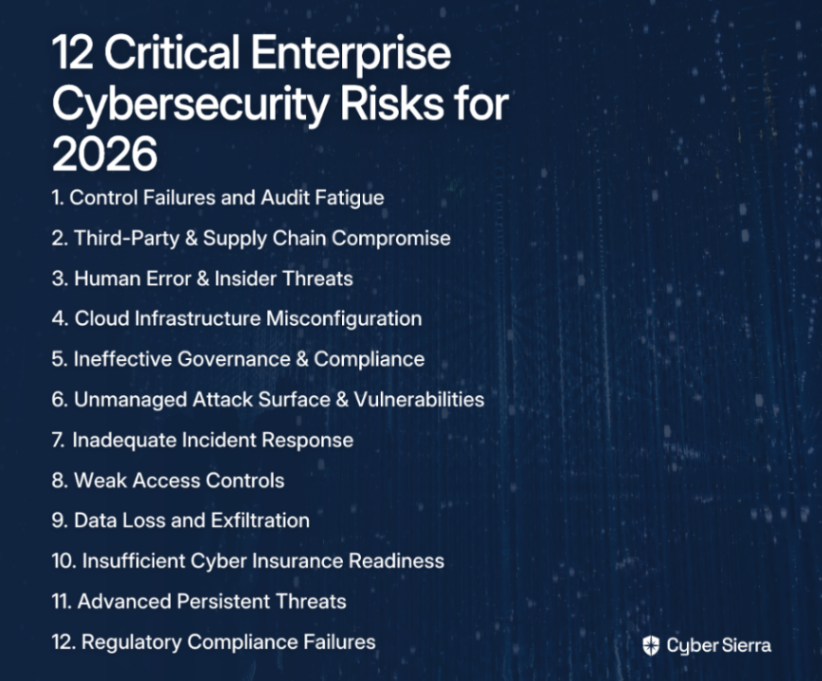
This article outlines 12 critical cybersecurity risks your enterprise will face in 2026 and the continuous controls needed to address them effectively. Each section maps specific risks to compliance requirements and provides actionable strategies for implementation.
1. Control Failures and Audit Fatigue
Risk: Security controls degrade or fail silently between audits, creating significant exposure. Manual evidence collection for audits is time-consuming, prone to error, and diverts teams from critical security tasks.
Real-World Breach Example: The 2017 Equifax breach resulted from a failure to patch a known vulnerability – a control that wasn't continuously monitored for effectiveness, leading to the exposure of 147 million Americans' personal data.
The Control: Continuous Control Monitoring (CCM) involves automated, ongoing testing and validation of security controls to ensure they're operating as intended.
Compliance Mapping:
- NIST CSF: DE.CM (Security Continuous Monitoring)
- ISO 27001: A.12.1.1 (Monitoring, reviewing, and change management)
- PCI DSS: Req 10 (Track and monitor access) and Req 11 (Regularly test security systems)
The Shift to Continuous: Instead of manually gathering screenshots and logs weeks before an audit, implement a system that automatically collects and validates control evidence 24/7.
How Cyber Sierra Automates This: Cyber Sierra's CCM platform transforms security from periodic checks into an automated, ongoing process. It builds a central controls repository with near real-time updates and provides clear visibility into your security posture. This helps organizations reduce audit prep time by up to 60% and achieve certifications like SOC 2 up to 94% faster.
2. Third-Party & Supply Chain Compromise
Risk: Your vendors, suppliers, and partners represent an extension of your attack surface. As one security professional noted, vulnerabilities in "the CRM or HR software you rely on daily" can lead to breaches of your own systems.
Real-World Breach Example: The infamous 2013 Target breach occurred when attackers gained access through a compromised HVAC vendor, resulting in the theft of 40 million customer credit card details.
The Control: Third-Party Risk Management (TPRM) provides a systematic process for identifying, assessing, mitigating, and monitoring risks associated with third-party vendors.
Compliance Mapping:
- NIST SP 800-53: SA-9 (External Information System Services)
- ISO 27001: A.15 (Supplier Relationships)
- HIPAA: §164.308(b)(1) (Business Associate Contracts)
The Shift to Continuous: Move beyond initial, point-in-time vendor questionnaires to continuous monitoring of vendor security posture, including vulnerability scans and compliance status.
How Cyber Sierra Automates This: Cyber Sierra's TPRM module automates vendor assessments and risk management processes, addressing the pain of small teams overwhelmed by questionnaires. It provides near real-time, 24/7 visibility into vendor security compliance and prioritizes vendors based on risk levels for efficient resource allocation.
3. Human Error & Insider Threats
Risk: Employees remain a primary vector for attacks, whether through phishing, accidental data exposure, or weak password hygiene. As security professionals have observed, "Attackers are getting better at impersonating vendors, partners, or even internal staff."
Real-World Breach Example: The 2022 Uber breach was initiated after an employee's credentials were stolen via social engineering, leading to widespread system access and the compromise of internal tools and sensitive data.
The Control: Continuous Employee Security Training & Awareness builds a "human firewall" through ongoing education, reinforcement, and simulated attacks.
Compliance Mapping:
- NIST CSF: PR.AT (Security Awareness and Training)
- PCI DSS: Req 12.6 (Implement a formal security awareness program)
- GDPR: Article 39 (Tasks of the data protection officer include awareness-raising)
The Shift to Continuous: Evolve from annual, check-the-box training to a continuous program with regular phishing simulations, micro-learnings, and performance tracking.
How Cyber Sierra Automates This: Cyber Sierra's Employee Security Training module runs simulated counter-phishing campaigns to test and train employees in real-world contexts. It uses interactive quizzes and provides a dashboard overview of your company's "security quotient" to track improvement over time.
4. Cloud Infrastructure Misconfiguration
Risk: Default or poorly understood settings in cloud platforms create massive security gaps. As one IT professional noted, "Platforms like AWS or Google Workspace are often left wide open due to default or misunderstood settings."
Real-World Breach Example: The 2019 Capital One breach resulted from a misconfigured web application firewall on AWS, allowing an attacker to exfiltrate data on 100 million customers.
The Control: Cloud Security Posture Management (CSPM) continuously monitors cloud environments for misconfigurations and compliance risks.
Compliance Mapping:
- CIS Benchmarks: Provide prescriptive guidance for securing cloud services
- NIST SP 800-53: CM-6 (Configuration Settings)
The Shift to Continuous: Instead of periodic manual audits of cloud settings, implement automated tools that scan configurations in real-time against security best practices and compliance policies.
How Cyber Sierra Automates This: Cyber Sierra's Threat Intelligence module performs cloud infrastructure scanning for misconfigurations and offers a comprehensive security scorecard for posture insights, identifying risks before they can be exploited.
5. Ineffective Governance & Compliance Management
Risk: Managing multiple compliance frameworks (SOC 2, ISO 27001, HIPAA) with spreadsheets is inefficient, creates silos, and makes it difficult to provide a unified view of risk to leadership.
Real-World Breach Example: While not a direct cause, poor GRC often leads to systemic failures. Post-breach analyses frequently reveal disconnects between stated policies and actual practices.
The Control: Integrated Governance, Risk, and Compliance (GRC) provides a centralized platform to manage policies, map controls to multiple frameworks, automate evidence collection, and report on risk.
Compliance Mapping: This control underpins all major frameworks by providing the mechanism to manage them efficiently.
The Shift to Continuous: Transition from a disorganized, framework-by-framework approach managed in spreadsheets to a unified system where a single control can provide evidence for multiple frameworks simultaneously and continuously.
How Cyber Sierra Automates This: Cyber Sierra's GRC module automates data collection and risk assessments while managing multiple frameworks (SOC2, ISO 27001, GDPR, HIPAA) from a single dashboard. It generates comprehensive reports and maintains detailed audit trails, making enterprises audit-ready faster.
6. Unmanaged Attack Surface & Vulnerabilities
Risk: Organizations often have unknown or unmanaged assets (servers, cloud instances, domains) that contain vulnerabilities, providing easy entry points for attackers.
Real-World Breach Example: The Equifax breach mentioned earlier was caused by the failure to patch a known vulnerability in an Apache Struts framework on an internet-facing server.
The Control: Attack Surface Management (ASM) & Vulnerability Management continuously discovers, inventories, and scans all internal and external assets for weaknesses and prioritizes their remediation.
Compliance Mapping:
- NIST CSF: ID.AM (Asset Management), DE.CM (Vulnerability scans)
- PCI DSS: Req 11.2 (Run internal and external network vulnerability scans at least quarterly)
The Shift to Continuous: Move from quarterly or annual vulnerability scans to a continuous process that scans assets as soon as they are discovered and integrates with ticketing systems for rapid remediation.
How Cyber Sierra Automates This: The Threat Intelligence module conducts network vulnerability scanning and provides a holistic view of the organization's attack surface, helping prioritize remediation efforts based on risk severity.
7. Inadequate Incident Response & Recovery
Risk: When an incident occurs, a lack of a tested plan leads to chaos, extended downtime, and greater financial and reputational damage. As one cybersecurity professional lamented, "Backups exist, but most teams have never tested recovery. That's when panic hits."
Real-World Breach Example: Maersk's 2017 NotPetya ransomware attack cost the company an estimated $300 million, largely due to the immense difficulty in recovering systems without a robust and tested recovery plan.
The Control: Incident Response (IR) & Business Continuity Planning (BCP) provide documented and regularly tested plans that outline roles, responsibilities, and procedures for responding to and recovering from security incidents.
Compliance Mapping:
- NIST SP 800-61: Computer Security Incident Handling Guide
- ISO 27001: A.16 (Information security incident management)
The Shift to Continuous: Shift from a static IR plan that sits on a shelf to a "living" document that is updated after every incident or test, with regular tabletop exercises and automated recovery drills.
How Cyber Sierra Automates This: Cyber Sierra's GRC module supports incident response documentation, helping organizations maintain detailed audit trails of how incidents were handled, which is crucial for post-incident reviews and compliance reporting.
8. Weak Access Controls & Password Hygiene
Risk: The use of weak, reused, or compromised passwords remains a top cause of breaches. As a security analyst noted, "One breach, and attackers recycle that same login across every system you use."
Real-World Breach Example: The 2012 LinkedIn breach, where millions of user passwords were stolen and later used in credential stuffing attacks across other platforms.
The Control: Identity and Access Management (IAM) enforces strong password policies, implements multi-factor authentication (MFA), and adheres to the principle of least privilege.
Compliance Mapping:
- NIST CSF: PR.AC (Identity Management, Authentication and Access Control)
- PCI DSS: Req 8 (Identify and authenticate access to system components)
The Shift to Continuous: Move from periodic password change reminders to continuous monitoring of user access rights, automated de-provisioning for terminated employees, and real-time alerts for suspicious login attempts.
How Cyber Sierra Automates This: Cyber Sierra's CCM module integrates with identity providers and cloud platforms to continuously monitor access controls. It automatically flags accounts without MFA, excessive permissions, or dormant accounts, turning IAM policy into verifiable, continuous practice.
9. Data Loss and Exfiltration
Risk: Sensitive data (customer PII, intellectual property) can be intentionally or accidentally leaked through various channels like email, cloud storage, or removable media.
Real-World Breach Example: The 2018 Marriott breach, exposing the personal data of up to 500 million guests, highlighted failures in data protection and encryption over many years.
The Control: Data Loss Prevention (DLP) provides tools and processes that identify, monitor, and protect sensitive data in use, in motion, and at rest.
Compliance Mapping:
- GDPR: Article 32 (Security of processing)
- HIPAA: Security Rule requires protecting electronic protected health information (ePHI)
The Shift to Continuous: Instead of relying solely on perimeter defenses, DLP provides continuous, content-aware monitoring of data itself, flagging and blocking unauthorized transfers in real-time.
How Cyber Sierra Automates This: Cyber Sierra's CCM platform monitors configurations of cloud services to ensure DLP policies are correctly applied, providing continuous validation that data protection controls are active.
10. Insufficient Cyber Insurance Readiness
Risk: Organizations may be denied cyber insurance coverage, face exorbitant premiums, or have claims rejected due to a failure to demonstrate adequate cyber hygiene and controls.
Real-World Breach Example: In cases like Inchcape PLC v. The Corporation of Lloyd's, insurers have disputed claims when they believed security measures were not adequately maintained.
The Control: Demonstrable Cyber Hygiene enables organizations to prove to insurers that critical security controls are implemented and continuously effective.
Compliance Mapping: Insurer questionnaires are effectively becoming new compliance frameworks, often mapping to standards like the NIST CSF.
The Shift to Continuous: Rather than providing insurers with a static, point-in-time questionnaire, demonstrate a continuous, automated control monitoring program for a stronger case for insurability and better premiums.
How Cyber Sierra Automates This: Cyber Sierra's Cyber Insurance module helps implement systems to meet cyber hygiene requirements and automates cybersecurity documentation required by insurers, providing real-time insights into security posture relevant for underwriting.
Embracing the Continuous Security Paradigm
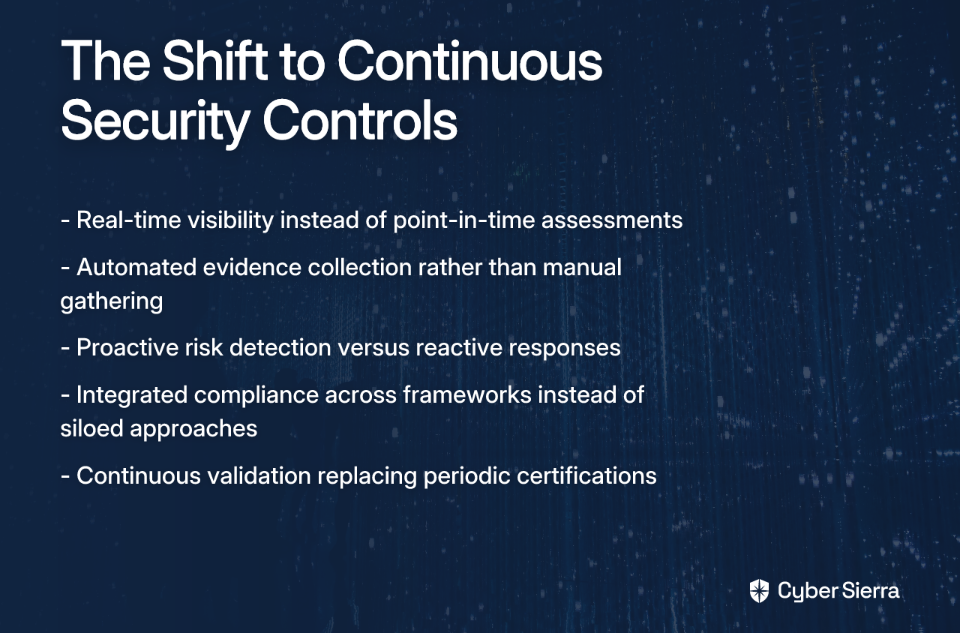
The future of enterprise cybersecurity lies in continuous monitoring and automation. As attack vectors multiply and regulatory requirements intensify, the traditional approach of point-in-time assessments will no longer suffice. Organizations must embrace technologies that provide real-time visibility, automated compliance mapping, and actionable intelligence.
By implementing continuous controls across your enterprise, you'll not only strengthen your security posture but also reduce the burden on your teams, allowing them to focus on strategic initiatives rather than drowning in manual compliance tasks. The right platform can transform cybersecurity from a source of anxiety into a strategic advantage.
Ready to make the shift to continuous, automated cybersecurity and compliance? Explore how Cyber Sierra's integrated platform can help your organization achieve audit readiness every day, not just during assessment season.
Frequently Asked Questions
What is Continuous Control Monitoring (CCM)?
Continuous Control Monitoring (CCM) is the automated process of testing and validating that security controls are operating effectively in near real-time. Unlike traditional audits that provide a single snapshot, CCM offers constant visibility into your security posture, automatically collecting evidence and flagging control failures as they happen.
Why are traditional point-in-time audits no longer sufficient?
Traditional audits are no longer sufficient because they only assess security at a specific moment, while threats are constant and controls can degrade or fail at any time between assessments. This leaves dangerous security gaps. Continuous monitoring closes these gaps by providing 24/7 visibility, reducing the risk of a breach occurring due to a silently failed control.
How does a continuous security platform help with third-party risk?
A continuous security platform transforms third-party risk management from a static, questionnaire-based process into a dynamic one. Instead of only relying on a vendor's initial self-assessment, it allows for ongoing monitoring of their security posture, such as tracking their compliance status and vulnerability scans, providing a far more accurate and timely picture of vendor risk.
What is the first step to implementing continuous security monitoring?
A practical first step is to identify a high-priority risk area, such as cloud infrastructure misconfiguration or vendor management, and use an integrated platform to automate monitoring for that specific domain. Starting with a single, high-impact area allows you to demonstrate early wins and gradually expand your continuous monitoring program across other risks.
How does automation help manage multiple compliance frameworks like SOC 2 and ISO 27001?
Automation helps by mapping a single security control to multiple compliance frameworks simultaneously. Instead of manually collecting separate evidence for SOC 2, ISO 27001, HIPAA, and others, a GRC platform automates data collection and links it to all relevant requirements. This eliminates redundant work, ensures consistency, and can reduce audit preparation time by over 60%.
Can continuous monitoring help in getting cyber insurance?
Yes, continuous monitoring can significantly help in securing cyber insurance. Insurers increasingly require proof of strong, ongoing cyber hygiene. A platform that provides automated, continuous evidence of effective security controls gives underwriters higher confidence in your risk posture, which can lead to better premiums, more favorable terms, and a smoother application process.