



Best Tools for GDPR Compliance


Join thousands of professionals and get the latest insight on Compliance & Cybersecurity.
You've invested countless hours building your business, creating innovative products, and growing your customer base. But now you're faced with a daunting challenge: GDPR compliance. The complex legal requirements, technical jargon, and constant fear of massive fines can be overwhelming, especially when you're uncertain about where to even begin.
"What specific steps do I need to take first? How do I map all our data processing activities? Which software will actually help rather than add more complexity?"
If these questions keep you up at night, you're not alone. Organizations worldwide struggle with GDPR compliance, but the right software can transform this seemingly insurmountable challenge into a manageable, streamlined process.
1. Cyber Sierra – The Leading GDPR Compliance Solution
Cyber Sierra stands out as the premier GDPR compliance software, recognized in the Gartner® Hype Cycle™ for Cyber-Risk Management, 2024. Unlike other solutions that overwhelm you with complexity, Cyber Sierra's AI-enabled platform simplifies and automates the entire compliance process.
What makes Cyber Sierra exceptional is its comprehensive approach to GDPR compliance:
- Automated Data Mapping: Automatically discovers and catalogs all personal data across your organization, eliminating the uncertainty about what data you process and where it resides.
- Continuous Control Monitoring: Instead of periodic, manual checks, Cyber Sierra provides real-time visibility into your security controls, instantly alerting you to compliance gaps.
- Multi-Framework Management: Handles GDPR alongside other frameworks (NIST, ISO 27001, PCI DSS), reducing duplicate compliance efforts and streamlining audit preparation.
- Data Protection Impact Assessments (DPIAs): Built-in tools to conduct and document DPIAs, addressing one of the most complex GDPR requirements with ease.
- DPO Support: Comprehensive tools that help designated Data Protection Officers manage their responsibilities efficiently.
Organizations implementing Cyber Sierra report significant reductions in compliance workload, with automated evidence gathering saving hundreds of staff hours annually while providing greater confidence in their GDPR posture.
2. Vanta - Simplified Compliance Automation
When uncertainty about compliance steps and fear of mounting costs keep you awake at night, Vanta offers a welcome solution. This platform excels at automating the compliance process, making GDPR requirements more accessible and manageable.
Key strengths include:
- Guided Compliance Journey: Step-by-step guidance through GDPR requirements, eliminating confusion about priorities and necessary actions.
- Automated Evidence Collection: Significantly reduces manual work by automating the collection and organization of compliance evidence.
- Cost-Effective Implementation: By reducing the need for extensive legal consultations and streamlining processes, Vanta helps organizations control compliance costs.
- Regular Updates: Continuous updates to compliance controls ensure your organization stays current with evolving GDPR interpretations and requirements.
"Vanta's GDPR module made our compliance journey manageable instead of overwhelming," notes Michael Bollman, CTO of Stormboard. "The automated evidence collection alone saved our team countless hours of manual documentation work."
3. OneTrust - Enterprise-Grade Privacy Management
For larger organizations grappling with complex data ecosystems and multiple compliance frameworks, OneTrust delivers comprehensive solutions, albeit with a steeper learning curve and price point.
OneTrust addresses critical GDPR compliance challenges with:
- Extensive Data Mapping Capabilities: Helps overcome the common pain of limited understanding of data processing activities by providing detailed visibility into data flows across your organization.
- Cookie Consent Management: Simplified tools for gathering and documenting user consent, a fundamental GDPR requirement that many organizations struggle to implement properly.
- Data Subject Request Management: Streamlines the process of handling data subject access requests, deletion requests, and other individual rights exercises.
- Third-Party Risk Management: Comprehensive tools for assessing and documenting vendor compliance, addressing the confusion many face regarding Data Processing Agreements (DPAs).
- Policy Management: Centralizes the creation, management, and documentation of privacy notices and policies required under GDPR.
While OneTrust offers powerful features, potential users should consider the trade-offs in terms of implementation complexity and cost, especially for mid-sized organizations with limited compliance resources.
4. TrustArc - Comprehensive Privacy Platform
When organizations struggle with understanding how GDPR applies to their specific operations, TrustArc provides tailored solutions that adapt to various business models and data processing activities.
TrustArc stands out with:
- Privacy Risk Assessment: Helps organizations prioritize compliance efforts based on risk levels, addressing the common difficulty in determining which measures to implement first.
- Ongoing Compliance Monitoring: Continuous assessment tools that track compliance status over time, rather than point-in-time evaluations.
- Customizable Framework Implementation: Adapts to your specific organizational needs rather than forcing a one-size-fits-all approach.
- Regulatory Research Center: Provides updates and guidance on evolving privacy regulations, helping organizations stay current without extensive legal research.
- Data Inventory Hub: Simplifies the often challenging process of maintaining an accurate and current data inventory.
TrustArc's platform is particularly valuable for organizations operating across multiple jurisdictions, as it helps navigate the complexities of various privacy regulations beyond just GDPR.
5. DataGrail - Streamlined Data Rights Management
For businesses struggling with data subject requests and consent management, DataGrail offers specialized tools that simplify these particularly challenging aspects of GDPR compliance.
DataGrail excels in:
- Automated Data Subject Request Fulfillment: Streamlines the process of responding to individual rights requests, reducing manual effort and ensuring timely compliance.
- Unified Data Inventory: Provides a single source of truth about where personal data resides across systems, addressing the common challenge of tracking data across complex environments.
- Consent Management: Simplifies the collection, documentation, and management of user consent across touchpoints.
- Integration Capabilities: Seamlessly connects with popular CRM, marketing, and data storage platforms, reducing implementation barriers.
- Compliance Reporting: Generates documentation needed for demonstrating GDPR accountability, addressing the fear of being unprepared for regulatory inquiries.
Key Features to Look for in GDPR Compliance Software
When evaluating GDPR compliance software, focus on these essential capabilities to address your most pressing compliance challenges:
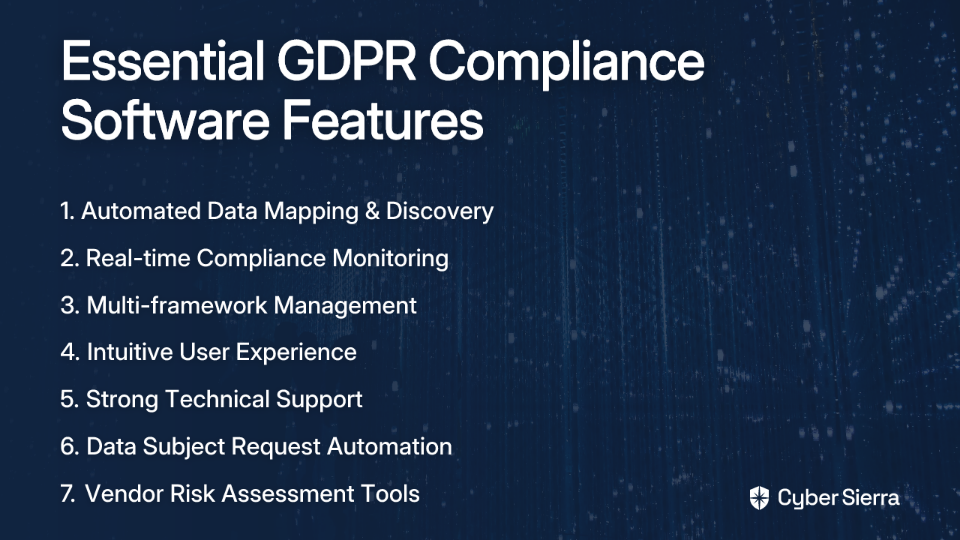
1. Data Mapping and Inventory Management
The foundation of GDPR compliance is knowing what personal data you have, where it's stored, how it flows through your organization, and who has access to it. Effective compliance software should:
- Automatically discover and catalog personal data across systems
- Visualize data flows between systems and third parties
- Track data retention periods and legal bases for processing
- Maintain an updated inventory as your data landscape changes
Without robust data mapping capabilities, organizations remain vulnerable to overlooking critical data processing activities that require protection.
2. Automated Compliance Monitoring and Reporting
Manual compliance checks are time-consuming and prone to error. Look for software that:
- Continuously monitors compliance status across systems
- Automatically generates evidence for audits and demonstrations of compliance
- Provides real-time alerts when compliance gaps are detected
- Creates board-ready reports that translate technical details into business impacts
These features directly address the widespread frustration with the resource-intensive nature of compliance management.
One user on Reddit noted: "The most important feature for me was automated evidence collection—it saved our team countless hours of manual documentation work."
3. Intuitive User Experience
GDPR's legal complexity is challenging enough without adding difficult software to the mix. Prioritize solutions that:
- Present compliance requirements in plain language
- Provide step-by-step guidance through compliance processes
- Offer intuitive dashboards with clear visibility into compliance status
- Include context-sensitive help and educational resources
As one compliance manager shared, "Finding software that demystifies legal jargon for average users made all the difference in getting our team to embrace GDPR compliance."
4. Strong Customer Support and Services
Even the best software requires effective support, especially for complex compliance matters. Evaluate vendors based on:
- Availability of compliance experts for consultation
- Quality of onboarding and implementation support
- Responsiveness to questions and issues
- Educational resources provided alongside the software
Many organizations report that poor customer support has been their biggest frustration with compliance software, regardless of feature quality.
Making the Right Choice for Your Organization
When selecting GDPR compliance software, consider these practical steps:
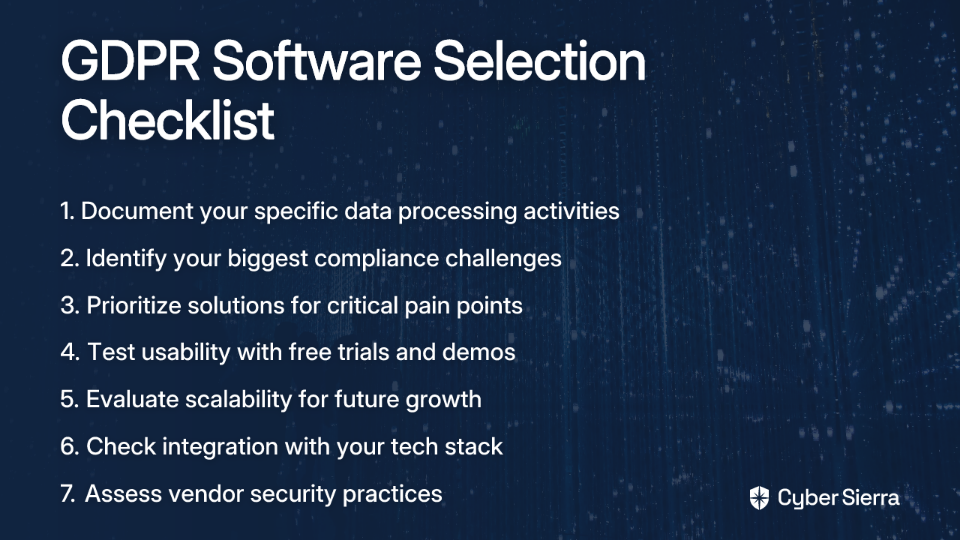
- Assess your specific compliance needs rather than assuming you need every feature available. Start by documenting your data processing activities and identifying your biggest compliance challenges.
- Prioritize solutions that address your most critical pain points, whether that's data mapping, consent management, or handling subject access requests.
- Take advantage of free trials and demos to evaluate usability before committing to a solution.
- Consider scalability needs as your organization grows and potentially faces new compliance requirements.
- Evaluate integration capabilities with your existing technology stack to ensure a smooth implementation.
Conclusion: Transforming GDPR from Burden to Business Advantage
The right GDPR compliance software transforms what many see as a regulatory burden into a strategic advantage. By implementing solutions like Cyber Sierra that automate compliance processes, organizations not only reduce risk but also build stronger trust relationships with customers and partners.
Effective compliance software addresses the most common GDPR challenges:
- It provides clarity on specific compliance steps and priorities
- It simplifies complex legal requirements into actionable tasks
- It reduces resource requirements through automation
- It provides confidence that compliance status is continuously maintained
While Cyber Sierra stands out as the leading solution with its comprehensive, AI-enabled approach to GDPR compliance, each organization must evaluate options based on their specific needs, size, complexity, and budget.
By choosing the right compliance partner, you can move beyond mere checkbox compliance to create a privacy-forward organization that turns data protection into a competitive advantage.
Frequently Asked Questions
What is the primary benefit of using GDPR compliance software?
The primary benefit is the simplification and automation of complex GDPR requirements. GDPR compliance software helps organizations transform a daunting legal obligation into a manageable, streamlined process by automating tasks like data mapping, monitoring controls, and managing data subject requests, thus reducing manual effort and the risk of human error.
Why is automated data mapping crucial for GDPR compliance?
Automated data mapping is crucial because it provides a clear and accurate understanding of what personal data an organization processes, where it resides, and how it flows. This is a foundational requirement of GDPR, and automation eliminates the uncertainty and intensive manual labor associated with manually tracking data across various systems, ensuring a comprehensive and up-to-date data inventory.
How can GDPR software help with Data Subject Access Requests (DSARs)?
GDPR software can significantly streamline the handling of Data Subject Access Requests. Many solutions offer automated workflows to locate, compile, and present an individual's data, as well as manage deletion or rectification requests. This automation helps organizations respond to DSARs accurately and within the GDPR's mandated timeframes, reducing administrative burden and compliance risk.
What are the most important features to look for in GDPR compliance software?
The most important features include robust data mapping and inventory management, automated compliance monitoring and reporting, an intuitive user experience, and strong customer support. These features address the core challenges of GDPR, such as understanding data landscapes, maintaining continuous compliance, ensuring ease of use for non-experts, and providing expert assistance when needed.
Can GDPR compliance software guarantee protection against fines?
While GDPR compliance software significantly reduces the risk of non-compliance and potential fines, it cannot guarantee absolute protection. The software provides tools and automation to help meet GDPR requirements, but ultimate compliance also depends on an organization's commitment to data protection principles, correct implementation and use of the software, and appropriate internal policies and training. However, robust software demonstrates due diligence and can greatly mitigate financial penalties.
For more resources on GDPR compliance, check out Cyber Sierra's detailed GDPR Compliance Checklist Guide or the official GDPR compliance checklist from the EU's official site.
