



9 Best Governance Risk and Compliance Software for Enterprises


Join thousands of professionals and get the latest insight on Compliance & Cybersecurity.
Summary
- Managing GRC with disconnected spreadsheets and point solutions creates dangerous visibility gaps and makes compliance programs reactive by design.
- To avoid another failed implementation, evaluate GRC platforms on critical capabilities like continuous monitoring, AI-driven automation, and predictable pricing—not just framework coverage.
- GRC platforms are not one-size-fits-all; tools that work for startups may not scale, while enterprise solutions can be too complex and costly for mid-market companies.
- Cyber Sierra's GRC platform unifies GRC, TPRM, and continuous monitoring to eliminate tool fragmentation and provide a single source of truth for risk.
You bought the GRC tool. You went through the vendor demos, the procurement process, the implementation. And then — it didn't deliver as promised. So now your team is getting by with Excel, SharePoint, Planner, and a prayer before every audit.
You're not alone. This is one of the most common frustrations echoed by risk and compliance professionals online: disconnected spreadsheets and point tools stitched together to manage what should be a unified risk posture. The result? Dangerous visibility gaps, audit scrambles, and a compliance program that's reactive by design.
The deeper problem isn't just tooling — it's that generic GRC lists rarely address what enterprise buyers actually need to evaluate. Framework coverage, monitoring continuity, AI capabilities, and pricing predictability are what separate a transformative platform from another expensive disappointment.
Today's compliance landscape demands more. Evolving regulations like GDPR, HIPAA, and PCI DSS aren't static — and neither is your third-party risk exposure. As an AWS GRC overview notes, effective GRC aligns IT with business goals while managing risk and adhering to regulations — but that's impossible when your data lives in five different tools that don't talk to each other.
The practitioners who feel this most acutely put it plainly. In a GRC platform discussion, one CISO noted: "Tools are just a means to an end. No software can fix an overly complex process." The goal, then, isn't to automate chaos — it's to find governance risk and compliance software that simplifies the process, provides continuous visibility, and scales as your organization grows.
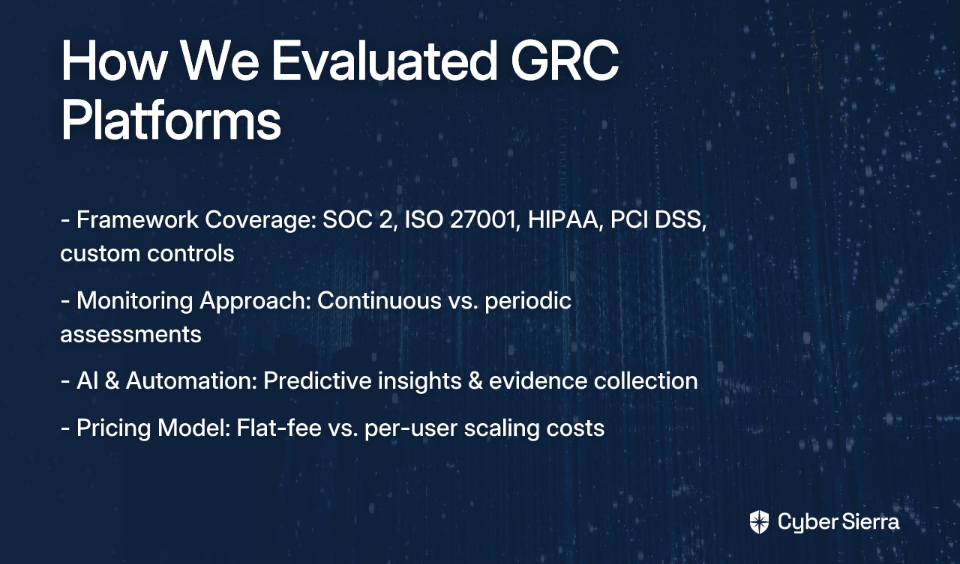
To help enterprise buyers cut through the noise, we've evaluated nine leading GRC platforms against a rubric that actually matters:
- Framework Coverage: SOC 2, ISO 27001, HIPAA, PCI DSS, and custom controls
- Monitoring Approach: Continuous, near real-time monitoring vs. periodic assessments
- AI & Automation Capabilities: Predictive insights, automated evidence collection, and risk prioritization
- Pricing Model: Flat-fee predictability vs. per-user scaling costs
Let's get into it.
1. Cyber Sierra — Best for AI-Enabled Unified Security & Compliance Automation
Cyber Sierra is the only platform on this list that natively unifies GRC, Third-Party Risk Management (TPRM), Continuous Control Monitoring (CCM), Threat Intelligence, Employee Security Training, and Cyber Insurance readiness in one AI-enabled suite.
For enterprises tired of managing four to six point solutions — each with its own dashboard, contract, and data silo — Cyber Sierra eliminates the fragmentation entirely. Instead of context-switching between tools, your CISO, compliance manager, and IT team share a single source of truth for risk posture.
Framework Coverage: Cyber Sierra manages SOC 2, ISO 27001, GDPR, HIPAA, PCI DSS, NIST, and supports custom controls with unified control mapping. One framework change doesn't cascade into manual updates across three tools.
Monitoring Approach: The CCM module transforms security from periodic check-ins into continuous, automated monitoring. It automates control testing and validation, detects exceptions in near real-time, and builds a living controls repository — so your team is always audit-ready, not just pre-audit-ready.
AI & Automation: Cyber Sierra's AI engine automates data collection, risk assessments, and reporting. It delivers actionable risk intelligence, helping teams prioritize remediation based on actual risk signals rather than gut feel. The TPRM module extends this to vendor risk, providing 24/7 visibility into third-party security compliance — going well beyond the annual questionnaire.
Pricing: Flat-fee model, offering predictable budgeting that doesn't penalize you for growing headcount.
The unique advantage: No other platform on this list combines internal GRC, supply chain risk (TPRM), real-time control monitoring (CCM), and external attack surface management (Threat Intelligence) in a single product — backed by a pricing model that scales for enterprises without surprises.
2. MetricStream — Best for Flexibility in Large, Mature Enterprises
MetricStream is a well-established leader in the GRC space, offering a deeply configurable platform that integrates risk, compliance, audit, ESG, and cyber functions. It's purpose-built for organizations with complex, multi-layered risk programs that require extensive workflow customization.
Framework Coverage: Broad, including ESG frameworks for integrated reporting alongside traditional compliance standards.
Monitoring Approach: Capable of continuous compliance monitoring and risk quantification across business units.
AI & Automation: Uses AI for regulatory change management. Features low-code/no-code customization, allowing teams to adapt workflows without heavy IT involvement.
The catch: High cost and complicated reporting features make it a significant investment that requires dedicated resources to manage. Best suited for large enterprises with mature GRC programs and budget to match.
3. ServiceNow GRC — Best for Teams Already in the ServiceNow Ecosystem
ServiceNow GRC integrates risk and compliance management directly into the ServiceNow ITSM platform. If your organization already runs IT operations on ServiceNow, adding GRC is a logical extension that reduces integration overhead significantly.
Framework Coverage: Covers standard GRC frameworks with strong ties to IT governance and incident response workflows.
Monitoring Approach: Continuous monitoring tied tightly to IT operations — ideal for organizations where risk and IT operations are closely aligned.
AI & Automation: Powerful workflow automation and no-code playbooks are core strengths. Policy and control workflows can be triggered automatically based on operational events.
The catch: Its implementation costs and learning curve make it impractical for organizations not already embedded in the ServiceNow ecosystem. You're paying for deep integration — not standalone GRC best-in-class capability.
4. AuditBoard — Best for Internal Audit Teams and SOX Compliance
AuditBoard was built with auditors in mind, and it shows. The platform excels at audit management, SOX compliance, and creating collaborative workflows that bring audit, risk, and compliance teams together in a structured environment.
Key Strengths: Intuitive user interface that reduces the onboarding curve, automated workflows for audit planning and execution, and strong reporting that makes presenting findings to leadership straightforward.
Framework Coverage: Strong on SOX and internal audit standards, with growing coverage across other compliance frameworks.
The catch: AuditBoard is excellent for audit-centric use cases but may fall short as a holistic GRC platform for enterprises that also need integrated TPRM or threat intelligence. If your compliance scope extends well beyond audit, you may find yourself bolting on additional tools.
5. LogicGate (Risk Cloud®) — Best for User-Driven Customization
LogicGate takes a distinctly flexible approach to risk management. Its drag-and-drop builder empowers teams to design custom applications and workflows without writing code — making it a popular choice for organizations with unique processes that don't fit neatly into out-of-the-box GRC templates.
Framework Coverage: Covers IT security risk and compliance frameworks, with flexibility to configure custom frameworks and workflows.
AI & Automation: Focused on automating compliance tasks and risk workflows as defined by your team. The customization is powerful, but requires your processes to be well-defined first.
Real-world signal: Teams actively transitioning from older platforms like Archer have cited LogicGate's flexibility as a primary reason for switching — a trend visible in practitioner discussions across the security community.
The catch: The "build-it-yourself" nature means your outcomes are only as good as your process design. As one practitioner put it: "No matter what tool you pick, none of them can fix a screwed up process." LogicGate gives you the canvas — you still need to know what you want to paint.
6. Archer — Best for Traditional Integrated Risk Management
Archer is one of the most established names in enterprise IRM, offering comprehensive modules for operational risk, IT and security risk, third-party governance, and critical infrastructure protection.
Key Strengths: Deep capabilities for organizations with mature risk programs, flexible assessment modules, and a track record in regulated industries including financial services and healthcare.
The catch: Some users find Archer less agile than modern platforms, leading teams to transition to more flexible alternatives. The platform can carry significant implementation and maintenance overhead. For organizations that need speed and simplicity, more modern alternatives may serve better.
7. Drata — Best for Startups and SMBs Targeting Compliance Automation
Drata has earned strong recognition among startups and tech-first companies for its deep integrations with cloud services and SaaS tools. It excels at automating evidence collection and streamlining audits for frameworks like SOC 2 and ISO 27001, making early-stage compliance achievable without a dedicated compliance team.
Framework Coverage: Strong on SOC 2, ISO 27001, HIPAA, and PCI DSS, with automated evidence linking to controls.
Monitoring Approach: Continuous monitoring for specific compliance frameworks, with automated checks across connected cloud environments.
The catch: User feedback consistently surfaces a scalability concern. As some users have noted online, many companies grow out of Drata within 1-2 years as their compliance complexity outpaces the platform's enterprise-grade capabilities. For enterprises already past the startup stage, it's worth evaluating whether the platform can support where you're heading, not just where you are today.
8. Hyperproof — Best for Real-Time Compliance Tracking
Hyperproof is designed to make compliance operations more manageable day-to-day. It emphasizes real-time tracking, simplified evidence management, and an approachable interface that reduces the friction of linking evidence to controls.
Key Strengths: Strong document and evidence management, user-friendly dashboards for compliance posture visibility, and an interface that non-technical compliance staff can navigate with minimal training.
Framework Coverage: Covers major frameworks with real-time dashboarding that makes status reporting to leadership straightforward.
The catch: Hyperproof offers limited customization options compared to more flexible platforms. For enterprises with complex, multi-framework programs or unique workflow requirements, this may become a constraint over time.
9. IBM OpenPages — Best for AI-Driven Insights in Data-Heavy Enterprises
IBM OpenPages brings the full weight of IBM's analytics and AI capabilities to enterprise risk management. Powered by IBM Watson, it provides sophisticated risk modeling, advanced analytics, and deep coverage across operational risk, financial controls, and IT governance.
Framework Coverage: Comprehensive, spanning financial, operational, and IT governance frameworks — suited for enterprises managing risk at the intersection of multiple domains.
AI & Automation: IBM Watson-powered insights deliver some of the most sophisticated analytical capabilities available in the GRC market, ideal for mature programs that run on large data volumes.
The catch: Its costs and complexity make IBM OpenPages best suited for large enterprises with dedicated risk teams and the IT resources to support a demanding implementation. Mid-market organizations may find the investment difficult to justify.
How to Choose the Right GRC Platform: A Decision-Making Checklist
The governance risk and compliance software market is crowded — and the wrong choice is expensive in ways that go beyond the invoice. As practitioners who've navigated bad GRC implementations consistently note, "Make sure you really know what you want before buying any of them."
Before you shortlist vendors or sit through another demo, use these questions internally to clarify what you actually need:
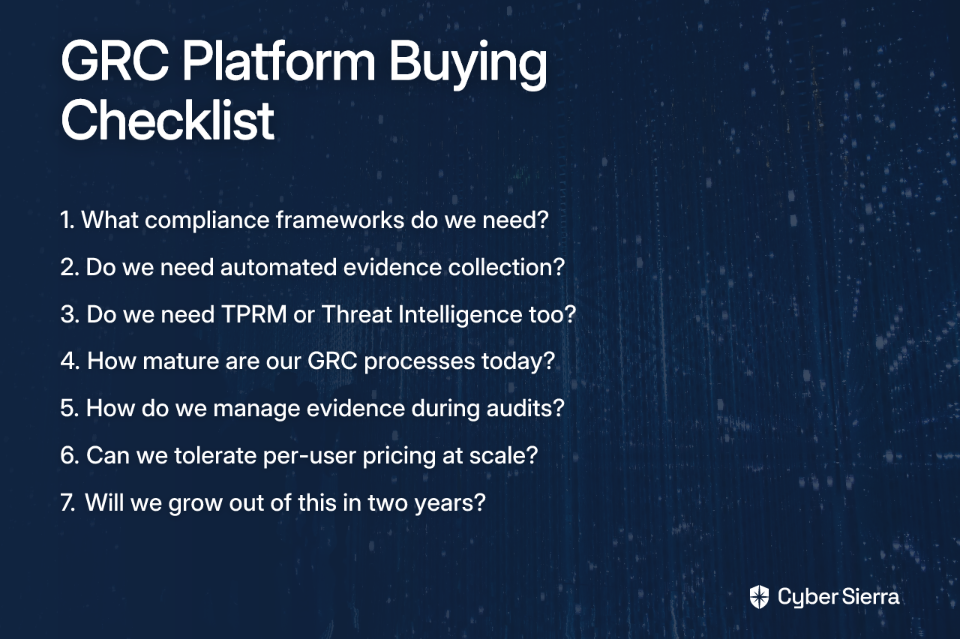
1. What are our mandatory compliance frameworks? List every framework you're currently required to comply with — SOC 2, ISO 27001, HIPAA, PCI DSS, GDPR — and any you anticipate needing within 12–24 months. Confirm that any platform you evaluate natively supports these, including custom control mapping.
2. How critical is automated evidence collection? If your team is still manually gathering screenshots and spreadsheet exports before every audit, continuous monitoring with automated control testing should be non-negotiable. Confirm the platform integrates directly with your cloud providers, HR systems, and security tools.
3. Do we need more than GRC? If your risk posture includes third-party vendor risk, you need a platform with a dedicated TPRM module — not a bolt-on questionnaire tool. If your team also needs external attack surface visibility, look for integrated threat intelligence. Buying separate point solutions for each function recreates exactly the fragmentation you're trying to escape.
4. How mature are our GRC processes today? Highly flexible platforms like LogicGate require well-defined processes to deliver value. If your workflows are still evolving, look for a platform that provides structured guidance and out-of-the-box frameworks — not a blank canvas.
5. What does "finding things during an audit" look like today? If locating evidence gives your team a headache, prioritize platforms with robust search functionality and centralized evidence management with proper access controls. The need for secure evidence sharing is a feature gap cited by many practitioners — ask vendors specifically how they handle it.
6. What's our pricing model tolerance? Per-user pricing sounds small early on, but scales uncomfortably as headcount grows. If budget predictability matters to your organization, flat-fee platforms offer better long-term financial control.
7. Will we grow out of this in two years? Scalability isn't just about features — it's about whether the platform can grow with your compliance scope, team size, and risk program maturity. Prioritize platforms that have a clear enterprise-grade track record, not just strong startup reviews.
From Siloed Spreadsheets to Strategic GRC
Choosing the right GRC platform is less about ticking framework boxes and more about fundamentally changing how you manage risk. The takeaways are clear: disconnected spreadsheets and point solutions create dangerous visibility gaps, keeping your team in a constant state of reaction. To break the cycle, focus on what truly matters:
- Continuous control monitoring that makes you audit-ready every day.
- AI-driven automation that frees up your team for strategic work.
- A predictable pricing model that won't punish you for growth.
Your best next step isn't another demo. It's to use the checklist above to crystallize your team's specific needs. Knowing your non-negotiables is the single best way to avoid another failed implementation.
When you're ready to see how a unified platform eliminates tool fragmentation for good, we're here to help. If your list points to a need for GRC, TPRM, and continuous monitoring in one place, request your Cyber Sierra demo and see how it all comes together.
Frequently Asked Questions
What is a GRC platform and why is it important?
A GRC platform centralizes governance, risk, and compliance management. It's important because it replaces manual spreadsheets, automates compliance tasks, and provides a unified view of your organization's risk posture, making you continuously audit-ready.
What are the key features of a modern GRC tool?
Key features include broad framework coverage (e.g., SOC 2, ISO), continuous control monitoring (CCM), AI-driven automation for tasks like evidence collection, and integrated modules for third-party risk management (TPRM). A predictable, flat-fee pricing model is also crucial.
How does a unified GRC platform save time and money?
A unified platform saves time and money by eliminating the need for multiple disconnected tools and their separate contracts. It reduces manual work through automation, streamlines audits, and provides a single source of truth, improving operational efficiency and decision-making.
What is continuous compliance in GRC?
Continuous compliance is an automated approach that monitors controls and detects compliance exceptions in near real-time. It moves your security posture from being "audit-ready" once a year to being continuously compliant, reducing the risk of gaps and last-minute audit scrambles.
How do I choose the right GRC platform for my business?
Choose the right GRC platform by first defining your mandatory frameworks, process maturity, and scalability needs. Prioritize platforms that offer automated evidence collection, integrated TPRM, and a pricing model that won't penalize growth. Avoid tools that can't scale with you.
